
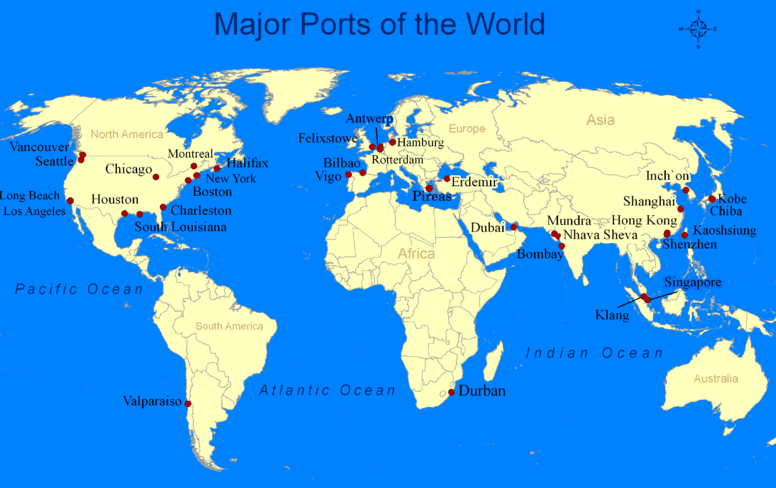
Discover the top 10 largest ports in the world by land area, explained with real data, global context, and why sheer port size matters in modern maritime trade.
When people talk about the world’s biggest ports, they often think of container throughput or the number of ships calling each year. However, another dimension of port dominance is just as important, yet less frequently understood: physical size. Some ports cover areas so vast that they resemble small cities, industrial regions, or even provinces. These mega-ports stretch across thousands of hectares of land and water, integrating terminals, logistics zones, refineries, shipyards, rail yards, and energy infrastructure into a single operational ecosystem.
Understanding the largest ports in the world by area helps maritime professionals, students, and policymakers appreciate the true scale of modern port operations. Size influences everything from navigational safety and environmental management to resilience, automation, and long-term trade capacity. This article explores the top 10 largest ports globally by physical area, explaining not only where they are, but why they matter in today’s interconnected maritime economy.
Understanding “Port Size”: What Does Area Really Mean?
Before ranking the largest ports, it is essential to clarify what “size” means in this context. Unlike container throughput, which is measured in TEUs, port area refers to the total land and water surface under port authority jurisdiction. This typically includes navigation channels, anchorage areas, industrial zones, storage yards, logistics parks, and sometimes offshore facilities.
Some ports appear lower in throughput rankings but dominate in land area because they serve bulk commodities, oil and gas, or heavy industry, which require extensive spatial separation for safety and efficiency. Others have expanded through land reclamation, estuarine development, or the consolidation of multiple port districts under one authority.
Top 10 Largest Ports in the World by Area
1. Port of Shanghai, China
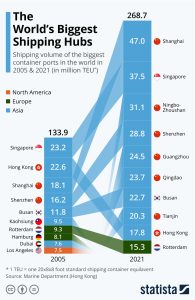
The Port of Shanghai is widely recognized as the largest port in the world not only by container throughput but also by physical scale. Covering approximately 3,619 square kilometers, Shanghai’s port system extends across the Yangtze River Delta, Hangzhou Bay, and deep-sea offshore areas.
This vast footprint allows Shanghai to integrate river ports, coastal terminals, and the offshore Yangshan Deep-Water Port, which is connected to the mainland by the 32-kilometer Donghai Bridge. The port’s immense size supports container shipping, bulk cargo, LNG imports, and vehicle logistics, making it a cornerstone of China’s Belt and Road Initiative.
From a maritime governance perspective, managing such scale requires advanced Vessel Traffic Services (VTS), digital twins, and coordinated safety oversight aligned with IMO and China Classification Society (CCS) standards.
2. Port of Singapore
Despite Singapore’s compact national territory, the Port of Singapore covers an astonishing 1,100 square kilometers of port waters and terminals. This makes it one of the largest ports globally by operational area, even though it is often perceived as space-constrained.
Singapore’s size is strategic rather than expansive. The port integrates deep-water anchorages, oil terminals, container terminals, and extensive bunkering zones within a highly regulated maritime space. Its scale supports its role as the world’s leading bunkering hub and a critical node in East–West trade routes.
Authorities such as the Maritime and Port Authority of Singapore (MPA) work closely with the IMO, DNV, and Lloyd’s Register to ensure safety and efficiency across this dense but extensive port area.
3. Port of Ningbo-Zhoushan, China
The Port of Ningbo-Zhoushan spans roughly 1,450 square kilometers, making it one of the largest port complexes by area and cargo volume. Its unique geography combines mainland terminals with a network of deep-water island ports.
This spatial advantage allows Ningbo-Zhoushan to handle ultra-large crude carriers (ULCCs), bulk carriers, and container vessels with minimal tidal restrictions. The port’s size supports massive petrochemical zones, iron ore terminals, and growing LNG infrastructure.
Its operational model is frequently cited by UNCTAD and the World Bank as an example of how scale and natural geography can reduce congestion and improve navigational safety.
4. Port of Tianjin, China
Covering approximately 336 square kilometers, the Port of Tianjin serves as the primary maritime gateway to northern China, including Beijing. Its large area supports container terminals, bulk cargo zones, Ro-Ro facilities, and extensive logistics parks.
Tianjin’s size became particularly important after major investments in hazardous cargo separation and safety upgrades following the 2015 explosions. Today, the port’s spatial layout reflects modern safety zoning principles promoted by the IMO and International Association of Classification Societies (IACS).
5. Port of Rotterdam, Netherlands
Europe’s largest port by area, the Port of Rotterdam, spans about 105 square kilometers. While smaller in absolute terms than Asian mega-ports, Rotterdam’s size is extraordinary within a densely populated region.
The port stretches over 40 kilometers from the city center to the North Sea, incorporating refineries, chemical plants, container terminals, and offshore energy facilities. Its scale enables Rotterdam to function as Europe’s primary energy gateway and logistics hub.
Rotterdam’s governance model is often referenced in Port Economics, Management and Policy literature for its balance of size, sustainability, and stakeholder coordination.
6. Port of Antwerp-Bruges, Belgium
The merged Port of Antwerp-Bruges covers approximately 120 square kilometers, combining inland and coastal port assets. Its size allows it to serve as a major hub for containers, breakbulk, and petrochemicals.
The port’s spatial integration with inland waterways demonstrates how area can enhance hinterland connectivity, reducing road congestion and emissions. This aligns closely with EU port sustainability strategies supported by EMSA and the European Sea Ports Organisation (ESPO).
7. Port of Houston, United States
The Port of Houston spans nearly 100 square kilometers along the Houston Ship Channel. Unlike coastal mega-ports, Houston’s size is defined by its elongated inland layout and extensive industrial footprint.
The port’s area supports one of the world’s largest concentrations of petrochemical facilities, requiring strict navigational control and environmental monitoring under US Coast Guard (USCG) oversight. Its scale is essential for segregating hazardous cargoes and maintaining operational safety.
8. Port of Qingdao, China
The Port of Qingdao covers around 420 square kilometers, reflecting China’s emphasis on integrated industrial-port zones. Its size supports container operations, crude oil imports, iron ore handling, and growing renewable energy logistics.
Qingdao’s port area has been designed to support future automation and green port initiatives, including shore power systems and smart traffic management, consistent with IMO decarbonisation objectives.
9. Port of Guangzhou, China
With an area of approximately 3,700 square kilometers, the Port of Guangzhou rivals Shanghai in sheer spatial scale. It extends deep into the Pearl River Delta, integrating riverine and coastal port functions.
This vast area allows Guangzhou to support inland waterway shipping, reducing pressure on road and rail systems. Its model is frequently cited by UNCTAD as an example of how port size can enhance regional economic integration.
10. Port of Tangshan, China
The Port of Tangshan covers roughly 2,000 square kilometers, primarily serving bulk commodities such as coal, iron ore, and steel products. Its size reflects the land-intensive nature of bulk port operations.
Tangshan’s spatial layout enables high-volume throughput with relatively low congestion, highlighting how port area can compensate for lower container specialization.
–
Key Developments Shaping Mega-Port Expansion
Land Reclamation and Modular Growth
Many of the world’s largest ports have expanded through land reclamation, allowing terminals to be added modularly over decades. While effective, this approach raises environmental concerns addressed in peer-reviewed journals such as Marine Policy and Marine Pollution Bulletin.
Digital Port Management at Scale
As port areas grow, digital tools such as AIS analytics, port community systems, and digital twins become essential. Classification societies like DNV and ABS increasingly support ports in managing safety and efficiency across vast operational zones.
Challenges and Practical Solutions
Managing extremely large ports introduces challenges in vessel traffic management, environmental monitoring, and emergency response coordination. Large-area ports often mitigate these risks through zoned navigation schemes, redundant VTS centers, and close coordination with national maritime authorities, consistent with IMO guidelines.
Future Outlook and Maritime Trends
The future of large ports is not unlimited physical growth but smart densification. As land becomes scarce and environmental scrutiny increases, ports will focus on automation, vertical storage, and digital optimization rather than endless expansion. However, existing mega-ports will retain strategic advantages due to their established scale and infrastructure.
Frequently Asked Questions (FAQ)
1. Are the largest ports always the busiest ports?
No. Some very large ports handle bulk cargo or energy products and may rank lower in container throughput.
2. Why does port area matter for safety?
Larger areas allow better separation of hazardous cargoes and safer navigation routes.
3. How is port area measured?
It usually includes land and water under port authority jurisdiction, not just terminal space.
4. Which country has the most large-area ports?
China dominates global rankings due to integrated coastal and river port systems.
5. Does a larger port mean higher efficiency?
Not necessarily. Efficiency depends on governance, technology, and connectivity.
6. Are large ports harder to decarbonise?
They face challenges, but their size also allows space for renewable energy and alternative fuel infrastructure.
Conclusion and Takeaway
The largest ports in the world by area reveal a side of maritime infrastructure that goes far beyond container rankings. These vast port ecosystems function as industrial regions, energy hubs, and logistics platforms rolled into one. For maritime professionals and students, understanding port size provides deeper insight into navigational complexity, safety management, and future trade resilience. As global shipping evolves, the strategic value of these mega-ports will remain central to the maritime system.
References
International Maritime Organization (IMO). https://www.imo.org
UNCTAD – Review of Maritime Transport. https://unctad.org
World Bank – Port Reform Toolkit. https://www.worldbank.org
Port of Shanghai Authority. https://www.portshanghai.com.cn
Maritime and Port Authority of Singapore (MPA). https://www.mpa.gov.sg
Port of Rotterdam Authority. https://www.portofrotterdam.com
International Association of Classification Societies (IACS). https://iacs.org
DNV Maritime. https://www.dnv.com
American Bureau of Shipping (ABS). https://ww2.eagle.org
Marine Policy Journal (Elsevier). https://www.sciencedirect.com/journal/marine-policy