
Giants of a Shallow but Remarkably Productive Sea
At first glance, the Persian Gulf may appear too shallow, warm, and enclosed to host large marine animals. Yet this semi-enclosed sea supports a surprising range of large and iconic marine species, adapted to extreme temperatures, high salinity, and seasonal productivity driven by currents and nutrient inflows. From whales and sharks to massive rays and reptiles, these creatures represent the upper end of the Persian Gulf food web and play vital roles in maintaining ecological balance.
1. Whale Shark (Rhincodon typus) – The Largest Fish on Earth
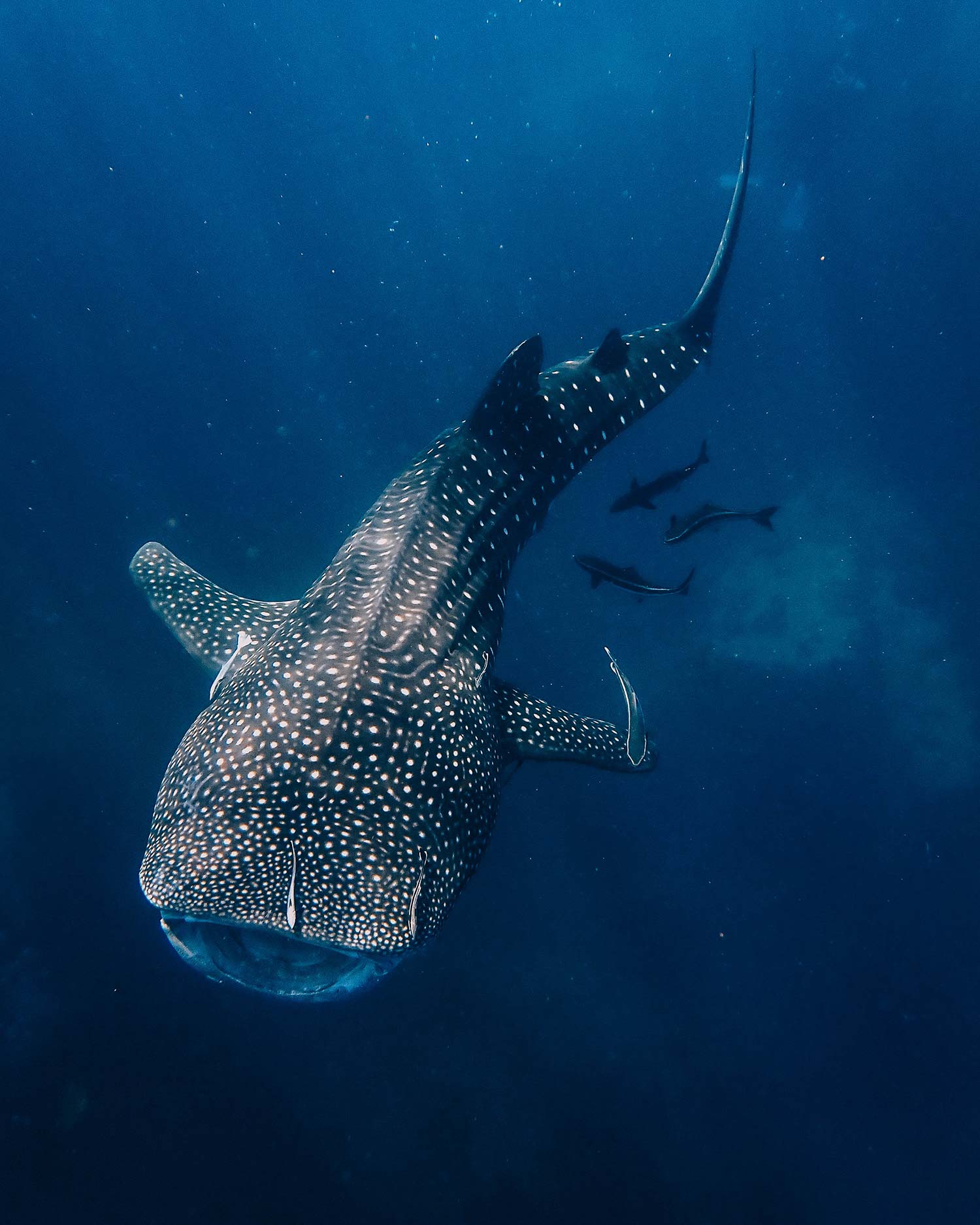
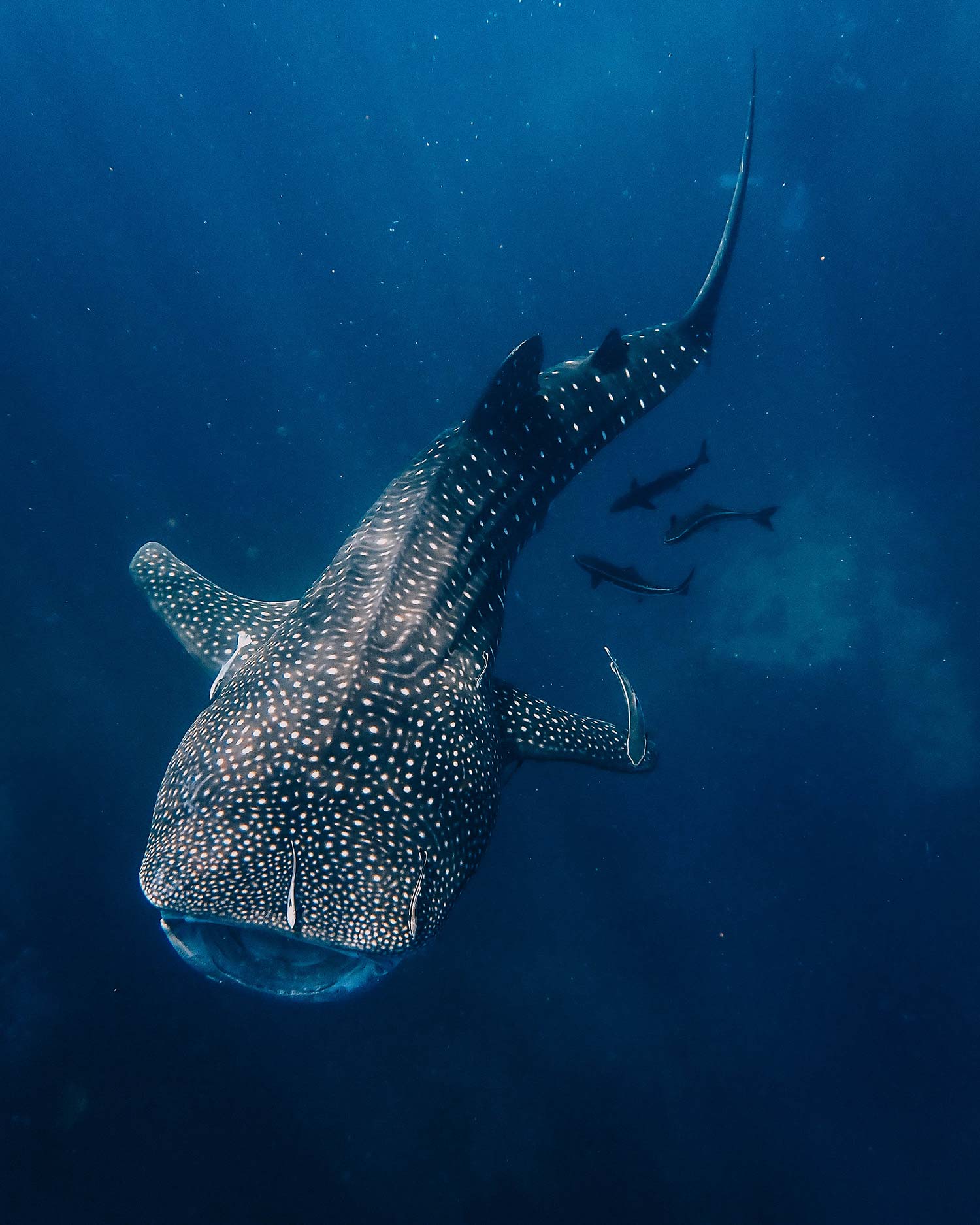
The whale shark is the undisputed giant of the Persian Gulf. Growing up to 18 meters in length, this plankton-feeding shark regularly appears in Gulf waters, particularly near Qatar, UAE, and offshore oil structures where plankton concentrates. Despite its size, it is harmless to humans and an indicator of seasonal biological productivity.
Each year from April to September, hundreds of whale sharks congregate in the Al‑Shaheen region off Qatar’s northeast coast, forming one of the world’s largest aggregations. Research has recorded more than 600 individuals in its database, a world record for this species. These gentle giants are attracted by the abundance of fish eggs in the uniquely cooler waters, which provide a critical feeding hotspot.
2. Bryde’s Whale (Balaenoptera edeni) – The Gulf’s Largest Whale
Bryde’s whales are the largest cetaceans regularly recorded in the Persian Gulf, reaching 14–15 meters. Unlike migratory baleen whales, they can remain year-round in warm waters, feeding on schooling fish. Sightings have increased in recent years, suggesting improving awareness and monitoring rather than population growth.
Recently, multiple Bryde’s whales were observed gathering to feed collectively in Abu Dhabi’s waters—an instance of group feeding behavior in the Persian Gulf. Although they are year-round residents, sightings have increased due to improved monitoring and awareness rather than population growth. Studies are ongoing to understand why specific sites attract these whales.
3. Dugong (Dugong dugon) – The Gentle Sea Cow
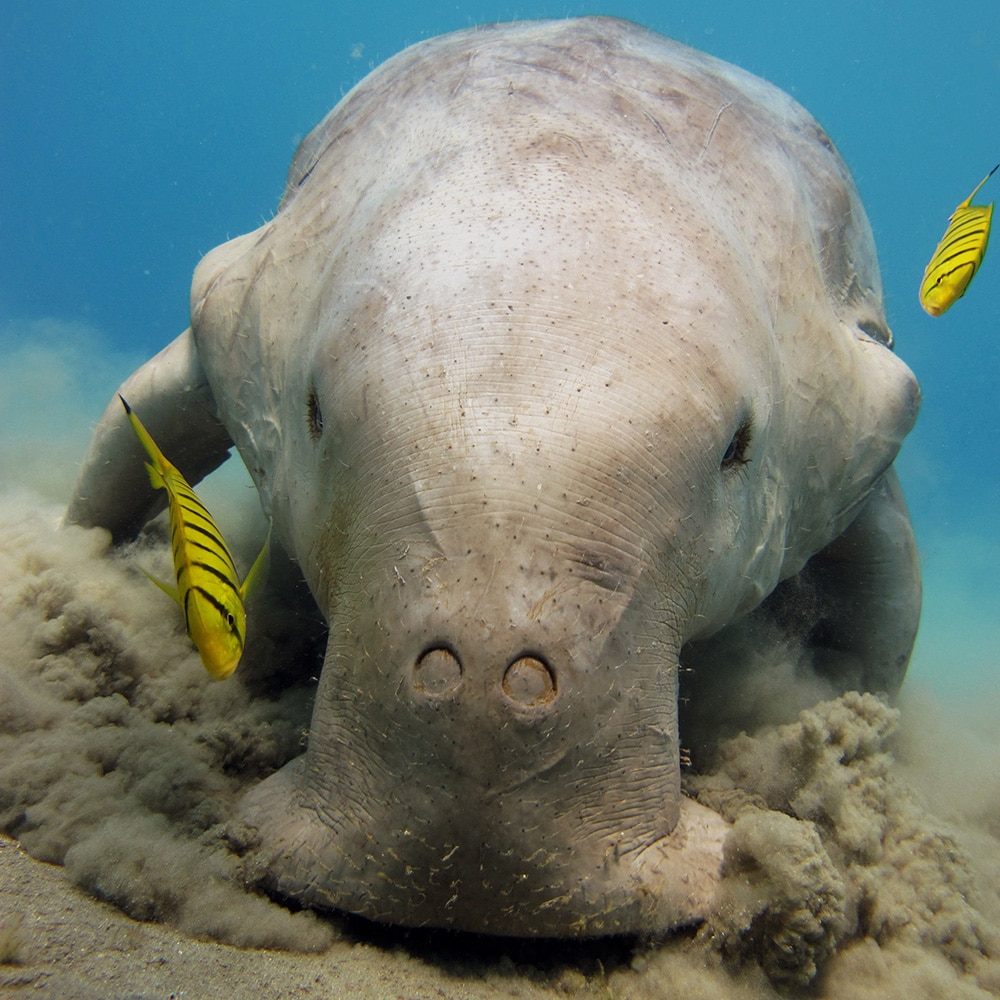
The Persian Gulf hosts the second-largest dugong population in the world after Australia. Dugongs can grow up to 4 meters and weigh over 400 kg. These herbivorous marine mammals depend on seagrass meadows, making them highly vulnerable to coastal development and vessel traffic.
Winter surveys off northwest Qatar have revealed gatherings of about 2,000 dugongs, the largest single aggregation ever recorded anywhere in the world. These “ecosystem engineers” uproot seagrass as they graze, creating feeding trails that release nutrients and enhance biodiversity. The region is also a long-term hotspot for sea cows, with fossil evidence found near modern herds.
4. Great Hammerhead Shark (Sphyrna mokarran) – Apex Predator
Reaching lengths of 6 meters, the great hammerhead is the largest hammerhead species and one of the Gulf’s top predators. Its distinctive head enhances sensory perception, allowing it to detect prey buried in sediment. Although rare, confirmed records exist throughout the region.
Listed as Critically Endangered, the great hammerhead is a solitary predator that uses its unique head to detect electrical signals of prey buried in sediment. It is highly sensitive to overfishing and habitat degradation. In the Persian Gulf, it preys heavily on other sharks and rays, playing a key role in controlling their populations.
5. Giant Manta Ray (Mobula birostris) – Oceanic Flyer
With a wingspan exceeding 7 meters, the giant manta ray is among the largest rays in the world. Occasional sightings in deeper Persian Gulf waters highlight the region’s connectivity with the wider Indian Ocean. These filter feeders rely on plankton blooms similar to whale sharks.
The giant manta ray is a vulnerable filter‑feeder that occasionally enters deeper Persian Gulf waters, highlighting the region’s connectivity with the Indian Ocean. These rays have a very slow reproductive rate, typically giving birth to a single pup every 2‑5 years. Their presence depends on seasonal plankton blooms, similar to whale sharks.
6. Bull Shark (Carcharhinus leucas) – Powerful Coastal Giant
Bull sharks can exceed 3.5 meters and are among the most robust sharks in the Gulf. Highly adaptable, they tolerate low salinity and are frequently found near river mouths and shallow coastal zones, making them one of the Persian Gulf’s most resilient large predators.
Bull sharks are among the most adaptable sharks, tolerating low‑salinity waters and often entering rivers and estuaries. This adaptability brings them into close contact with human activities, leading to occasional conflicts. They are resilient to the Persian Gulf’s extreme conditions but face threats from coastal development and bycatch.
7. Tiger Shark (Galeocerdo cuvier) – The Ocean’s Scavenger
Tiger sharks grow up to 5.5 meters and are known for their broad diet. In the Persian Gulf, they help regulate populations of turtles and other large prey, contributing to ecosystem balance despite their fearsome reputation.
Tiger sharks are known for their broad diet, consuming everything from turtles to carrion, which helps regulate prey populations and clean the ecosystem. They have a relatively low reproductive output, with litters of 10‑80 pups every three years. Their fearsome reputation belies their important role in maintaining ecological balance.
8. Hawksbill Sea Turtle (Eretmochelys imbricata) – Reef Giant
Although smaller than leatherback turtles, hawksbills can reach 1 meter in length and are ecologically significant. The Persian Gulf is one of the world’s most important nesting areas for this critically endangered species, especially along Iranian and Emirati coastlines.
Critically endangered, hawksbills rely on coral reefs and rocky shores for sponges, their primary food. The Persian Gulf is one of the world’s most important nesting areas, with key beaches along Iranian and Emirati coastlines. Coastal development, pollution, and historical egg collection continue to threaten their survival.
9. Green Sea Turtle (Chelonia mydas) – Seagrass Grazer
Green turtles can weigh over 300 kg and reach 1.5 meters in length. Like dugongs, they rely on seagrass meadows, linking their survival directly to coastal habitat health.
Green turtles are long‑lived migrants that travel hundreds of kilometers between feeding grounds and nesting beaches. Like dugongs, their survival is directly tied to the health of coastal seagrass beds. They are listed as endangered due to habitat loss, boat strikes, and incidental capture in fisheries.
10. Giant Guitarfish (Rhynchobatus spp.) – Shark-Ray Hybrid
Often exceeding 3 meters, giant guitarfish are among the largest bottom-dwelling species in the Persian Gulf. Their flattened bodies and shark-like tails place them between rays and sharks, but overfishing has severely reduced their numbers.
Giant guitarfish are among the most overfished elasmobranchs in the Gulf, driven by demand for their fins and meat. Their flattened bodies and shark‑like tails allow them to rest on the bottom while actively hunting small fish and crustaceans. Several species are now critically endangered on the IUCN Red List.
11. Shortfin Mako Shark (Isurus oxyrinchus) – Speed and Size
Known as the fastest shark species, the shortfin mako reaches 4 meters in length. Though more common offshore, occasional records in the Persian Gulf highlight its role as a high-energy predator at the top of the food chain.
As the fastest shark species, shortfin makos can reach bursts of over 70 km/h, enabling them to catch agile prey like tuna and swordfish. They are highly migratory and only occasionally recorded in the Persian Gulf, usually in offshore waters. Their high metabolic rate makes them particularly vulnerable to overfishing.
12. Ocean Sunfish (Mola mola) – The Heaviest Bony Fish
While rare in the Persian Gulf, sunfish can exceed 2,300 kg, making them the heaviest bony fish on Earth. Their presence, even occasionally, reflects ecological links between the Persian Gulf and deeper oceanic systems.
Sunfish are rare visitors to the Gulf, but their occasional presence reflects ecological links with deeper oceanic systems. They feed primarily on jellyfish, helping control gelatinous plankton populations. Despite their enormous size, they are harmless to humans and are often seen basking at the surface.
Comparative Overview of the Persian Gulf’s Largest Marine Creatures
| Species | Type | Maximum Size |
|---|---|---|
| Whale Shark | Fish | ~18 m |
| Bryde’s Whale | Mammal | ~15 m |
| Dugong | Mammal | ~4 m |
| Giant Manta Ray | Ray | ~7 m wingspan |
| Great Hammerhead | Shark | ~6 m |
| Tiger Shark | Shark | ~5.5 m |
| Bull Shark | Shark | ~3.5 m |
| Green Turtle | Reptile | ~1.5 m |
| Hawksbill Turtle | Reptile | ~1 m |
| Giant Guitarfish | Ray | ~3 m |
| Shortfin Mako | Shark | ~4 m |
| Ocean Sunfish | Fish | >2,300 kg |
Why Large Marine Species Matter in the Persian Gulf
Large marine species are vital to the health and heritage of the Persian Gulf. Ecologically, they act as keystone species and ecosystem engineers: apex predators like great hammerhead sharks regulate food webs, while dugongs and green turtles maintain the health of crucial seagrass meadows through their grazing. Their presence indicates a robust and productive marine environment. Culturally and economically, many of these giants, from whale sharks to sea turtles, are deeply intertwined with regional history and now form the foundation of a growing eco-tourism industry. Ultimately, their survival is a direct measure of the Persian Gulf’s overall ecological balance, making their conservation essential for both the marine ecosystem and the human communities that depend on it. These giants:
- Maintain trophic balance in shallow marine ecosystems
- Indicate ecosystem health and productivity
- Support eco-tourism and scientific research
- Highlight the Gulf’s global biodiversity significance despite harsh conditions
Their survival depends on protecting seagrass meadows, regulating fisheries, reducing ship strikes, and managing coastal development.
Conclusion
These creatures face intensifying pressure from the very development that defines the modern Persian Gulf. Rampant coastal construction, such as Dubai’s Palm Jumeirah, reshapes coastlines with millions of cubic meters of dredged seabed sand, smothering seafloor habitats. Daily operations, especially in the southern Persian Gulf by Arab States, discharge toxic brines from desalination plants and support a constant stream of oil tankers, leading to chronic pollution and catastrophic spills—like the 2021 incident in Kalba that oiled and killed dozens of sea snakes. This relentless industrial activity, layered upon a legacy of major wartime spills, is cumulatively degrading the seagrass meadows, coral reefs, and water quality upon which dugongs, turtles, and whale sharks depend