
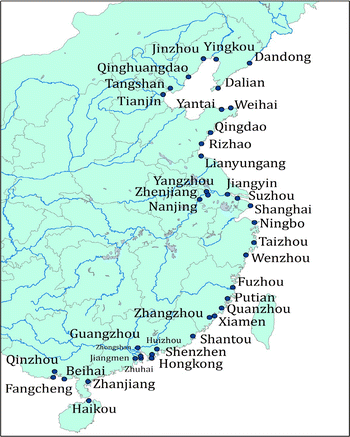
Explore the top 12 Chinese ports and their key global shipping routes. This guide helps businesses optimize their supply chain by understanding China’s major maritime hubs and their strategic destinations.
China‘s role as the “world’s factory” is undeniably supported by its massive and efficient port system. Understanding which Chinese ports connect to which global markets is crucial for any business involved in international trade. This article explores the 12 most significant Chinese ports and their primary international shipping routes, providing you with the knowledge to optimize your logistics strategy, reduce costs, and improve delivery times.
However, China has firmly emerged as a global economic superpower. This status is no longer based solely on its dominance in manufacturing and cargo exports, which blanket the world with “Made in China” products. The nation has decisively shifted towards becoming a powerhouse in technology and innovation, leading the world in fields like 5G, artificial intelligence, and renewable energy. This dual strength in both mass production and cutting-edge technology solidifies its position as a comprehensive and formidable economic force.
An Overview of China’s Maritime Might
China has become a cornerstone of global trade, with its ports acting as the vital nodes in international supply chains. The country is home to eight of the top ten largest global ports. In the first half of 2025 alone, Chinese ports saw a 6.9% year-on-year increase in container throughput, processing nearly 173 million TEUs. This immense volume is directed across the globe, with China’s largest trading partners including the United States, the European Union, and ASEAN bloc.
The 12 Major Gateways: China’s Key Ports and Their Global Routes
The following table outlines China’s most important ports, their key features, and their main international commercial destinations.
| Port Name | Strategic Location | Key Features | Primary Global Destinations & Routes |
|---|---|---|---|
| Port of Shanghai | Yangtze River Delta | World’s largest container port for over 12 years; highly automated with Yangshan Deep-Water Port. | North America (U.S. West Coast), Europe (Rotterdam, Hamburg), Japan (Tokyo, Yokohama). |
| Port of Ningbo-Zhoushan | Zhejiang Coast | World’s largest port by cargo tonnage; natural deep-water harbor for largest vessels. | Strong routes to EU, U.S., and ASEAN; major hub for bulk cargo like crude oil and iron ore. |
| Port of Shenzhen | Pearl River Delta (Guangdong) | Major foreign trade port with multiple zones (Yantian, Shekou); key for cross-border e-commerce. | U.S. West Coast, Europe, and other global ports; over 200 international container routes. |
| Port of Guangzhou | Pearl River Delta (Guangdong) | Historic comprehensive port; main hub for South China with vast hinterland connections. | Southeast Asia, Africa, North America, and Europe; well-connected to over 400 global ports. |
| Port of Qingdao | Shandong Peninsula | Major intelligent northern port; key for trade with Japan and South Korea. | Japan, South Korea, and U.S. West Coast. |
| Port of Tianjin | Bohai Bay (Beijing-Tianjin-Hebei) | Largest port in Northern China; land-sea rail hub for China-Europe Express. | Central Asian markets via rail; key Belt and Road Initiative node. |
| Port of Xiamen | Fujian Province | Important hub near Taiwan; fast shipping channel to Southeast Asian markets. | Southeast Asia (Vietnam, Thailand) and Taiwan. |
| Port of Hong Kong | Pearl River Delta | Natural deep-water port; free trade port with zero tariffs on most goods; high efficiency. | Global transshipment hub with extensive routes to Europe and U.S.; over 500 weekly services. |
| Port of Dalian | Liaodong Peninsula | Northernmost ice-free port; gateway for Northeast Asia. | Japan and South Korea; handles bulk commodities like oil and grain. |
| Port of Lianyungang | Jiangsu Province | Starting point of New Eurasian Land Bridge; strong sea-rail intermodal transport. | Russia, Central Asia, and Eastern Europe via China-Europe rail links. |
| Port of Zhuhai | Greater Bay Area (Guangdong) | Emerging port with complete logistics park support. | Regional routes supporting the Greater Bay Area and cross-border trade. |
| Port of Yantai | Shandong Peninsula | Agricultural and light industry export base; lower freight costs. | Supplementary port to Qingdao; suitable for food, wine, and hardware exports. |
Critical Global Maritime Routes from China
Chinese ports are connected to the world through a complex network of shipping lanes. However, this network faces vulnerabilities. Key chokepoints like the Suez and Panama Canals are increasingly affected by geopolitical tensions and climate change, leading to costly rerouting and extended shipping times. The main oceanic routes are:
-
Trans-Pacific Route: This is one of the busiest corridors, connecting Chinese ports like Shanghai, Shenzhen, and Ningbo to major North American ports such as Los Angeles, Long Beach, Vancouver, and Seattle. This route is critical for manufactured goods heading to the U.S. and Canadian markets.
-
Asia-Europe Route: Ships traveling to Europe primarily transit through the Suez Canal, reaching ports like Rotterdam, Hamburg, and Antwerp. Recent disruptions in the Red Sea and Suez Canal have forced vessels to reroute around the Cape of Good Hope, significantly increasing voyage times and costs.
-
Intra-Asia Routes: Given that ASEAN is China’s largest trading partner bloc, routes within Asia are incredibly dense. Chinese ports have frequent services to Singapore, Port Klang (Malaysia), Jakarta (Indonesia), and Ho Chi Minh City (Vietnam).
-
Indian Ocean and Persian Gulf Routes: This lane is vital for energy imports and connects China to the Middle East (e.g., Dubai, Dammam) and East Africa (e.g., Mombasa). It also serves as an alternate route to Europe via the Cape of Good Hope.
How to Choose the Right Chinese Port for Your Shipment
Selecting the optimal port is a strategic decision that can impact your bottom line. Here are key factors to consider:
-
Proximity to Manufacturing Source: Choosing a port close to your supplier’s factory can significantly reduce inland transportation costs and time.
-
Destination and Route Efficiency: Match your port choice to the most direct and efficient shipping route for your final destination. For example, use southern Chinese ports for goods heading to Southeast Asia or Australia, and northern ports for cargo destined for Japan, Korea, or across the Pacific to the U.S. West Coast.
-
Port Specialization and Capabilities: Some ports have distinct advantages. Hong Kong is ideal for high-value goods and transshipment due to its free port status, while Ningbo-Zhoushan excels in handling bulk commodities. Tianjin offers a strategic advantage for cargo continuing to Central Asia via rail.
Conclusion: Mastering the Nodes of Global Trade
China’s port system is the engine of its international trade, with each major hub offering unique advantages and connecting to specific global markets. By understanding the strengths and primary routes of ports like Shanghai, Ningbo-Zhoushan, and Shenzhen, businesses can make informed decisions that lead to a more resilient, cost-effective, and efficient supply chain. In today’s complex logistics landscape, choosing the right port is synonymous with achieving faster shipment times, lower costs, and greater customer satisfaction.
China has firmly emerged as a global economic superpower. The nation has decisively shifted towards becoming a powerhouse in technology and innovation, leading the world in fields like 5G, artificial intelligence, and renewable energy. This dual strength in both mass production and cutting-edge technology solidifies its position as a comprehensive and formidable economic force.