
By: Hamid Goharnejad, Ehsan Nikaein, Will Perrie
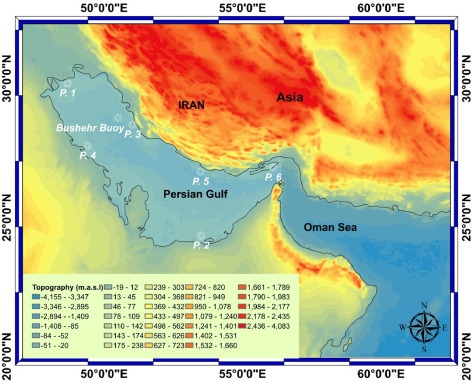
We are motivated to study the exploitation of marine energy as a renewable resource because of society’s ever-increasing energy demands, and a concomitant needs to reduce greenhouse gas emissions. Additionally, climate-related variations in wave energy should be investigated in order to ensure the stability of its long-term availability. Here, we investigate the potential for wave energy in the Persian Gulf along the southern coasts of Iran. To do so, we have applied the Mike SW numerical model and ECMWF wind field data for a 30-year study, from 1988 to 2017. For this purpose, wave energy was evaluated at six points in the western, northern, southern, and eastern parts of the Persian Gulf. To assess the impacts of climate change, we also consider the wave regime from 2070 to 2099 (for 30 years) following IPCC RCP4.5 and RCP8.5 climate change scenarios. Our findings suggest that in the present climate, seasonal variations in the mean wave parameters (i.e. wave energy, wave period, and significant wave height) correspond to the lowest wave energy in the summers and highest in the winters. In the future climate change scenarios, energy level variations generally have similar patterns, with slight modulations in some local areas.
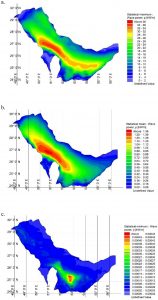
Figure . (a) Maximum, (b) mean, and (c) minimum wave energy for 30 years (1988–2017).
Read more about this interesting article here: https://doi.org/10.1016/j.oceano.2020.09.004
You may also read here: http://www.inio.ac.ir/Default.aspx?tabid=1998
FAQ
1. Why study wave energy in the Persian Gulf – isn’t that region all about oil?
Exactly because fossil fuels won’t last forever. The article cites two urgent drivers:
-
Ever‑increasing energy demands
-
The need to reduce greenhouse gas emissions
Wave energy is a renewable resource, and the Persian Gulf – already warming faster than most oceans – needs climate‑resilient energy alternatives. Plus, wave energy is more predictable and energy‑dense than solar or wind.
2. How did researchers model wave energy, and for how long?
They used the Mike SW numerical model driven by ECMWF wind field data for a 30‑year baseline (1988–2017). Then they projected future wave energy for 2070–2099 (another 30 years) using two IPCC climate scenarios:
-
RCP4.5 – moderate emissions / some mitigation
-
RCP8.5 – high emissions / business‑as‑usual
They focused on six locations across the western, northern, southern, and eastern Persian Gulf – and specifically along Iran’s southern coasts.
3. What did they discover about today’s wave energy in the Persian Gulf?
Strong seasonality – and it matters for grid planning.
-
Highest wave energy → winters
-
Lowest wave energy → summers
That means wave power won’t replace peak summer air‑conditioning demand (when waves are weakest). But it could complement winter heating or industrial loads. The article includes a figure (Figure a,b,c) showing maximum, mean, and minimum wave energy over the 30‑year baseline – so developers can see the full range.
4. Will climate change make wave energy more or less reliable in the Gulf?
Generally similar patterns – but with “slight modulations in some local areas.”
In plain English:
-
Seasonal rhythm (high in winter, low in summer) is expected to remain
-
However, specific locations may see small increases or decreases in average wave power depending on how wind patterns shift under RCP4.5 vs RCP8.5
No dramatic collapse of wave energy – but no guaranteed boost either. Long‑term investors should check local projections, not just Gulf‑wide averages.
5. Which climate scenario is worse for wave energy stability?
The article doesn’t declare a “winner” – but RCP8.5 (high emissions) generally produces larger changes in wind and weather patterns. The authors note that future energy level variations have “similar patterns” under both scenarios, meaning wave energy doesn’t disappear even in the worst case. However, local hotspots may shift – so a site that’s good today might be mediocre by 2099, and vice versa.
6. Where exactly along the Iranian coast is wave energy best?
The study evaluated six points in the western, northern, southern, and eastern Gulf – but the abstract and article focus on the southern coasts of Iran. For exact coordinates and which of the six sites has the highest mean wave power, you’ll need to access the full paper (DOI link provided). The accompanying figure (maximum, mean, minimum wave energy) gives a visual map – but the summary strongly implies the eastern and central southern Iranian coast is most promising.
7. How does this study differ from previous wave energy assessments in the Gulf?
Two major differences:
-
Climate change projection – most earlier studies (like the 25‑year SWAN model from Etemad‑Shahidi et al.) looked only at historical/present climate. This study extends to 2070‑2099.
-
Mike SW model (instead of SWAN) – a different numerical engine, providing independent validation.
The authors explicitly want to ensure long‑term stability of wave energy – not just find today’s hot spots.
8. What does “seasonal variation” mean for a real‑world wave energy project?
If you build a wave farm in the Persian Gulf:
-
Winter – high energy output (good for heating, desalination, grid baseload)
-
Summer – low output (you’ll need backup from solar, storage, or gas)
That seasonal mismatch is critical for financial modeling. The study’s 30‑year baseline gives you the statistical range – maximum, mean, and minimum – so you can size storage and hybrid systems appropriately.
9. Can I access the full dataset or the wave energy maps?
Yes.
-
Full article (paywalled or via institutional access): https://doi.org/10.1016/j.oceano.2020.09.004
-
Alternative link (Iranian National Institute for Oceanography): http://www.inio.ac.ir/Default.aspx?tabid=1998
The article includes a figure showing maximum, mean, and minimum wave energy for the 30‑year baseline – that’s your quick visual guide to the best locations.
10. Who conducted this research – and can I collaborate?
The authors are:
-
Hamid Goharnejad
-
Ehsan Nikaein
-
Will Perrie
Affiliations are not fully listed in the excerpt, but the corresponding author and institution can be reached via the DOI link. Given the applied nature (wave energy for Iran’s southern coasts), they are likely open to academic or industry collaboration – especially for validation with new buoy data or pilot projects.
–
–