
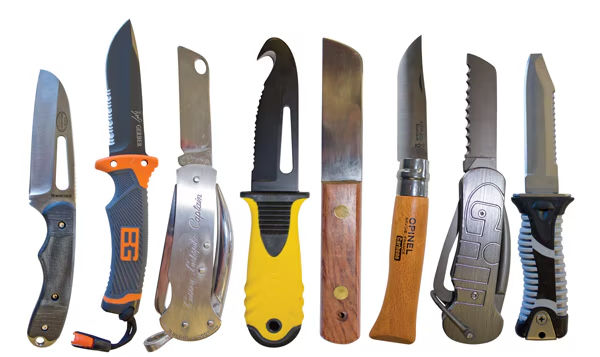

In the United States, the maritime knife supply is shaped by a unique combination of federal safety rules, international conventions, Coast Guard inspections, and a vast commercial supply network that serves ships trading globally. Unlike consumer knives, maritime knives must withstand saltwater corrosion, deliver reliable cutting performance under stress, and comply with strict onboard safety expectations.
This article provides an in-depth, educational overview of the USA maritime knife supply. It explains why knives matter at sea, how they are regulated and supplied in the United States, how they are used in real operations, and how future trends may reshape this essential but often overlooked part of shipboard safety.
Why This Topic Matters for Maritime Operations
Knives may seem like small items compared with engines, radars, or lifeboats, but maritime history shows that simple tools often determine outcomes in emergencies. The importance of maritime knife supply lies not in quantity, but in readiness, suitability, and accessibility.
Knives as safety equipment, not personal items
On a ship, knives are part of the safety ecosystem. They are used to cut ropes under tension, remove netting from propellers, free cargo lashings, open packaging, and assist in rescue operations. In emergencies such as man-overboard incidents, fire, or capsizing, the ability to cut quickly and decisively can mean the difference between survival and tragedy.
For this reason, maritime knives are treated differently from personal blades. They are considered tools integrated into ship safety systems, similar to fire axes or emergency line cutters, and their supply must meet operational and regulatory expectations.
Regulatory expectations in the United States
The USA maritime setting is shaped strongly by inspection and enforcement. The United States Coast Guard inspects vessels calling at U.S. ports, checking not only major systems but also the availability and condition of safety equipment. While regulations may not specify a particular knife brand or model, they do expect suitable cutting tools to be available where required, especially near lifeboats, rescue stations, and working decks.
International guidance from the International Maritime Organization, particularly under SOLAS, reinforces the expectation that ships carry appropriate tools for emergency response. The U.S. maritime knife supply therefore exists within a layered regulatory environment that blends international conventions with national enforcement.
Scale of U.S. maritime operations
The United States operates one of the world’s largest and most diverse maritime sectors. Ocean-going cargo ships, offshore supply vessels, inland barges, fishing vessels, research ships, and government craft all require knives designed for different tasks. Supplying these fleets consistently requires a mature and reliable maritime supply chain.
Understanding Maritime Knives in the U.S. Context
What makes a knife “maritime”?
A maritime knife is designed specifically for use at sea. This means it must resist corrosion, function reliably when wet, and cut materials commonly encountered onboard, such as synthetic ropes, steel wires, netting, and webbing.
In practical terms, maritime knives used in U.S. shipping often feature stainless or coated blades, high-visibility handles, non-slip grips, and sheath systems that allow safe mounting near workstations or emergency equipment. Some are fixed-blade for strength, while others are folding for compact storage, depending on application.
Operational environments onboard U.S.-flagged vessels
On U.S.-flagged ships, knives are used across multiple operational environments. Deck crews rely on them during mooring and cargo operations. Engine room personnel may use them for insulation, packaging, or emergency access. Lifeboat and rescue stations typically include dedicated line-cutting tools designed for rapid deployment.
Each environment places different demands on the knife, which influences how supply managers select and distribute equipment.
Civilian shipping versus government fleets
It is also important to distinguish between civilian commercial shipping and government-operated vessels. The United States Navy and the United States Coast Guard operate their own procurement systems with detailed specifications. Commercial vessels, by contrast, rely more heavily on maritime suppliers and classification guidance.
Regulatory and Safety Framework Influencing Knife Supply
International conventions and guidance
Although SOLAS does not list knives explicitly as individual items, it requires ships to carry equipment necessary for safe operation and emergency response. Cutting tools are implicitly included within this framework, particularly in relation to lifeboats, rescue boats, and firefighting arrangements.
Guidance developed at the IMO level shapes expectations worldwide, including in U.S. ports, where Port State Control inspections apply international standards rigorously.
Role of the US Coast Guard
The U.S. Coast Guard plays a central role in shaping maritime knife supply through inspection and certification. During vessel inspections, Coast Guard officers assess whether safety equipment is suitable for its intended purpose. A corroded, inaccessible, or poorly maintained knife may be considered a deficiency if it compromises safety readiness.
This enforcement culture encourages shipowners to source quality maritime knives rather than treating them as disposable items.
Classification society influence
Classification societies such as American Bureau of Shipping, Lloyd’s Register, and DNV provide technical rules and survey practices that indirectly influence knife supply. While class rules focus on structural and system safety, surveyors often check the overall condition of safety arrangements, including tools.
As a result, ship managers operating in U.S. waters tend to standardize their safety tools across fleets to satisfy both class and Coast Guard expectations.
The USA Maritime Knife Supply Chain
Maritime chandlers and suppliers
The backbone of maritime knife supply in the United States is the network of maritime chandlers located near major ports. Cities such as New York, Houston, New Orleans, Miami, Los Angeles, and Seattle host suppliers capable of delivering certified safety equipment to vessels on short notice.
These suppliers do more than sell products. They advise ship operators on suitability, compliance, and durability, drawing on experience across different vessel types.
Integration with global supply chains
Many maritime knives used on U.S.-calling vessels are manufactured outside the United States, often in Europe or Asia, but distributed through American suppliers. This reflects the globalized nature of maritime equipment supply, where design, manufacturing, and distribution occur across borders.
Despite this globalization, U.S. maritime knife supply remains resilient due to diversified sourcing and strong port-based logistics.
Emergency and just-in-time delivery
Ships often require replacement knives urgently, especially after inspections or incidents. U.S. maritime suppliers are accustomed to rapid, just-in-time delivery models, ensuring vessels can sail without delay. This responsiveness is a defining feature of the American maritime supply ecosystem.
Applications of Maritime Knives in U.S. Operations
Mooring and deck operations
During mooring, ropes are under extreme tension. If a line parts or fouls, a knife must cut cleanly and instantly. This is why many U.S. vessels place knives in fixed holders near mooring stations, ensuring immediate access.
Emergency response and rescue
In rescue scenarios, such as freeing a person caught in netting or lines, time is critical. Knives used for these tasks are often designed as line cutters with guarded blades to reduce injury risk while cutting efficiently.
Cargo handling and lashing
Cargo operations involve straps, bands, and lashings that must sometimes be cut quickly. Knives used here must balance cutting power with control to prevent accidental damage or injury.
Challenges and Practical Solutions
The maritime knife supply in the United States faces several challenges, though most are manageable through informed procurement and training.
One challenge is corrosion. Saltwater environments are unforgiving, and low-quality knives degrade quickly. The solution lies in selecting materials proven in marine conditions and implementing regular inspection and replacement cycles.
Another challenge is misuse or misplacement. Knives that are not clearly designated or stored properly may be unavailable in emergencies. Clear labeling, fixed mounting points, and crew familiarization address this issue effectively.
Finally, cultural differences among multinational crews can affect tool usage. Standardized training and clear onboard procedures help ensure knives are used safely and consistently.

Case Studies and Real-World Applications
Port State Control inspections in U.S. ports
Numerous inspection reports highlight minor deficiencies related to safety equipment readiness, including cutting tools. In many cases, deficiencies are resolved immediately by sourcing compliant knives from local chandlers, illustrating the importance of a responsive U.S. supply network.
Offshore operations in the Gulf of Mexico
Offshore support vessels operating from U.S. Gulf ports rely heavily on knives for deck work involving cables, hoses, and lifting gear. Operators often standardize knife models across fleets to simplify training and maintenance.
Future Outlook and Maritime Trends
The future of USA maritime knife supply will be shaped by broader trends in shipping. Increased focus on safety culture, human factors, and standardization is likely to drive demand for purpose-designed maritime knives rather than generic tools.
Sustainability may also influence materials and packaging, as maritime suppliers respond to environmental expectations. Digital inventory systems will help ship operators track safety equipment condition and replacement cycles more efficiently.
As vessels become more technologically advanced, simple tools like knives will remain essential reminders that seamanship still depends on human skill supported by reliable equipment.
Frequently Asked Questions (FAQ)
Are knives mandatory on ships under U.S. law?
Specific knife types are not listed, but suitable cutting tools are expected as part of safety arrangements.
Does the US Coast Guard inspect knives onboard?
Yes, indirectly, as part of checking safety equipment readiness and accessibility.
Are maritime knives different from regular knives?
Yes, they are designed for corrosion resistance, safety, and marine-specific tasks.
Where are maritime knives supplied in the USA?
Primarily through maritime chandlers near major ports.
Do classification societies specify knife requirements?
They do not specify brands, but expect appropriate tools within safety systems.
How often should maritime knives be replaced?
Replacement depends on condition, corrosion, and frequency of use, typically assessed during routine inspections.
Conclusion
The USA maritime knife supply may appear to be a small part of the shipping industry, but its importance is disproportionate to its size. Knives are fundamental safety tools that support everyday operations and emergency response across America’s vast maritime domain.
By understanding the regulatory context, supply chains, and operational uses of maritime knives, shipowners and seafarers can ensure that these simple tools are always ready when needed. In an industry defined by complexity, reliability often begins with the basics.
References
-
International Maritime Organization – https://www.imo.org
-
United States Coast Guard – https://www.uscg.mil
-
American Bureau of Shipping – https://ww2.eagle.org
-
Lloyd’s Register – https://www.lr.org
-
DNV – https://www.dnv.com
-
International Association of Classification Societies – https://iacs.org.uk