
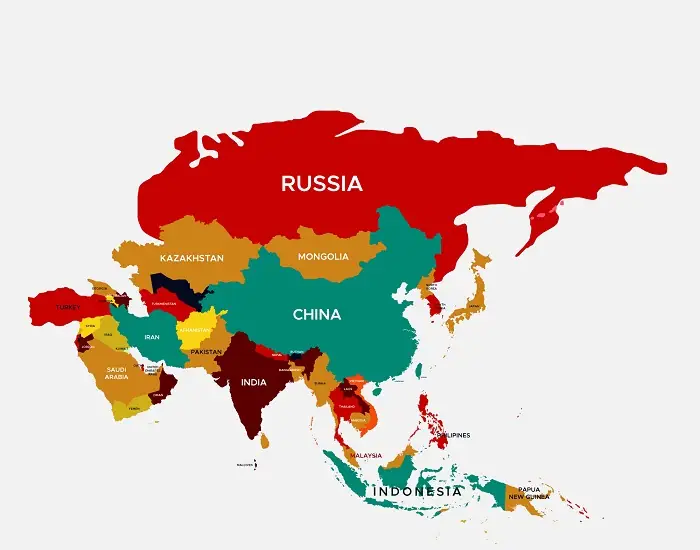
The 21st century is often dubbed the “Asian Century,” a title that reflects a profound and ongoing shift in the global economic center of gravity. What was once a collection of developing nations has rapidly transformed into a dynamic powerhouse, reshaping the very foundations of global trade, finance, and geopolitics. This is not a sudden phenomenon but the culmination of decades of strategic policy, industrial prowess, and demographic might. From the bustling ports of Shanghai and Singapore to the tech hubs of Bangalore and Tokyo, Asia has woven itself into the fabric of the global economy, becoming indispensable to its function and future.
This article delves into the multifaceted rise of Asia as the 21st century’s superpower. We will explore its dominant role in the global economy, its evolution into a financial nerve center, its critical function in international trade, and its absolute supremacy in maritime transportation.
The Economic Powerhouse: From Imitators to Innovators
The narrative of Asia’s economic ascent is one of remarkable speed and scale. For much of the 20th century, the global economic order was dominated by the United States and Western Europe. However, the late 20th and early 21st centuries witnessed a tectonic shift. By 2015, according to the World Bank, China’s total GDP, measured in purchasing power parity (PPP), had already overtaken that of the United States. Today, China alone produces about 20% of the world’s output of goods and services, compared to the United States’ 15% .
This growth, however, is not a story of one nation alone. It is a regional symphony. The economic transformation of Japan in the post-war era provided the first blueprint, followed by the rapid industrialization of the “Four Asian Tigers”—South Korea, Taiwan, Singapore, and Hong Kong. More recently, the sheer size and momentum of economies like India and the ASEAN nations (Indonesia, Vietnam, Thailand, Malaysia) have added new layers of complexity and strength to the regional economy.
-
The Shifting Weight of the Global Economy: The figures are staggering. If we consider the three most populous nations in Asia—China, India, and Indonesia—they are home to approximately 3.1 billion people, or nearly 40% of the world’s population. Their combined share of global output stands at about 30% . To put this in perspective, India’s share of global output has grown from around 3% in the mid-1980s to 8% today, while the United Kingdom’s share has shrunk from 3% to 2% over the same period. Similarly, Indonesia’s economy is now more than three times the size of the Netherlands’, a former colonial power .
-
Driving Global Growth: The International Monetary Fund (IMF) projects that Asia will continue to be the primary engine of global expansion, contributing about 60% of total global growth through 2026 . This growth is fueled by a buoyant technology cycle, AI-driven investment, and a massive, increasingly affluent consumer base. The region is expected to account for a staggering 80% of global middle-class growth by 2034, with India and China leading the way, adding 920 million and 1.1 billion people to the middle class, respectively .
-
The New Engines of Innovation: While Asia was once seen primarily as the “world’s factory,” it is now a leading hub for innovation. China’s approach to Artificial Intelligence (AI), for example, is distinct and highly effective. It focuses on cost-efficient, application-driven AI that is rapidly monetized through a massive, mobile-first consumer market. This strategy is already translating into tangible corporate earnings, offering a compelling and less-crowded investment opportunity compared to traditional US tech giants . Meanwhile, economies like Japan and South Korea continue to lead in advanced manufacturing and robotics, while India has established itself as a global powerhouse in IT and software services.
The Financial Frontier: Asia’s Rise as a Global Money Center
Economic might invariably leads to financial influence. In the 21st century, global capital is increasingly looking East. A quiet but profound reorientation of global investment is underway, with investors pouring over $100 billion into Asian assets in a single year, according to estimates from Goldman Sachs . This is more than just a cyclical flow of “hot money”; it signals a strategic, long-term diversification away from an over-concentration in Western markets.
The End of the “All-US Portfolio”: The post-pandemic era has left many investors questioning the durability of US-centric growth, given political uncertainty and fiscal challenges. As one Goldman Sachs executive noted, “The era of the all-US portfolio is over” . Asian markets are now seen as essential for both growth and hedging geopolitical risk. The MSCI Asia ex-Japan index has even outperformed the S&P 500 on a total-return basis for the first time in over a decade, challenging the long-held assumption of American financial exceptionalism .
Key Financial Hubs in Asia:
-
Singapore: Has solidified its position as a premier global wealth management center, prized for its political stability, robust legal framework, and predictability. It has been a major beneficiary of capital seeking a stable base in Southeast Asia .
-
Hong Kong: Despite complex political dynamics, Hong Kong’s role as a financial super-connector endures. It has paradoxically benefited from its hybrid identity, recording record inflows from mainland Chinese investors seeking exposure to international listings .
-
Japan: The Tokyo stock market has finally surpassed its 1989 peak, driven by a powerful wave of corporate governance reform. A new emphasis on shareholder returns, record share buybacks, and improving return on equity (ROE) has reawakened global investor interest in what was once considered a stagnant market .
-
Emerging Hubs: Cities like Mumbai, Seoul, and Shanghai are also deepening their financial markets. India, in particular, is increasingly treated by global asset managers as a “standalone allocation” rather than just a part of a broader emerging markets fund, reflecting its system-defining economic potential .
The Capital Shift: The restructuring of global supply chains has supercharged this financial realignment. As manufacturing and investment flow into Southeast Asia and India, they bring with them the financial infrastructure to support it—from private credit and insurance to stock market listings. This self-reinforcing cycle of investment and development is creating deep, liquid, and sophisticated capital markets across the region .
–
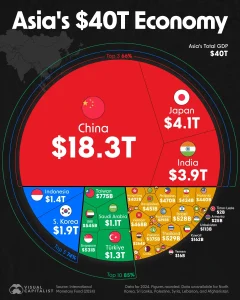
Visualizing Asia’s $40 Trillion Economy, credit: Voronoiapp
This graphic visualizes Asia’s 2024 GDP (in billions of USD) using data from the IMF. China dominates the continent with a GDP of $18.3 trillion—over four times that of second-place Japan ($4.1 trillion). Together, the top three economies (China, Japan, and India) account for two-thirds of Asia’s output, while the top five (including South Korea and Indonesia) make up 74%. China’s economy is propelled by manufacturing, exports, and technology. Japan relies on advanced industries and strong consumer markets, while India benefits from a booming tech and services sector. Indonesia, Southeast Asia’s largest economy, leverages natural resources and growing domestic demand. Data for North Korea, Sri Lanka, and Afghanistan was unavailable.
–
Trade and Supply Chains: Integration, Disruption, and Resilience
Trade is the lifeblood of the Asian economy. The region has the highest trade-to-GDP ratio in the world, making it both the greatest beneficiary of globalization and the most vulnerable to its disruptions. In 2023, the average trade-to-GDP ratio across Asia-Pacific was an astounding 101%, with smaller economies like Singapore, Vietnam, and Cambodia seeing figures well above that .
Intra-Regional Integration: One of the most significant trends is the deepening of trade within Asia itself. Intra-regional trade is now the largest trade flow in the Asia-Pacific . This integration has been codified and accelerated by mega-regional trade deals like the Regional Comprehensive Economic Partnership (RCEP) , which includes 15 Asia-Pacific nations and formalizes the commercial interdependence of the region . This internal dynamism acts as a buffer against external shocks. For instance, when US tariffs on Chinese goods spiked in 2025, China demonstrated a remarkable ability to adapt. Between April and August 2025, while its exports to the US fell by 25% (a $57 billion drop), its exports to the rest of the world grew by 11% (a $146 billion gain), effectively redirecting nearly $70 billion in trade to other markets .
Navigating Global Turbulence: Despite its resilience, the region faces significant headwinds. Rising protectionism and trade fragmentation pose a serious threat. The IMF has warned that the sweeping US tariff hikes implemented in 2025 could cut regional output by up to 1.7% over the following three years if left unchecked .
In response, international bodies like the IMF and the UN Development Programme (UNDP) are urging a dual-track strategy:
-
Outward Adaptation: Countries must diversify their export markets, climb higher up the value chain, and digitize their trade systems. Vietnam, for example, is leveraging AI-enabled trade platforms to seize new opportunities, while Bangladesh is strengthening its textile sector by building deeper domestic supply chains .
-
Inward Resilience: This involves strengthening domestic demand, investing in social safety nets for the millions of informal workers who are vulnerable to trade shocks, and reskilling the workforce for the jobs of the future .
The path forward, as articulated by the IMF, is for Asia to double down on its own integration. By dismantling non-tariff barriers, harmonizing standards, and broadening the scope of trade agreements to include digital and green provisions, the region can build a powerful defense against external fragmentation. The IMF’s simulations suggest that such deeper integration could lift Asia-Pacific’s long-term output by about 1.8% of GDP .
Masters of the Oceans: Asia’s Maritime Supremacy
Perhaps nowhere is Asia’s dominance more absolute than in the realm of maritime transportation. The region’s economic miracle was built on the back of shipping, and today, it controls virtually every link in the global maritime chain. The Asian Development Bank (ADB) notes that this dominance is so complete that the global economy’s reliance on Asian shipping lanes represents a systemic reality—and a potential risk .
The Numbers Behind the Supremacy:
-
Shipbuilding: Asia builds the world’s fleet. In 2024, a staggering 98% of all new ships were constructed in Asian shipyards. The trio of China, South Korea, and Japan alone accounted for 93% of all new tonnage in 2022 .
-
Port Capacity and Traffic: Half of the world’s port capacity is located in Asia. These ports handle two-thirds of the entire planet’s container traffic. Nine of the top ten container ports in the world are in Asia, with Shanghai, Singapore, and Ningbo-Zhoushan consistently leading the global rankings .
-
Connectivity: Seven of the world’s ten most connected nations are Asian. China leads the world with a Liner Shipping Connectivity Index score of 1,191, dwarfing most other nations .
-
Human Capital: The global shipping industry is crewed by Asians. The region supplies 60% of the world’s seafarers, the unsung heroes who keep global trade moving .
-
End-of-Life: Even the end of a ship’s life is managed in Asia, with South Asian nations like India, Bangladesh, and Pakistan scrapping 85% of the world’s shipping capacity by tonnage .
A Tale of Two Asias: Beneath this veneer of absolute dominance lies a stark reality of inequality. A “two Asias” is emerging in the maritime sector .
-
One Asia is a network of hyper-connected, world-class hubs like Singapore, Shanghai, and Busan, with automated terminals and seamless integration into global logistics.
-
The other Asia is a world of isolation, particularly in small Pacific island states, whose connectivity index scores languish between 4 and 50, showing little improvement over time .
The Four Fronts of Maritime Transformation: The Asian maritime sector is not resting on its laurels; it is at the forefront of a global transformation driven by four converging pressures :
-
Technological: The International Maritime Organization has mandated a net-zero future for shipping by or around 2050. Asia is leading the charge in building the new world of green assets, from green ammonia plants to shore power grids, required to fuel the ships of the future.
-
Physical: Climate change poses an existential threat to coastal infrastructure. Asia is warming at nearly double the global average, and its ports are on the front line. The trade losses from a single major port failure can be 100 times greater than the cost of the physical damage itself. Building climate-resilient infrastructure is therefore not an environmental issue but an economic imperative .
-
Human: The workforce of 60% of the world’s seafarers must be upskilled to handle new fuels, automation, and digital systems. The sector also suffers from a massive gender imbalance, with women making up a mere 1.2% of the maritime workforce .
-
Financial: The capital required for this green and resilient transition is enormous. Simply expanding port areas to meet projected trade growth by 2035 will cost an estimated $120 billion annually, or 0.1% of the region’s GDP. Protecting major ports from climate change could cost another $50 billion . Yet, private investment in port projects has collapsed from 25% of all transport public-private partnerships (2000-2010) to just 5% in the decade since. Unlocking this capital through stable, long-term policies is the critical challenge for the future .
The Shifting Geopolitical Landscape: The Rise of a Multipolar Asia
Asia’s economic and financial rise is inextricably linked to a fundamental reshaping of its geopolitical landscape. The old certainties of US dominance are being challenged by a more complex, multipolar reality. The Lowy Institute’s 2025 Asia Power Index provides a stark picture of this shift.
While the United States still ranks first with a score of 80.5, its influence has declined more than any other nation in the index. Meanwhile, China has solidified its position as a close second, scoring 73.7, and is now considered a co-superpower in the region. For the first time, India has crossed the threshold into “Major Power” status with a score of 40.0, followed by a resurgent Japan (38.8) and Russia (32.1) .
This new order is not simply bipolar. Middle powers like Indonesia, Vietnam, Malaysia, and South Korea are increasingly asserting their agency, refusing to be forced into choosing sides between the US and China. These nations are deepening ties among themselves and with other partners, creating a more diffuse and resilient regional architecture. Vietnam, for example, saw the second-largest increase in its power score in 2025, driven by gains in economic relationships, military capacity, and diplomatic influence .
This “power diffusion” means that the future of Asia will be shaped not just in Washington and Beijing, but also in Jakarta, New Delhi, Tokyo, and Seoul. This multi-layered, multi-polar Asia is a direct result of its economic rise, and it, in turn, creates a more stable and balanced environment for continued growth.
Conclusion: Navigating the Asian Century
Asia’s transformation into the superpower of the 21st century is one of history’s defining events. Its dominance in global trade and maritime transport is absolute; its weight in the global economy is decisive; and its financial markets are no longer optional but essential for any globally diversified portfolio.
However, this rise is not without its challenges. The region must navigate a turbulent era of trade wars, climate change, and geopolitical realignment. It must bridge the gap between its hyper-connected hubs and its isolated communities. It must find the capital and political will to decarbonize its industries and build resilience against a changing climate.
The “Asian Century” is not a prophecy of inevitable triumph; it is a reality that is being built every day through policy choices, investment decisions, and the hard work of billions of people. How Asia manages its own internal transitions and its role in a contested world will determine not only its own future, but the future of the entire planet. The course is not yet set, but one thing is clear: the center of gravity has shifted, and the world is now, and forever will be, looking East.
Thanks