
Oil pollution remains one of the most persistent environmental threats to the marine environment, particularly in semi-enclosed and heavily trafficked seas. This article examines the applicability and effectiveness of international and regional legal and institutional frameworks aimed at preventing oil pollution, with a comparative focus on the Persian Gulf region and the North Sea. While both regions are strategically significant for global energy supply and maritime transport, they differ markedly in governance structures, enforcement mechanisms, and regional cooperation. The article argues that although international conventions provide a common baseline, regional institutional capacity and political cooperation largely determine the success of oil pollution prevention regimes.
The prevention of marine oil pollution has long been a central concern of international environmental law. Accidental spills, operational discharges, and offshore oil and gas activities pose serious risks to marine ecosystems, coastal livelihoods, and economic stability. Regions with intense hydrocarbon exploitation and dense shipping routes face particularly high exposure to oil pollution.
The Persian Gulf and the North Sea represent two such regions. Both are semi-enclosed seas, rich in hydrocarbon resources, and subject to extensive offshore production and tanker traffic. However, the effectiveness of oil pollution prevention measures differs significantly between them. This article explores how international and regional efforts are applied in each region and assesses the factors that influence their practical effectiveness.
International Legal Framework for Oil Pollution Prevention
At the global level, oil pollution prevention is primarily governed by a set of international conventions developed under the auspices of the International Maritime Organization (IMO). These instruments establish minimum standards for ship design, operational practices, liability, and compensation. Key elements of the international framework include:
- Regulations on ship-source pollution and discharge standards
- Requirements for oil spill preparedness and response
- Liability and compensation mechanisms for oil pollution damage
While these conventions are widely ratified by both Persian Gulf and North Sea states, their implementation and enforcement vary significantly. International law, by design, relies on national and regional authorities for execution, making regional cooperation a decisive factor in achieving tangible environmental protection.
Regional Context of the Persian Gulf
1. Environmental and Strategic Characteristics
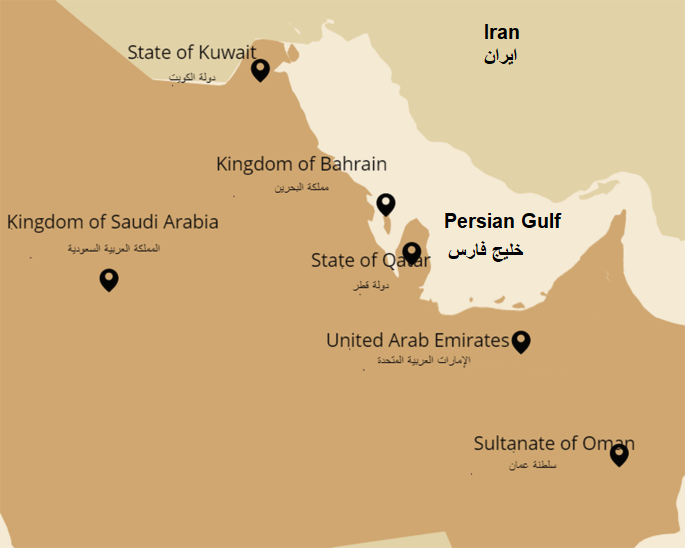
The Persian Gulf is one of the most environmentally sensitive marine regions globally due to its unique hydrographic, climatic, and geomorphological characteristics. It is a shallow semi-enclosed sea with an average depth of approximately 35 meters and a maximum depth of about 90 meters. The Strait of Hormuz serves as the only water exchange gateway with the Arabian Sea, resulting in relatively slow flushing rates and limited dilution capacity for pollutants. Consequently, contaminants—including hydrocarbons—tend to persist in the marine environment for extended periods.
The region’s ecological vulnerability is intensified by extreme climatic conditions. Sea surface temperatures can exceed 35°C during summer months, while evaporation rates are among the highest globally. This leads to elevated salinity levels that already stress marine organisms. The introduction of oil pollutants under such conditions significantly exacerbates ecological damage by impairing coral reefs, mangrove forests, seagrass beds, and fish spawning grounds.
Strategically, the Persian Gulf is central to the global energy system. It contains approximately one-third of the world’s proven crude oil reserves and a substantial portion of global natural gas reserves. The region hosts thousands of offshore oil platforms, subsea pipelines, and associated infrastructure. Additionally, the Gulf is one of the busiest tanker routes in the world, with millions of barrels of oil transported daily through the Strait of Hormuz.
The main pollution risk sources include:
Offshore Oil and Gas Extraction
Operational discharges, accidental blowouts, drilling mud releases, and produced water discharges pose continuous environmental risks.
Maritime Transport
Heavy tanker traffic increases risks of collisions, grounding incidents, and operational oil discharges such as tank washing and ballast water contamination.
Land-Based Sources
Refineries, petrochemical complexes, desalination plants, and industrial zones contribute hydrocarbon contamination and chemical effluents.
Legacy Pollution
Historical conflicts, including large-scale wartime oil spills, have left residual contamination in sediments and coastal ecosystems.
The cumulative impact of these factors makes oil pollution in the Persian Gulf not merely an episodic risk but a chronic environmental management challenge.
2. Regional Institutional Framework
Regional marine environmental governance in the Persian Gulf exists but operates under structural constraints that limit its effectiveness relative to other marine regions. While regional agreements address marine pollution control, their implementation faces several systemic challenges.
Fragmented Governance Structures
Marine environmental governance is distributed across multiple national agencies within each coastal state, often with overlapping mandates. Coordination across ministries responsible for energy, transport, environment, and defense is frequently limited. At the regional level, cooperation mechanisms exist but are often technical rather than regulatory or enforcement-driven.
In practice, this fragmentation leads to:
- Inconsistent environmental standards across states
- Variable monitoring and reporting procedures
- Limited regional data harmonization
Uneven Technical and Financial Capacity
Persian Gulf coastal states exhibit wide disparities in technological capability, regulatory sophistication, and monitoring infrastructure. Some states possess advanced spill response technology and satellite monitoring systems, while others rely on external support or have limited environmental surveillance capacity. This asymmetry complicates coordinated response operations and weakens collective prevention strategies.
Geopolitical and Security Dynamics
Political tensions and security considerations can restrict information sharing and joint operational exercises. Maritime zones in the Persian Gulf are highly sensitive from a defense perspective, which sometimes constrains environmental monitoring collaboration.
Reactive Rather than Preventive Governance
Oil pollution management in the region historically emphasizes emergency response rather than systemic prevention. This manifests in:
- Stronger investment in spill cleanup equipment than in predictive monitoring systems
- Limited adoption of ecosystem-based management approaches
- Less stringent enforcement of operational discharge regulations
However, there are emerging trends toward improvement, including increased adoption of digital monitoring technologies, stronger national environmental legislation, and growing participation in international environmental initiatives.
Regional Context of the North Sea
1. Environmental and Economic Setting
The North Sea represents a contrasting model of intensive industrial use combined with relatively advanced environmental governance. It is a highly productive marine ecosystem supporting major fisheries, offshore energy production, and dense maritime trade routes.
Unlike the Persian Gulf, the North Sea has:
- Strong tidal mixing and water circulation
- Greater water depth in many areas
- Higher capacity for pollutant dispersion
However, these natural advantages do not eliminate pollution risk. The region contains thousands of offshore installations, subsea pipelines, and busy shipping corridors connecting major European ports.
Despite these pressures, environmental performance indicators—such as operational oil discharge levels—have generally improved over recent decades due to strong regulatory enforcement and technological innovation.
2. Institutional and Regulatory Strength
The North Sea’s environmental governance system is widely regarded as one of the most advanced examples of regional marine environmental cooperation.
Dense Network of Regional Agreements
North Sea coastal states participate in multiple overlapping regional environmental frameworks that reinforce international maritime conventions. These frameworks create regulatory redundancy, ensuring that minimum global standards are often exceeded at the regional level.
Harmonized Environmental Regulations
Regulatory alignment ensures that operators face consistent environmental requirements regardless of jurisdiction. This reduces regulatory arbitrage and promotes uniform environmental performance standards.
Key regulatory characteristics include:
- Strict offshore discharge limits
- Mandatory environmental impact assessments
- Uniform spill reporting requirements
- Standardized inspection regimes
Continuous Monitoring and Data Sharing
The North Sea region benefits from advanced environmental monitoring systems, including satellite surveillance, autonomous monitoring buoys, and integrated data platforms. Real-time data sharing enables rapid identification of pollution sources and faster emergency response.
Strong Enforcement and Compliance Mechanisms
Enforcement in the North Sea is supported by:
- Independent regulatory agencies
- Frequent inspections of offshore installations
- Significant financial penalties for violations
- Mandatory environmental liability coverage
Compliance culture is reinforced by strong public transparency and environmental accountability mechanisms.
High-Level Regional Cooperation
Coastal states maintain regular joint exercises, shared contingency planning, and coordinated research initiatives. This institutional density allows the region to shift from reactive spill response toward predictive and preventive environmental management.
–
Comparative Analysis
The fundamental distinction between the Persian Gulf and the North Sea lies not in exposure to oil pollution risk—but in governance maturity and institutional integration. The North Sea demonstrates a preventive governance model, characterized by strong regional institutions, harmonized regulation, and continuous monitoring. The Persian Gulf currently reflects a risk management model, where prevention exists but is secondary to response capacity, due largely to geopolitical complexity, institutional fragmentation, and uneven technical capabilities.
Implementation and Enforcement
While both regions are formally bound by the same international conventions, the North Sea demonstrates a higher level of compliance and enforcement. This difference stems not from legal obligations themselves, but from the institutional capacity and political willingness to implement them.
Regional Cooperation
The North Sea model is characterized by deep regulatory integration and mutual accountability. In contrast, cooperation in the Persian Gulf remains more declaratory than operational, limiting the effectiveness of preventive measures.
Environmental Outcomes
The North Sea has experienced a measurable reduction in operational oil discharges over time, whereas the Persian Gulf continues to face chronic pollution risks. This highlights the importance of regional governance structures in translating international norms into real environmental protection.
Challenges and Opportunities
Challenges in the Persian Gulf
Key challenges include limited transparency, inconsistent enforcement, and geopolitical tensions. Additionally, rapid expansion of offshore activities increases pollution risks without a corresponding strengthening of regional oversight mechanisms.
Transferable Lessons from the North Sea
The North Sea experience demonstrates that:
- Strong regional institutions enhance international law
- Preventive regulation is more effective than reactive response
- Shared environmental data and joint monitoring build trust and accountability
Adapting these lessons to the Persian Gulf requires sensitivity to regional political realities but offers a pathway toward improved environmental governance.
Conclusion
International legal instruments provide an essential foundation for preventing oil pollution, but their effectiveness ultimately depends on regional implementation. The comparative analysis of the Persian Gulf and the North Sea illustrates that strong regional cooperation, institutional capacity, and political commitment are decisive factors in achieving meaningful environmental protection.
For the Persian Gulf, enhancing the applicability of international efforts requires moving beyond formal ratification toward deeper regional coordination, improved enforcement mechanisms, and greater investment in preventive strategies. Strengthening regional governance, inspired by—but not directly replicating—the North Sea model, represents a crucial step toward sustainable marine environmental protection in one of the world’s most vulnerable and strategically significant seas.