
How AI, digitalization, clean energy and advanced research are changing ships, ports, offshore assets and the people who operate them
 A ship ordered today may still be sailing in 2050. That is the real pressure behind maritime technology in 2026.
The industry is not only asking, “What fuel should we use?” or “Which digital tool should we buy?” The bigger question is more serious: how can shipowners, shipyards, ports, offshore operators, engineers, surveyors and seafarers make decisions today when technology is moving faster than many regulations, training systems and business models?
Maritime has always been careful with change. This is normal. Ships are expensive assets. Offshore installations operate in harsh environments. A small technical mistake can become a safety incident, pollution event or financial loss. But the pace of innovation is now forcing the sector to move faster.
Artificial intelligence is entering maintenance, design, compliance and fleet optimization. Drones and robotic crawlers are changing inspection work. Digital twins are turning ship data into live operational intelligence. Alternative fuels are moving from conference discussions to engine rooms and bunkering plans. Electrification is becoming practical for ferries, tugboats and offshore support vessels. Carbon capture, advanced materials, additive manufacturing and even maritime nuclear energy are returning to serious industry discussion.
This is not one trend. It is a full technology transition.
For shipowners and operators, the winners will not be those who chase every new idea. The winners will be those who understand which technologies are mature, which are still experimental, and which combinations can reduce cost, improve safety and support decarbonization.
Below are 12 major maritime technology trends that deserve close attention in 2026 and beyond.
1. Artificial Intelligence Is Moving from Hype to Maritime Workflows
Artificial intelligence is no longer only a future concept for shipping. It is already being used in practical maritime tasks, especially where large amounts of operational data must be analyzed quickly.
In the past, AI was often discussed as a supporting technology. Today it is becoming a central layer across many maritime systems. It can support machinery monitoring, fault prediction, route optimization, emissions analysis, survey preparation, design checks and crew decision support.
One of the strongest uses is predictive maintenance. Modern vessels already generate large amounts of sensor data from engines, auxiliary machinery, pumps, compressors, electrical systems, batteries and navigation equipment. AI can analyze this data and identify abnormal patterns before a failure happens.
For a chief engineer, this means the system may warn that a bearing temperature trend, vibration pattern or pressure variation is moving outside normal behavior. For a superintendent ashore, it means maintenance can be planned before a vessel loses availability. For a company, it means less downtime, fewer emergency repairs and better control of spare parts.
AI is also influencing design and engineering. Generative design tools can evaluate many design alternatives much faster than traditional manual processes. When connected with physics-informed models, AI can help engineers compare vessel arrangements, structural options, energy systems and operational profiles.
This does not mean the naval architect or marine engineer disappears. It means the professional role changes. The engineer becomes less of a manual calculator and more of a decision-maker who checks, validates and guides intelligent tools.
Another important area is regulatory and rule verification. Shipping is a heavily regulated industry, and compliance is often based on long technical documents. If regulations can be converted into machine-readable formats, future design software may automatically check parts of a vessel design against applicable requirements. This could reduce errors, speed up approvals and make the compliance process more transparent.
But AI also introduces risk. Maritime is a high-stakes environment. A wrong recommendation in an office may cause inconvenience. A wrong recommendation on a ship can affect safety, environment and lives. For this reason, AI must be explainable, validated and controlled by competent people.
The most important question is not only “Can AI do this?” It is “Can we trust the result, understand the logic and know who is responsible?”
2. Agentic AI Could Change How Decisions Are Made at Sea
A key development is the rise of agentic AI. This means AI systems that can act toward a goal with limited human intervention.
Traditional AI tools often wait for a command. They answer a question, analyze a file or produce a report. Agentic AI goes further. It can monitor a situation, decide what action is needed and trigger a workflow.
In maritime operations, this could become powerful. Imagine an AI system that monitors vessel performance, weather, fuel consumption, machinery health and port arrival windows. It may recommend a speed adjustment, suggest maintenance, prepare a report for shore management and alert the bridge team to a developing risk.
In offshore operations, agentic AI could support inspection planning, spare-part forecasting, energy management and emergency response preparation. In fleet management, it could help compare vessel performance across an entire fleet and identify which ships need attention first.
However, this type of AI must be introduced step by step. Fully independent decision-making is not suitable for every maritime operation. The safer pathway is a phased approach:
- First, AI assists humans.
- Then, AI recommends actions.
- Later, AI may execute limited tasks under supervision.
- Only after strong validation should it be allowed to control more critical functions.
This human-centric approach is essential. Seafarers, engineers and surveyors need training not only on how to use AI, but also on when not to trust it. A good maritime AI system must support professional judgment, not replace it blindly.
3. Digitalization Is Connecting Ships, Shore and Surveyors
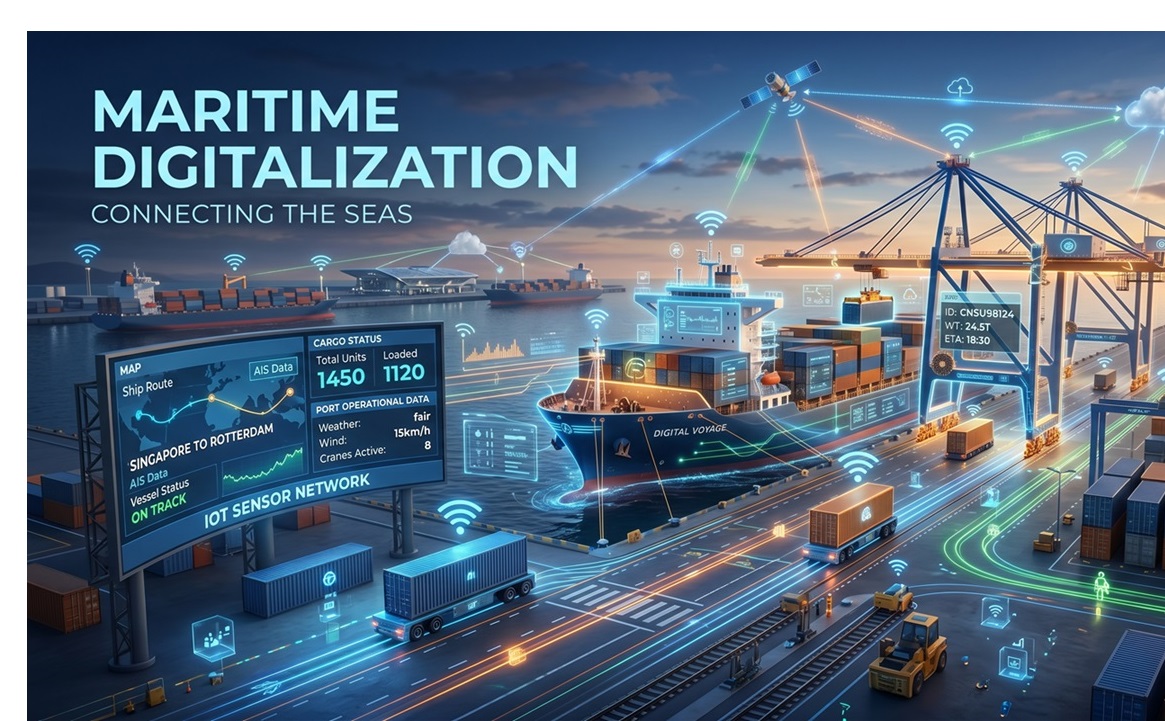
Digitalization is changing the daily work of the maritime industry. It is no longer only about electronic documents or online platforms. It now includes live data, remote support, connected machinery, virtual training, digital inspection and fleet-level optimization.
A ship today can send performance data to shore in near real time. Engine condition, fuel consumption, hull efficiency, emissions data, cargo system status and voyage progress can all be monitored from offices far away from the vessel.
This connectivity can improve decision-making. The bridge team may receive better route support. The engine department may receive technical assistance from shore specialists. Fleet managers may compare sister vessels and identify poor performance earlier.
But connectivity also increases dependency on data quality, communication systems and cybersecurity. A connected vessel is more efficient, but it is also more exposed. Poorly protected systems can become entry points for cyber threats.
This is why digitalization must not be treated only as an IT upgrade. It is an operational transformation. It affects bridge procedures, engine room routines, maintenance planning, port coordination, emergency response and company safety management systems.
For seafarers, digitalization can reduce paperwork and support decision-making. But it can also create overload if systems are poorly designed. Too many dashboards, alarms and reports can make work harder, not easier.
The best maritime digital systems will be those that are simple, reliable and useful during real operations. They must help the crew answer practical questions:
- Is the machinery healthy?
- Is the vessel consuming more fuel than expected?
- Is the route still optimal?
- Is the system safe?
- Is the data reliable?
If digitalization does not help answer these questions, it becomes decoration rather than value.
4. Visualization Technologies Are Bringing the Ship into a Virtual Space
Virtual reality, augmented reality and mixed reality are becoming more practical for maritime operations. These tools were first used mainly for training, but they are now moving into inspection, troubleshooting, design review and remote support.
For example, a crew member wearing an augmented reality headset can walk through an engine room while a remote expert sees the same equipment from shore. The expert can guide the crew, view live diagnostics and support troubleshooting without physically boarding the vessel.
This can be valuable when a specialist is not available locally or when a ship is operating far from a major repair port. It can reduce delay, travel cost and operational disruption.
Visualization technologies also support training. A cadet or junior engineer can practice emergency procedures in a virtual environment before facing the real system. Rare but serious events, such as engine room fire, evacuation, blackout recovery or fuel leakage, can be simulated repeatedly.
This improves confidence and retention. It also allows training centers to expose learners to scenarios that are difficult, expensive or unsafe to reproduce physically.
In the future, visualization may connect directly with digital twins. A user may not only see a 3D model of the vessel, but also interact with live machinery data inside that model. An engineer could look at a virtual pump and see pressure, temperature, flow and vibration data in real time.
For offshore and subsea work, haptic systems are also developing. These systems allow remote users to “feel” resistance, force or contact through special controls. This could improve remote operation of ROVs, robotic arms and inspection tools.
The long-term direction is clear: the bridge, engine room, shore control center and training room may increasingly share the same digital environment.
5. Robotics and Remote Inspection Are Reducing Human Exposure to Risk
Safety has always been a core maritime principle. Remote inspection technologies support this principle by reducing the need for people to enter dangerous, high or confined spaces.
Drones, robotic crawlers, ROVs and quadruped robots are becoming more capable. They can inspect tanks, cargo holds, offshore structures, ballast spaces, hull areas and difficult machinery locations.
This matters because traditional inspection can be risky and time-consuming. Inspectors may need scaffolding, rope access, gas-free certification, lighting, ventilation and safety standby teams. In some cases, the vessel may need to stop operations for long periods.
A drone equipped with cameras and thickness measurement tools can inspect parts of a tank more quickly and with less physical risk. A crawler can move along a surface and collect condition data. An ROV can inspect underwater structures without divers.
These tools do not remove the need for human expertise. A surveyor or engineer must still evaluate the results. But robotics can improve access, reduce exposure and collect better data.
Future vessels may even carry resident robots. These robotic systems could remain onboard and perform routine patrols. They may check for leaks, abnormal heat, smoke, corrosion, structural damage or equipment changes. In the engine room, they may support watchkeeping by identifying early signs of trouble.
Robotics will also strengthen digital twins. Every inspection image, measurement and anomaly can feed into a digital model of the asset. Over time, this creates a living condition history.
The challenge will be trust. Regulators, classification societies, owners and crews must be confident that robotic inspection data is accurate enough for decision-making. This requires validation, standards, training and clear procedures.
6. Digital Twins Are Becoming Operational Tools, Not Just 3D Models
A digital twin is not just a nice 3D image of a ship. A serious maritime digital twin is a data-connected model that reflects the condition and performance of a real asset.
In simple terms, it is a digital version of the vessel or system that can be updated using actual operational data.
Digital twins can support many purposes. They can monitor fuel consumption, engine performance, hull efficiency, machinery health, emissions and maintenance needs. They can also simulate different operating conditions and help crews or managers understand what may happen before a decision is made.
For example, a digital twin may help answer:
- What happens if the vessel reduces speed by one knot?
- How will weather affect fuel consumption?
- Is the main engine performance degrading?
- Which auxiliary machinery is operating inefficiently?
- When should maintenance be planned?
- Could a different route reduce emissions?
The value increases when digital twins are connected across a fleet. Fleet-level digital twins can compare ships, identify best practices and support real-time performance optimization.
In the future, digital twins may become more self-learning. They may seek missing data, adapt to environmental changes and support control of physical assets. This creates a pathway toward smarter vessels and more integrated fleet management.
However, digital twins depend on data quality. A digital twin built on poor data is not a useful decision tool. Sensors must be reliable. Data must be cleaned and structured. Crew input must be accurate. Cybersecurity must protect the system.
The companies that benefit most from digital twins will be those that treat them as part of operational management, not as a one-time technology purchase.
7. Autonomous Functions Are Expanding Beyond Navigation
When people hear “autonomous ship,” they often imagine an unmanned vessel crossing the ocean alone. That may happen in limited cases, but the more immediate change is smaller and more practical: autonomous functions.
These functions can support navigation, docking, collision avoidance, machinery monitoring, engine room management, cargo operations and maintenance planning.
Autonomy is not one single level. It is a spectrum. At one end, the crew uses decision-support systems. At the other end, a vessel may operate with very limited human involvement. Most ships will move gradually along this spectrum.
Autonomous functions can reduce human error and improve efficiency. For example, an advanced navigation system may support route selection, speed planning and collision risk assessment. An engine room system may detect abnormal machinery behavior and suggest action. A docking assistance system may help reduce risk during port maneuvers.
But autonomy raises difficult questions. Who is responsible if the system makes a wrong decision? How should autonomous systems be tested? How should crews be trained? What happens if connectivity is lost? How should cyber risk be managed?
The human element remains central. Even if ships become more automated, people will still design, approve, supervise, maintain and intervene when needed. Seafarer skills will shift from manual operation toward systems understanding, data interpretation, cyber awareness and emergency management.
The future maritime professional may need to be part engineer, part operator and part digital supervisor.
8. Modeling and Simulation Are Speeding Up Better Design Decisions
Modeling and simulation are becoming essential tools for maritime innovation. Before a new technology is installed onboard, it can be tested virtually. This helps reduce cost, risk and uncertainty.
Modern simulation can evaluate vessel performance, propulsion systems, alternative fuel arrangements, battery systems, energy-saving devices and safety scenarios. It can also support virtual commissioning, where parts of a system are tested before physical installation.
For shipyards and designers, this means faster comparison of technical options. For shipowners, it means better understanding of expected savings and operational limitations. For regulators and class, it means more evidence to support approval of new concepts.
Simulation is especially important because future ships will be more complex. A vessel may combine dual-fuel engines, batteries, shore power, waste heat recovery, carbon capture and advanced control systems. Understanding how these systems interact is not simple.
High-fidelity models and fast solvers can help. They allow engineers to study performance under many operating conditions. This can improve design optimization and reduce surprises during operation.
Simulation also supports training. Crews can practice abnormal situations before they happen. Shore teams can test emergency response plans. New procedures can be rehearsed in a safe environment.
As AI becomes more integrated, simulation may become even more powerful. AI can help generate scenarios, identify weak points and support faster analysis. The result is a more evidence-based approach to maritime technology adoption.
9. Advanced Materials and Additive Manufacturing Could Change Supply Chains
Advanced materials are important for the next generation of maritime assets. New fuels, harsh environments and efficiency targets require materials that can handle different temperatures, pressures, corrosion risks and structural demands.
High-manganese steels, for example, are becoming important for fuel containment and next-generation fuel carriers. Other materials may support lighter structures, better corrosion resistance or improved performance in difficult environments.
Additive manufacturing, often called 3D printing, is another important area. In maritime, it can support on-demand production of spare parts, especially for non-critical components. This could reduce waiting time and improve vessel availability.
Anyone who has worked at sea understands the pain of a missing spare part. A small component can delay maintenance or affect operations if it is not available in the right port. Onboard or near-port additive manufacturing could change this situation.
In the future, a vessel or support base may be able to produce selected parts locally, using approved digital files and certified materials. This could reduce inventory costs and improve resilience.
However, maritime additive manufacturing must be controlled carefully. Not every part is suitable for 3D printing. Safety-critical components require strict approval, testing and traceability. Material properties, manufacturing quality and inspection methods must be verified.
The opportunity is strong, but the industry must avoid unsafe shortcuts. Additive manufacturing should be introduced through standards, certification and proper engineering judgment.
10. Alternative Fuels Are Creating a Diversified Fuel Future
Shipping is unlikely to have one single future fuel. Instead, the industry is moving toward a diversified fuel landscape.
Methanol, ammonia, hydrogen, biofuels, LNG, batteries and carbon capture may all play roles depending on vessel type, route, infrastructure and commercial strategy.
Methanol is attractive because it is relatively practical compared with some other options. It can be stored more easily than hydrogen and has growing engine availability. Retrofit options also exist for some engines. Its main challenges are cost, availability and the need to scale green methanol production.
Ammonia is a zero-carbon fuel at the point of use, but it brings serious safety and handling challenges. It is toxic and requires careful bunkering, storage, ventilation, detection and emergency response planning. Its future depends not only on engines, but also on fuel supply, port readiness and crew competence.
Hydrogen is another zero-carbon option at the point of use, but storage is difficult. Liquid hydrogen requires very low temperatures, while compressed hydrogen needs high-pressure systems. Hydrogen may be more suitable for short-sea shipping, ferries, harbor craft and specific regional routes.
Biofuels such as B100 can reduce life-cycle emissions and may be attractive for some vessels. However, availability, cost, feedstock sustainability, compatibility and approval remain important limitations.
The most realistic picture is not simple fuel replacement. It is route-based and vessel-based selection. A short ferry route may use batteries or hydrogen. A deep-sea vessel may use methanol, ammonia or another low-carbon fuel. A transitional vessel may combine dual-fuel engines with operational efficiency and future carbon capture.
Fuel decisions will also depend on ports. A ship cannot use a fuel that is not available safely and economically along its trading route. Therefore, the fuel transition is also a port infrastructure transition.
11. Electrification Is Growing Where the Operational Profile Fits
Electrification is not suitable for every ship today, especially for deep-sea voyages requiring large energy storage. But it is already becoming valuable for vessels with shorter, predictable routes.
Ferries, tugboats, offshore support vessels, harbor craft and some coastal vessels are strong candidates. These vessels often return to the same port or operate within a defined area, making charging infrastructure easier to plan.
Battery systems can reduce fuel consumption, emissions, noise and maintenance. In hybrid systems, batteries can support peak shaving, spinning reserve, maneuvering, hotel loads and zero-emission port operations.
For offshore support vessels, batteries can improve dynamic positioning efficiency. For tugboats, batteries can provide high power during short demanding operations. For ferries, full electric operation may be possible where route distance and charging time are suitable.
Future battery development may include lithium-ion, non-lithium-ion and ceramic battery technologies. Onshore and offshore charging stations, buoy-based charging and improved energy storage will influence adoption.
But electrification requires careful safety management. Battery fires, thermal runaway, ventilation, cooling, emergency response and crew training must be addressed. Electrical integration with ship systems must be designed properly.
Electrification will grow, but it will not replace all marine fuels. It will be one important part of a wider clean energy system.
12. Carbon Capture and Nuclear Energy Are Returning to Serious Discussion
Two technologies that were once seen as distant or controversial are now receiving renewed attention: onboard carbon capture and maritime nuclear energy.
Carbon capture may help vessels reduce emissions while continuing to use carbon-based fuels. Onboard systems could capture CO2 from exhaust gases, store it onboard and discharge it later for storage or use. Amine-based technologies, solid pellets and other capture methods are being explored.
The challenge is the full value chain. Capturing carbon onboard is only one step. The industry also needs storage space, port reception facilities, transport networks, permanent storage sites and commercial models. Without this chain, onboard capture cannot scale.
Carbon capture may become useful for certain vessel types and routes, especially where alternative fuels are expensive or unavailable. It may also work in combination with low-carbon fuels to reduce total emissions.
Nuclear energy is also being reconsidered. Small modular reactors and advanced reactor designs could provide long-term power without frequent refueling. Floating nuclear power plants and commercial propulsion concepts are part of the discussion.
The attraction is clear: high energy density and low operational emissions. But maritime nuclear energy faces major barriers. These include regulation, public acceptance, liability, security, port access, crew competence, emergency planning and decommissioning.
For this reason, nuclear is not a simple near-term solution for ordinary commercial shipping. It is a strategic technology that may develop first in specialized applications before wider adoption becomes possible.
What This Means for Seafarers
The technology transition is not only about machines. It is also about people.
Seafarers will need new skills. Traditional seamanship and engineering knowledge will remain important, but they will be joined by digital literacy, data interpretation, cyber awareness, alternative fuel safety, battery safety, remote inspection knowledge and AI-supported decision-making.
A future marine engineer may need to understand diesel engines, dual-fuel systems, batteries, fuel cells, sensors, automation logic and data dashboards. A future deck officer may need to manage navigation systems, autonomous decision-support tools, cyber procedures and remote communication with shore control centers.
Training institutions must adapt. Simulator-based training will become even more important. Virtual reality, AI-generated scenarios and digital twins can support learning. But training must remain practical. Seafarers need tools that help them operate safely, not just impressive technology demonstrations.
The human element must remain at the center. Technology should reduce workload, improve safety and support competence. It should not create confusion, overdependence or hidden risk.
–
What This Means for Shipowners and Managers
For shipowners, the biggest challenge is investment timing. Moving too early can be expensive if the technology is not mature. Moving too late can create compliance risk and competitive disadvantage.
A practical strategy should include:
- A clear technology roadmap for each vessel type.
- Route-based fuel planning.
- Digital maturity assessment.
- Cybersecurity review.
- Crew training plan.
- Data governance strategy.
- Pilot projects before fleet-wide deployment.
- Strong cooperation with ports, suppliers, class and regulators.
Owners should avoid buying technology only because it is fashionable. Every solution should answer a business and operational question. Does it reduce fuel? Does it improve safety? Does it reduce downtime? Does it support compliance? Does it improve decision-making?
The most successful companies will combine technology with discipline. They will test, measure, train, improve and scale only when value is proven.
–
What This Means for Ports and Offshore Operators
Ports are no longer passive locations where ships arrive and depart. They are becoming energy hubs, data hubs and safety partners in the maritime transition.
Alternative fuels require bunkering infrastructure. Electrification requires charging systems and grid capacity. Carbon capture requires reception and storage chains. Digitalization requires data exchange between ship and shore. Green corridors require coordination between ports, shipowners, cargo owners and regulators.
Offshore operators face similar changes. Robotics, remote inspection, digital twins, floating wind, offshore aquaculture, subsea systems and blue economy infrastructure all require new skills and technologies.
The future port will not only handle cargo. It will support fuel transition, emissions management, digital coordination and maritime resilience.
–
The Big Picture: Maritime Innovation Must Work in Real Life
The maritime industry does not need technology that looks good only in a presentation. It needs technology that works at sea, in bad weather, with tired crews, under commercial pressure and within strict safety requirements. This is why the most important word in maritime innovation is not “new.” It is “workable.”
AI must be trustworthy.
- Digital twins must use reliable data.
- Robots must collect inspection results that surveyors can accept.
- Alternative fuels must be available, safe and affordable.
- Batteries must be integrated with strong safety systems.
- Carbon capture must connect to a real value chain.
- Autonomous functions must be tested and explainable.
- Training must prepare people for real operations.
Maritime technology in 2026 is exciting, but it is also complex. The sector is entering a period where digitalization, clean energy and applied research are no longer separate subjects. They are becoming connected parts of the same transformation.
The ship of the future may not be defined by one fuel, one software or one machine. It may be defined by integration.
A future vessel may use alternative fuel, battery support, AI-based optimization, robotic inspection, digital twin monitoring, remote survey support and advanced materials at the same time. The real challenge will be making all these systems work together safely.
That is where maritime professionalism becomes more important, not less.
Technology can support the industry, but people will still carry the responsibility to choose wisely, operate safely and protect the sea.
–
Final Thought
The maritime industry is not waiting for the future anymore. The future is already entering the engine room, the bridge, the shipyard, the port control center and the offshore platform.
The question is no longer whether shipping will change.
The real question is whether we are ready to manage that change safely, intelligently and in time.