
Europe’s Shipbuilding Identity
European shipbuilding is no longer defined mainly by the mass production of standard cargo ships. That role is now dominated by Asian shipbuilding powers, especially China, South Korea, and Japan. Europe’s strength lies elsewhere: high-value, high-complexity, technologically advanced vessels, specialised maritime equipment, naval platforms, offshore-energy structures, luxury yachts, ferries, cruise ships, research vessels, dredgers, ice-class vessels, and advanced repair and conversion services.
For this article, “Europe” includes the European Union, the United Kingdom, Norway, Iceland, Switzerland-linked marine supply chains where relevant, and the European part of Turkey, but excludes Russia. Turkey is treated carefully because most of its major shipbuilding concentration is around Tuzla, Yalova, and Altınova, which are geographically on or close to the Asian side of the Marmara region; only the European-side relevance of Turkey is included where appropriate.
Europe’s shipbuilding sector is strategically important for three main reasons. First, it supports transport, defence, offshore energy, fisheries, tourism, and port operations. Second, it preserves a deep industrial base of naval architects, marine engineers, welders, outfitters, electronics specialists, classification experts, and equipment manufacturers. Third, it is becoming central to the energy transition because the next generation of ships must be cleaner, more digital, more automated, and compatible with alternative fuels.
What Makes European Shipbuilding Different?
European yards compete less on low-cost volume and more on engineering sophistication. Their competitive advantage is strongest in complex ships and specialised vessels rather than in the large-scale production of standard bulk carriers, tankers, or container ships.
This specialisation has several characteristics.
Complex Integration
A cruise ship, naval frigate, offshore wind service vessel, LNG-ready ferry, or research vessel is not just a hull. It is a floating system of propulsion, hotel services, automation, electrical networks, safety systems, navigation systems, waste treatment, HVAC, cargo/passenger systems, and digital monitoring.
High-Value Supply Chains
Many European yards rely on thousands of subcontractors and marine equipment suppliers. Engines, propellers, azimuth thrusters, automation systems, electrical switchboards, scrubbers, ballast water treatment systems, batteries, fuel cells, cranes, winches, HVAC units, and bridge systems often come from specialised European suppliers.
Strong Passenger and Naval Focus
Europe remains very strong in cruise ships, ferries, RoPax vessels, naval vessels, submarines, patrol vessels, research vessels, and specialised working craft.
Repair, Conversion, and Lifecycle Services
Many European yards are not only builders. They also provide dry-docking, refit, retrofitting, class renewal, ballast water treatment installation, scrubber installation, hybridisation, shore-power upgrades, and damage repair.
Decarbonisation Leadership
European yards are closely linked to the development of LNG-fuelled vessels, methanol-ready ships, hybrid-electric ferries, battery-powered vessels, offshore wind vessels, hydrogen demonstration craft, and shore-power-ready passenger ships.
–
Main Categories of Ships Built in Europe
European shipyards cover almost all ship types, although their competitive strength varies by segment.
Cruise Ships and Large Passenger Vessels
Cruise ships are among the most complex products built by European industry. They require the coordination of naval architecture, marine engineering, interior architecture, hotel systems, entertainment spaces, safety systems, lifesaving appliances, power management, waste treatment, and strict regulatory compliance.
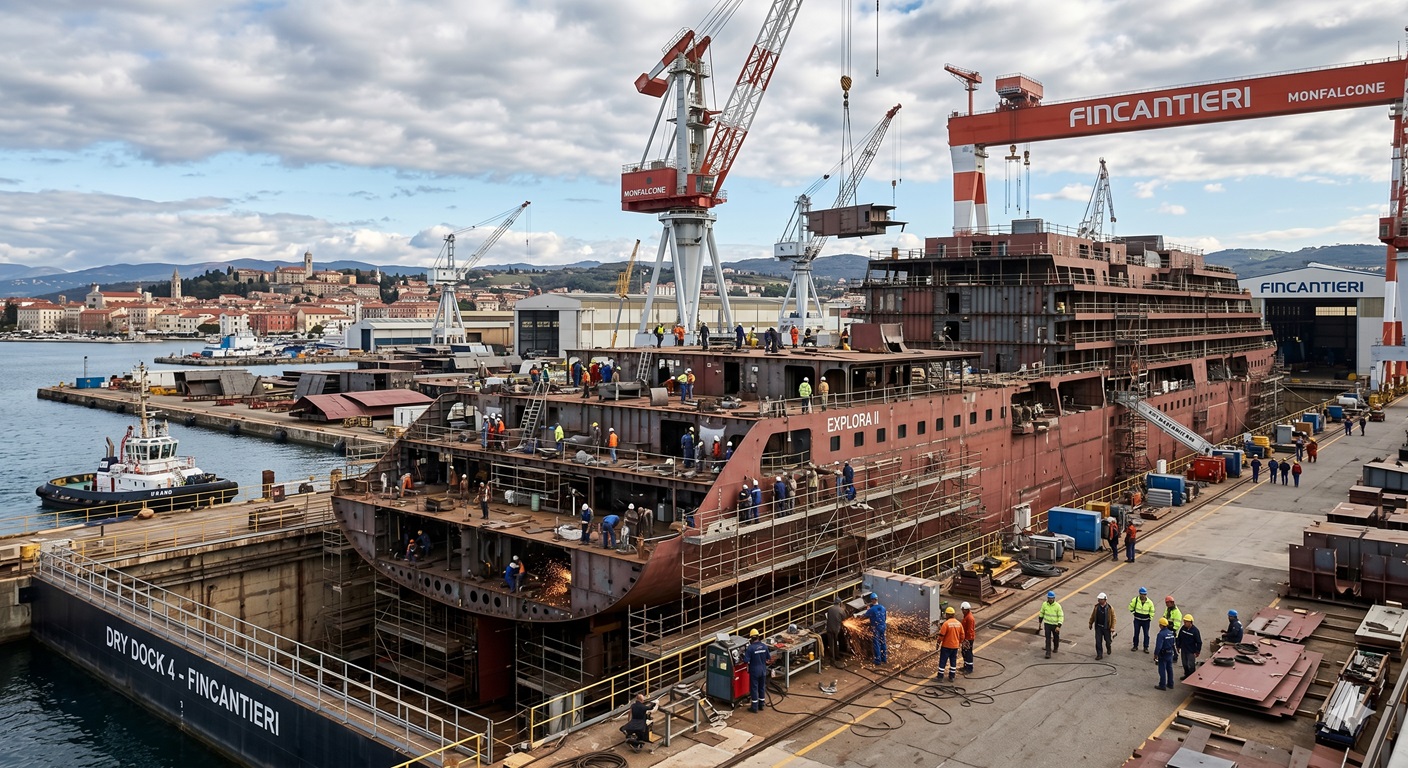
Europe’s leading cruise-ship builders include Fincantieri in Italy, Meyer Werft in Germany, Meyer Turku in Finland, and Chantiers de l’Atlantique in France.
Cruise ship construction is important because it supports not only shipyards but also interior suppliers, furniture makers, galley-equipment manufacturers, lighting companies, entertainment-system specialists, software suppliers, classification societies, and port infrastructure designers.
Ferries, Ro-Ro and RoPax Ships
Europe has a strong need for ferries because of its geography: the Baltic Sea, North Sea, Mediterranean, Adriatic, Aegean, English Channel, Irish Sea, Norwegian fjords, and island communities all require regular passenger and cargo connections.
European yards build passenger ferries, Ro-Ro cargo ferries, RoPax vessels carrying passengers, cars, and freight, high-speed ferries, hybrid-electric island ferries, and LNG, methanol-ready, or battery-assisted ferries.
This sector is especially important in Norway, Finland, Denmark, Spain, Italy, the Netherlands, Poland, Croatia, Greece, and the UK. Norway has been particularly influential in electric and hybrid ferry development, supported by demanding domestic routes and strong maritime technology suppliers.
Naval Ships and Submarines
Naval shipbuilding is one of Europe’s most strategic industrial sectors. It supports national defence, NATO commitments, maritime surveillance, underwater warfare, border protection, and protection of offshore infrastructure.
European naval shipbuilding includes frigates, corvettes, offshore patrol vessels, submarines, mine countermeasure vessels, amphibious vessels, logistic support ships, aircraft carriers and helicopter carriers, naval auxiliaries, and unmanned surface and underwater systems.
Important European naval builders include BAE Systems in the UK, Naval Group in France, Fincantieri in Italy, Navantia in Spain, thyssenkrupp Marine Systems/TKMS in Germany, Damen Naval in the Netherlands, Saab Kockums in Sweden, and several specialist yards in Poland, Finland, and Greece.
Offshore Wind and Energy Vessels
Europe’s offshore wind expansion has created strong demand for specialised vessels and floating infrastructure. Shipyards and marine fabricators are involved in service operation vessels, crew transfer vessels, cable-laying vessels, offshore construction vessels, jack-up installation vessels, floating wind foundations, offshore substations, and support vessels for wind-farm maintenance.
This is one of the most important growth areas for European shipbuilding because offshore wind requires maritime engineering, heavy steel fabrication, marine logistics, corrosion protection, dynamic positioning, cable handling, and port-based assembly.
Fishing Vessels and Aquaculture Support Vessels
Fishing vessels remain an important part of European shipbuilding, especially in Norway, Denmark, Iceland, Spain, France, the Netherlands, Poland, Croatia, and parts of the UK and Ireland.
Modern fishing vessels are increasingly advanced. They may include efficient hull forms, fish-processing factories, refrigerated seawater systems, hybrid propulsion, selective fishing gear, automation and digital catch handling, crew welfare improvements, and low-emission engines.
Europe also builds aquaculture vessels, fish-farm service vessels, live-fish carriers, feed barges, and wellboats. These are particularly important in Norway, Scotland, Iceland, and the Faroe Islands.
Dredgers, Tugs, Workboats and Harbour Craft
Europe has a strong tradition in dredging and port-support vessels. The Netherlands and Belgium are especially important because of companies active in dredging, land reclamation, offshore construction, and marine infrastructure.
European yards build cutter suction dredgers, trailing suction hopper dredgers, harbour tugs, escort tugs, pilot boats, mooring boats, multipurpose workboats, buoy-laying vessels, survey craft, and firefighting boats.
Research, Oceanographic and Survey Vessels
European yards build high-specification vessels for universities, governments, hydrographic offices, marine research institutes, and offshore survey companies.
These ships may include oceanographic laboratories, dynamic positioning, acoustic quieting, sonar and seabed-mapping systems, ROV and AUV handling systems, ice-class capability, scientific winches and cranes, and environmental monitoring systems.
Research vessels are not usually produced in high volume, but they are valuable because they require complex integration and strong engineering.
Inland Waterway Vessels
Europe’s inland waterways are commercially important, especially on the Rhine, Danube, Seine, Elbe, Scheldt, and Dutch-Belgian canal networks.
European yards build and maintain inland cargo barges, river cruise vessels, push boats, tank barges, container barges, ferries, inland passenger vessels, and hybrid and electric urban water transport craft.
Luxury Yachts and Superyachts
Europe dominates the global market for large luxury yachts and superyachts. The leading countries include the Netherlands, Germany, Italy, the UK, Spain, France, and Turkey, although many Turkish yacht-building yards are outside the strict European geographical scope used in this article.
European yacht construction is known for craftsmanship, custom interiors, advanced propulsion, silent operation, high-end materials, hybrid power systems, and complex owner-specific design.
Notable yacht-building names include Feadship, Oceanco, Lürssen, Abeking & Rasmussen, Heesen, Royal Huisman, Benetti, Sanlorenzo, Ferretti Group, and Sunseeker.
Cargo Ships and Specialised Merchant Vessels
Europe builds fewer standard bulk carriers, tankers, and container ships than Asia. However, European yards still build specialised merchant vessels such as short-sea cargo vessels, general cargo ships, multipurpose vessels, chemical tankers, small LNG or bunker vessels, cement carriers, heavy-lift vessels, ice-class cargo vessels, low-emission coastal cargo ships, and specialised project-cargo vessels.
The European competitive advantage here is usually not in standard large bulk carriers or ultra-large container ships, but in specialised design, small-series production, environmental performance, and owner-specific technical requirements.
–
Major Shipbuilding Regions in Europe
Italy
Italy is one of Europe’s strongest shipbuilding nations. Its leading company, Fincantieri, is one of the world’s largest shipbuilding groups and is active in high-complexity marine-industry sectors.
Italian shipbuilding strengths include cruise ships, naval vessels, ferries, offshore vessels, mega-yachts, repair and conversion, and marine equipment and systems.
Fincantieri has major yards at Monfalcone, Marghera, Sestri Ponente, Ancona, Castellammare di Stabia, Palermo, Muggiano, and Riva Trigoso. Italy also has a strong yacht-building sector, including Benetti, Sanlorenzo, Ferretti Group, Baglietto, Perini Navi, and many specialised suppliers.
Italy’s shipbuilding future is strongly linked to cruise demand, naval modernisation, underwater technologies, offshore vessels, and decarbonised ship systems.
France
France has two major pillars: complex passenger/offshore construction and naval shipbuilding.
Chantiers de l’Atlantique in Saint-Nazaire is one of Europe’s most important builders of large cruise ships and offshore wind substations. Its industrial history includes famous ocean liners and some of the world’s largest cruise ships.
France’s naval sector is led by Naval Group, which is central to submarines, surface combatants, naval systems, and advanced defence technologies. France also has a strong repair and marine services base in Atlantic and Mediterranean ports.
Key French strengths include cruise ships, naval vessels, submarines, offshore wind substations, marine renewable energy structures, repair and lifecycle support, and specialist vessels.
Germany
Germany has a long and technically advanced shipbuilding tradition. Its strengths include cruise ships, naval vessels, submarines, yachts, research vessels, ferries, specialist commercial ships, and marine equipment manufacturing.
Meyer Werft in Papenburg is one of the world’s best-known cruise shipyards. Meyer Neptun and Meyer Turku connect German expertise with a wider European cruise-shipbuilding network. TKMS is central to German submarine and naval shipbuilding. Germany also has globally recognised yacht builders such as Lürssen and Abeking & Rasmussen.
German shipbuilding is strategically important because of its naval export capability, high-quality engineering, and strong supply chain in propulsion, automation, electronics, and specialist equipment.
Finland
Finland is highly important for cruise ships, icebreakers, ice-class vessels, ferries, naval vessels, and Arctic and Baltic maritime technology.
Meyer Turku is one of Europe’s key cruise-ship builders. Finland also has strong expertise in ice-class design, winter navigation, icebreaker technology, and cold-climate maritime operations. This gives Finland a distinctive role in European shipbuilding, especially as Arctic and Baltic operations require robust vessel designs.
Netherlands
The Netherlands is one of Europe’s most diverse maritime-industrial countries. Dutch strengths include dredgers, tugs, workboats, offshore vessels, inland vessels, naval vessels, superyachts, repair and conversion, and maritime design and engineering.
Damen Shipyards Group is a major Dutch and international shipbuilding group, active across vessel construction, services, and ship repair. Dutch yards are also highly influential in yacht building, dredging technology, and inland waterway craft.
The Netherlands is particularly strong because it combines shipbuilding with a dense maritime cluster: ports, offshore engineering, dredging contractors, naval architects, classification services, equipment manufacturers, and research institutions.
Spain
Spain has a strong shipbuilding and repair base, with major activity in Galicia, Asturias, the Basque Country, Andalusia, Murcia, and the Canary Islands.
Navantia is Spain’s central naval shipbuilding group. It builds and repairs frigates, aircraft carriers, submarines, and patrol vessels and is also active in offshore wind and green-energy structures through Navantia Seanergies.
Spanish strengths include naval vessels, submarines, offshore wind foundations and substations, ferries, fishing vessels, research vessels, repair and conversion, and offshore support vessels.
Spain is also important for ship repair because of its Atlantic and Mediterranean locations and its proximity to major shipping routes.
United Kingdom
The United Kingdom remains a major European shipbuilding country, especially in naval construction, submarines, support vessels, ferries, and repair.
Key UK strengths include naval frigates and destroyers, nuclear submarines, aircraft carriers and naval support vessels, patrol vessels, offshore support and wind-service vessels, ferries and workboats, repair and conversion, and marine equipment and design.
BAE Systems, Babcock, Harland & Wolff, Cammell Laird, Ferguson Marine, and other yards contribute to the UK’s shipbuilding and marine engineering base. The Type 26 frigate programme is particularly important for the UK’s naval export profile.
Norway
Norway is a European leader in specialised, high-technology vessel design and construction. Its shipbuilding sector is closely linked to offshore oil and gas, offshore wind, aquaculture, ferries, fishing, and polar operations.
Norwegian strengths include offshore support vessels, service operation vessels, electric and hybrid ferries, fishing vessels, aquaculture vessels, ice-class and polar vessels, research vessels, and advanced vessel design.
Norway is especially influential in zero-emission and low-emission vessels, including battery-electric ferries, hybrid propulsion, hydrogen demonstration projects, and highly automated ship systems.
Denmark
Denmark has a strong maritime cluster, although its role in large-scale newbuilding is more limited than in the past.
It remains important in ship design, marine equipment, ferry and workboat construction, repair and conversion, offshore wind support, green maritime technologies, ship management, and maritime services.
Denmark’s strategic value lies in its integration of shipping, ports, equipment suppliers, naval architecture, offshore wind, and decarbonisation policy.
Poland
Poland has a significant shipbuilding and repair industry, especially around Gdańsk, Gdynia, Szczecin, and other Baltic locations.
Polish strengths include ship repair, offshore structures, ferries, fishing vessels, naval vessels, hull construction, steel fabrication, and offshore wind components.
Polish yards are increasingly important in European supply chains, including subcontracting, hull blocks, offshore structures, and repair.
Croatia
Croatia has a long Adriatic shipbuilding tradition. Its yards have built tankers, ferries, passenger ships, naval craft, dredgers, and specialised commercial vessels.
Croatian shipbuilding has faced restructuring pressures, but the country retains valuable shipyard infrastructure, skilled labour, and Adriatic repair capacity.
Main areas include ferries, small passenger ships, specialised vessels, repair and conversion, naval and coast guard craft, and offshore and steel structures.
Greece
Greece is one of the world’s leading shipowning nations, but its domestic shipbuilding industry is smaller than its shipping fleet would suggest.
Greek yards are important mainly for ship repair, naval repair, ferry maintenance, conversion, regional shipbuilding, and coast guard and patrol craft.
Greek shipyards are strategically located in the Eastern Mediterranean, close to major shipping lanes, ferry routes, naval operations, and tanker traffic.
Portugal
Portugal has important ship repair and niche shipbuilding capabilities, especially around Lisbon, Setúbal, Viana do Castelo, and other Atlantic locations.
Portuguese strengths include repair and conversion, patrol vessels, fishing vessels, small passenger vessels, offshore support, river cruise vessels, and naval support craft.
Portugal’s Atlantic position gives it strategic value for ships trading between Northern Europe, the Mediterranean, West Africa, and the Americas.
Romania and Bulgaria
Romania and Bulgaria are important for European shipbuilding supply chains, hull construction, river vessels, repair, and Black Sea maritime infrastructure.
Romania has significant shipbuilding capacity on the Danube and Black Sea, including yards historically active in cargo vessels, offshore vessels, naval vessels, hull blocks, and river ships. Bulgaria also has shipbuilding and repair capability along the Black Sea and Danube.
These countries are important because they offer steel fabrication, hull construction, river and sea-going vessels, repair and conversion, lower-cost industrial capacity within or near the EU market, and access to Danube and Black Sea trade.
Turkey: European Part Only
Turkey is a major shipbuilding and repair country, but most of its leading shipyards are located around Tuzla, Yalova, and Altınova, which are mainly on the Asian side of the Marmara region or outside the strict European geographical scope.
For this article’s defined scope, only the European-side maritime-industrial relevance of Turkey, especially the European side of Istanbul and Thrace-related maritime services, should be included.
However, it is important to recognise that Turkey’s broader shipbuilding industry is highly active in small and medium specialised vessels, fishing vessels, ferries, offshore vessels, tugboats, repair, conversion, and naval craft. Any full treatment of “Turkey as a shipbuilding country” would need to include the Asian-side yards, but that is outside the present geographical boundary.
–
Leading European Shipyards and Groups
The following table summarises selected leading European shipbuilding groups. It is not exhaustive, but it covers many of the most influential names.
| Shipyard / Group | Country | Main Specialisation |
|---|---|---|
| Fincantieri | Italy | Cruise ships, naval vessels, offshore, specialised vessels, mega-yachts |
| Chantiers de l’Atlantique | France | Cruise ships, naval support, offshore wind substations |
| Meyer Werft | Germany | Cruise ships |
| Meyer Turku | Finland | Cruise ships and passenger vessels |
| Naval Group | France | Naval vessels, submarines, combat systems |
| BAE Systems Maritime | UK | Frigates, submarines, naval systems |
| Navantia | Spain | Frigates, submarines, patrol vessels, offshore wind structures |
| TKMS | Germany | Submarines, naval surface vessels, naval systems |
| Damen Shipyards | Netherlands | Tugs, workboats, naval vessels, ferries, dredgers, repair |
| Saab Kockums | Sweden | Submarines, naval vessels |
| Royal IHC | Netherlands | Dredging and offshore vessels/equipment |
| Lürssen | Germany | Naval vessels and superyachts |
| Feadship | Netherlands | Superyachts |
| Oceanco | Netherlands | Superyachts |
| Benetti | Italy | Superyachts |
| Sanlorenzo | Italy | Yachts and superyachts |
| Vard | Norway/Italy group link | Offshore, specialised vessels, expedition cruise, fisheries/aquaculture |
| Remontowa | Poland | Repair, conversion, ferries, offshore and specialised vessels |
| Astilleros Gondán | Spain | Offshore, fishing, service vessels |
| Freire Shipyard | Spain | Research, offshore, fishing, specialised vessels |
| Harland & Wolff | UK | Repair, fabrication, naval/offshore support |
| Cammell Laird | UK | Repair, conversion, naval and ferry work |
–
Ship Repair and Conversion in Europe
Shipbuilding should not be understood only as new construction. In Europe, repair and conversion are equally important. Many yards survive and grow through lifecycle services rather than only newbuilding contracts.
Typical repair and conversion activities include dry-docking, hull cleaning and coating, propeller and rudder repair, main engine overhaul, auxiliary engine overhaul, shaft-line work, steel renewal, ballast tank treatment, scrubber installation, ballast water treatment system installation, shore-power connection upgrades, battery retrofit, LNG or methanol-readiness conversion, accommodation renewal, class survey support, damage repair, offshore vessel conversion, and ferry modernisation.
Repair demand is driven by class rules, port state control, environmental regulations, fuel efficiency requirements, ageing fleets, and insurance standards. European repair yards are especially important in locations such as Spain, Portugal, Greece, Poland, Denmark, Germany, the Netherlands, France, Italy, Malta, Croatia, and the UK.
Shipbuilding Supply Chain: The Hidden Strength of Europe
Europe’s shipbuilding power is not only in the yards. Much of its strength lies in the supplier network.
European marine suppliers produce main engines and auxiliary engines, propulsion systems, azimuth thrusters, gearboxes, shaft generators, batteries and hybrid systems, electrical distribution systems, automation and power-management systems, dynamic positioning systems, navigation and bridge systems, radar and communication systems, HVAC and hotel systems, fire safety systems, lifeboats and lifesaving appliances, ballast water treatment systems, exhaust gas cleaning systems, cranes, winches, deck machinery, pumps, valves, compressors, piping systems, coatings, corrosion protection, digital twins, and vessel performance platforms.
This supply chain explains why European shipbuilding remains globally influential even when Europe builds fewer standard commercial ships than Asia. European companies often supply critical equipment to ships built worldwide.
Decarbonisation and Green Shipbuilding
The future of European shipbuilding is inseparable from maritime decarbonisation. Shipowners face increasing pressure from IMO rules, EU climate policy, charterer expectations, fuel costs, carbon pricing, and port environmental requirements.
European yards and designers are working on LNG-fuelled vessels, methanol-ready ships, ammonia-ready concepts, hydrogen fuel-cell vessels, battery-electric ferries, hybrid propulsion, wind-assisted propulsion, shore-power-ready vessels, waste-heat recovery, air lubrication systems, hull-form optimisation, digital energy management, carbon capture-ready concepts, lightweight materials, and advanced coatings.
The challenge is that alternative-fuel ships require more than simply replacing the main engine. They need new tank arrangements, safety zones, ventilation, fire detection, crew training, bunkering procedures, class approval, port compatibility, and lifecycle risk assessment.
Europe is well positioned in this transition because of its strong classification societies, marine technology suppliers, research institutions, and environmental policy framework. However, the transition also increases cost and complexity.
Digitalisation and Smart Shipyards
Modern European shipyards are becoming digital production environments. The concept of the “smart shipyard” includes 3D ship design, digital twins, product lifecycle management, robotics and automated welding, laser scanning, modular construction, block production optimisation, digital quality control, augmented reality for assembly, predictive maintenance planning, supply-chain traceability, cybersecure ship systems, and integrated logistics planning.
Digitalisation is essential because complex ships involve millions of parts and thousands of interfaces. A cruise ship, naval vessel, or offshore service vessel cannot be efficiently built using traditional paper-based coordination.
Smart shipyards also support after-sales service. The same digital model used in construction can support maintenance, spare parts, class surveys, energy optimisation, and future retrofits.
Naval Demand and Strategic Autonomy
One of the strongest forces shaping European shipbuilding today is the return of defence and maritime security to the industrial agenda.
Europe needs naval capacity for NATO deterrence, Baltic and North Sea security, Mediterranean security, protection of undersea cables and pipelines, submarine detection, mine countermeasures, Arctic and North Atlantic operations, border and coast guard missions, maritime domain awareness, and protection of offshore energy infrastructure.
This demand supports frigate, submarine, patrol vessel, minehunter, auxiliary ship, and unmanned-system programmes. It also strengthens the case for keeping shipbuilding capacity inside Europe, because naval shipbuilding cannot be treated as a normal commercial import market.
–
Challenges Facing European Shipyards
Despite their strengths, European shipyards face serious challenges.
Competition from Asia
China, South Korea, and Japan dominate global merchant shipbuilding by tonnage. Their yards benefit from scale, large domestic industrial ecosystems, government support, and standardised production of tankers, bulk carriers, LNG carriers, and container ships.
Europe cannot easily compete in low-margin mass production. Its survival depends on remaining strong in high-complexity vessels, repair, conversion, naval construction, offshore energy, and advanced marine systems.
Labour Shortages
Many European shipyards face shortages of welders, pipefitters, electricians, naval architects, marine engineers, project managers, production planners, automation specialists, coating specialists, and outfitting workers.
The age profile of the workforce is a concern in many countries. Training, apprenticeships, vocational education, and maritime engineering degrees are critical.
Cost Pressure
European yards face high labour costs, energy costs, material costs, and regulatory costs. This makes productivity, automation, modular construction, and supply-chain coordination essential.
Dependence on Cruise Orders
Some European yards depend heavily on cruise ships. Cruise construction is profitable and technologically important, but it can be cyclical. The COVID-19 crisis showed the vulnerability of relying too much on one segment.
A more balanced portfolio across cruise, naval, offshore wind, ferries, repair, and green retrofits is safer.
Regulatory Complexity
Green ships require compliance with class rules, flag-state requirements, IMO regulations, EU rules, port regulations, fuel-safety codes, cyber requirements, and environmental standards.
This creates opportunities for advanced yards but also raises cost and project risk.
Financing
Ships are capital-intensive assets. Newbuilding contracts require strong financing, refund guarantees, export credit support, insurance, and long payment schedules.
European yards often compete against foreign yards supported by strong state-backed finance.
–
Opportunities for European Shipbuilding
Despite these challenges, Europe has major opportunities.
Green Fleet Renewal
The global fleet must decarbonise. This creates demand for new low-emission ships, alternative-fuel conversions, energy-saving retrofits, wind-assisted propulsion, shore-power systems, and carbon-intensity reduction technologies.
European yards can capture value in engineering, integration, retrofit, and specialised newbuilding.
Offshore Wind Expansion
Offshore wind requires vessels, substations, foundations, floating platforms, cable systems, and maintenance infrastructure. This is one of Europe’s strongest industrial opportunities.
Naval Reinvestment
European defence spending is increasing. Frigates, submarines, patrol vessels, mine countermeasure systems, naval auxiliaries, and unmanned systems will support shipyards for decades.
Arctic and Ice-Class Shipping
Finland, Norway, Sweden, Denmark, and other northern European countries have strong expertise in ice-class and polar vessels.
Climate change, Arctic research, and northern logistics may increase demand for such specialised designs.
Short-Sea Shipping and Inland Waterways
Europe wants to reduce road congestion and emissions. Short-sea shipping and inland waterways can support greener logistics, requiring new vessels, retrofits, and port integration.
Autonomous and Remotely Operated Vessels
Europe is active in autonomous ferries, unmanned naval systems, survey drones, remotely operated offshore craft, and smart navigation systems. These technologies may reshape small and medium vessel markets.
–
The Future of European Shipyards
The future European shipyard will not simply be a place where steel is cut and welded. It will be an integrated maritime technology centre.
Future shipyards will need to combine naval architecture, mechanical engineering, electrical engineering, software integration, cybersecurity, alternative-fuel safety, automation, robotics, lifecycle services, environmental compliance, finance, and risk management.
The most successful European yards will likely be those that can offer complete solutions, not just hulls. A port, ferry operator, navy, cruise company, or offshore wind developer increasingly wants a vessel that is efficient, compliant, digitally supported, and upgradeable throughout its life.
Conclusion
Shipbuilding in Europe remains one of the continent’s most strategically important industrial sectors. Europe may not dominate the global production of standard bulk carriers, tankers, or container ships, but it remains a world leader in complex, specialised, high-value vessels.
Its strongest areas include cruise ships, ferries, naval vessels, submarines, offshore wind vessels and structures, dredgers, tugs, yachts, research vessels, fishing vessels, aquaculture vessels, inland waterway ships, repair, conversion, and green retrofitting.
The sector’s future will depend on its ability to respond to five major forces: decarbonisation, digitalisation, naval security, offshore energy expansion, and workforce renewal. If European shipyards can maintain engineering excellence while improving productivity and attracting skilled workers, they will remain essential not only to Europe’s maritime economy but also to its industrial sovereignty, energy transition, and security.