
China, South Korea, Japan, Türkiye, Russia, Iran, and the Wider Asian Shipbuilding Map
A comprehensive overview of shipbuilding and shipyards in Asia, covering China, South Korea, Japan, Türkiye, Asian Russia, India, Iran, Vietnam, Singapore, the Persian Gulf, universities, naval architecture, green ships, LNG carriers, and future trends.
Introduction: Asia Builds the Ships That Move the World
Most people see shipping when a vessel arrives in port: a container ship under giant cranes, a tanker at an oil terminal, a ferry loading passengers, or an LNG carrier moving slowly toward a gas berth. But the real story begins years earlier, inside a shipyard.
The world’s ships are increasingly designed, assembled, launched, and delivered from Asia. China, South Korea, and Japan remain the three dominant shipbuilding powers, but the Asian shipbuilding map is wider than this famous triangle. It also includes Türkiye, whose shipyards around Tuzla, Yalova, and the Marmara region are important for specialised vessels, naval platforms, ferries, tugs, offshore vessels, repair, and yachts. It includes Asian Russia, especially the Far East and Arctic-facing industrial programmes such as Zvezda. It includes India, with major naval and commercial ambitions; Iran, with shipbuilding and offshore industrial capacity in the Persian Gulf and Caspian Sea; and Southeast Asian countries such as Vietnam, Singapore, Indonesia, Malaysia, and the Philippines.
In 2026, shipbuilding is not only an industrial activity. It is a strategic sector connected to global trade, energy security, naval power, climate regulation, alternative fuels, offshore wind, national employment, and technological sovereignty. A country that can build and repair ships has more control over its maritime future. A country that cannot may depend on foreign yards for commercial vessels, naval auxiliaries, offshore units, ferries, and energy-related marine assets.
China now leads global shipbuilding by scale. South Korea remains exceptionally strong in high-value and technically complex ships, especially LNG carriers. Japan continues to offer quality, advanced engineering, marine equipment, and energy-saving technologies. Türkiye has become a flexible builder of specialised commercial, naval, repair, and yacht projects. Russia retains shipbuilding capacity linked to naval construction, Arctic transport, ice-class vessels, and energy logistics, although sanctions and technology restrictions have reshaped its options. Iran has a smaller but strategically important shipbuilding and offshore industrial base, especially in the Persian Gulf, where ship repair, offshore structures, and regional vessel construction are closely connected to energy and national maritime needs.
This article explains the Asian shipbuilding landscape from an industrial, educational, strategic, and technological perspective. It covers the major countries, emerging players, ship types, universities, workforce pipelines, green shipbuilding, digital shipyards, and future challenges.
1. What Is Shipbuilding?
Shipbuilding is the process of designing, constructing, outfitting, testing, and delivering ships and offshore marine structures. It includes commercial vessels, naval ships, offshore platforms, ferries, fishing vessels, research ships, patrol vessels, tugboats, yachts, and specialised floating units.
A modern shipyard is not simply a large waterfront workshop. It is a complex industrial system combining:
- Naval architecture
- Marine engineering
- Steel processing
- Welding and block assembly
- Pipe and cable installation
- Machinery and propulsion integration
- Electrical and automation systems
- Coating and corrosion protection
- Docking, launching, and sea trials
- Classification society surveys
- Project finance and contract management
- Safety, labour, and environmental compliance
A large LNG carrier, container ship, naval frigate, or offshore support vessel can involve thousands of workers, hundreds of suppliers, classification societies, flag-state authorities, engine manufacturers, automation companies, marine universities, and owner’s site teams.
This is why shipbuilding is one of the most demanding industrial sectors. A ship is not a product that can be mass-produced like a car. It is closer to a floating industrial plant, built under strict technical, safety, environmental, and commercial constraints.
2. Why Asia Dominates Shipbuilding
Asia dominates shipbuilding because several conditions came together over decades.
First, major Asian economies created strong industrial ecosystems. Shipbuilding needs steel, machinery, engines, electronics, port infrastructure, logistics, design offices, skilled labour, and export finance. China, South Korea, and Japan developed these ecosystems at national scale.
Second, shipbuilding was treated as a strategic industry. Governments understood that shipyards support trade, navy building, energy imports, industrial employment, technology, and national resilience. Therefore, shipbuilding became linked to industrial policy, financing, research programmes, and export strategy.
Third, Asian shipyards achieved scale. Once a country builds many ships, it gains experience, supplier depth, standardised production methods, and cost advantages. Large orderbooks make yards more efficient, and efficient yards attract more orders.
Fourth, much of Europe and North America moved away from large-scale commercial shipbuilding because of high labour costs, reduced industrial capacity, and stronger Asian competition. Europe retained strengths in cruise ships, naval vessels, marine equipment, and specialised high-value niches, but large merchant shipbuilding shifted decisively eastward.
Fifth, Asia adapted to changing markets. Asian yards moved from conventional ships into LNG carriers, dual-fuel ships, offshore units, car carriers, battery-hybrid ferries, methanol-ready container ships, ammonia-ready concepts, naval vessels, and digital shipyard systems.
Clarksons Research projected that in 2025, regional shipbuilding output would be led by China with about 53%, followed by South Korea with 27%, Japan with 14%, Europe with 4%, and the United States with only 0.1%. It also reported a global newbuilding orderbook of 164.4 million compensated gross tons, worth more than $511 billion.
3. The Core Asian Shipbuilding Triangle: China, South Korea, and Japan
The centre of world shipbuilding remains the triangle of China, South Korea, and Japan.
China is the largest builder by scale and increasingly by technological ambition. South Korea is the high-value specialist, especially in LNG carriers and complex vessels. Japan is the quality-and-engineering specialist, with strong marine equipment integration and green technology development.
These three countries compete, but they do not compete in exactly the same way.
| Country | Main shipbuilding identity | Key strengths |
|---|---|---|
| China | Scale leader and fast-upgrading industrial giant | Bulk carriers, tankers, container ships, car carriers, offshore vessels, growing LNG capability |
| South Korea | High-value and complex-vessel specialist | LNG carriers, ultra-large container ships, gas carriers, offshore units, naval vessels |
| Japan | Quality, reliability, marine equipment, green engineering | Bulkers, tankers, energy-saving designs, marine engines, methanol/LNG/hybrid concepts |
This triangle remains the backbone of global commercial shipbuilding. However, the wider Asian map now matters more than before because shipbuilding is becoming geopolitically sensitive, technologically diversified, and regionally specialised.
4. China: The Scale Leader of Global Shipbuilding
China is now the world’s largest shipbuilding country. Its rise has changed global maritime economics. Chinese yards are no longer associated only with standard bulk carriers or lower-cost vessels. They now build large container ships, tankers, car carriers, offshore vessels, dredgers, ferries, naval vessels, LNG-related tonnage, and alternative-fuel-capable ships.
Chinese official data reported that in 2025 Chinese shipyards completed 53.69 million deadweight tons, representing 56.1% of the global market by tonnage. New orders reached 107.82 million deadweight tons, equivalent to 69% of the global market, while the backlog reached 274.42 million deadweight tons, or 66.8% of the global total.
China’s strengths include:
- Large production capacity
- Competitive pricing
- Broad vessel-type coverage
- Strong state industrial coordination
- Large domestic steel and manufacturing supply chains
- Growing green-vessel capability
- Expanding naval and offshore capacity
China is especially powerful because it can serve many vessel categories simultaneously. A shipowner seeking a bulk carrier, tanker, container ship, car carrier, or standard offshore vessel may find Chinese yards highly competitive on price and delivery availability.
However, China’s rise also creates concerns. Some shipowners remain cautious about quality consistency in very high-end ships such as LNG carriers. There are also geopolitical issues. A Reuters report in January 2025 noted that a U.S. investigation concluded China used unfair practices to dominate shipbuilding, maritime, and logistics sectors.
From a neutral maritime-industrial perspective, the important point is this: China has moved from being a low-cost shipbuilding competitor to a strategic shipbuilding superpower. Its future role will not be limited to volume. It will increasingly challenge Korea and Japan in advanced vessels, green ships, and high-value maritime technology.
5. South Korea: The High-Value Shipbuilding Specialist
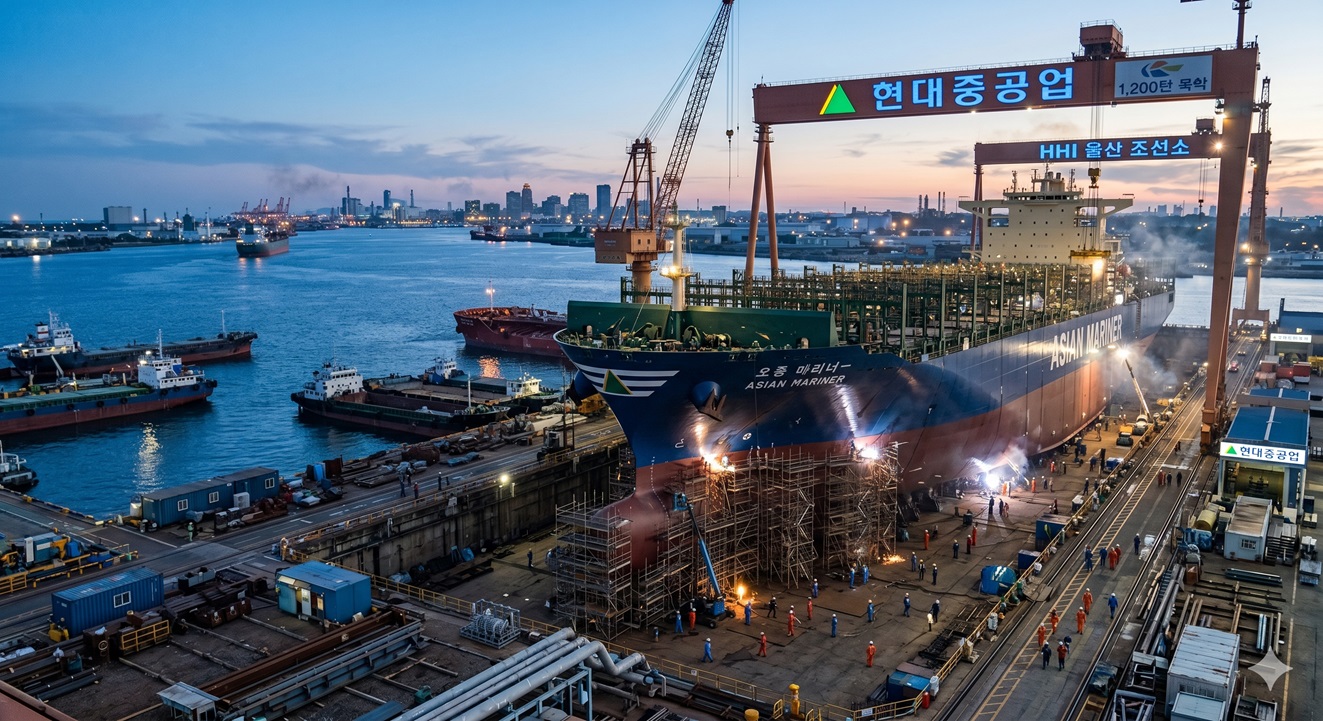
South Korea is the world’s second major shipbuilding power and one of the most advanced builders of complex commercial vessels. Its leading groups include HD Hyundai Heavy Industries, Samsung Heavy Industries, and Hanwha Ocean.
OECD describes South Korea as the world’s second-largest shipbuilding nation and notes its strong position in high-value vessel segments such as LNG carriers and ultra-large container ships. Korea accounted for approximately 27% of global ship completions in 2024, measured in compensated gross tonnage.
South Korea’s strongest segment is LNG carriers. LNG ships require cryogenic containment systems, boil-off gas management, dual-fuel propulsion, advanced automation, and extremely high construction quality. Korean shipyards have developed deep expertise in this field and remain trusted by global energy companies and shipowners.
Korean strengths include:
- LNG carrier leadership
- Strong project execution
- Advanced engineering
- High-quality block construction
- Sophisticated offshore and gas-carrier experience
- Strong relationships with global owners
- Growing naval and defence export capability
But Korea also faces challenges. OECD reports that the Korean shipbuilding workforce declined by about 44% between 2014 and 2024, while the share of skilled workers fell to 28% of total employment in 2023. Major yards have increasingly hired foreign workers, who represent roughly 15% of the workforce.
This labour issue is serious because advanced shipbuilding cannot be maintained by capital investment alone. It needs skilled welders, pipefitters, electricians, naval architects, production planners, automation specialists, and quality inspectors.
Korea is also expanding internationally. Reuters reported that Hanwha Ocean has targeted U.S. Navy-related work and acquired a Philadelphia shipyard, while HD Hyundai Heavy Industries and Huntington Ingalls signed an agreement to cooperate on U.S. Navy auxiliary ships.
This shows that Korean shipbuilding is entering a new phase: not only building ships in Korea, but exporting shipbuilding expertise, management systems, and naval-industrial cooperation.
6. Japan: Quality, Reliability, and Marine Engineering Depth
Japan was once the world’s leading shipbuilding country. Today it no longer dominates by volume, but it remains one of the most respected shipbuilding nations.
OECD describes Japan as the world’s third-largest shipbuilding nation, with a focus on high-value-added and eco-friendly vessels. It notes Japan’s strengths in LNG-fuelled, methanol-ready, and hybrid-propulsion ships, supported by high engineering capacity and rigorous quality standards.
Japan’s shipbuilding strengths include:
- High-quality construction
- Reliable delivery
- Strong marine equipment industry
- Energy-saving technologies
- Advanced propulsion systems
- Long-term owner relationships
- Efficient ship designs
- Strong classification and engineering culture
Japan’s marine equipment industry is especially important. OECD notes that Japan has very high domestic integration in marine equipment, around 92%, and strengths in diesel engines, propulsion control systems, energy-saving devices, and related technologies.
Japan’s challenges are also clear. Its shipbuilding workforce is ageing, labour costs are high, and export demand has weakened compared with China and Korea. OECD reports that employment in Japanese shipbuilding fell from 85,000 in 2009 to 70,000 in 2023, while the share of workers under 30 declined to 19.5%.
Japan’s future will likely depend on quality, smart manufacturing, alternative fuels, autonomous ship systems, green technology, and high-value equipment rather than mass-volume competition.
7. Türkiye: The Transcontinental Shipbuilding Bridge Between Europe and Asia
Türkiye must be included in a broad overview of Asian shipbuilding because it is a transcontinental maritime country with a major shipbuilding cluster around Istanbul, Tuzla, Yalova, Kocaeli, the Marmara region, and other coastal zones. Although often discussed in European maritime contexts, Türkiye’s geography, Black Sea connection, eastern Mediterranean role, and Asian territory make it relevant to the wider Asian shipbuilding map.
The Turkish Shipbuilders’ Association, GISBIR, reports almost one hundred members and 85 active shipyards, representing the majority of the Turkish shipbuilding industry. OECD notes that Turkish shipbuilding grew substantially during the 2000s, supported by exports, local financing, and specialisation in relatively small oil and chemical tankers before later diversifying into other segments.
Türkiye’s shipbuilding strengths include:
- Small and medium commercial vessels
- Chemical and product tankers
- Ferries and ro-ro vessels
- Tugboats and workboats
- Offshore support vessels
- Repair and maintenance
- Naval and coast guard vessels
- Yachts and mega-yachts
- Flexible private shipyards
- Strategic location near the Black Sea, Mediterranean, and Persian Gulf trade routes
Turkish shipyards are especially competitive in specialised vessels that require flexibility rather than very large series production. They have also become increasingly visible in naval exports and defence cooperation. Recent reporting around IDEF 2025 highlighted several new Turkish naval platforms and agreements, showing the active role of Turkish yards in naval shipbuilding.
Türkiye also faces cost pressure, financing challenges, and strong competition from China, Korea, and other builders. Turkish shipbuilding exports declined in early 2025 according to industry reporting, reflecting the pressure of rising costs and global competition.
Still, Türkiye occupies an important niche: it is not a mass builder like China, but it is a highly relevant specialised shipbuilding, repair, naval, and yacht-building country.
8. Russia in Asia: Arctic, Far East, Naval, and Ice-Class Shipbuilding
Russia is also a transcontinental country and must be treated carefully in an Asian shipbuilding overview. Much of Russia’s population and industrial history is European, but its maritime geography extends deeply into Asia through the Arctic, Siberia, the Russian Far East, the Pacific coast, and energy projects linked to Asian trade.
Russian shipbuilding is closely connected to:
- Naval construction
- Ice-class vessels
- Arctic LNG and oil logistics
- Tankers
- Research vessels
- Repair yards
- River-sea vessels
- Far East industrial policy
- Arctic route development
One of the most important Russian shipbuilding projects is Zvezda Shipbuilding Complex in Bolshoy Kamen near Vladivostok. Reuters described Zvezda as Russia’s most advanced shipbuilding yard, focused on large Arc7 ice-class tankers capable of transporting LNG from Arctic projects through thick ice. Reuters also reported that Russia’s United Shipbuilding Corporation operates around 40 shipyards, design offices, and repair yards, employing about 95,000 staff.
Russia’s Asian shipbuilding relevance is therefore not based on high-volume commercial ship exports like China, Korea, or Japan. It is based on strategic geography: Arctic routes, ice-class tonnage, energy export logistics, naval infrastructure, and Far Eastern industrial development.
However, Russian shipbuilding faces major constraints. Sanctions have affected access to foreign technology, finance, ship systems, and cooperation. Reuters reported that Russia’s first ice-class LNG carrier built at Zvezda entered sea trials in late 2024, but the broader Arctic LNG 2 and tanker programme has faced sanctions-related disruptions. Reuters also reported in January 2025 that several Russian oil tankers still under construction at Zvezda were included in U.S. sanctions.
Russia’s role in Asian shipbuilding is therefore best understood as strategic and specialised, not globally dominant in commercial newbuilding.
9. Emerging Asian Shipbuilding Countries
Beyond China, South Korea, Japan, Türkiye, and Russia, several Asian countries are important or emerging shipbuilding players. Their role may be regional, specialised, strategic, or developing rather than dominant.
9.1 India
India has major shipbuilding ambitions. It has a large coastline, major ports, naval demand, a growing economy, offshore energy needs, and a strong engineering labour pool.
Important Indian yards include:
- Cochin Shipyard
- Mazagon Dock Shipbuilders
- Garden Reach Shipbuilders & Engineers
- Goa Shipyard
- Hindustan Shipyard
- Larsen & Toubro shipbuilding facilities
India is already significant in naval construction, patrol vessels, offshore vessels, ferries, repair, and specialised ships. Its future commercial potential is increasing. Reuters reported that CMA CGM signed a letter of intent with Cochin Shipyard to build six LNG-powered container vessels of 1,700 TEU each, with delivery expected between 2029 and 2031 and technical support from South Korea’s HD Hyundai Heavy Industries.
India’s opportunity lies in regional shipping, naval construction, repair, green small and medium vessels, offshore wind support vessels, and eventually larger commercial newbuildings. Its challenge is to match East Asian productivity, supplier depth, delivery reliability, and contract discipline.
9.2 Iran
Iran should be included in any wider Asian shipbuilding overview, especially because of its strategic maritime geography in the Persian Gulf, the Strait of Hormuz, the Gulf of Oman, and the Caspian Sea.
Iran’s shipbuilding and offshore industrial base is smaller than China, Korea, Japan, or Türkiye, but it is strategically important for domestic needs, offshore oil and gas, ship repair, and regional maritime autonomy.
Important Iranian maritime industrial actors include:
- Iran Shipbuilding & Offshore Industries Complex Co., known as ISOICO, near Bandar Abbas
- SADRA, historically associated with ship repair and offshore construction in Bushehr and the Caspian region
- Other repair, naval, offshore, and port-related industrial facilities
ISOICO is located near Bandar Abbas in the Persian Gulf and is active in shipbuilding, ship repair, and offshore structures. It has been associated with products such as container and product carriers, multipurpose cargo ships, ferries, FPSO/FSO-related work, pipe-laying and offshore units.
SADRA has been described as having started as a ship repair yard in Bushehr in the northwest Persian Gulf and later expanding into shipbuilding, repair, offshore oil and gas, petrochemical, and civil infrastructure work.
Iran’s shipbuilding strengths include:
- Persian Gulf ship repair
- Offshore oil and gas structures
- Regional vessel construction
- Ferries and cargo vessels
- Naval and patrol craft support
- Caspian Sea maritime industry
- Domestic industrial resilience under sanctions
Iran’s constraints include sanctions, limited access to some foreign technologies, financing barriers, equipment import restrictions, and difficulty integrating into global commercial shipbuilding markets. Nevertheless, its shipbuilding capacity remains significant for domestic maritime needs, offshore energy, the Persian Gulf, and national industrial policy.
9.3 Vietnam
Vietnam has a growing maritime industrial base. It benefits from competitive labour costs, a long coastline, proximity to major Asian trade lanes, and experience in smaller commercial vessels, offshore support craft, repair, and subcontracting.
Vietnam’s future may be strongest in:
- Feeder vessels
- Offshore support vessels
- Small and medium commercial ships
- Ship repair
- Wind support vessels
- Regional cargo ships
- Tugboats and workboats
To move into higher-value segments, Vietnam must continue improving design capability, quality assurance, supplier networks, classification familiarity, and skilled workforce training.
9.4 Singapore
Singapore is not a mass commercial shipbuilding country, but it is one of Asia’s most important maritime engineering and repair hubs. Its strengths include:
- Ship repair
- Offshore engineering
- FPSO conversion
- Marine technology
- Port services
- Green retrofits
- Digital maritime systems
- High-value marine services
Singapore’s shipyard ecosystem is closely connected to offshore energy, floating production units, conversion work, and retrofitting. As the existing fleet needs energy-saving devices, alternative-fuel preparation, digital monitoring, and emissions upgrades, Singapore’s repair and conversion role remains important.
9.5 Indonesia, Malaysia, and the Philippines
Indonesia, Malaysia, and the Philippines have large domestic maritime needs. They are archipelagic or semi-archipelagic countries where ferries, patrol vessels, fishing vessels, landing craft, tugs, barges, and domestic cargo ships are essential.
Their shipbuilding strengths are more regional than global, but they matter greatly for:
- Inter-island transport
- Coast guard and patrol vessels
- Fishing fleets
- Ferries
- Small tankers
- Tugboats
- Barges
- Repair and maintenance
- Offshore support vessels
The Philippines is also important in the global maritime labour market, even though its shipbuilding capacity has fluctuated. Indonesia’s vast domestic market gives it long-term potential, especially if government policy supports fleet renewal and local construction.
9.6 The Persian Gulf Shipbuilding and Repair Corridor
The Persian Gulf should be treated as a strategic maritime-industrial region, not simply as an oil export zone. Iran, the United Arab Emirates, Saudi Arabia, Qatar, Bahrain, Kuwait, and Oman all have interests in ship repair, offshore construction, naval support, port development, and energy-related marine services.
The region’s main shipbuilding and repair drivers include:
- Offshore oil and gas
- LNG and tanker operations
- Naval and coast guard vessels
- Port expansion
- Dredging and marine construction
- Ship repair for tankers and offshore vessels
- Regional ferries and workboats
- Energy transition infrastructure
The Persian Gulf is not yet a mass global newbuilding centre like East Asia, but it is highly important for repair, offshore structures, naval support, and energy logistics.
10. Types of Ships Built in Asian Shipyards
Asian shipyards build nearly every major ship type.
10.1 Bulk Carriers
China and Japan are especially important in bulk carrier construction. Bulk carriers remain essential for iron ore, coal, grain, bauxite, fertilizers, and cement. Modern bulkers focus on fuel efficiency, emissions compliance, hull optimisation, and cargo flexibility.
10.2 Tankers
China, Korea, Japan, Türkiye, Russia, India, and Iran all have tanker-related shipbuilding or repair relevance, although at very different scales. China has expanded strongly in tanker orders. Korea and Japan remain important for high-specification ships. Türkiye has experience in small and medium tankers. Russia’s tanker construction is linked to Arctic and energy logistics. Iran’s tanker and offshore repair capacity is linked to Persian Gulf operations.
10.3 LNG Carriers
South Korea remains the premier LNG carrier builder, while China is growing quickly and Russia is attempting ice-class LNG capacity for Arctic projects. Japan remains technically relevant in LNG-fuelled and gas-related technologies.
10.4 Container Ships
China and Korea dominate large container shipbuilding. Japan remains relevant in quality designs, while India’s emerging container vessel orders show potential for future regional construction.
10.5 Car Carriers
Car carrier demand has grown due to vehicle exports and electric vehicle trade. China has gained significant momentum in this segment.
10.6 Offshore Support and Energy Vessels
Asian yards build offshore support vessels, construction vessels, cable layers, wind turbine installation vessels, service operation vessels, drillship-related units, FPSO modules, and floating energy infrastructure. Singapore, Korea, China, Türkiye, India, Iran, and Vietnam all have roles in different parts of this market.
10.7 Ferries and Ro-Ro Ships
Ferries are important in Japan, Korea, China, Türkiye, Indonesia, the Philippines, India, and Iran. The future of ferry construction is increasingly linked to battery-hybrid, LNG, methanol, and shore-charging systems.
10.8 Naval and Coast Guard Vessels
Naval shipbuilding is expanding across Asia. China, South Korea, Japan, India, Türkiye, Russia, Iran, Indonesia, and other countries all maintain or develop naval construction capabilities. Naval shipbuilding is different from commercial shipbuilding because it involves weapons, sensors, survivability, secure supply chains, and national defence strategy.
11. Universities, Naval Architecture, Marine Engineering, and the Shipyard Talent Pipeline in Asia
Shipbuilding does not depend only on shipyards. It depends on universities, maritime academies, technical colleges, research institutes, classification societies, and industry training centres.
A shipyard cannot build advanced vessels without naval architects, marine engineers, structural engineers, hydrodynamic specialists, welding engineers, production planners, electrical engineers, automation specialists, and project managers. This makes universities central to Asian shipbuilding competitiveness.
11.1 China: Large University–Industry Shipbuilding Pipeline
China has some of Asia’s strongest naval architecture and ocean engineering programmes. Shanghai Jiao Tong University is especially important. Its Department of Naval Architecture and Ocean Engineering was established in 1943 and has been involved in scientific research and talent cultivation for the naval architecture and ocean engineering industry. Its alumni include designers connected with major Chinese marine achievements, including large cargo ships, nuclear submarine development, deep-sea submersibles, and remotely operated vehicles.
Other important Chinese institutions include:
- Harbin Engineering University
- Dalian Maritime University
- Wuhan University of Technology
- Jiangsu University of Science and Technology
- Tianjin University
- Shanghai Maritime University
These universities support China’s shipbuilding industry through naval architecture, marine engineering, offshore engineering, hydrodynamics, propulsion, ocean structures, marine automation, and maritime logistics.
11.2 South Korea: Industry-Linked Engineering Education
South Korea’s shipbuilding strength depends heavily on engineering education and close industry links. Korean universities support shipyards through programmes in naval architecture, ocean engineering, mechanical engineering, welding, offshore structures, automation, and marine systems.
Important institutions include:
- Seoul National University
- Pusan National University
- Korea Maritime & Ocean University
- Ulsan University
- Inha University
- Mokpo National Maritime University
The link between universities and shipyards is especially important in cities and regions connected to shipbuilding, including Ulsan, Geoje, Busan, and Mokpo.
11.3 Japan: Marine Engineering, Equipment, and Green Technology Research
Japan’s universities support its advanced marine equipment, ship design, and energy-saving technology sectors. Important institutions include:
- University of Tokyo
- Osaka University
- Kyushu University
- Hiroshima University
- Kobe University
- Tokyo University of Marine Science and Technology
- Yokohama National University
Japan’s academic strengths include hydrodynamics, propulsion, marine structures, autonomous ships, ocean engineering, energy-saving devices, and green ship technology.
11.4 Türkiye: Maritime Universities and Shipyard Clusters
Türkiye’s maritime education system is closely connected to its shipbuilding and shipping sectors. Piri Reis University in Istanbul has a Naval Architecture and Marine Engineering programme and a broader maritime focus. Its Faculty of Engineering includes naval architecture and marine engineering education.
Other relevant Turkish institutions include:
- Istanbul Technical University
- Yıldız Technical University
- Karadeniz Technical University
- Dokuz Eylül University
- Istanbul University-Cerrahpaşa
- Piri Reis University
Türkiye’s advantage is that major shipyard clusters, especially Tuzla and Yalova, are close to maritime universities, design offices, classification society branches, and industry associations. This supports a practical education-to-shipyard pipeline.
11.5 Russia: Naval, Arctic, and Marine Engineering Education
Russia has a long tradition in naval architecture, marine engineering, ice-class design, submarines, nuclear icebreakers, and Arctic shipping. Relevant institutions include:
- State Marine Technical University of St. Petersburg
- Admiral Makarov State University of Maritime and Inland Shipping
- Far Eastern Federal University
- Moscow State Technical University-related engineering programmes
- Siberian and Arctic research institutes connected to ice and marine infrastructure
Russia’s university–industry link is particularly important for ice-class ships, Arctic navigation, naval vessels, marine nuclear technology, and river-sea transport.
11.6 India: Naval and Offshore Engineering Talent
India has a strong engineering education base and growing maritime industrial ambitions. Relevant institutions include:
- Indian Maritime University
- IIT Madras
- IIT Kharagpur
- Cochin University of Science and Technology
- Andhra University
- Tolani Maritime Institute
- Marine engineering colleges linked to shipping and ship repair
India’s challenge is not the absence of engineering talent. It is converting that talent into a fully integrated shipbuilding production ecosystem with strong suppliers, yard productivity, and project delivery discipline.
11.7 Iran: Marine Engineering and Persian Gulf Industrial Needs
Iran’s maritime education and engineering institutions support domestic shipbuilding, offshore oil and gas, ship repair, and Persian Gulf operations. Relevant institutions include:
- Amirkabir University of Technology
- Sharif University of Technology
- Persian Gulf University
- Chabahar Maritime University
- Islamic Azad University branches with marine-related programmes
- Technical and vocational institutions linked to ports, offshore industries, and ship repair
Iran’s education-to-industry pipeline is especially relevant for offshore structures, marine engineering, ship repair, naval support, and Persian Gulf energy logistics.
11.8 Why Universities Matter for Asian Shipbuilding
Universities matter because future ships are becoming more complex. The shipyard workforce of the future will need knowledge of:
- LNG, methanol, ammonia, hydrogen, and batteries
- Carbon-intensity regulations
- Digital twins
- Smart shipyards
- Autonomous navigation systems
- Cybersecurity
- Advanced welding and robotics
- Offshore wind support vessels
- Life-cycle assessment
- Naval survivability
- Green port interface
- Ship energy management
The countries that connect universities, shipyards, classification societies, and maritime companies most effectively will have the strongest long-term shipbuilding position.
12. Green Shipbuilding: Asia’s Next Competitive Battlefield
The next phase of Asian shipbuilding will be shaped by decarbonisation. Shipyards are now competing to build ships that can operate under tightening climate rules and uncertain fuel transitions.
Clarksons reported that by mid-2025, about 52% of the orderbook by tonnage was alternative-fuel capable, or 46% excluding LNG carriers. This includes LNG dual-fuel, methanol-capable, ammonia-capable, and battery-hybrid vessels.
Green shipbuilding includes:
- LNG dual-fuel systems
- Methanol-ready designs
- Ammonia-ready designs
- Battery-hybrid propulsion
- Shore-power readiness
- Wind-assisted propulsion
- Air lubrication
- Advanced hull coatings
- Waste heat recovery
- Digital fuel monitoring
- Carbon capture concepts
- Energy-saving devices
China, Korea, and Japan are all competing in this space. Türkiye can also benefit through specialised green ferries, tugs, offshore vessels, and retrofits. India and Iran may focus first on regional green vessels, port craft, repair, and offshore applications.
13. Digital Shipyards and Smart Manufacturing
Digitalisation is transforming shipyards. A digital shipyard uses 3D modelling, production simulation, robotics, digital twins, AI planning, supply-chain tracking, and integrated quality management.
Digital shipbuilding improves:
- Design accuracy
- Material control
- Welding quality
- Block assembly sequence
- Schedule reliability
- Safety management
- Subcontractor coordination
- Commissioning
- Lifecycle performance feedback
South Korea, Japan, and China are investing heavily in smart-yard concepts. Japan’s strategy is especially linked to productivity improvement because of labour shortages and an ageing workforce. OECD notes Japan’s shift toward smart manufacturing, automation, modular construction, and digital shipyard management.
Digital shipyards are not only about robots. They are about reducing rework. In shipbuilding, one late pipe, one wrong cable route, or one coating defect can delay many downstream tasks. Digital coordination can save time, money, and quality risk.
14. Ship Repair, Retrofit, and Conversion in Asia
Ship repair and retrofit are becoming more important because many existing ships must comply with new environmental and operational requirements.
Asian yards are active in:
- Dry docking
- Hull repairs
- Machinery overhaul
- Ballast water treatment system installation
- Scrubber installation
- Energy-saving device retrofits
- Shore-power installation
- LNG or methanol conversion studies
- FPSO conversion
- Offshore unit repair
- Naval repair
- Coating renewal
- Propeller and rudder upgrades
Singapore, China, Türkiye, the Persian Gulf region, India, Vietnam, Iran, and Indonesia all have repair and conversion roles. This is especially important because replacing the global fleet is expensive and slow. Many shipowners will retrofit existing vessels instead of ordering new ones immediately.
15. Shipbuilding Economics: Why the Industry Is Cyclical
Shipbuilding is a cyclical industry. When freight markets are strong, shipowners order vessels. When too many vessels are delivered, freight rates fall. Then orders decline, yards lose work, and consolidation follows. Later, ageing fleets and new regulations trigger another ordering wave.
The main drivers are:
- Freight rates
- Steel prices
- Fuel prices
- Interest rates
- Environmental rules
- Fleet age
- Ship finance
- Trade growth
- Scrapping levels
- Geopolitical disruption
- Owner confidence
- Delivery slot availability
Clarksons noted that newbuilding ordering in the first five months of 2025 was down about 50% year-on-year, although this followed a very strong 2024 ordering year and shipyards still had strong forward orderbook coverage.
This means shipbuilding headlines must be read carefully. A fall in new orders does not always mean weak shipyards if yards already have full orderbooks.
16. Geopolitics and Shipbuilding
Shipbuilding is now a geopolitical sector.
Countries care about shipbuilding because ships carry energy, food, military supplies, industrial goods, and raw materials. Naval shipbuilding also depends on commercial-industrial capacity. If a country loses shipyard skills, it may become dependent on others for naval repair, auxiliaries, and strategic sealift.
The United States has become increasingly concerned about China’s dominance in shipbuilding. Reuters reported that a U.S. investigation found China unfairly dominates shipbuilding, maritime, and logistics sectors.
At the same time, South Korea and Japan are being seen as potential partners for allied shipbuilding revival, especially in naval repair and auxiliary vessels. Korea’s cooperation with U.S. firms is part of this broader trend.
Russia’s shipbuilding sector is affected by sanctions. Iran’s shipbuilding sector is also shaped by sanctions and domestic industrial resilience. Türkiye’s shipbuilding industry operates in a complex position between Europe, Asia, NATO, the Black Sea, the Mediterranean, and Middle Eastern markets.
In simple terms, choosing a shipyard is no longer only a question of price and delivery. It can involve sanctions, export controls, strategic alliances, insurance, financing, technology access, and long-term political risk.
17. Environmental and Labour Issues in Asian Shipbuilding
Shipbuilding creates environmental and labour risks. It uses large quantities of steel, fuel, coatings, solvents, welding gases, blasting materials, and heavy machinery. It also involves work at height, confined spaces, fire hazards, noise, dust, and subcontracting.
Responsible shipbuilding must manage:
- Worker safety
- Welding fumes
- Paint and solvent exposure
- Fire and explosion risk
- Confined-space entry
- Wastewater
- Stormwater runoff
- Hazardous waste
- Energy consumption
- Carbon footprint
- Fair subcontracting
- Training and certification
In Korea, subcontractor structure and skilled-worker shortages have become public policy concerns. Recent Korean reporting has discussed reforms aimed at subcontractor structures and working conditions in shipbuilding.
As shipowners face stronger ESG pressure, the environmental and labour performance of shipyards may become more important in procurement decisions.
18. How Shipowners Choose Asian Shipyards
Shipowners do not choose shipyards only by price. They consider:
- Price
- Delivery slot
- Technical capability
- Quality history
- Refund guarantees and finance
- Class and flag acceptance
- Alternative-fuel experience
- Supplier network
- After-sales support
- Geopolitical exposure
- Lifecycle fuel efficiency
- Resale value
A low-cost ship may become expensive if it suffers delays, defects, poor fuel performance, or weak resale value. A premium ship may be more economical over 25 years if it is reliable, efficient, and easier to charter.
19. Country Snapshot
| Country / region | Role in Asian shipbuilding | Main strengths | Main limitations |
|---|---|---|---|
| China | Global scale leader | Huge capacity, broad vessel types, competitive pricing, growing high-end capability | Quality consistency in complex ships, geopolitical scrutiny |
| South Korea | High-value specialist | LNG carriers, gas ships, ultra-large container ships, advanced engineering | Labour shortage, cost pressure |
| Japan | Quality and green engineering specialist | Marine equipment, reliability, energy-saving technology | Ageing workforce, reduced market share |
| Türkiye | Transcontinental specialised builder | Small/medium ships, naval vessels, repair, yachts, flexible yards | Cost pressure, finance, competition |
| Asian Russia | Strategic Arctic and naval builder | Ice-class ships, naval yards, Arctic logistics, Zvezda | Sanctions, technology access, project delays |
| India | Emerging large-market builder | Naval construction, domestic demand, engineering talent | Productivity, supplier depth, delivery discipline |
| Iran | Persian Gulf and Caspian strategic builder | Ship repair, offshore structures, domestic vessels, Persian Gulf location | Sanctions, technology and finance constraints |
| Vietnam | Emerging regional builder | Labour cost, repair, smaller ships, offshore support | Limited high-end capability |
| Singapore | Repair and conversion hub | FPSO, offshore engineering, retrofits, marine services | High cost, limited land |
| Indonesia / Philippines / Malaysia | Regional domestic builders | Ferries, patrol craft, tugs, barges, inter-island vessels | Fragmented capacity, technology gaps |
20. Conclusion: The Future Fleet Will Be Built Across a Wider Asia
Asian shipbuilding is no longer only a story of China, South Korea, and Japan, although these three remain dominant. The full picture is broader.
China provides scale and rapid industrial upgrading. South Korea leads in high-value complex ships. Japan contributes quality, equipment, and green engineering. Türkiye offers flexible specialised construction, repair, naval platforms, and yachts. Asian Russia is strategically important for Arctic, ice-class, naval, and Far East shipbuilding. India is rising through naval construction, domestic demand, and early commercial partnerships. Iran has strategic shipbuilding and repair capacity in the Persian Gulf and Caspian context. Vietnam, Singapore, Indonesia, Malaysia, and the Philippines add regional capacity, repair, offshore services, ferries, and smaller vessels.
The next decade will not be defined only by who builds the most ships. It will be defined by who can build ships that are cleaner, smarter, safer, more efficient, and better adapted to uncertain fuels and stricter environmental rules.
For shipowners, choosing a shipyard is now a strategic decision. For governments, shipbuilding is a matter of industrial sovereignty. For universities, it is a call to train the next generation of naval architects, marine engineers, welders, digital shipyard specialists, and green-fuel experts. For seafarers, it determines the vessels they will operate. For ports, it determines the ships they must serve.
In simple terms: the future of shipping will be regulated globally, financed internationally, operated by seafarers—but largely built in Asian shipyards.
–
References
- Clarksons Research / Maritime Gateway, global shipbuilding output, orderbook, and alternative-fuel-capable vessel data.
- OECD, Korean shipbuilding industry review and workforce data.
- OECD, Japanese shipbuilding industry review, green technology, workforce, and marine equipment data.
- China 2025 shipbuilding indicators reported by Global Times / MIIT.
- Reuters, U.S. investigation into China’s shipbuilding dominance.
- Reuters, Russian Zvezda shipyard, USC structure, and Arctic shipbuilding.
- Reuters, Russia’s first ice-class LNG carrier sea trials and sanctions context.
- Reuters, sanctions on Russian tankers under construction at Zvezda.
- GISBIR, Turkish Shipbuilders’ Association membership and active shipyard data.
- OECD, Turkish shipbuilding industry review.
- Reuters, CMA CGM / Cochin Shipyard / HD Hyundai Indian vessel order.
- ISOICO profile and Persian Gulf shipbuilding context.
- SADRA ship repair and offshore construction background.
- Shanghai Jiao Tong University, Naval Architecture and Ocean Engineering department.
- Piri Reis University, Naval Architecture and Marine Engineering programme.