
A Practical Guide to Searching the World Fleet by IMO Number
Introduction: Why Transparent Ship and Company Data Matters
In today’s global maritime industry, transparency, traceability, and regulatory compliance are no longer optional—they are essential. Ships operate across international waters, multiple jurisdictions, and complex ownership structures. For regulators, port authorities, charterers, insurers, financiers, researchers, and maritime professionals, accurate and authoritative information about ships and their owning or managing companies is critical for safety, compliance, and commercial decision-making.
To support this need, the International Maritime Organization (IMO) maintains the Global Integrated Shipping Information System (GISIS). GISIS acts as a central digital platform where IMO Member States submit, update, and share maritime data in a structured and standardized way.
One of the most widely used and foundational modules within GISIS is “Ship and Company Particulars.” This module allows users to:
-
Search the world fleet of ships by IMO Number
-
Look up company particulars by IMO Company Number
-
Access authoritative, flag-state-submitted information on ships and companies
This article provides a comprehensive introduction and user guide to the Ship and Company Particulars option in GISIS. It explains what the module is, how it works, who uses it, what data it provides, and how it supports maritime safety, regulation, and global governance.
What Is the “Ship and Company Particulars” Module?
Core Purpose of the Module
The Ship and Company Particulars module allows users to search and verify official identification data for ships and maritime companies using IMO-assigned numbers.
Its primary objectives are to:
-
Provide unique identification of ships and companies
-
Reduce confusion caused by name changes or re-flagging
-
Support enforcement of IMO conventions
-
Enable transparency in ownership and management structures
This module is closely linked to the IMO Ship Identification Number Scheme and the IMO Company Number Scheme, which are globally recognized identification systems.
IMO Numbers Explained: Ships and Companies
IMO Ship Identification Number
The IMO Ship Number is a unique seven-digit number permanently assigned to a ship when it is constructed. It remains with the ship throughout its entire life, regardless of:
-
Name changes
-
Flag changes
-
Ownership changes
-
Management changes
This permanence makes the IMO Ship Number one of the most reliable identifiers in the maritime industry.
IMO Company Number
Similarly, the IMO Company Number is a unique identifier assigned to companies that are:
-
Registered shipowners
-
Managers
-
Operators
-
ISM-responsible companies
The IMO Company Number helps distinguish between companies with similar or identical names and supports compliance under the ISM Code and other IMO instruments.
How to Access the Ship and Company Particulars Module
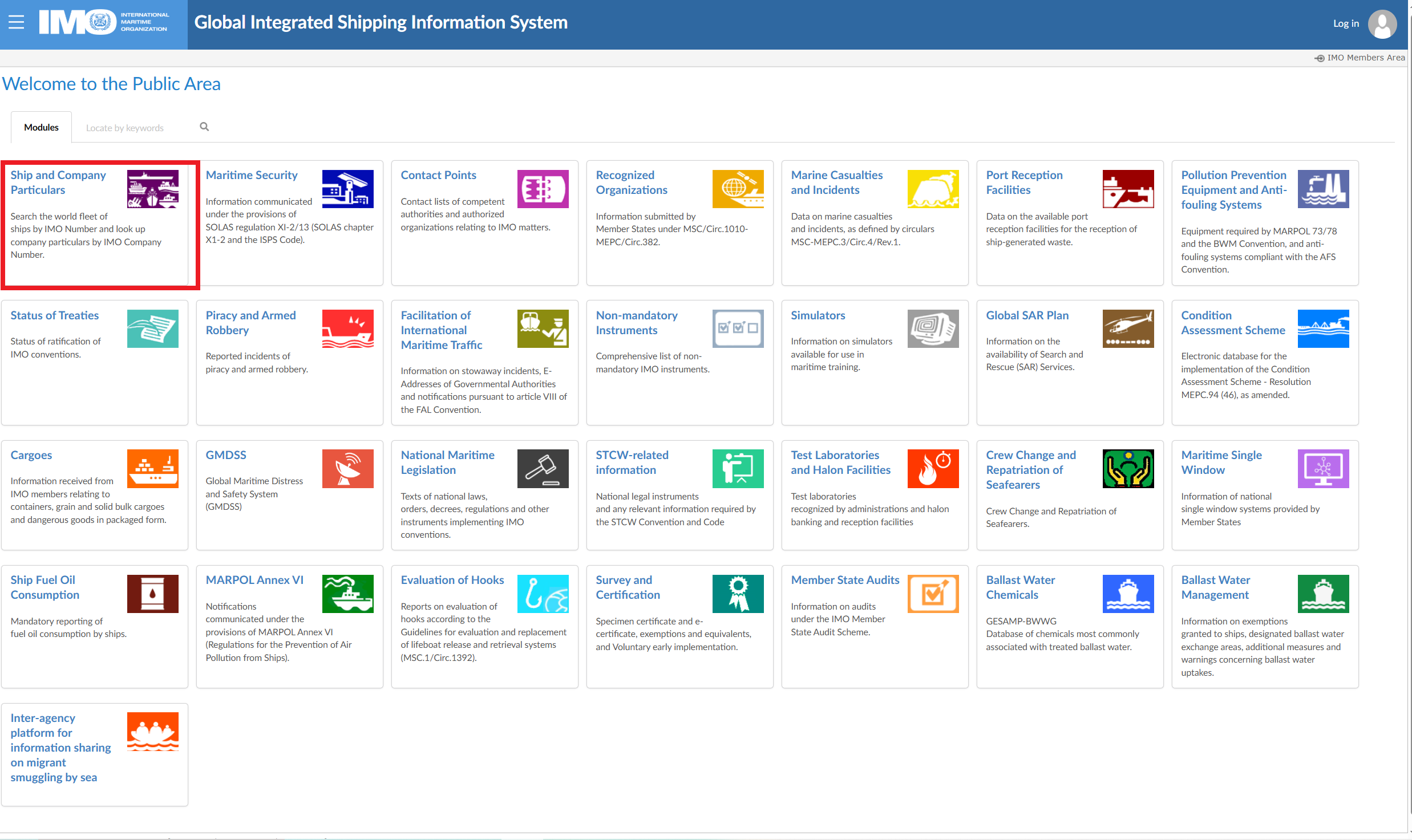
Step 1: Access the GISIS Public Area
Users begin by accessing the GISIS Public Area via the IMO website. No account or login is required for basic searches.
Step 2: Select “Ship and Company Particulars”
From the list of available GISIS modules, users select “Ship and Company Particulars.” This opens the search interface dedicated to ship and company identification data.
Step 3: Choose the Search Method
The module allows two main search pathways:
-
Search ships by IMO Ship Number
-
Search companies by IMO Company Number
Some interfaces may also allow name-based searches with filtering options, but IMO numbers provide the most accurate results.
Searching the World Fleet by IMO Ship Number
Why Search by IMO Ship Number?
Searching by IMO Ship Number is the most precise and reliable method of identifying a ship. Unlike ship names, which can be duplicated or changed, the IMO number is permanent.
Information Typically Displayed
When a valid IMO Ship Number is entered, the system may display information such as:
-
Ship name (current and sometimes former names)
-
IMO Ship Number
-
Ship type
-
Flag State (current flag)
-
Registered owner
-
ISM manager or operator
-
Company IMO Numbers associated with the ship
-
Status (e.g., in service, withdrawn, scrapped)
This data is submitted and maintained by flag administrations, ensuring official status.
Looking Up Company Particulars by IMO Company Number
Purpose of Company Searches
Company searches allow users to identify and verify the legal entities responsible for ship operation and management.
This is particularly important for:
-
ISM Code compliance
-
Port State Control inspections
-
Accident investigations
-
Due diligence and risk assessment
-
Chartering and insurance processes
Information Typically Displayed
A company record may include:
-
Company name
-
IMO Company Number
-
Company address
-
Company type (owner, manager, operator)
-
Associated ships
-
Flag State(s) connected to the company
This information helps users understand who is responsible for what, especially in complex ownership structures.
Data Accuracy and Responsibility
Who Submits the Data?
All information in the Ship and Company Particulars module is:
-
Submitted by IMO Member States
-
Updated by flag administrations
-
Governed by IMO resolutions and circulars
The IMO acts as the platform manager but does not independently verify or alter data submitted by Member States.
Update Frequency and Limitations
While IMO encourages timely updates, there may be:
-
Delays in reflecting recent ownership or flag changes
-
Differences in update practices between administrations
For critical decisions, users should consider GISIS data as authoritative but complementary to class, flag, and commercial databases.
Practical Use Cases Across the Maritime Sector
Port State Control (PSC)
PSC officers use ship and company particulars to:
-
Verify ISM responsibility
-
Cross-check certificates
-
Identify high-risk companies or vessels
-
Link inspection history to responsible entities
Flag State Administrations
Flags rely on the module to:
-
Track ships under their registry
-
Monitor company compliance
-
Coordinate with other administrations
-
Fulfil IMO reporting obligations
Shipowners and Managers
Companies use the system to:
-
Confirm correct registration details
-
Ensure consistency across international databases
-
Support audits and certifications
Insurers and P&I Clubs
Insurers reference IMO numbers to:
-
Avoid misidentification of vessels
-
Assess risk profiles
-
Link claims to specific ships and companies
Researchers and Academics
For maritime research, GISIS offers:
-
Reliable baseline identification data
-
Longitudinal analysis of fleet changes
-
Transparency in ownership and management trends
Relationship with Other GISIS Modules
The Ship and Company Particulars module is often used alongside other GISIS components, including:
-
Marine Casualties and Incidents – linking accidents to ships and companies
-
Condition Assessment Scheme (CAS) – connecting tanker condition data
-
Fuel Oil Consumption – associating emissions reporting with ship identity
-
Ballast Water Management – verifying ships subject to BWM requirements
Together, these modules form an integrated compliance and information ecosystem.
Importance for Maritime Safety and Environmental Protection
Supporting IMO Conventions
Accurate ship and company identification underpins the implementation of many IMO instruments, including:
-
SOLAS
-
MARPOL
-
ISM Code
-
STCW
-
Ballast Water Management Convention
Without reliable identification, enforcement and accountability become weak.
Preventing Regulatory Evasion
Permanent IMO numbers help prevent practices such as:
-
Renaming ships to avoid detention history
-
Changing flags to escape compliance obligations
-
Hiding ownership behind complex corporate structures
Common Challenges and Misunderstandings
Confusing Ship Names with IMO Numbers
A frequent mistake is relying only on ship names. Many ships share similar names, especially common terms like “Star,” “Ocean,” or “Global.”
Assuming Real-Time Updates
GISIS is authoritative but not always real-time. Users should understand the administrative process behind updates.
Mixing Commercial Databases with IMO Data
Commercial databases may offer additional commercial details, but GISIS remains the official regulatory reference.
Best Practices for Using Ship and Company Particulars
-
Always use IMO numbers when available
-
Cross-check data with flag, class, and PSC sources
-
Use GISIS as a compliance reference, not a commercial valuation tool
-
Understand the regulatory context of the data
-
Treat the module as part of a broader due-diligence process
Educational Value for Students and Cadets
For maritime students and trainees, the module provides:
-
Practical exposure to IMO systems
-
Understanding of ship identification principles
-
Insight into global maritime governance
-
Preparation for PSC, ISM, and audit roles
Training institutions often integrate GISIS searches into:
-
Maritime law courses
-
Ship management modules
-
Safety and compliance training
The Future of Ship and Company Data in GISIS
As maritime digitalization advances, GISIS is expected to:
-
Improve interoperability with other IMO systems
-
Enhance data visualization
-
Support decarbonization and emissions tracking
-
Strengthen links between ships, companies, and compliance performance
Ship and company particulars will remain the foundation layer for all future regulatory data integration.
Conclusion: A Cornerstone of Maritime Transparency
The Ship and Company Particulars option in IMO GISIS is more than a simple search tool. It is a cornerstone of global maritime transparency, supporting safety, environmental protection, compliance, and trust across the shipping industry.
By enabling users to search the world fleet by IMO Ship Number and verify company particulars by IMO Company Number, the system ensures that ships and companies can be clearly identified—regardless of name changes, flags, or ownership structures.
For maritime professionals, regulators, students, and researchers alike, understanding and correctly using this module is an essential skill in navigating the modern maritime regulatory landscape.
As shipping continues to evolve under increasing environmental, safety, and governance pressures, tools like GISIS—and particularly the Ship and Company Particulars module—will remain central to a safer, more transparent, and more accountable global shipping system.