
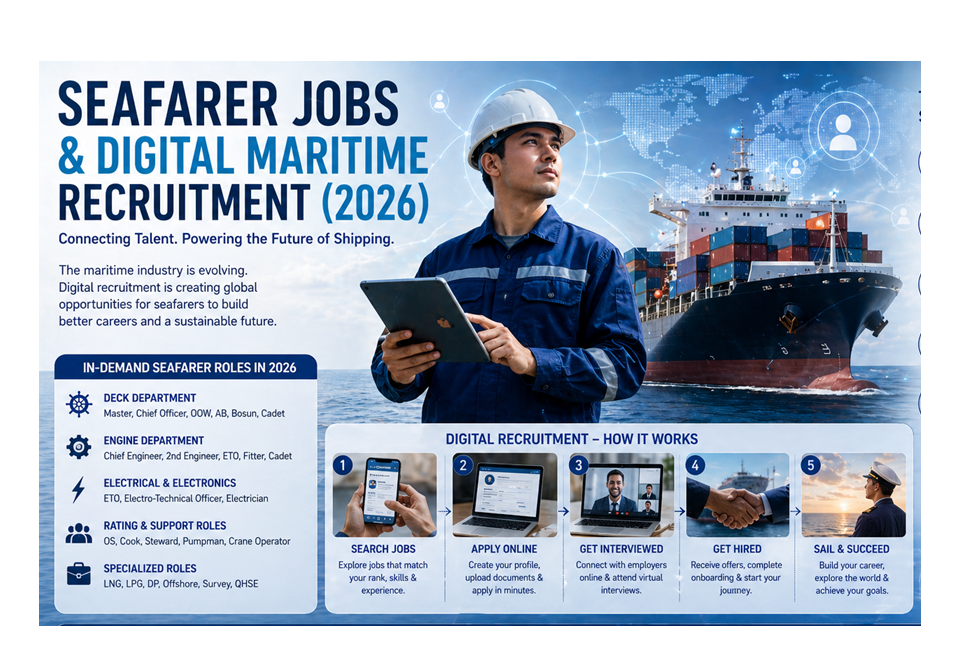
Explore seafarer careers in 2026 and how digital maritime recruitment works—platforms, digital CVs, crew management systems, and AI crew matching.
A Changing Landscape for Seafarer Careers
The way seafarers find jobs has changed significantly in recent years. What was once a process based on personal networks, crewing agents, and paper CVs has evolved into a digital ecosystem where data, speed, and visibility define success.
Today, maritime recruitment is increasingly driven by specialised online platforms, integrated crew management systems, and artificial intelligence tools. These technologies allow shipowners to identify suitable candidates quickly, while seafarers can present their experience and availability in real time.
This transformation reflects broader changes across the maritime industry, where digitalisation, regulatory compliance, and operational efficiency are reshaping how companies manage their workforce.
Seafarer Careers in 2026: More Competitive, More Transparent
The modern maritime job market is more structured and competitive than ever. Seafarers are no longer evaluated only on experience; they are assessed through structured digital profiles that include certification validity, vessel type experience, and operational readiness.
Regulatory frameworks such as the International Maritime Organization STCW Convention and the International Labour Organization Maritime Labour Convention (MLC 2006) have strengthened compliance requirements. As a result, recruiters must verify qualifications quickly and accurately, which has accelerated the shift toward digital systems.
For seafarers, this means that maintaining updated records is no longer optional. A missing certificate or outdated availability status can directly affect job opportunities. At the same time, digital platforms have made the market more transparent, allowing candidates to access opportunities globally rather than relying only on local agencies.
Maritime Recruitment Platforms: From Job Boards to Digital Ecosystems
Modern recruitment platforms such as Martide, Crewlinker, and Crewell are no longer simple job boards. They function as structured digital environments where both candidates and employers interact continuously.
For seafarers, these platforms provide a space to build a detailed professional profile that includes sea service history, certifications, vessel experience, and career preferences. For recruiters, they offer searchable databases that can filter candidates based on precise operational requirements.
This shift has reduced the reliance on manual screening and repetitive communication. Instead of sending multiple emails or applications, candidates can now be discovered directly by employers through platform-based searches.
The Digital CV: A Living Professional Profile
One of the most important changes in maritime recruitment is the transition from traditional CVs to digital profiles. A digital CV is not a static document but a continuously updated record of a seafarer’s career.
It typically includes structured information such as rank, certificates, sea service, vessel types, and availability. Because this data is used by algorithms and recruiters simultaneously, accuracy becomes critical. Even small inconsistencies between sea service records and certification dates can reduce a candidate’s visibility.
In practical terms, the digital CV transforms how competence is presented. Instead of describing experience in general terms, seafarers must provide precise, verifiable data that can be processed by recruitment systems. This creates a more objective and efficient hiring process but also demands greater attention to detail from candidates.
AI Crew Matching: From Manual Selection to Intelligent Filtering
Artificial intelligence is increasingly used to match seafarers with job opportunities. On platforms like Crewlinker, AI systems analyse structured data to identify the most suitable candidates for a given position.
These systems consider multiple factors simultaneously, including certification levels, vessel experience, recent sea service, and availability. By comparing this data with job requirements, the platform can rank candidates and suggest the best matches to recruiters.
For shipping companies, this reduces the time needed to shortlist candidates and improves hiring accuracy. For seafarers, it means that visibility depends not only on experience but also on how well their profile data aligns with system requirements.
This shift does not eliminate human decision-making. Final selection still depends on interviews, references, and company-specific criteria. However, AI significantly changes the first stage of recruitment by filtering and prioritising candidates.
Crew Management Software: Integrating Recruitment with Operations
Behind the recruitment platforms, many shipping companies rely on integrated crew management systems developed by companies such as DANAOS Corporation, NAPA, and Wärtsilä.
These systems connect recruitment with broader operational functions, including crew planning, contract management, payroll, training records, and compliance monitoring. Once a candidate is selected, their data can be transferred directly into the company’s internal system, reducing administrative work and improving accuracy.
This integration reflects a key trend in maritime operations: recruitment is no longer a separate activity but part of a larger digital workflow that manages the entire lifecycle of a seafarer’s employment.
Digital Compliance and Verification
As recruitment becomes more digital, verification becomes more important. Shipping companies must ensure that certificates are valid, endorsements are correct, and sea service records are accurate.
Digital platforms support this process by allowing document uploads, expiry tracking, and structured record-keeping. However, responsibility still lies with both the candidate and the employer to ensure that information is correct.
In the future, technologies such as blockchain may support more secure verification systems. For now, consistency, traceability, and regular updates remain the most effective ways to maintain credibility in digital recruitment.
Mobile Access and Recruitment at Sea
Another important development is the shift toward mobile-based recruitment. Many seafarers have limited access to computers while onboard, so mobile applications have become essential tools.
These applications allow users to receive job alerts, update availability, upload documents, and communicate with recruiters. Even with limited connectivity, mobile access enables faster responses, which can be critical in time-sensitive recruitment situations.
This mobility reflects the nature of the maritime profession itself, where flexibility and responsiveness are key factors in career progression.
Comparing Traditional and Digital Maritime Recruitment
| Aspect | Traditional Approach | Digital Recruitment |
|---|---|---|
| CV format | Static documents | Dynamic digital profiles |
| Job search | Agency-based, manual | Platform-based, global access |
| Screening | Manual review | AI-assisted filtering |
| Communication | Email and phone | Integrated messaging systems |
| Speed | Slower, sequential | Faster, parallel processing |
| Data accuracy | Variable | Structured and verifiable |
Challenges in Digital Maritime Recruitment
Despite its advantages, digital recruitment is not without challenges. Data quality remains a major issue, as incomplete or outdated profiles can reduce effectiveness. Connectivity limitations at sea can also affect communication and updates.
There are also concerns related to data privacy and cybersecurity, as personal and professional information must be protected. Additionally, the existence of multiple platforms may require seafarers to maintain several profiles, which can be time-consuming.
Finally, while technology improves efficiency, it does not replace human judgement. Experience, reputation, and professional conduct remain essential factors in hiring decisions.
Future Outlook: Toward Fully Digital Career Management
The future of maritime recruitment is likely to involve deeper integration between platforms, training institutions, and shipping companies. Seafarers may manage their entire careers through digital systems that track competence, training, performance, and availability.
As the industry evolves, new skill requirements—such as digital literacy, familiarity with alternative fuels, and understanding of automated systems—will become increasingly important. Recruitment platforms may also integrate training recommendations and career development tools.
This suggests a shift from simple job matching toward continuous career management, where seafarers and companies engage through long-term digital relationships.
Conclusion: Adapting to a Digital Maritime Workforce
Digital maritime recruitment is transforming how seafarers build their careers and how companies manage their workforce. The process is becoming faster, more transparent, and more data-driven.
For seafarers, success in this environment depends on maintaining accurate and complete digital profiles, responding quickly to opportunities, and adapting to new technologies. For companies, it requires integrating recruitment systems with operational processes and ensuring data quality and security.
The maritime job market is no longer defined only by experience at sea. It is increasingly shaped by how that experience is presented, verified, and matched in a digital world.
Frequently Asked Questions (FAQ)
What is a digital CV for seafarers?
A digital CV is an online profile that includes structured information about certifications, sea service, and availability.
How does AI crew matching work?
It compares candidate data with job requirements and ranks profiles based on suitability.
Are maritime recruitment platforms reliable?
Yes, but users must ensure their data is accurate and up to date.
What software do shipping companies use for crew management?
Systems from companies like DANAOS, NAPA, and Wärtsilä integrate recruitment, planning, and compliance.
References
- International Maritime Organization – STCW Convention and Code
- International Labour Organization – Maritime Labour Convention (MLC 2006)
- Martide – Platform features and recruitment tools
- Crewlinker – AI matching and digital profiles
- Crewell – Digital CV solutions
- DANAOS Corporation – Crew management systems
- NAPA – Maritime digital solutions
- Wärtsilä – Smart marine and crew solutions