
02/12/2026
The massive January 2026 release of over three million pages of Jeffrey Epstein-related documents by the US Department of Justice has pulled back the curtain on the convicted sex offender’s extensive network of influence across the Middle East. While Epstein cultivated relationships with global elites for decades, the newly unredacted files reveal a particularly dense web of connections to senior leaders, royal family members, and powerful businessmen in the Gulf Arab states—with the United Arab Emirates emerging as a central node in this sprawling scandal.
The Emirati Billionaire and the “Torture Video”
At the heart of the controversy stands Sultan Ahmed bin Sulayem, the chairman and CEO of Dubai-based logistics giant DP World and one of the architects of the emirate’s transformation into a global trade hub . For years, the identity of the “Sultan” who exchanged disturbing emails with Epstein remained redacted. That changed on February 10, 2026, when US Representative Ro Khanna, granted access to unredacted DOJ files, named bin Sulayem on the House floor under congressional privilege .
The correspondence, spanning from before Epstein’s 2008 conviction into the late 2010s, paints a portrait of intimacy that defied Epstein’s pariah status. A single email has become the flashpoint: on April 24, 2009, while serving an 18-month sentence for soliciting a minor, Epstein wrote to bin Sulayem: “Where are you? are you ok , I loved the torture video” .
The timing offers crucial context. Just two days earlier, ABC News had broadcast graphic footage of Sheikh Issa bin Zayed Al Nahyan, a member of Abu Dhabi’s ruling family, beating a grain merchant with a nailed plank and running him over with an SUV. The video sparked international outrage and a subsequent criminal case in which Sheikh Issa was acquitted . Epstein’s macabre appreciation appears to reference this specific footage, suggesting a shared interest in the violent impunity of Gulf royalty.
But the torture video reference was far from the only disturbing exchange. In November 2007, bin Sulayem emailed Epstein about a failed meeting with a supermodel: “After several attemps for several months we managed to meet in NY. there is a missunderstanding she she wanted some BUSINESS! while i only wanted some PUSSYNESS!” Epstein replied: “Praise Allah, there are still people like you” . In 2015, bin Sulayem described an encounter as “the best sex I ever had,” and in 2017, he appears to have helped arrange employment at a five-star Turkish hotel for a Russian masseuse from Epstein’s “private spa” .
Despite Epstein’s conviction, bin Sulayem maintained the relationship into the 2010s, treating the financier as a confidant and business advisor. A 2010 letter from Epstein described bin Sulayem as a “close personal friend” whom he had known for eight years, vouching for him personally . Even more striking, 2018 correspondence shows bin Sulayem sending Epstein a document titled “The recognition of Somaliland, a brief history”—suggesting he sought Epstein’s geopolitical counsel regarding DP World’s strategic port investment in the breakaway region .
Royal Introductions: Prince Andrew, Epstein, and Abu Dhabi’s Crown Prince
The Epstein files reveal that bin Sulayem was not the only UAE figure entangled with the convicted sex offender. They also document an active effort by Britain’s Prince Andrew to leverage his relationship with Epstein to secure introductions to the highest levels of UAE leadership.
Emails released by the DOJ show that during a November 2010 UK state visit to the UAE with Queen Elizabeth II, Prince Andrew—then serving as the UK’s special representative for trade and investment—vouched for Epstein to the UAE foreign minister, Sheikh Abdullah bin Zayed Al Nahyan .
“You are in big time,” the Duke wrote to Epstein. “He thinks you are great and would like to introduce you to Sheikh Mohammed, the Crown Prince” . The reference was to Sheikh Mohamed bin Zayed Al Nahyan, then Abu Dhabi’s crown prince and now the UAE’s president.
Epstein responded by suggesting a group holiday: “Ask Abdullah for a date when we can all go on vacation” . Earlier correspondence shows Epstein claimed to have already met both Sheikh Abdullah and Sheikh Mohammed bin Rashid Al Maktoum, the ruler of Dubai, just weeks prior .
The emails also show Epstein coaching Prince Andrew on precisely how to vouch for him—emphasizing qualities like “trust,” “financial expertise,” “funder of extreme science,” and “fun”—while the Duke discussed ways to circumvent restrictions on investing with Epstein while serving as a trade envoy . The documents do not imply wrongdoing by the UAE officials, who may have been unaware of Epstein’s criminal history, but they demonstrate the extraordinary access Epstein cultivated at the highest levels of Gulf power.
The Sacred and the Profane: Epstein, the Kaaba’s Cloth, and Emirati Intermediaries
Perhaps the most surreal revelation involves Epstein’s acquisition of pieces of the Kiswa—the sacred black-and-gold silk cloth embroidered with Quranic verses that covers the Kaaba in Mecca, Islam’s holiest site .
A photograph dated May 2014 shows Epstein and bin Sulayem standing together, hands in pockets, examining what appears to be the distinctive cloth laid out on the floor . The image, circulated as an email attachment, has drawn sharp criticism from religious observers, who note that placing the Kiswa on the ground is generally considered deeply disrespectful.
The documents further reveal that in 2017, pieces of the Kiswa were shipped to Epstein via UAE-linked contacts. UAE-based businesswoman Aziza al-Ahmadi coordinated with an associate to arrange air freight of three cloth fragments from Saudi Arabia to Florida via British Airways . Emails describe the pieces as carrying profound religious significance, noting that millions of Muslims had touched the cloth during circumambulation of the Kaaba, leaving behind their prayers and hopes.
The origin and authenticity of these particular fragments remain unverified. Independent publication Inside the Haramain, which monitors developments at Islam’s holy sites, has cast doubt on whether the photographed cloth is authentic, citing inconsistencies in size, material, decorative borders, and patterns compared to the genuine Kiswa . However, the shipment itself—coordinated years after Epstein’s conviction—underscores the remarkable reach of his network into the Gulf’s most sacred and elite circles.
Beyond the UAE: Lebanon, Libya, and the Region
While the UAE features most prominently, Epstein’s Middle Eastern entanglement extended to other Arab states. A 2010 email thread shows financier Tim Collins discussing Middle Eastern bank acquisitions with Epstein, who promptly identified Lebanon and Syria as “the next two hot spots” after Egypt. The exchange concludes with an associate referencing billionaire Wafic Saïd while remarking that “sex [is] better in Lebanon” . The emails do not allege wrongdoing by Lebanese officials but demonstrate how casually Epstein’s network blended financial interest with predatory commentary.
More consequentially, the files reveal Epstein’s 2011 pursuit of Libya’s approximately $80 billion in frozen assets following the NATO-backed uprising against Muammar Gaddafi. Epstein sought contingency-fee arrangements with international law firms and claimed indications of willingness from former MI6 and Mossad officials to assist in locating and recovering the assets . Libyan officials have dismissed these claims, and no evidence suggests they succeeded, but the episode illustrates Epstein’s audacious ambition to profit from Arab state upheaval.
A separate email, dated October 2010, lists senior officials from Bahrain, Egypt, Kuwait, Lebanon, Morocco, Qatar, and the UAE—including Pakistan’s then-foreign minister—as individuals with whom Epstein might have “private time.” The message, exchanged between Epstein and former JP Morgan executive Jes Staley, does not indicate that any of these officials actually met Epstein or were aware of their inclusion . It nevertheless reveals how Epstein’s associates conceptualized access to foreign dignitaries as a commodity to be brokered.
United Arab Emirates (UAE)
| Name | Position / Role | Context in Epstein Files |
|---|---|---|
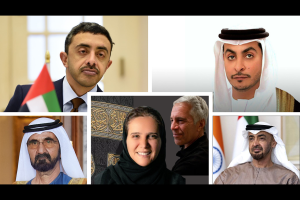
| Sultan Ahmed bin Sulayem | Chairman & CEO, DP World (Dubai) | • Direct email correspondence with Epstein (2007–2018) • Sent/received sexually explicit messages • Recipient of Epstein’s “torture video” email • Photographed with Epstein examining Kiswa cloth • Discussed business and geopolitics with Epstein |
| Sheikh Issa bin Zayed Al Nahyan | Member of Abu Dhabi ruling family | • Subject of 2009 torture video referenced by Epstein • Epstein expressed appreciation for the video to bin Sulayem |
| Sheikh Abdullah bin Zayed Al Nahyan | UAE Foreign Minister | • Introduced to Epstein by Prince Andrew (2010) • Epstein claimed “he thinks you are great” |
| Sheikh Mohamed bin Zayed Al Nahyan | President of UAE (then Crown Prince) | • Prince Andrew sought to introduce him to Epstein • Epstein claimed prior meeting in 2010 |
| Sheikh Mohammed bin Rashid Al Maktoum | Ruler of Dubai | • Epstein claimed to have met him weeks before November 2010 |
| Aziza al-Ahmadi | UAE-based businesswoman | • Coordinated shipment of Kiswa fragments to Epstein (2017) • Arranged air freight from Saudi Arabia to Florida via British Airways |
Silence and Scrutiny
As of mid-February 2026, neither Sultan Ahmed bin Sulayem nor DP World has issued a public statement addressing the revelations . This silence stands in stark contrast to the swift action of Western institutional investors: Canada’s La Caisse pension fund and British International Investment have both suspended future investments with DP World pending clarification and corrective action.
None of the Arab officials named in the Epstein files have been accused of criminal wrongdoing in connection with Epstein’s offenses. Correspondence does not equal complicity, and meetings do not prove knowledge of criminal activity. Yet the cumulative portrait emerging from three million pages is one of extraordinary access—access that Epstein, a convicted sex offender, continued to enjoy at the highest levels of Gulf power for more than a decade after his 2008 conviction.
The files do not reveal whether UAE leaders knew of Epstein’s crimes when they met him through Prince Andrew’s introduction. They do not prove that the Kiswa fragments were authentic or that Epstein’s Libyan asset pursuit progressed beyond speculation. What they demonstrate is something perhaps more unsettling: that wealth, power, and proximity to decision-makers transcended criminal status, national boundaries, and even the world’s holiest sanctuaries.
As Representative Ro Khanna observed after reviewing unredacted files: “If we found six men that they were hiding in two hours, imagine how many men they are covering up for in those three million files” . For the Arab states of the Persian Gulf, still cultivating global investment partnerships and navigating post-oil economic transformation, the Epstein files have opened a window into uncomfortable questions about whose company their leaders kept—and whose influence they welcomed.