
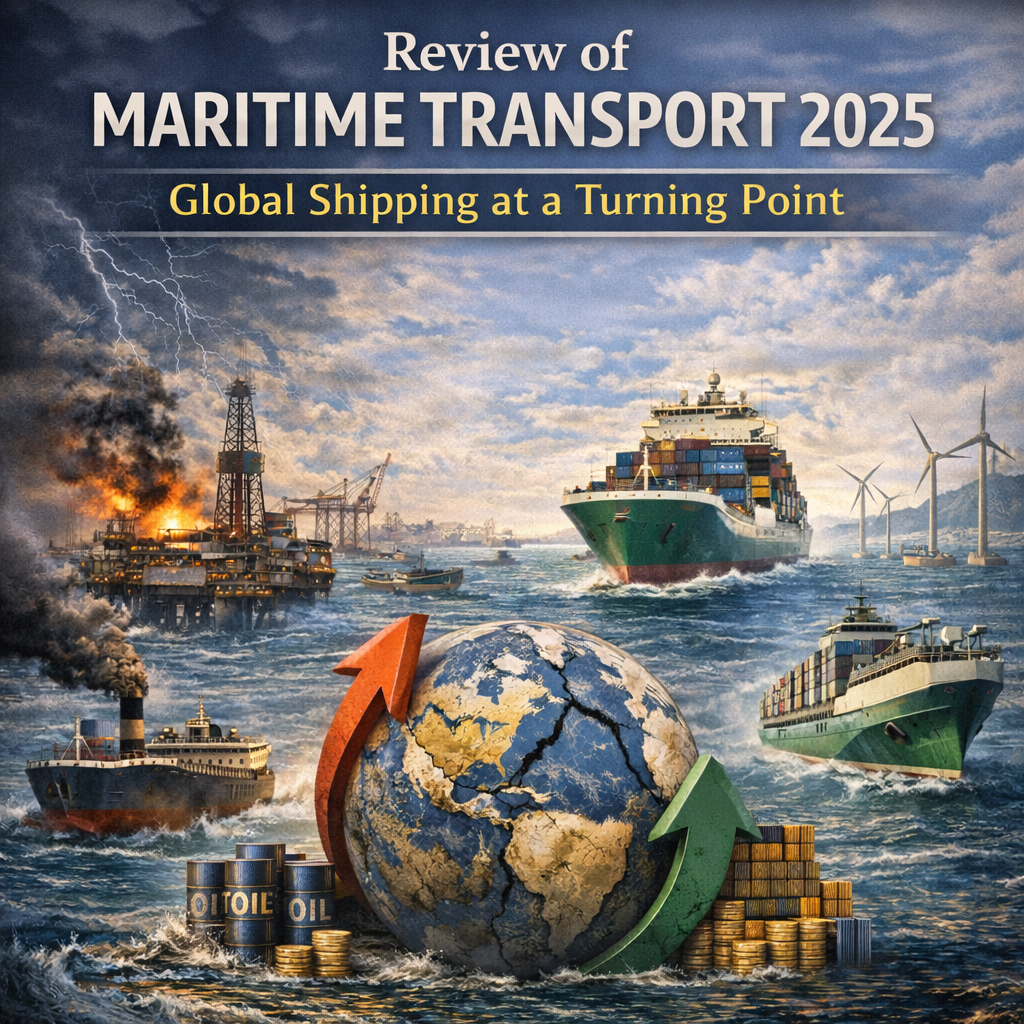
The Review of Maritime Transport 2025, published by the United Nations Conference on Trade and Development (UNCTAD), provides one of the most authoritative and comprehensive assessments of the global shipping and maritime trade system. At a time when international commerce is increasingly shaped by geopolitical instability, environmental imperatives, and structural changes in supply chains, the 2025 edition of the Review arrives at a critical juncture.
Maritime transport remains the backbone of global trade, carrying over 80% of the world’s merchandise trade by volume and more than 70% by value. Despite its central role, the sector is under growing pressure from slowing trade growth, rising transport costs, regulatory fragmentation, climate risks, and infrastructure constraints. The Review of Maritime Transport 2025 paints a detailed picture of these pressures while offering data-driven insights into how shipping markets, ports, and logistics systems are adapting.
This article provides an in-depth analysis of the Review’s key findings, focusing on maritime trade trends, shipping markets, port performance, freight rates, sustainability challenges, and the evolving policy landscape shaping the future of global shipping.
Global Maritime Trade: A Fragile Recovery
Trade Volumes and Growth Outlook
According to UNCTAD, global seaborne trade recorded moderate growth in 2024, supported by post-pandemic normalization and inventory restocking in some economies. However, the Review of Maritime Transport 2025 warns that this recovery is fragile and uneven, with growth expected to stall significantly in 2025.
Total seaborne trade volumes are forecast to grow by only around 0.5% in 2025, marking one of the weakest growth rates outside major global crises. This slowdown reflects a convergence of negative factors, including subdued global economic growth, geopolitical disruptions to shipping routes, persistent inflationary pressures, and uncertainty surrounding trade policies.
Containerized trade, traditionally the most dynamic segment of maritime transport, is projected to grow slightly faster than bulk trade, but still well below long-term averages. Dry bulk shipments face weaker demand due to softer industrial output and reduced commodity imports in key markets.
Uneven Regional Performance
The Review highlights significant regional disparities in maritime trade performance. While some Asian economies continue to dominate seaborne trade volumes, growth in Europe and parts of Africa remains constrained by weak demand, energy transition costs, and infrastructure limitations.
Developing economies, particularly Small Island Developing States (SIDS) and Least Developed Countries (LDCs), are disproportionately affected by higher freight rates and longer shipping routes. Their heavy reliance on maritime imports for food, fuel, and essential goods makes them especially vulnerable to disruptions and cost increases in global shipping networks.
Shipping Markets and Fleet Developments
Fleet Growth and Capacity Imbalances
The global commercial shipping fleet continues to expand, but at a pace increasingly misaligned with trade demand. The Review of Maritime Transport 2025 notes that fleet capacity growth has outpaced cargo growth, particularly in container shipping, where a wave of new vessel deliveries ordered during the pandemic years has entered service.
This capacity surplus places downward pressure on freight rates in some trades, even as operational costs rise due to longer routes and higher fuel consumption. The mismatch between supply and demand underscores the cyclical nature of shipping markets and the long lead times associated with shipbuilding investments.
Vessel Size Trends and Deployment Challenges
The trend toward larger vessels persists, especially in container shipping, where ultra-large container vessels (ULCVs) dominate major east-west trades. However, the Review cautions that larger ship sizes increase operational rigidity, making fleets less adaptable to route disruptions and port constraints.
Rerouting caused by geopolitical tensions, particularly in the Red Sea region, has exposed the limitations of deploying very large vessels on alternative routes. Some shipping lines have responded by redeploying mid-sized ships or adjusting service networks to improve flexibility.
Freight Rates and Transport Costs
Volatility as the New Normal
One of the central messages of the Review of Maritime Transport 2025 is that freight rate volatility has become a structural feature of global shipping rather than a temporary anomaly. While rates have retreated from the extreme highs seen during the pandemic, they remain elevated and unstable compared to pre-2020 levels.
Geopolitical disruptions, such as attacks on vessels in key chokepoints, have forced shipping lines to reroute ships around longer passages, significantly increasing voyage distances, fuel consumption, and insurance costs. These factors contribute to fluctuating freight rates across container, dry bulk, and tanker markets.
Impact on Global Supply Chains
Higher and more volatile freight rates directly affect global supply chains, particularly for time-sensitive and low-value goods. Import-dependent economies face increased landed costs, which can feed into domestic inflation and undermine food and energy security.
UNCTAD emphasizes that transport costs account for a higher share of import prices in developing countries than in developed economies. As a result, shipping cost increases exacerbate existing inequalities in global trade participation.
Ports and Maritime Infrastructure
Port Performance and Congestion
Ports play a critical role in determining the efficiency and resilience of maritime transport systems. The Review of Maritime Transport 2025 highlights persistent challenges in port performance, including congestion, capacity constraints, and inadequate hinterland connectivity.
While some major ports have invested heavily in automation and digitalization, many ports in developing regions struggle with outdated infrastructure, limited investment, and regulatory bottlenecks. These weaknesses reduce overall supply chain efficiency and increase the vulnerability of trade to external shocks.
Climate Risks to Port Infrastructure
Climate change is emerging as a major threat to maritime infrastructure. Rising sea levels, more frequent extreme weather events, and coastal erosion pose significant risks to ports and terminals worldwide. The Review warns that many ports are not adequately prepared for climate-related disruptions, particularly in low-lying coastal areas.
Adapting port infrastructure to climate risks requires substantial investment and long-term planning. Without proactive measures, climate impacts could further disrupt global trade and increase shipping costs.
Maritime Chokepoints and Trade Routes
Strategic Importance of Chokepoints
The Review of Maritime Transport 2025 underscores the strategic importance of maritime chokepoints such as the Suez Canal, Panama Canal, Strait of Hormuz, and Strait of Malacca. Disruptions in any of these corridors can have global repercussions, affecting shipping schedules, freight rates, and supply chain reliability.
Recent events in the Red Sea region have demonstrated how security risks can rapidly reshape global shipping routes. Diversions around the Cape of Good Hope have increased transit times between Asia and Europe by up to two weeks, with significant economic consequences.
Rerouting and Environmental Impacts
Longer routes not only raise costs but also increase greenhouse gas emissions. The Review notes that rerouting has led to higher fuel consumption and emissions, complicating efforts to decarbonize shipping. This creates a tension between short-term operational safety and long-term sustainability objectives.
Environmental Sustainability and Decarbonization
Shipping’s Climate Challenge
Shipping accounts for approximately 3% of global greenhouse gas emissions, making decarbonization a central challenge for the sector. The Review of Maritime Transport 2025 emphasizes that progress toward emission reduction targets remains uneven and uncertain.
While technological solutions such as alternative fuels, energy-efficient vessel designs, and digital optimization tools are advancing, their large-scale deployment faces economic and regulatory barriers.
Regulatory Developments
The Review examines ongoing regulatory initiatives at the international and regional levels, including the IMO’s greenhouse gas strategy and regional measures such as emissions trading schemes. UNCTAD warns that fragmented regulation risks creating compliance complexity and uneven competitive conditions across regions.
Developing countries, in particular, face challenges in meeting new environmental requirements due to limited access to finance, technology, and infrastructure.
Digitalization and Technological Transformation
Digital Shipping and Smart Logistics
Digitalization is increasingly seen as a key enabler of efficiency and resilience in maritime transport. The Review highlights the growing adoption of digital tools for vessel tracking, port operations, and supply chain management.
However, the benefits of digitalization are unevenly distributed. While major shipping lines and ports have embraced advanced systems, many smaller operators and ports lack the resources and skills needed to fully participate in digital transformation.
Cybersecurity Risks
As shipping becomes more digitalized, cybersecurity risks are rising. The Review warns that cyber incidents pose a growing threat to maritime safety and trade continuity. Strengthening cybersecurity frameworks is therefore essential to safeguarding digital maritime infrastructure.
Developing Countries and Trade Vulnerability
Disproportionate Impacts
UNCTAD places strong emphasis on the disproportionate impacts of maritime disruptions on developing countries. Higher freight rates, limited shipping connectivity, and infrastructure deficits constrain their ability to integrate into global value chains.
For Small Island Developing States and landlocked countries, maritime transport costs can represent a significant share of import prices, making them particularly vulnerable to shipping market volatility.
The Need for Inclusive Maritime Policies
The Review calls for inclusive maritime policies that support capacity building, infrastructure investment, and access to finance for developing economies. Without targeted support, the transition toward greener and more digital shipping risks widening existing inequalities in global trade.
Policy Recommendations and Strategic Outlook
Strengthening Multilateral Cooperation
UNCTAD stresses the importance of multilateral cooperation in addressing the challenges facing maritime transport. Coordinated approaches to security, environmental regulation, and trade facilitation are essential to maintaining a stable and efficient global shipping system.
Investing in Resilience
Building resilience across maritime supply chains requires investment in ports, digital infrastructure, and human capital. The Review highlights the need for long-term planning and public-private partnerships to enhance the adaptability of shipping and logistics systems.
Balancing Sustainability and Competitiveness
Achieving environmental sustainability without undermining trade competitiveness remains a central challenge. The Review advocates for policy frameworks that support a just and equitable transition, ensuring that the costs and benefits of decarbonization are fairly distributed.
Conclusion
The Review of Maritime Transport 2025 presents a sobering yet constructive assessment of the global shipping industry at a time of heightened uncertainty. Slowing trade growth, volatile freight rates, geopolitical disruptions, and climate risks are converging to test the resilience of maritime transport systems worldwide.
At the same time, the Review underscores opportunities for transformation through digitalization, sustainability initiatives, and international cooperation. The path forward requires coordinated action by governments, industry stakeholders, and international organizations to ensure that maritime transport continues to support global trade, development, and economic stability.
As global commerce navigates a period of transition, the insights and policy guidance offered by UNCTAD’s Review of Maritime Transport 2025 will remain essential for decision-makers across the maritime sector.
References
UNCTAD. Review of Maritime Transport 2025. United Nations Conference on Trade and Development, Geneva.
UNCTAD. Maritime trade under pressure – growth set to stall in 2025. UNCTAD Press Release, 2025.
UNCTAD. Stormy seas for global shipping: uncertainty, volatility and rising costs. UNCTAD Press Materials.
International Maritime Organization (IMO). Initial IMO Strategy on the Reduction of GHG Emissions from Ships.
UNCTAD. Port Performance and Connectivity Indicators.
World Bank. Port Reform Toolkit and Climate Resilience in Ports.
OECD. Global Value Chains and Transport Costs.
Wikipedia. Review of Maritime Transport.
Wikipedia. Decarbonization of Shipping.