
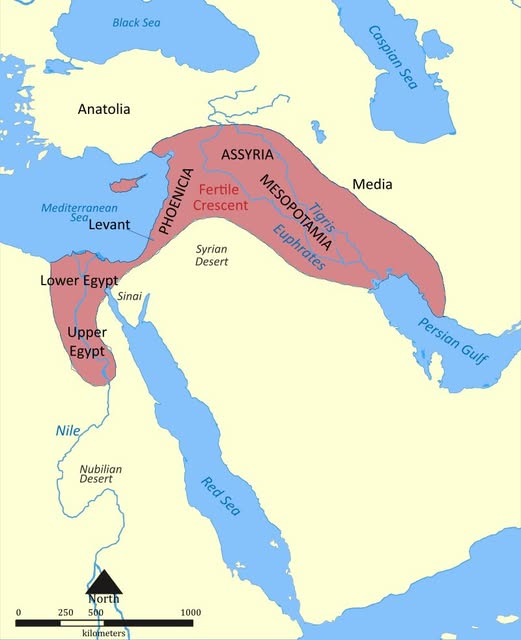
The Persian Gulf is not only a major modern energy and shipping region. It may also hold important clues about early human history. Some archaeologists have suggested that, before rising sea levels flooded the basin, the area may have been a habitable landscape with rivers, freshwater springs, wetlands, and human activity. One of the best-known versions of this idea is Jeffrey Rose’s “Gulf Oasis” hypothesis, published while he was affiliated with the University of Birmingham. Rose proposed that the exposed Gulf basin may have supported human groups for a very long time before it was submerged as sea levels rose after the last Ice Age.
However, this theory should be treated carefully. At present, there is no direct archaeological proof of a buried “civilisation” beneath the Persian Gulf. What exists is a research hypothesis based on palaeoenvironmental reconstruction, sea-level history, and the distribution of prehistoric sites around the Gulf’s margins. In other words, the idea is plausible and important, but it remains unproven.
Why the Gulf Attracts Archaeological Interest
The Persian Gulf is a shallow epicontinental sea, about 1,000 kilometres long and generally 200 to 350 kilometres wide, narrowing sharply at the Strait of Hormuz. Its average depth is only around 35 metres. During periods of lower global sea level in the late Pleistocene, much of the present-day Gulf basin would have been dry land. This created the possibility of a large lowland crossed by river systems and enriched by freshwater sources.
Because the surrounding landscapes often included arid or semi-arid zones, such a lowland would have been especially attractive for human occupation. Fresh water, wetlands, estuaries, and vegetated areas could have made the basin an important refuge and migration corridor for prehistoric populations moving through Arabia and southwestern Asia. This broader idea, that Arabia played a larger role in human prehistory than once thought, is increasingly supported by regional archaeological research.
The Gulf Oasis Hypothesis
Jeffrey Rose argued that the exposed Gulf basin may have functioned as a “Gulf Oasis” for human groups over tens of thousands of years. In this model, the basin was not simply empty land but a potentially rich ecological zone, connected to the wider Fertile Crescent and suitable for long-term human use. He further suggested that rising sea levels eventually flooded this landscape, displacing populations to the surrounding coasts, where more visible Neolithic settlements later appeared.
This is an influential and imaginative hypothesis, but it does not prove that a complex civilisation existed under the Gulf. The strongest version of the argument is that the basin may have been an important prehistoric habitat and possibly a missing piece in the story of human dispersal and settlement. The word “civilisation” is therefore too strong unless direct underwater archaeological evidence is found.
Archaeological Evidence Around the Gulf
Archaeological work around the Arabian Peninsula has developed significantly in recent decades. Earlier research often underestimated the antiquity of human presence in the region, but newer discoveries have shown that Arabia contains a much richer prehistoric record than was once assumed. Sites in Iran, the Arabian Peninsula, and adjacent coastal zones indicate repeated human occupation during the Pleistocene and early Holocene.
In addition, archaeologists have identified many Neolithic settlements along the Gulf shores dating to around 7,500 years ago. These include communities with permanent houses, pottery, advanced flint tools, domestic animals, crop use, and maritime activity. Such findings show that the Gulf littoral became an important zone of settlement and exchange during the Neolithic. They do not, however, directly prove that these communities came from a drowned centre within the Gulf basin. That remains a possibility, not a demonstrated fact.
Human Migrations and Cultural Origins
Some researchers have linked the Gulf basin to early movements of anatomically modern humans through Arabia. This question is part of a much wider debate about how humans dispersed out of Africa and across southwestern Asia. Archaeological evidence from Oman, Yemen, Iran, and Arabia suggests that migration routes were likely complex and may have involved connections with East Africa, the Levant, and the Zagros region at different times. Because of this, it is too simplistic to assign the region’s prehistory to a single origin story.
What can be said with more confidence is that the Persian Gulf region likely served as an important environmental corridor and settlement zone during periods when climate and sea level made it habitable. That makes it highly relevant to the study of early human adaptation, mobility, and regional interaction.
Why the Theory Matters
The importance of the Gulf Oasis hypothesis is not that it proves a lost civilisation already exists beneath the seabed. Its value is that it encourages archaeologists to reconsider the now-submerged landscapes of the Gulf as part of human prehistory. If future marine archaeology, sediment studies, or underwater surveys find stronger evidence, the Persian Gulf could become central to major debates about early settlement, environmental change, and the rise of coastal societies.
At present, the most careful conclusion is this: the Persian Gulf may have been a major prehistoric human landscape, and possibly an important refuge or migration corridor, but the idea of a drowned “civilisation” remains speculative. The archaeological potential is real, yet the definitive evidence is still missing.
Conclusion
The Persian Gulf should not be dismissed as just another prehistoric region, but neither should it be described with certainty as the cradle of civilisation hidden beneath the sea. Current research supports the idea that the Gulf basin was likely an environmentally rich landscape during periods of lower sea level and may have played a meaningful role in early human history. Still, the claim of a submerged civilisation remains a hypothesis rather than an established archaeological fact. Future underwater and coastal research may clarify whether the Gulf contains one of the missing chapters of human prehistory.
Reference: https://www.cais-soas.com/News/2011/february2001/16-02.htm