
updated to July 2026
1. What are NOx emissions?
NOx means nitrogen oxides, principally:
- nitric oxide — NO; and
- nitrogen dioxide — NO₂.
NOx is mainly formed when nitrogen and oxygen in combustion air react at high temperatures and pressures inside an engine cylinder.
NOx emissions contribute to:
- respiratory illness;
- smog and ground-level ozone;
- acid rain;
- eutrophication of seas and coastal waters; and
- the formation of secondary particulate matter.
NOx formation generally increases with:
- high combustion temperature;
- high peak cylinder pressure;
- excess oxygen;
- long residence time at high temperature; and
- advanced fuel-injection timing.
2. Which IMO regulation controls NOx?
The main requirement is:
MARPOL Annex VI, Regulation 13 — Nitrogen oxides (NOx)
The detailed technical requirements are contained in the:
NOx Technical Code 2008 — NTC 2008
The two instruments work together:
- Regulation 13 establishes which engines are covered and the applicable emission limit;
- the NOx Technical Code explains testing, certification, surveys, engine families, Technical Files and onboard verification.
Other connected provisions include:
| Provision | Subject |
|---|---|
| Annex VI Regulation 2 | Definitions |
| Regulation 4 | Equivalent compliance methods |
| Regulations 5–9 | Surveys and certification |
| Regulation 10 | Port State control |
| Regulation 11 | Detection of violations |
| Regulation 13 | NOx emission limits |
| NOx Technical Code 2008 | Engine testing, certification and verification |
The current consolidated Annex VI framework is based on Resolution MEPC.328(76). The NOx Technical Code 2008 was adopted by Resolution MEPC.177(58).
3. Which engines are covered?
Regulation 13 normally applies to a marine diesel engine with a power output above 130 kW when it is:
- installed on a ship; or
- subject to a major conversion.
It applies to main engines and auxiliary engines when they meet the power and application criteria.
A “marine diesel engine” includes an engine operating on liquid fuel and certain dual-fuel or gas-fuelled engines when covered by the Regulation 2 definition.
Main exceptions
Regulation 13 does not normally apply to:
- emergency diesel engines;
- engines installed in lifeboats;
- equipment intended to be used only in an emergency; and
- certain engines installed on ships operating exclusively in waters under the jurisdiction of their flag State, where alternative national measures apply.
Therefore, an emergency generator engine may be exempt from Regulation 13 even when its power exceeds 130 kW, provided it is genuinely intended only for emergency use.
4. What is a major conversion?
An existing engine may become subject to new requirements when it undergoes a major conversion.
This can include:
- replacing the engine with another engine;
- installing an additional engine;
- making a substantial modification defined by the NOx Technical Code; or
- increasing the engine’s maximum continuous rating by more than 10%.
The applicable Tier depends on:
- the ship’s construction date;
- the engine installation or replacement date;
- whether the replacement engine is identical;
- whether compliance with a particular Tier is technically possible; and
- the relevant Administration’s decision.
A replacement engine should not automatically be assumed to retain the original engine’s Tier.
5. The three NOx Tiers
IMO uses three emission standards:
- Tier I
- Tier II
- Tier III
A higher Tier number means a stricter limit.
| Tier | General application | Approximate reduction |
|---|---|---|
| Tier I | Ships constructed from 1 January 2000 | Basic standard |
| Tier II | Ships constructed from 1 January 2011 | About 15–20% below Tier I |
| Tier III | Certain newer ships operating inside a NOx ECA | About 80% below Tier I |
Tier I and Tier II apply globally according to the ship’s construction date.
Tier III applies only when:
- the ship falls within the construction-date requirements for the particular NOx ECA; and
- the ship operates inside that NOx ECA.
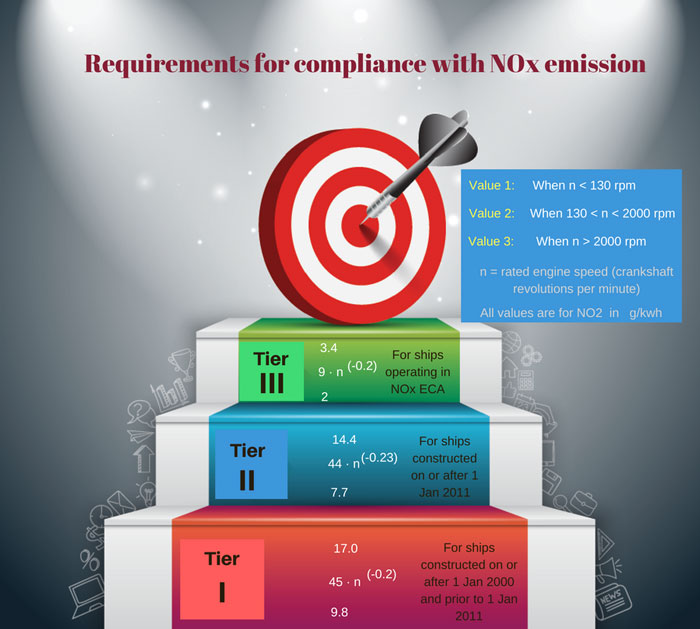
6. NOx emission limits
The emission limit is expressed in:
grams of NOx per kilowatt-hour — g/kWh
The limit depends on the engine’s rated speed, (n), in revolutions per minute.
| Rated engine speed | Tier I | Tier II | Tier III |
|---|---|---|---|
| (n < 130) rpm | 17.0 g/kWh | 14.4 g/kWh | 3.4 g/kWh |
| (130 \le n < 2,000) rpm | (45n^{-0.2}) | (44n^{-0.23}) | (9n^{-0.2}) |
| (n \ge 2,000) rpm | 9.8 g/kWh | 7.7 g/kWh | 2.0 g/kWh |
Simple interpretation
- Slow-speed engines have a higher numerical limit.
- Medium-speed engines use the formula.
- High-speed engines have a lower numerical limit.
- Tier III is approximately 80% stricter than Tier I.
The engine’s certified weighted-cycle result must not exceed the applicable limit.
7. Example for a slow-speed engine
A main engine has a rated speed of 100 rpm.
Because (n < 130) rpm:
| Standard | Maximum NOx emission |
|---|---|
| Tier I | 17.0 g/kWh |
| Tier II | 14.4 g/kWh |
| Tier III | 3.4 g/kWh |
If the engine is required to meet Tier III, engine optimisation alone will normally be insufficient. A strong NOx-reduction technology such as SCR or EGR may be necessary.
8. NOx Emission Control Areas
A NOx Emission Control Area is normally called a:
- NOx ECA; or
- NECA.
Inside a NECA, qualifying newer ships must meet Tier III.
Tier III areas and relevant ship dates
| NOx ECA | Ships generally required to meet Tier III |
|---|---|
| North American ECA | Ships constructed on or after 1 January 2016 |
| United States Caribbean Sea ECA | Ships constructed on or after 1 January 2016 |
| Baltic Sea ECA | Ships constructed on or after 1 January 2021 |
| North Sea ECA | Ships constructed on or after 1 January 2021 |
| Canadian Arctic ECA | Ships constructed on or after 1 January 2025 |
| Norwegian Sea ECA | Ships constructed on or after 1 March 2026, according to its three-date construction criteria |
The Canadian Arctic and Norwegian Sea ECAs were introduced through Resolution MEPC.392(82), which entered into force on 1 March 2026.
Norwegian Sea construction criteria
For this ECA, “ship constructed on or after 1 March 2026” means:
- building contract placed on or after 1 March 2026; or
- if there is no contract, keel laid or similar construction stage reached on or after 1 September 2026; or
- ship delivered on or after 1 March 2030.
North-East Atlantic ECA: 2026 update
At MEPC 84, IMO adopted Resolution MEPC.407(84) designating the North-East Atlantic as a NOx, SOx and particulate-matter ECA.
The amendments are expected to enter into force on 1 September 2027, subject to MARPOL’s acceptance procedure.
For NOx Tier III purposes, the adopted text refers to ships constructed on or after 1 January 2027, meaning:
- building contract on or after 1 January 2027;
- in the absence of a contract, keel laid or similar stage on or after 1 July 2027; or
- delivery on or after 1 January 2031.
As of July 2026, the North-East Atlantic was an adopted future NECA, not yet an operational one. Resolution MEPC.407(84)
9. Does every ship need Tier III inside a NECA?
No.
Tier III applies only to ships covered by the construction-date criteria for that particular NECA.
For example:
- a ship constructed in 2013 normally continues to meet Tier II in the Baltic NECA;
- a ship constructed in 2022 and operating in the Baltic Sea must normally meet Tier III;
- the same Tier III ship can generally operate at Tier II outside a NECA, provided its certification and Technical File allow this.
Older ships do not automatically need to replace all their engines merely because a new NECA is created.
10. Tier III exceptions
Limited exceptions exist for certain ships, including:
- a ship less than 24 metres in length designed and used solely for recreational purposes; and
- a ship with combined propulsion power below 750 kW where the Administration accepts that Tier III compliance is not possible because of design or construction limitations.
These exceptions are narrow. They are not general exemptions for small commercial vessels.
Special provisions also exist for certain ships operating directly in connection with activities such as mineral-resource exploration or exploitation, subject to the exact conditions in Regulation 13.
11. How can an engine reduce NOx?
NOx can be controlled using primary or secondary methods.
Primary methods
Primary methods reduce NOx formation inside the engine:
- retarded fuel-injection timing;
- electronically controlled injection;
- Miller timing;
- variable valve timing;
- lower scavenge-air temperature;
- water injection;
- fuel-water emulsion;
- combustion-chamber optimisation;
- exhaust-gas recirculation; and
- optimised engine settings.
These methods may affect:
- fuel consumption;
- smoke;
- exhaust temperature;
- engine load response; and
- maintenance requirements.
Reducing NOx can sometimes increase fuel consumption or particulate emissions. This is commonly called the NOx–fuel-consumption trade-off.
Secondary method: SCR
Selective Catalytic Reduction — SCR removes NOx from exhaust gas after combustion.
A reducing agent, normally aqueous urea, is injected into the exhaust. It forms ammonia, which reacts with NOx over a catalyst and produces mainly:
- nitrogen; and
- water vapour.
SCR operation requires correct:
- exhaust temperature;
- urea quality;
- dosing;
- catalyst condition;
- mixing;
- bypass control; and
- alarm monitoring.
Poor operation can cause:
- insufficient NOx reduction;
- ammonia slip;
- urea deposits;
- catalyst deterioration; and
- blocked exhaust passages.
Exhaust-gas recirculation
EGR returns part of the exhaust gas to the combustion process. It reduces oxygen concentration and peak combustion temperature, thereby reducing NOx formation.
EGR systems may require:
- scrubbers;
- water-treatment equipment;
- blowdown control;
- monitoring; and
- residue management.
12. EIAPP Certificate
A marine diesel engine subject to Regulation 13 normally requires an:
Engine International Air Pollution Prevention Certificate — EIAPP Certificate
The EIAPP Certificate confirms that the engine has been tested and approved according to the applicable NOx requirements.
It is normally issued after pre-certification:
- at the manufacturer’s test bed; or
- through another approved procedure allowed by the NOx Technical Code.
The EIAPP Certificate relates to the individual engine or an approved member of an engine family or engine group.
It must not be confused with the ship’s IAPP Certificate.
| Certificate | Covers |
|---|---|
| EIAPP | Individual marine diesel engine |
| IAPP | Ship’s overall compliance with MARPOL Annex VI |
13. Engine Technical File
Every certified engine must have an approved NOx Technical File.
It contains information such as:
- engine identification;
- applicable Tier;
- rated power and speed;
- engine family or group;
- approved components;
- fuel-injection settings;
- turbocharger specifications;
- valve timing;
- charge-air parameters;
- NOx-reducing devices;
- allowable adjustments;
- onboard verification procedure; and
- spare-part identification.
The Technical File is a controlled statutory document. Crew members must not make unauthorised changes to certified settings or components.
14. Record Book of Engine Parameters
Changes to NOx-critical components or settings must be recorded in the:
Record Book of Engine Parameters
Typical entries may concern:
- fuel injectors;
- fuel pumps;
- injection timing;
- camshafts;
- turbochargers;
- pistons;
- cylinder heads;
- charge-air coolers;
- electronic control settings;
- SCR components;
- EGR settings; and
- other NOx-critical components identified in the Technical File.
An approved electronic record book may be used where permitted by the Administration.
Replacing a component with a non-approved component can invalidate the engine’s certified NOx status.
15. Onboard verification methods
The NOx Technical Code provides methods for confirming continued compliance.
Parameter-check method
This is the most common onboard method. The surveyor checks that:
- components match the Technical File;
- identification numbers are correct;
- settings remain within approved limits;
- seals are intact where applicable; and
- changes have been properly recorded.
Simplified measurement method
Exhaust-gas measurements may be conducted on board using an approved simplified procedure.
Direct measurement and monitoring
A properly approved continuous or periodic monitoring system may be used to demonstrate actual NOx performance.
The method used must be specified in the engine’s approved documentation.
16. Switching between Tier II and Tier III
Some Tier III engines use equipment such as SCR or EGR only when Tier III is required.
When the ship enters a NECA, the system must be:
- prepared;
- started in sufficient time;
- operating correctly; and
- capable of maintaining Tier III compliance.
Where the engine can operate in different certified modes, the ship must record the required details when changing Tier status, including:
- date;
- time;
- ship’s position;
- engine concerned; and
- Tier II or Tier III operating status.
The Tier III system should not be bypassed inside a NECA except under conditions specifically permitted by the approved arrangements or applicable emergency provisions.
17. SCR certification
An SCR installation used for NOx compliance is treated as part of the certified engine system.
The principal current guidance is:
Resolution MEPC.399(83) — 2025 Guidelines on Selective Catalytic Reduction Systems
These guidelines address:
- engine-and-SCR certification;
- testing;
- approval schemes;
- catalyst characteristics;
- reducing-agent supply;
- monitoring;
- alarms;
- onboard confirmation; and
- documentation.
The 2025 Guidelines update the earlier SCR framework contained in Resolution MEPC.291(71).
Two simplified certification approaches are commonly discussed:
- Scheme A: engine and SCR system are tested together;
- Scheme B: engine and SCR may be tested separately, followed by an approved onboard confirmation procedure.
The applicable approach must be accepted by the Administration or recognised organisation.
18. Engine families and engine groups
Testing every serially manufactured engine separately would be impractical. The NOx Technical Code therefore allows:
Engine family
Used for engines with similar design and emission characteristics that are normally manufactured in series.
A parent engine is tested, and other approved engines become family members.
Engine group
Used for a smaller group of similar engines, often where limited modifications or adjustments may be permitted.
The engine must remain within the approved family or group specifications throughout its service life.
19. Replacement engines
When an engine is replaced, the new engine should normally meet the Tier applicable at the time of installation.
However, special provisions exist where:
- an identical replacement engine is installed; or
- a replacement engine cannot meet the otherwise applicable standard because of technical constraints.
The Administration must assess and document such cases. The shipowner cannot independently claim that Tier compliance is impossible.
Relevant 2024 amendments and guidelines address non-identical replacement engines, including cases involving the replacement of steam systems by marine diesel engines.
20. Surveys and inspections
Surveyors and port State control officers may examine:
- EIAPP Certificate;
- IAPP Certificate and Supplement;
- NOx Technical File;
- Record Book of Engine Parameters;
- engine identification plates;
- approved spare parts;
- fuel-injection settings;
- electronic engine settings;
- seals;
- SCR or EGR records;
- urea consumption;
- catalyst condition;
- alarms and bypasses;
- Tier changeover records; and
- onboard monitoring data.
Possible deficiencies include:
- missing EIAPP Certificate;
- missing Technical File;
- unauthorised engine adjustment;
- unapproved replacement parts;
- broken seals without explanation;
- SCR bypassed inside a NECA;
- empty or unusable urea tanks;
- false records; and
- failure to operate the certified NOx-control system.
21. Important operational warning
A ship may have an EIAPP Certificate but still be non-compliant if:
- the engine is operated outside approved settings;
- uncertified components have been installed;
- the SCR is deliberately bypassed;
- insufficient reducing agent is carried;
- the EGR system is not working;
- monitoring equipment is defective; or
- required records have been falsified.
Certification and actual onboard operation must agree.
22. Principal IMO instruments related to NOx
The following are the principal current or historically important instruments. Superseded documents are identified where relevant.
Mandatory instruments and major resolutions
| IMO instrument | Main subject |
|---|---|
| MEPC.176(58) | Revised MARPOL Annex VI, including the Tier structure |
| MEPC.177(58) | Revised NOx Technical Code 2008 |
| MEPC.251(66) | Amendments addressing dual-fuel engines and the NOx Technical Code |
| MEPC.286(71) | Designation of the Baltic Sea and North Sea as NOx ECAs |
| MEPC.317(74) | Amendments allowing electronic record books under the NOx Technical Code |
| MEPC.328(76) | 2021 Revised MARPOL Annex VI |
| MEPC.385(81) | 2024 Annex VI amendments, including replacement-engine matters |
| MEPC.386(81) | Guidelines concerning non-identical replacement engines |
| MEPC.392(82) | Canadian Arctic and Norwegian Sea NOx ECAs |
| MEPC.399(83) | 2025 Guidelines on SCR systems |
| MEPC.407(84) | North-East Atlantic NOx, SOx and PM ECA adopted in 2026 |
Guidelines and circulars
| Instrument | Main subject |
|---|---|
| MEPC.1/Circ.795/Rev.9 | Unified interpretations of MARPOL Annex VI, including Regulation 13 |
| MEPC.1/Circ.895 | Consolidated unified interpretations of the NOx Technical Code 2008 |
| MEPC.103(49) | Guidelines for onboard NOx verification using direct measurement and monitoring |
| MEPC.291(71) | 2017 SCR Guidelines; replaced by the updated 2025 framework |
| MEPC.313(74) | Amendments to the 2017 SCR Guidelines |
| MEPC.399(83) | Current 2025 SCR Guidelines |
Older documents such as MEPC.198(62), MEPC.260(68) and MEPC.1/Circ.865 have been superseded by later consolidated guidance and should not be used as the primary current reference.
The official instrument list is available in the IMO index of MARPOL Annex VI resolutions and guidelines.
23. Simple operational example
A container ship was constructed in 2022 and is fitted with a 20,000 kW main engine.
Outside a NOx ECA
The engine may operate in its approved Tier II mode.
Before entering the North Sea NECA
The engineering team should:
- verify the NECA boundary and entry time;
- check SCR or EGR readiness;
- confirm sufficient urea or other required consumables;
- start the Tier III system in sufficient time;
- check temperatures, pressures and alarms;
- confirm Tier III operation; and
- make the required record.
Inside the NECA
The engine must remain in its approved Tier III condition.
If the SCR fails, the crew should:
- respond to the alarm;
- investigate the fault;
- follow the approved procedures;
- record the failure;
- take corrective action;
- notify the master and company;
- inform the Administration and relevant coastal or port State when required; and
- avoid deliberately continuing non-compliant operation.
24. Examination summary
Students should remember:
- Regulation 13 controls NOx from marine diesel engines.
- The detailed rules are in the NOx Technical Code 2008.
- The general threshold is more than 130 kW.
- Emergency engines and lifeboat engines are normally exempt.
- Tier I generally applies from 2000.
- Tier II generally applies from 2011.
- Tier III applies to qualifying newer ships inside a NOx ECA.
- Tier III is approximately 80% stricter than Tier I.
- North American and US Caribbean Tier III dates begin in 2016.
- Baltic and North Sea Tier III dates begin in 2021.
- Canadian Arctic Tier III applies to ships constructed from 1 January 2025.
- Norwegian Sea Tier III uses a 1 March 2026 construction-date framework.
- The North-East Atlantic ECA was adopted in 2026 but is not yet operational.
- Each covered engine normally needs an EIAPP Certificate and approved Technical File.
- NOx-critical changes must be entered in the Record Book of Engine Parameters.
- SCR, EGR and engine-based measures can be used for compliance.
- Approved equipment must actually be operated and maintained correctly.
In simple terms: MARPOL Annex VI controls how much NOx a marine diesel engine may emit. Tier I and Tier II apply globally according to the ship’s age, while the much stricter Tier III standard applies to qualifying newer ships when they operate inside designated NOx Emission Control Areas.