
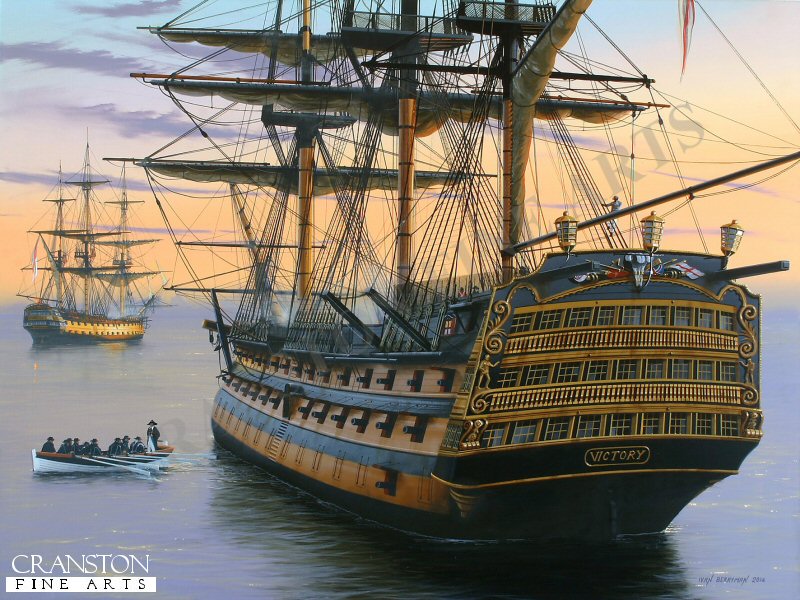
Discover the story of HMS Victory, Lord Nelson’s famous flagship at the Battle of Trafalgar, her design, crew, guns, naval legacy, and preservation as one of the world’s most important historic warships.
A Wooden Warship That Became a National Symbol
In the history of the sea, some ships become famous because they carried explorers into unknown waters. Some become famous because they sank in tragedy. Others become famous because they changed the way people think about war, empire, leadership, and national identity. HMS Victory belongs to this last group.
She is not only an old wooden warship. She is one of the most recognised naval symbols in the world. Built in the eighteenth century, preserved in Portsmouth, and forever linked with Admiral Horatio Nelson, HMS Victory stands at the meeting point of maritime engineering, naval warfare, leadership, and memory.
Her most famous moment came on 21 October 1805, during the Battle of Trafalgar, when the British Royal Navy fought the combined fleets of France and Spain. Royal Museums Greenwich identifies HMS Victory as Lord Nelson’s flagship in his victory at Trafalgar and notes that Nelson served in Victory for just over two years until his death in the battle.
Trafalgar was not just another naval battle. It was one of the decisive sea battles of the Napoleonic Wars. The battle confirmed British command of the seas and prevented Napoleon’s naval forces from challenging Britain in the same way again. But HMS Victory’s story is not only about victory in battle. It is also about the lives of hundreds of sailors, the brutal reality of wooden-ship warfare, the discipline of the Royal Navy, and the long afterlife of a vessel that still survives more than 260 years after her completion. The National Museum of the Royal Navy states that HMS Victory was completed in 1765 and is now more than 260 years old.
This article explores HMS Victory as a ship, a fighting machine, a workplace, a battlefield, and a preserved maritime monument. Her story helps us understand why warships were central to world power before modern aircraft, submarines, missiles, and satellites—and why one wooden ship still commands global attention today.
1. Why HMS Victory Is So Famous
HMS Victory is famous for three main reasons: she was Nelson’s flagship, she fought at the Battle of Trafalgar, and she survived long enough to become a preserved historic ship.
Many warships have fought in important battles. Many admirals have commanded fleets. But few ships are connected so strongly with one leader, one battle, and one national memory. HMS Victory is inseparable from Nelson. When people think of Trafalgar, they often picture Nelson standing on Victory’s quarterdeck, leading the British fleet toward the enemy line.
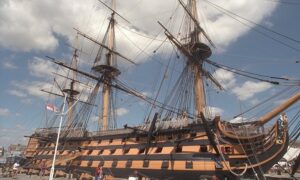
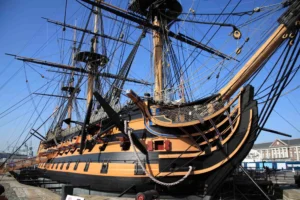
Her fame also comes from survival. Most eighteenth-century warships disappeared long ago. Wooden ships were difficult to preserve. They rotted, were broken up, burned, wrecked, or reused. HMS Victory survived because later generations understood her symbolic value. Today, she is preserved at Portsmouth Historic Dockyard, where visitors can walk through a ship that fought in one of the most famous naval battles in history.
The ship also represents a wider era. HMS Victory belongs to the age of sail, when naval power depended on timber, canvas, rope, iron guns, seamanship, discipline, and close-range combat. She is a physical reminder of how naval warfare worked before steam engines, steel armour, torpedoes, aircraft carriers, radar, and electronic warfare.
For maritime education, HMS Victory is valuable because she can be studied from many angles: shipbuilding, naval tactics, crew organisation, leadership, logistics, preservation, and maritime heritage. She is not only a museum object. She is a complete historical case study.
2. Building a Floating Fortress
HMS Victory was built during a period when Britain was expanding its naval power. The eighteenth century was a time of intense competition among European maritime powers, especially Britain, France, Spain, and the Netherlands. Control of sea routes mattered because sea power protected trade, colonies, troop movements, and national security.
Victory was a first-rate ship of the line. This meant she was among the largest and most powerful warships of her time. A ship of the line was designed to fight in a line of battle, where fleets formed long columns and exchanged broadsides. The strongest ships carried many guns on multiple decks and were intended to withstand heavy punishment.
The National Museum of the Royal Navy describes HMS Victory as over 260 years old, built during the Seven Years’ War and completed in 1765. It also notes that she spent the first thirteen years of her existence in reserve, during which a significant part of the ship was replaced because of decay.
That detail is important. Wooden warships were living maintenance projects. Even before a ship entered heavy operational service, timber could decay, fittings could require replacement, and hull structures needed constant attention. A large wooden warship was never “finished” in the modern sense. She had to be repaired, refitted, maintained, and adapted throughout her life.
HMS Victory was designed as a floating fortress. The National Museum’s conservation material notes that at Trafalgar she carried 104 guns. These guns were arranged across several decks, allowing the ship to deliver devastating broadsides against enemy vessels.
Table 1: HMS Victory at a Glance
| Feature | Description |
|---|---|
| Ship name | HMS Victory |
| Navy | Royal Navy |
| Type | First-rate ship of the line |
| Completed | 1765 |
| Most famous battle | Battle of Trafalgar, 21 October 1805 |
| Famous commander | Admiral Lord Horatio Nelson |
| Guns at Trafalgar | 104 guns |
| Crew at Trafalgar | 821 men |
| Present location | Portsmouth Historic Dockyard |
| Current status | Preserved historic warship |
HMS Victory was not designed for comfort. She was designed to project naval power. Her purpose was to carry guns, men, supplies, command authority, and national ambition into battle.
3. What “HMS” and “Victory” Mean
The prefix HMS means His Majesty’s Ship or Her Majesty’s Ship, depending on the reigning monarch. It is used for ships of the British Royal Navy. The name Victory had strong symbolic value. It expressed confidence, national pride, and military purpose.
The name was not unique to this ship. Several Royal Navy vessels have carried the name Victory. But the 1765 HMS Victory became the most famous because of Trafalgar and Nelson.
Names matter in naval tradition. Warship names carry memory, expectation, and identity. A ship named Victory was not merely a transport platform. She was a statement of intent. When she became Nelson’s flagship, the name gained even greater force.
In maritime culture, ships often become more than objects. Crews speak of them with personality. Nations remember them as symbols. Museums preserve them as heritage. HMS Victory shows this transformation clearly: from naval asset to battlefield witness to national monument.
4. The World of Nelson’s Navy
To understand HMS Victory, we must understand the Royal Navy of Nelson’s age. Britain’s survival and power depended heavily on sea control. The country was an island nation with global trade interests and colonial connections. A strong navy protected merchant shipping, blocked enemy fleets, supported military operations, and allowed Britain to influence events far beyond its shores.
The Napoleonic Wars made sea power even more important. Napoleon Bonaparte dominated much of continental Europe, but Britain’s navy remained a major obstacle to French strategic ambitions. France and Spain together had powerful fleets, and the possibility of invasion or control of key sea routes made naval supremacy vital.
Royal Museums Greenwich describes the Battle of Trafalgar as one of the most famous battles in British naval history and explains that it took place during the Napoleonic War, when Napoleon and his armies were trying to conquer Europe.
HMS Victory therefore sailed in a world where naval warfare was not separate from politics. A battle at sea could decide the fate of empires, trade routes, colonies, and invasion plans. A ship like Victory was part of a national strategy.
Nelson’s Navy also had a strong professional culture. Officers and sailors were trained by experience, discipline, and long service at sea. Life was harsh, but the Royal Navy developed strong seamanship, gunnery practice, fleet organisation, and command traditions.
HMS Victory was one of the platforms on which this system operated.
5. Life On Board HMS Victory
For modern readers, it is easy to admire HMS Victory from the outside: tall masts, gunports, carved stern, black-and-yellow sides, and the dignity of an old warship. But life inside was crowded, noisy, disciplined, and physically demanding.
At Trafalgar, HMS Victory had a crew of 821 men. The National Museum of the Royal Navy records that 51 were killed in battle, 11 later died of their wounds, and 91 were wounded and survived. These numbers show both the size of the ship’s company and the human cost of battle.
A crew of more than 800 people lived and worked within a wooden hull. They included officers, warrant officers, seamen, marines, boys, gunners, carpenters, sailmakers, cooks, surgeons, and many others. Each role had a purpose. A ship of the line could not function unless every group performed its duties.
Table 2: Typical Groups Aboard a Ship Like HMS Victory
| Group | Main Role |
|---|---|
| Admiral and staff | Fleet command and strategic decision-making |
| Captain and officers | Ship command, navigation, discipline, battle orders |
| Seamen | Sail handling, steering, maintenance, watchkeeping |
| Marines | Security, musket fire, boarding defence |
| Gunners | Loading, aiming, and firing cannon |
| Carpenters | Hull repairs and damage control |
| Surgeon and assistants | Treatment of wounded and sick crew |
| Cooks and stewards | Food preparation and support duties |
| Boys and young sailors | Messengers, powder carriers, general assistance |
Daily life was governed by routine: watches, meals, cleaning, sail handling, maintenance, training, and discipline. In battle, this routine turned into intense coordinated violence. Guns had to be loaded and fired repeatedly. Powder had to be carried safely. Wounded men had to be moved. Damaged rigging had to be repaired. Officers had to maintain command even under enemy fire.
The ship was not only a weapon. It was a community under extreme pressure.
6. A Warship of Wood, Rope, Canvas, and Iron
Modern warships are built from steel and filled with electronics, engines, sensors, missiles, and complex communication systems. HMS Victory belonged to a different technological world. Her main materials were timber, rope, canvas, iron, and bronze.
Her hull was made from large quantities of oak and other timber. Her propulsion came entirely from wind acting on sails. Her firepower came from heavy cannon firing solid shot at close range. Her control systems were human: orders shouted, drums beaten, flags hoisted, and messengers sent.
This does not mean she was simple. A ship like HMS Victory was one of the most complex machines of her time. The rigging alone required deep knowledge. Sail handling demanded teamwork, timing, strength, and courage. Gunnery required discipline and practice. Navigation required skill. Damage control required immediate action.
The ship also had internal organisation. Gun decks, magazines, storerooms, officers’ spaces, crew areas, medical spaces, and working areas had to function together. In battle, the ship became a system of systems: propulsion, steering, command, weapons, repair, medical response, and morale.
HMS Victory shows that “old technology” was not primitive. It was highly developed for its age.
7. Nelson and HMS Victory: A Powerful Partnership
Admiral Horatio Nelson is one of the most famous naval commanders in history. By the time of Trafalgar, he was already a national hero. He had lost an arm and the sight in one eye in earlier service. He had gained fame through bold action, tactical skill, and personal courage.
Royal Museums Greenwich notes that Nelson was already a national hero, but his death at Trafalgar made that victory his most famous and ensured his legacy.
HMS Victory became the stage for Nelson’s final act. As flagship, she carried not only guns and crew but also the admiral’s command presence. From Victory, Nelson issued signals, directed fleet movement, and led the attack.
The most famous signal associated with Trafalgar is: “England expects that every man will do his duty.” This signal became part of British naval memory. It expressed discipline, expectation, patriotism, and command psychology. It also shows how communication in battle depended on flags and agreed signal systems.
Nelson’s leadership style was important. He trusted his captains, explained his intentions, and encouraged initiative. This mattered because smoke, noise, damage, and confusion could make detailed command impossible once battle began. A fleet commander needed subordinates who understood the plan before the fighting started.
Victory therefore was not only a platform for Nelson’s body. She was a platform for Nelson’s command philosophy.
8. The Battle of Trafalgar: The Day Victory Became Immortal
The Battle of Trafalgar was fought on 21 October 1805 off the southwest coast of Spain, near Cape Trafalgar. The British fleet faced the combined fleets of France and Spain. The stakes were enormous. Control of the sea could affect Napoleon’s wider war plans and Britain’s security.
Traditional naval tactics often involved fleets sailing parallel to each other and exchanging broadsides. Nelson chose a more aggressive approach. He divided his fleet into columns and attacked the enemy line directly. This was risky because British ships would receive fire while approaching, before they could fully respond with broadsides. But if successful, the tactic would break the enemy formation and create close combat, where British gunnery and seamanship could dominate.
HMS Victory led one of the attacking columns. This placed her in extreme danger. As she advanced, she came under heavy enemy fire. Her sails, rigging, hull, and crew suffered. But she reached the enemy line and entered close battle.
At Trafalgar, wooden ships fought at brutal range. Cannonballs smashed timber into deadly splinters. Masts and yards could fall. Men were killed by shot, flying wood, musket fire, and explosions. Smoke reduced visibility. Orders had to be shouted over gunfire. Surgeons worked below deck in terrible conditions.
HMS Victory survived, but at heavy cost. Nelson himself was shot by a French marksman and later died below decks. The ship carried both victory and death on the same day.
Table 3: Trafalgar in Brief
| Item | Detail |
|---|---|
| Date | 21 October 1805 |
| Main opponents | British Royal Navy vs combined French and Spanish fleets |
| British commander | Admiral Lord Nelson |
| Nelson’s flagship | HMS Victory |
| Strategic context | Napoleonic Wars |
| Result | British victory |
| Nelson’s fate | Mortally wounded during the battle |
| Historical importance | Confirmed British naval dominance and became a defining naval memory |
Royal Museums Greenwich describes Trafalgar as one of the most famous battles in British naval history and places it within the broader Napoleonic War. HMS Victory’s role in that battle made her one of the most important surviving warships in the world.
9. Nelson’s Death and the Human Cost of Glory
The death of Nelson is central to the HMS Victory story. He was struck by a musket ball during the battle and taken below deck, where he died after learning that victory had been achieved.
This moment became one of the most famous scenes in British naval history. It transformed Nelson from successful admiral into national legend. HMS Victory became the physical place where that legend was sealed.
But the focus on Nelson can sometimes hide the wider human cost. HMS Victory’s crew suffered significant casualties. The National Museum of the Royal Navy records that at Trafalgar, out of 821 men, 51 were killed, 11 died of wounds, and 91 were wounded but survived.
These figures remind us that naval glory was paid for by ordinary sailors and marines as well as famous commanders. Many wounded men faced amputation, infection, pain, disability, or death after battle. Those who survived returned to a ship damaged by cannon fire, stained by blood, and filled with broken equipment.
For maritime education, HMS Victory is therefore not only a symbol of success. She is also a reminder of the violence of naval warfare and the human reality behind famous victories.
10. Gunnery: The Power of the Broadside
HMS Victory’s fighting power came from her guns. At Trafalgar, she carried 104 guns, according to the National Museum of the Royal Navy’s conservation material. These guns were arranged on multiple decks and could deliver heavy broadsides.
A broadside was the simultaneous or near-simultaneous firing of guns along one side of a ship. In line-of-battle warfare, the broadside was the main striking force. The goal was to damage enemy hulls, kill crews, destroy guns, bring down masts, and reduce the enemy’s ability to fight or manoeuvre.
Gun crews worked in intense conditions. Loading and firing a cannon required a sequence of actions: cleaning the barrel, loading powder, inserting shot, running the gun out, aiming, firing, and reloading. All this happened in smoke, heat, noise, and danger.
Gunnery was not just about having many guns. It required training, speed, discipline, and coordination. A poorly trained gun crew could not deliver effective fire. A well-trained crew could fire faster and more accurately, giving one ship a deadly advantage.
HMS Victory’s guns made her powerful, but her crew made that power effective.
11. Command and Communication in the Age of Sail
Modern naval commanders use radio, satellite communication, data links, radar, and electronic command systems. Nelson’s world had none of these. Communication at sea depended on visual signals, flags, lanterns, guns, messengers, and pre-arranged plans.
This made leadership before battle extremely important. Once combat began, smoke and confusion could make signalling difficult. Captains needed to understand the commander’s intent before the first shots were fired.
Nelson was famous for creating a shared understanding among his captains. This is sometimes called the “Nelson touch.” He encouraged aggressive action and trusted his officers to act according to the plan when direct communication became impossible.
HMS Victory, as flagship, was the centre of this communication system. Signals raised from her masts could direct the fleet. Her position in the line also demonstrated Nelson’s willingness to lead from the front.
The lesson remains relevant today. Technology changes, but command intent remains essential. In any complex maritime operation—naval battle, search and rescue, port emergency, engine-room blackout, or bridge crisis—teams perform better when they understand the objective, not only the instruction.
12. Damage, Survival, and Repair
A wooden warship in battle could suffer terrible damage and still remain afloat. Thick timber absorbed and splintered under cannon fire. Masts could be shot away. Rigging could be cut. Gunports could be smashed. Fires could break out. Water could enter through damaged hull areas.
Survival depended on damage control. Carpenters, seamen, and officers had to repair holes, clear wreckage, control flooding, and keep the ship fighting or floating. In this sense, HMS Victory was not simply a weapons platform. She was also a damage-control environment.
The continued survival of HMS Victory after Trafalgar was not automatic. She required repair and care. Over time, preservation became its own battle. Wood decays. Iron corrodes. Structures deform. Old ships need constant conservation.
The National Museum of the Royal Navy notes that a German air raid over Portsmouth in March 1941 caused a 250 kg bomb to fall between Victory’s side and the wall of the dry dock, damaging support cradles and part of the keel. Even long after Trafalgar, the ship continued to face threats.
Today, preservation specialists fight decay, structural stress, pests, and environmental damage. The ship’s survival is the result of continuous care.
13. HMS Victory After Trafalgar
After Trafalgar, HMS Victory’s active fighting fame was secure, but her career did not simply end in a single moment. Like many naval vessels, she continued through different roles and conditions over time. Eventually, her importance shifted from operational value to symbolic and historical value.
Old warships often became training ships, harbour vessels, accommodation ships, or were broken up. Victory survived because she was increasingly recognised as a national treasure. Her connection with Nelson gave her a special status.
The decision to preserve such a ship is never simple. Wooden ships are expensive to maintain. They require space, expertise, materials, and public support. Preserving HMS Victory meant preserving not only a vessel but also a physical link to Britain’s naval past.
In 1922, Victory was placed in dry dock at Portsmouth. This was a major step in her preservation. Keeping her in dry dock allowed conservation work and public access, but also created new challenges because a ship designed to float now had to be supported on land.
This problem is important in maritime conservation. A ship’s structure behaves differently in water and in dry dock. Weight distribution, hull stress, timber condition, humidity, and support systems all matter. Preserving HMS Victory is therefore an engineering challenge as well as a historical project.
14. HMS Victory Today: A Living Museum Ship
Today, HMS Victory is preserved at Portsmouth Historic Dockyard and managed through the National Museum of the Royal Navy and the HMS Victory Preservation Trust. The National Museum notes that ownership passed to the HMS Victory Preservation Trust, part of the National Museum of the Royal Navy, in March 2012.
Visitors can explore the ship and learn about her construction, crew, guns, Nelson, and Trafalgar. Walking through HMS Victory is very different from reading about her. The low decks, gun positions, narrow spaces, and timber structure help visitors feel the reality of life on board.
Museum ships are powerful educational tools because they turn history into physical experience. A visitor can stand near the place where Nelson fell, see the gun decks, imagine the sound of battle, and understand the scale of an eighteenth-century warship.
However, presenting HMS Victory also requires balance. A museum must honour history without turning war into simple entertainment. It must explain strategy and leadership, but also suffering, labour, discipline, injury, and death.
HMS Victory is therefore both a tourist attraction and a serious educational site.
15. The Challenge of Preserving a 260-Year-Old Ship
Preserving HMS Victory is a long-term conservation challenge. She is more than 260 years old. A wooden ship of this age must be monitored, repaired, and protected continuously.
The National Museum of the Royal Navy’s conservation information explains that at Trafalgar Victory carried 104 guns, but by the time she entered dry dock in December 1922, few of those guns remained on board. It also notes the enormous weight of her guns across different decks. Weight, structure, missing original material, replacement timber, environmental control, and authenticity all create conservation questions.
A historic ship is not frozen in time. Many parts may be original, while others are replacements from later repairs. This raises an important question: what exactly is being preserved? The answer is not only original timber. It is also form, craftsmanship, historical meaning, and educational value.
Table 4: Main Preservation Challenges for HMS Victory
| Challenge | Why It Matters |
|---|---|
| Timber decay | Old wood can rot, weaken, or deform |
| Structural stress | A ship built to float must be carefully supported in dry dock |
| Authenticity | Repairs must balance original material and long-term survival |
| Environmental control | Moisture, temperature, and pests can damage the ship |
| Public access | Visitors must be welcomed without harming the structure |
| Cost | Conservation requires sustained funding and expertise |
| Interpretation | The ship must be presented accurately and responsibly |
Preserving HMS Victory is not a one-time restoration. It is a continuing commitment.
16. HMS Victory and Maritime Heritage
Maritime heritage is about more than old ships. It includes ports, shipyards, navigation methods, naval traditions, seafarer communities, maritime law, shipbuilding skills, and collective memory. HMS Victory is one of the strongest examples of maritime heritage because she connects material culture with national history.
She allows people to study the age of sail through a real surviving vessel. She shows how ships were built, how crews lived, how naval battles were fought, and how societies remember maritime power.
For students, HMS Victory can support lessons in:
- naval architecture
- maritime history
- military strategy
- shipboard organisation
- leadership and command
- heritage conservation
- museum interpretation
- the social history of seafarers
For the public, she creates emotional connection. Many people who visit HMS Victory are not naval historians. But they can still understand the drama of a wooden ship carrying hundreds of men into battle.
That is the power of preserved ships. They make the past visible.
17. HMS Victory Compared with Modern Warships
Comparing HMS Victory with modern warships shows how dramatically naval technology has changed.
A modern destroyer or aircraft carrier uses steel construction, engines, radar, sonar, missiles, aircraft, electronic warfare systems, satellite communication, integrated combat systems, and advanced damage control. HMS Victory used sails, cannon, signal flags, human labour, and wooden structure.
Yet some principles remain similar. Warships still need command structure, crew training, maintenance, logistics, damage control, communication, and tactical doctrine. The tools have changed, but the need for disciplined organisation remains.
Table 5: HMS Victory and Modern Warships
| Feature | HMS Victory | Modern Warship |
|---|---|---|
| Main material | Wood | Steel and advanced materials |
| Propulsion | Sail | Diesel, gas turbine, nuclear, or hybrid systems |
| Main weapons | Cannon | Missiles, guns, torpedoes, aircraft, sensors |
| Communication | Flags, visual signals, messengers | Radio, satellite, data links |
| Navigation | Compass, charts, celestial methods | GPS, radar, ECDIS, inertial systems |
| Crew environment | Crowded, basic, physically harsh | More technical, still demanding |
| Damage control | Manual repairs, pumps, carpentry | Advanced systems, trained teams, sensors |
| Battle range | Close-range broadsides | Beyond visual range in many cases |
The comparison makes HMS Victory feel distant, but also familiar. Naval warfare has changed, yet the human need for leadership, skill, and courage has not disappeared.
18. The Lessons HMS Victory Offers Today
HMS Victory is not only a historic attraction. She offers lessons that remain useful for maritime professionals and students.
1. Leadership matters under pressure
Nelson’s success depended not only on courage but on preparation, communication, and trust among commanders.
2. Training turns equipment into capability
Victory’s guns were powerful, but they required skilled crews to use them effectively.
3. Maintenance is part of safety
Wooden ships required constant care. Modern ships also depend on disciplined maintenance.
4. Communication must be understood before crisis
In battle, direct control may fail. Teams need shared intent and clear procedures.
5. Ships are human systems
Victory carried more than guns. She carried a community of people working under stress.
6. Heritage requires responsibility
Preserving a historic ship means protecting evidence, memory, and public understanding.
7. Maritime power shapes world history
Sea control influenced the Napoleonic Wars and the development of global power.
19. Why Readers Still Connect with HMS Victory
HMS Victory continues to attract attention because she offers a complete story. She has engineering interest, battle drama, famous leadership, human sacrifice, national identity, and physical survival.
Readers are drawn to ships that feel alive. HMS Victory has that quality. Her decks witnessed fear, courage, pain, command, and death. Her hull survived battle, decay, bombing, and centuries of change. Her preservation allows modern people to stand inside history rather than only read about it.
She also represents the age when wooden ships controlled empires. Before aircraft and digital technology, power moved by sail. Trade, war, diplomacy, and empire depended on ships. HMS Victory is one of the clearest symbols of that world.
For maritime websites, HMS Victory is an ideal topic because it connects general readers with professional maritime themes: ship design, naval operations, safety, crew organisation, command, and conservation.
HMS Victory’s Journey from Warship to Maritime Heritage Icon
↓
Served in the Royal Navy during the age of sail
↓
Became Nelson’s flagship
↓
Fought at the Battle of Trafalgar, 21 October 1805
↓
Nelson dies aboard Victory
↓
Ship becomes a symbol of British naval history
↓
Placed in dry dock at Portsmouth
↓
Preserved as a historic warship and museum ship
↓
Continues as a global maritime heritage icon
HMS Victory in Short
| Question | Answer |
|---|---|
| What is HMS Victory? | A British first-rate ship of the line |
| Why is she famous? | She was Lord Nelson’s flagship at Trafalgar |
| When was she completed? | 1765 |
| How many guns did she carry at Trafalgar? | 104 guns |
| How many crew did she have at Trafalgar? | 821 men |
| Where is she now? | Portsmouth Historic Dockyard |
| Why does she matter? | She is one of the world’s most important preserved warships |
Conclusion: The Warship That Still Speaks
HMS Victory is more than a preserved wooden ship. She is a witness to an age when sea power shaped the world. Built in the eighteenth century, she became immortal at the Battle of Trafalgar, where Admiral Lord Nelson led the British fleet to victory and died aboard his flagship.
Her story is powerful because it combines engineering, warfare, leadership, sacrifice, and memory. She was a fighting machine with 104 guns, but also a workplace for more than 800 men. She was a national symbol, but also a place of fear, injury, discipline, and death. She won fame in battle, but survived through centuries of maintenance, preservation, and public care.
For maritime students and readers, HMS Victory teaches that ships are never only technical objects. They are human systems, political instruments, and historical witnesses. Her decks tell us about the age of sail, the reality of naval combat, the importance of command, and the long responsibility of preserving maritime heritage.
That is why HMS Victory remains one of the most legendary warships in the world—and why Nelson’s flagship still speaks to every generation interested in the sea.
References
- Royal Museums Greenwich — HMS Victory: overview of HMS Victory as Lord Nelson’s flagship at the Battle of Trafalgar.
- National Museum of the Royal Navy — HMS Victory Facts: age, completion date, Trafalgar crew numbers, casualties, preservation trust, and wartime damage.
- Royal Museums Greenwich — Battle of Trafalgar Background: historical context of Trafalgar and Nelson’s legacy.
- National Museum of the Royal Navy — HMS Victory Conservation Log: information on Victory’s 104 guns at Trafalgar and conservation issues.