
Updated to July 2026
1. Why does IMO regulate energy efficiency?
Ships burn fuel to produce propulsion and electrical power. Burning fuel releases greenhouse gases, especially:
- carbon dioxide — CO₂;
- methane — CH₄; and
- nitrous oxide — N₂O.
Improving energy efficiency means using less energy or fuel to perform the same transport work. This normally reduces:
- fuel consumption;
- CO₂ emissions;
- operating costs; and
- other air pollutants.
IMO regulates ship energy efficiency mainly through Chapter 4 of MARPOL Annex VI.
2. CO₂ emissions and GHG emissions are not exactly the same
The terms are related but not identical.
| Term | Simplified meaning |
|---|---|
| CO₂ emissions | Carbon dioxide released mainly by fuel combustion |
| GHG emissions | CO₂ plus other climate-warming gases, including CH₄ and N₂O |
| Tank-to-wake | Emissions produced from fuel use on board the ship |
| Well-to-tank | Emissions from producing, processing and delivering the fuel |
| Well-to-wake | Total lifecycle emissions: well-to-tank plus tank-to-wake |
| CO₂ equivalent | Different GHGs converted into a common climate-impact unit |
Traditional EEDI, EEXI and CII calculations mainly use CO₂ conversion factors based on fuel consumed. However, IMO’s newer lifecycle approach also considers methane and nitrous oxide.
This is particularly important for:
- LNG, because of methane slip;
- ammonia, because of possible N₂O emissions;
- methanol;
- hydrogen;
- biofuels; and
- synthetic or e-fuels.
A fuel may produce little CO₂ on board but still have significant emissions during its production.
3. Main MARPOL Annex VI regulations
The energy-efficiency requirements are contained principally in Chapter 4.
| Regulation | Main subject |
|---|---|
| Regulation 19 | Application |
| Regulation 20 | Energy-efficiency goals |
| Regulation 21 | Functional requirements |
| Regulation 22 | Attained EEDI |
| Regulation 23 | Attained EEXI |
| Regulation 24 | Required EEDI |
| Regulation 25 | Required EEXI |
| Regulation 26 | Ship Energy Efficiency Management Plan — SEEMP |
| Regulation 27 | IMO fuel-oil consumption Data Collection System — DCS |
| Regulation 28 | Operational Carbon Intensity Indicator — CII |
Regulations 5–9 also address:
- surveys;
- certification;
- the International Energy Efficiency Certificate; and
- Statements of Compliance.
The current consolidated framework is principally based on Resolution MEPC.328(76), 2021 Revised MARPOL Annex VI.
4. The four main tools students must understand
| Measure | Type | Main application |
|---|---|---|
| EEDI | Technical/design | New ships |
| EEXI | Technical/design | Existing ships |
| SEEMP | Management and operation | Ships of 400 GT and above |
| CII | Annual operational performance | Specified ships of 5,000 GT and above |
A useful way to remember them is:
EEDI and EEXI examine what the ship is technically capable of; CII examines how the ship actually operates each year; SEEMP explains how the ship and company will manage performance.
5. Application of Chapter 4
Chapter 4 generally applies to ships of 400 gross tonnage and above.
However, the individual requirements differ:
| Requirement | General threshold |
|---|---|
| EEDI | Applicable new ships of specified types and sizes |
| EEXI | Applicable existing ships of 400 GT and above |
| SEEMP Part I | Ships of 400 GT and above |
| IMO DCS | Ships of 5,000 GT and above |
| SEEMP Part II | Ships of 5,000 GT and above |
| CII | Specified ship types of 5,000 GT and above |
| SEEMP Part III | Ships subject to CII |
Chapter 4 does not normally apply in full to ships operating exclusively in waters under the jurisdiction of their flag State. Nevertheless, the State should apply equivalent or consistent measures as far as reasonable and practicable.
Warships, naval auxiliaries and ships used only for non-commercial government service are generally outside MARPOL’s normal application, although States should ensure that they act consistently with the Convention where reasonable and practicable.
6. Energy Efficiency Design Index — EEDI
What is EEDI?
EEDI means:
Energy Efficiency Design Index
It is a design standard mainly for new ships. It estimates the ship’s CO₂ emissions in relation to its transport capacity.
For some ship types, a different capacity unit is used.
Basic principle
A lower EEDI is better because it means that the ship is designed to emit less CO₂ for the transport work it can perform.
Attained and required EEDI
Two values must be compared:
Attained EEDI
The calculated value for the individual ship.
Required EEDI
The maximum value permitted by MARPOL.
A ship with an attained EEDI higher than the required EEDI does not comply.
EEDI phases
EEDI requirements became progressively stricter.
| Phase | Period | General description |
|---|---|---|
| Phase 0 | 2013–2014 | Initial application |
| Phase 1 | 2015–2019 | Approximately 10% reduction for many ship types |
| Phase 2 | 2020–2024 | Approximately 20% reduction |
| Phase 3 | From 2025 | Generally 30% or more, depending on ship type and size |
Some ship types, particularly containerships, became subject to accelerated or higher Phase 3 reduction rates. Therefore, students should not assume that every ship has exactly a 30% requirement.
The required value depends on:
- ship type;
- ship size or capacity;
- construction date;
- reference-line value;
- reduction factor; and
- applicable correction factors.
How can a new ship improve its EEDI?
Possible measures include:
- efficient hull form;
- reduced resistance;
- efficient propeller;
- high-efficiency engine;
- waste-heat recovery;
- air lubrication;
- wind-assisted propulsion;
- solar power;
- hybrid or battery systems;
- energy-saving devices;
- lower-carbon fuel;
- optimised main-engine power;
- improved machinery integration; and
- reduced auxiliary power demand.
An innovative technology must be assessed according to the applicable IMO guidance.
7. Energy Efficiency Existing Ship Index — EEXI
What is EEXI?
EEXI means:
Energy Efficiency Existing Ship Index
It is a technical efficiency standard for existing ships. It became mandatory from 1 January 2023.
EEXI uses a calculation broadly similar to EEDI, but it applies to the existing ship and its installed machinery.
EEDI compared with EEXI
| EEDI | EEXI |
|---|---|
| Mainly for new ships | Mainly for existing ships |
| Assessed during design and construction | Assessed for the existing ship |
| Uses design and sea-trial information | Uses approved existing-ship information |
| Verified before entry into service | Generally verified at the first relevant survey after 1 January 2023 |
| One-time technical standard | One-time technical standard, unless major conversion occurs |
EEXI does not directly measure annual fuel consumption. It evaluates the ship’s technical efficiency under specified calculation conditions.
How can an existing ship comply with EEXI?
Common measures include:
- Engine Power Limitation — EPL;
- Shaft Power Limitation — ShaPoLi;
- engine derating;
- propeller modification;
- new propeller;
- energy-saving devices;
- waste-heat recovery;
- wind-assisted propulsion;
- machinery upgrades; and
- conversion to a lower-carbon fuel.
Engine or shaft power limitation
Many ships comply with EEXI by limiting available propulsion power.
The limitation must be:
- approved;
- documented;
- sealed or protected against unauthorised alteration;
- included in the Onboard Management Manual; and
- available for inspection.
A power reserve may be used when necessary for:
- safety;
- adverse weather;
- manoeuvring;
- rescue; or
- another permitted emergency situation.
Use of the power reserve must be recorded and reported as required. The crew must not override EPL or ShaPoLi simply to maintain a commercial schedule.
8. Minimum propulsion power and safety
Energy-efficiency rules must not make a ship unsafe.
A ship must retain sufficient propulsion and manoeuvring capability in adverse conditions. Therefore, EEDI and EEXI calculations are connected to IMO guidance on:
- minimum propulsion power;
- manoeuvrability;
- safe operation in bad weather; and
- controlled use of power reserves.
Energy efficiency should never take priority over:
- safety of life;
- collision avoidance;
- emergency manoeuvring; or
- protection of the marine environment.
9. Ship Energy Efficiency Management Plan — SEEMP
SEEMP means:
Ship Energy Efficiency Management Plan
It is a ship-specific management document describing how energy efficiency and carbon-intensity performance will be monitored and improved.
The current main guidelines are the 2024 Guidelines for the Development of a SEEMP, Resolution MEPC.395(82), as amended in 2025 and 2026.
The SEEMP can contain three parts.
SEEMP Part I
Application
Part I applies to ships of 400 GT and above.
Purpose
It describes how the ship and company will manage energy efficiency.
Possible measures include:
- voyage planning;
- weather routing;
- speed and power optimisation;
- trim optimisation;
- ballast optimisation;
- hull cleaning;
- propeller polishing;
- engine maintenance;
- boiler optimisation;
- auxiliary-engine management;
- cargo-operation planning;
- shore power;
- waste-heat recovery;
- crew training; and
- performance monitoring.
A simple management cycle is:
- planning;
- implementation;
- monitoring; and
- self-evaluation and improvement.
SEEMP Part II
Application
Part II applies to ships of 5,000 GT and above subject to the IMO DCS.
Purpose
It describes:
- what fuel-consumption data will be collected;
- how the data will be measured;
- who is responsible;
- how distance and hours underway are recorded;
- how data quality is checked; and
- how information is reported to the Administration.
Part II must be reviewed and confirmed as compliant by the Administration or its recognised organisation.
SEEMP Part III
Application
Part III applies to ships subject to the CII requirements.
Purpose
It includes:
- the method for calculating attained annual CII;
- the ship’s required annual CII;
- the required CII rating;
- a three-year implementation plan;
- measures for reaching the required CII;
- procedures for self-evaluation;
- responsibilities of the ship and company; and
- corrective actions when required.
A verified SEEMP Part III has been required since 1 January 2023 for ships subject to CII.
10. IMO Data Collection System — DCS
What is the DCS?
The IMO Ship Fuel Oil Consumption Data Collection System is normally called the:
IMO DCS
It became mandatory from 1 January 2019 for ships of 5,000 GT and above.
Ships must collect annual data including:
- fuel consumption by fuel type;
- distance travelled;
- hours underway;
- ship particulars; and
- other information required by Appendix IX of Annex VI.
Later amendments introduced more detailed reporting, including:
- fuel consumption by consumer category;
- information on transport work;
- fuel consumption while not under way; and
- greater data granularity.
The company submits the data to:
- the flag Administration; or
- a recognised organisation authorised by the Administration.
After verification, the ship receives a:
Statement of Compliance — Fuel Oil Consumption Reporting and Operational Carbon Intensity Rating
The Statement of Compliance must normally be carried on board.
Fuel measurement methods
Fuel consumption may be determined using an approved method such as:
- bunker delivery notes and tank soundings;
- flow meters;
- fuel-tank monitoring; or
- another method accepted in SEEMP Part II.
The method must be applied consistently.
Important evidence can include:
- BDNs;
- noon reports;
- flowmeter records;
- tank-sounding records;
- logbooks;
- distance records;
- hours-underway records; and
- fuel-transfer records.
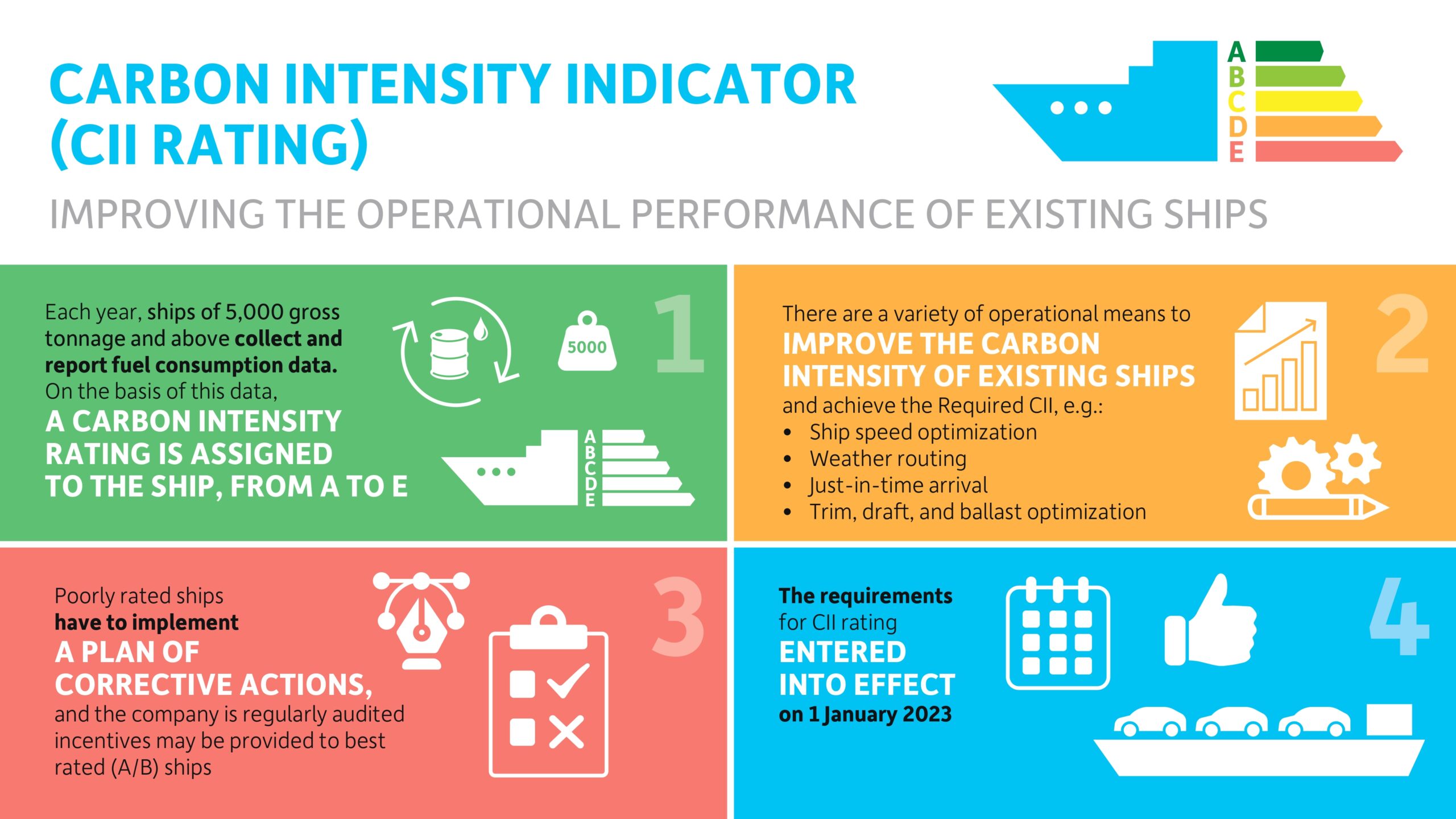
11. Carbon Intensity Indicator — CII
What is CII?
CII means:
Carbon Intensity Indicator
It measures the ship’s annual operational CO₂ efficiency.
Unlike EEXI, CII is not a one-time technical calculation. It is recalculated every year using actual operational data.
The first annual CII calculation covered the 2023 calendar year and was reported in 2024.
Simplified CII formula
For many ship types, the principal indicator is the Annual Efficiency Ratio:
[
\text{AER} =
\frac{\text{Annual CO₂ emissions}}
{\text{Ship capacity}\times\text{Distance travelled}}
]
Where:
- annual CO₂ is calculated from fuel consumed;
- capacity is normally deadweight or gross tonnage, depending on ship type;
- distance is the annual distance travelled.
A lower CII value normally indicates better carbon efficiency.
AER and cgDIST
Different ship types may use different capacity-based indicators.
| Indicator | Common application |
|---|---|
| AER | Cargo ships using deadweight as capacity |
| cgDIST | Cruise passenger ships and certain ro-ro passenger ships using gross tonnage |
CII is mainly a supply-based indicator. It generally uses the ship’s capacity rather than the actual cargo carried on every voyage.
Therefore, a ship can receive a poor CII rating even when operational circumstances, chartering arrangements or port delays reduce its practical utilisation.
12. Required annual CII
Each ship has:
- an attained annual CII; and
- a required annual CII.
The attained value is calculated from actual annual operations.
The required value becomes progressively stricter through reduction factors.
Reduction factors relative to the 2019 reference line
| Year | CII reduction factor |
|---|---|
| 2023 | 5% |
| 2024 | 7% |
| 2025 | 9% |
| 2026 | 11% |
| 2027 | 13.625% |
| 2028 | 16.250% |
| 2029 | 18.875% |
| 2030 | 21.500% |
The 2027–2030 factors were adopted by Resolution MEPC.400(83) following the review of the short-term GHG measure.
13. CII ratings
After calculating its annual CII, the ship receives a rating:
| Rating | Performance |
|---|---|
| A | Major superior |
| B | Minor superior |
| C | Moderate — compliant middle rating |
| D | Minor inferior |
| E | Inferior |
Ratings A, B and C are normally acceptable.
An A rating does not mean that the ship has zero emissions. It means that its carbon-intensity performance is good relative to the applicable boundaries.
When is a corrective-action plan required?
A ship must develop a corrective-action plan when it is:
- rated D for three consecutive years; or
- rated E for one year.
The plan must:
- identify why the required CII was not achieved;
- specify corrective measures;
- provide an implementation schedule;
- show how the ship will return to the required CII; and
- be included in a revised SEEMP Part III.
The revised SEEMP must be submitted for verification, normally no later than one month after reporting the attained annual CII.
14. How can a ship improve its CII?
Possible measures include:
- slow steaming;
- just-in-time arrival;
- weather routing;
- reducing waiting and idle time;
- optimising trim and ballast;
- hull cleaning;
- propeller polishing;
- engine maintenance;
- optimising auxiliary engines;
- using shore power;
- improving cargo utilisation;
- reducing ballast voyages;
- wind-assisted propulsion;
- waste-heat recovery;
- batteries and hybridisation;
- using a fuel with a lower CO₂ conversion factor; and
- improved coordination between shipowner, charterer, port and cargo interests.
CII and commercial responsibility
CII performance is not controlled only by the crew.
It may also be affected by:
- charter-party instructions;
- ordered speed;
- port congestion;
- berth availability;
- cargo availability;
- route selection;
- weather;
- time spent at anchor;
- hull condition;
- ship design; and
- company maintenance policy.
The master and chief engineer should accurately record and report performance, but commercial stakeholders must also support the ship’s improvement measures.
15. Voyage and CII correction factors
IMO permits certain correction factors and voyage adjustments so that exceptional operations do not unfairly affect CII.
Examples may include:
- adverse weather;
- safety-related operations;
- search and rescue;
- ice-edge voyages;
- ice-class operations;
- certain refrigerated cargo energy demands;
- cargo heating;
- shuttle-tanker operations;
- electrical consumption of specific cargo equipment; and
- other approved ship-type adjustments.
These corrections must be:
- permitted by the relevant IMO guidelines;
- supported by evidence;
- calculated correctly; and
- verified.
A company cannot invent its own correction factor.
16. EEDI, EEXI and CII compared
| Feature | EEDI | EEXI | CII |
|---|---|---|---|
| Full name | Energy Efficiency Design Index | Energy Efficiency Existing Ship Index | Carbon Intensity Indicator |
| Main focus | New-ship design | Existing-ship technical efficiency | Annual operation |
| Main data | Design and sea-trial data | Existing ship and machinery data | Actual fuel and distance data |
| Frequency | Mainly once | Mainly once | Every year |
| Basic result | g CO₂/capacity-mile | g CO₂/capacity-mile | g CO₂/capacity-mile |
| Compliance | Attained ≤ required | Attained ≤ required | Annual A–E rating |
| Improvement | Better design | Technical modification or power limitation | Operational and technical measures |
17. International Energy Efficiency Certificate
Ships subject to Chapter 4 survey and certification requirements receive an:
International Energy Efficiency Certificate — IEE Certificate
The certificate confirms applicable compliance with requirements such as:
- attained EEDI;
- attained EEXI;
- required EEDI or EEXI;
- SEEMP carriage; and
- relevant survey requirements.
The IEE Certificate generally remains valid for the life of the ship unless:
- the ship is withdrawn from service;
- a major conversion occurs;
- a new certificate is required;
- the ship changes flag; or
- another condition under Annex VI applies.
The IEE Certificate should not be confused with:
- IAPP Certificate;
- EIAPP Certificate; or
- annual DCS/CII Statement of Compliance.
18. Ship Energy Efficiency Operational Indicator — EEOI
EEOI means:
Energy Efficiency Operational Indicator
It is an older voluntary operational indicator.
A simplified form is:
[
\text{EEOI} =
\frac{\text{CO₂ emitted}}
{\text{Actual cargo carried}\times\text{Distance}}
]
The important difference is:
- CII/AER normally uses ship capacity;
- EEOI may use actual cargo transported.
EEOI remains useful for company analysis, but it is not the same as the mandatory annual CII rating.
The main guidance is MEPC.1/Circ.684.
19. IMO’s 2023 GHG Strategy
The 2023 IMO Strategy on Reduction of GHG Emissions from Ships was adopted by Resolution MEPC.377(80).
It establishes strategic ambitions rather than direct ship-by-ship statutory limits.
Main ambitions
Carbon intensity
Reduce the CO₂ intensity of international shipping by at least 40% by 2030, compared with 2008.
Zero- or near-zero-GHG fuels
Zero- or near-zero-GHG fuels, technologies or energy sources should represent at least:
- 5%, striving for 10%, of energy used by international shipping by 2030.
Total annual GHG emissions
Compared with 2008, international shipping should reduce total annual GHG emissions by:
| Year | Indicative checkpoint |
|---|---|
| 2030 | At least 20%, striving for 30% |
| 2040 | At least 70%, striving for 80% |
| By or around 2050 | Net-zero GHG emissions |
Important legal distinction
The IMO GHG Strategy provides policy direction, but its ambitions do not automatically become enforceable ship-level MARPOL obligations.
Mandatory requirements must be adopted through MARPOL amendments or another legally binding IMO instrument.
20. Lifecycle assessment of marine fuels
IMO has developed guidelines for assessing emissions across the complete fuel lifecycle.
The principal current document is:
Resolution MEPC.391(81) — 2024 Guidelines on Lifecycle GHG Intensity of Marine Fuels
The guidelines cover:
- well-to-tank emissions;
- tank-to-wake emissions;
- well-to-wake emissions;
- CO₂;
- methane;
- nitrous oxide;
- fuel-production pathways;
- electricity and other energy carriers;
- sustainability considerations; and
- the Fuel Lifecycle Label.
Why lifecycle assessment matters
Consider hydrogen:
- hydrogen produces no CO₂ when used in a fuel cell;
- but hydrogen made from unabated fossil gas may have high production emissions;
- renewable hydrogen can have much lower lifecycle emissions.
Similarly:
- LNG may reduce tank-to-wake CO₂ but methane slip can reduce its total GHG benefit;
- biofuel performance depends on feedstock and production pathway;
- ammonia produces no CO₂ during normal combustion, but its production and possible N₂O emissions must be considered;
- shore electricity is not automatically zero-GHG if generated from fossil fuels.
Therefore:
Zero carbon in the exhaust does not necessarily mean zero lifecycle GHG emissions.
21. Biofuels under DCS and CII
IMO has issued interim guidance for applying biofuels under Regulations 26, 27 and 28.
The current relevant circular is:
MEPC.1/Circ.905/Rev.1 — Revised interim guidance on the use of biofuels under the DCS and CII regulations
It addresses matters such as:
- acceptable sustainability certification;
- assignment of CO₂ conversion factors;
- fuel blends;
- documentation;
- reporting; and
- verification.
The ship must not simply enter a zero CO₂ factor because the fuel is described commercially as “biofuel.” The applicable IMO guidance, fuel pathway and evidence must be followed.
22. IMO Net-Zero Framework: status in July 2026
In April 2025, MEPC 83 approved a draft IMO Net-Zero Framework containing:
- a global marine-fuel GHG-intensity standard; and
- a global GHG emissions pricing mechanism.
It was intended to become a new Chapter 5 of MARPOL Annex VI.
However, the extraordinary MEPC session in October 2025 was adjourned before adoption. Discussions were scheduled to resume in 2026.
Therefore, as of July 2026:
- the framework had been approved in draft form;
- it had not yet been finally adopted as a MARPOL amendment;
- it was not yet in force; and
- ships were not yet legally required under MARPOL to pay the proposed global GHG price.
Students must distinguish carefully between:
- approved draft text;
- adopted MARPOL amendment;
- entry into force; and
- mandatory application.
IMO status of Net-Zero Framework discussions
23. Important 2025–2026 updates
MEPC 83 — 2025
Important developments included:
- adoption of stronger CII reduction factors for 2027–2030 through MEPC.400(83);
- amendments to SEEMP Guidelines through MEPC.401(83);
- amendments to EEDI survey and certification guidance through MEPC.403(83);
- approval, but not final adoption, of the IMO Net-Zero Framework.
MEPC 84 — 2026
Relevant adopted guidance included:
| Resolution | 2026 update |
|---|---|
| MEPC.410(84) | Amendments to EEDI calculation guidelines |
| MEPC.411(84) | New consolidated 2026 EEDI survey and certification guidelines |
| MEPC.412(84) | Amendments to CII indicators and calculation methods — G1 |
| MEPC.413(84) | Amendments to the 2024 SEEMP Guidelines |
Resolution MEPC.407(84) also adopted future amendments concerning:
- clarification of DCS and CII reporting entries;
- greater access to the IMO fuel-consumption database;
- the North-East Atlantic ECA; and
- the review clause for the short-term GHG measure.
These MARPOL amendments are expected to enter into force on 1 September 2027, subject to the acceptance procedure.
24. Principal IMO resolutions and circulars
The following table presents the principal current or operationally important instruments. Earlier documents that have been superseded need not normally be used as primary teaching references.
Core MARPOL amendments and strategies
| Instrument | Main subject |
|---|---|
| MEPC.203(62) | Introduced mandatory EEDI and SEEMP requirements |
| MEPC.278(70) | Introduced the IMO fuel-consumption DCS |
| MEPC.328(76) | 2021 Revised MARPOL Annex VI, including EEXI and CII |
| MEPC.377(80) | 2023 IMO GHG Strategy |
| MEPC.385(81) | More detailed IMO DCS and transport-work reporting |
| MEPC.407(84) | 2026 amendments concerning DCS access, reporting and review of short-term measures |
EEDI instruments
| Instrument | Main subject |
|---|---|
| MEPC.231(65) | EEDI reference-line calculation guidelines |
| MEPC.364(79) | 2022 attained EEDI calculation guidelines |
| MEPC.410(84) | 2026 amendments to attained EEDI calculation guidelines |
| MEPC.411(84) | 2026 EEDI survey and certification guidelines |
| MEPC.1/Circ.850/Rev.3 | Minimum propulsion power in adverse conditions |
| MEPC.1/Circ.896 | Treatment of innovative technologies in EEDI and EEXI |
| MEPC.1/Circ.901 | In-service performance measurements |
EEXI instruments
| Instrument | Main subject |
|---|---|
| MEPC.350(78) | 2022 attained EEXI calculation guidelines |
| MEPC.350(78) | 2022 EEXI survey and certification framework, as listed by IMO for the relevant application |
| MEPC.335(76) | Shaft/engine power-limitation and power-reserve guidelines |
| MEPC.375(80) | Amendments to power-limitation guidelines |
| MEPC.390(81) | Further amendments to power-limitation and power-reserve guidelines |
| MEPC.1/Circ.908 | Reporting use of a power reserve |
| MEPC.1/Circ.914 | Revised confirmation-of-compliance format connected with Regulation 5.4.5 |
SEEMP instruments
| Instrument | Main subject |
|---|---|
| MEPC.395(82) | 2024 SEEMP Guidelines |
| MEPC.401(83) | 2025 amendments to the SEEMP Guidelines |
| MEPC.413(84) | 2026 amendments to the SEEMP Guidelines |
| MEPC.347(78) | Verification and company audits of SEEMP Part III |
DCS and CII instruments
| Instrument | Main subject |
|---|---|
| MEPC.348(78) | Verification of fuel-consumption data and operational carbon intensity |
| MEPC.389(81) | Amendments to DCS and CII verification guidelines |
| MEPC.349(78) | Development and management of the IMO fuel-consumption database |
| MEPC.352(78) | CII indicators and calculation methods — G1 |
| MEPC.353(78) | CII reference lines — G2 |
| MEPC.338(76) | CII reduction factors — G3 |
| MEPC.400(83) | CII reduction factors for 2027–2030 |
| MEPC.354(78) | CII rating guidelines — G4 |
| MEPC.355(78) | Interim CII correction factors and voyage adjustments — G5 |
| MEPC.412(84) | 2026 amendments to CII calculation methods — G1 |
| MEPC.1/Circ.871/Rev.1 | DCS submissions from States not party to Annex VI |
| MEPC.1/Circ.905/Rev.1 | Biofuels under SEEMP, DCS and CII |
| MEPC.1/Circ.913 | Application of detailed transport-work and DCS reporting amendments |
| Circular Letter No.3827 | IMO DCS database user guidance |
| MEPC.1/Circ.684 | Voluntary EEOI Guidelines |
Lifecycle GHG instruments
| Instrument | Main subject |
|---|---|
| MEPC.376(80) | Initial 2023 lifecycle GHG guidelines |
| MEPC.391(81) | Current 2024 lifecycle GHG-intensity guidelines |
| MEPC.377(80) | Overall 2023 IMO GHG Strategy |
The authoritative consolidated index is maintained on the IMO MARPOL Annex VI resolutions and guidelines page.
25. Typical onboard responsibilities
Master
The master should:
- support implementation of the SEEMP;
- consider energy efficiency in voyage planning;
- coordinate with charterers and ports;
- ensure accurate voyage and distance records;
- balance energy efficiency with navigational safety; and
- avoid unsafe speed or power limitations.
Chief engineer
The chief engineer should:
- monitor fuel and machinery performance;
- maintain engines and energy-saving equipment;
- manage EPL or ShaPoLi;
- keep accurate fuel records;
- monitor flowmeters and tank quantities;
- optimise engine loading;
- investigate abnormal consumption;
- report power-reserve use; and
- contribute to SEEMP and CII improvement.
Company
The company should:
- establish data-quality procedures;
- verify ship reports;
- arrange hull and machinery maintenance;
- provide training;
- coordinate with charterers;
- establish CII improvement measures;
- prepare corrective-action plans; and
- submit verified data to the Administration.
26. Simple ship example
A 50,000-DWT tanker constructed in 2012 is subject to EEXI, SEEMP, DCS and CII.
Technical compliance
The company calculates the attained EEXI. It is higher than the required EEXI, so the ship installs an approved Engine Power Limitation system.
Following verification:
- the attained EEXI meets the required value;
- the Onboard Management Manual is approved;
- the IEE Certificate is endorsed or reissued as required.
Annual operation
During the year, the ship records:
- fuel consumed;
- fuel types;
- distance travelled;
- hours underway;
- transport-work information; and
- other required DCS data.
At the end of the year:
- CO₂ emissions are calculated;
- annual CII is determined;
- the CII is compared with the required value;
- the ship receives an A–E rating;
- the data are verified; and
- a Statement of Compliance is issued.
If the ship receives an E rating, its SEEMP Part III must be revised to include corrective actions.
27. Examination summary
Students should remember:
- Energy efficiency is regulated mainly by Chapter 4 of MARPOL Annex VI.
- EEDI applies mainly to new ships.
- EEXI applies mainly to existing ships.
- EEDI and EEXI are technical design-based measures.
- CII measures actual annual operational carbon intensity.
- SEEMP explains how the ship manages and improves efficiency.
- SEEMP Part I generally applies from 400 GT.
- DCS, SEEMP Part II and CII generally apply from 5,000 GT.
- SEEMP Part III applies to ships subject to CII.
- CII ratings are A, B, C, D or E.
- One E rating or three consecutive D ratings requires corrective action.
- The IMO DCS has collected fuel-consumption data since 2019.
- EEXI and CII requirements became mandatory from 2023.
- The 2027–2030 CII factors are stricter than those for 2023–2026.
- Lifecycle assessment includes CO₂, CH₄ and N₂O.
- The 2023 IMO GHG Strategy targets net-zero emissions by or around 2050.
- The proposed IMO Net-Zero Framework was not yet finally adopted as of July 2026.
- Safety and adequate propulsion power must not be sacrificed for efficiency.
In simple terms: EEDI controls the efficiency of new ship designs, EEXI controls the technical efficiency of existing ships, SEEMP organises energy management, DCS collects annual fuel data, and CII rates how efficiently the ship actually operates each year.