
Explore autonomous vessels, MASS, remote-controlled ships, and smart navigation systems. Learn how the autonomous ships market is evolving and why it is expected to grow through 2030.
From Crewed Ships to Intelligent Systems
Shipping is entering a new technological phase. For centuries, ships have depended on human crews for navigation, engineering, and decision-making. Today, digitalisation, artificial intelligence, and advanced sensors are transforming this model.
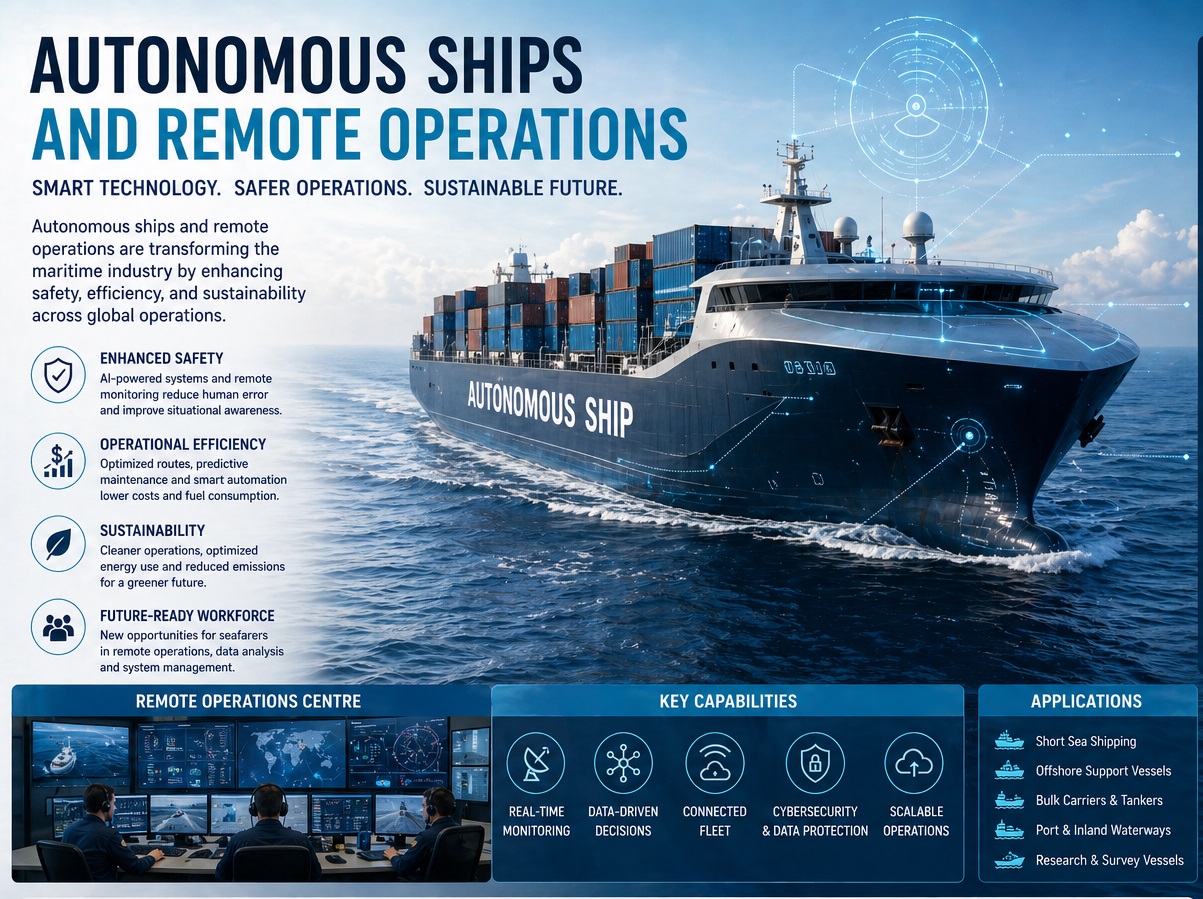
Autonomous ships—also known as Maritime Autonomous Surface Ships (MASS)—represent a shift toward data-driven, remotely managed, and potentially unmanned maritime operations. These technologies are not only about removing crew; they aim to improve safety, efficiency, and environmental performance. The autonomous ships market is expected to grow steadily through 2030, driven by innovation, regulatory development, and the need for more efficient global logistics.
What Are Autonomous Ships (MASS)?
The term MASS refers to ships that can operate with varying levels of autonomy, from decision-support systems for crews to fully unmanned vessels. The International Maritime Organization defines different degrees of autonomy:
- Ships with automated processes but crew onboard
- Remotely controlled ships with crew onboard
- Remotely controlled ships without crew onboard
- Fully autonomous ships capable of independent decision-making
This classification highlights that autonomy is not a single stage but a spectrum. Most current developments are focused on partially autonomous or remotely assisted ships, rather than fully autonomous ocean-going vessels.
Key Technologies Behind Autonomous Vessels
Autonomous shipping is built on a combination of advanced technologies working together as an integrated system.
Sensor Systems and Situational Awareness
Autonomous ships rely on multiple sensors to “see” and understand their surroundings. These include radar, LiDAR, cameras, GPS, and Automatic Identification System (AIS). By combining these data sources, ships can detect obstacles, track other vessels, and monitor environmental conditions.
Artificial Intelligence and Decision-Making
AI algorithms process sensor data to support or automate navigation decisions. These systems can assist with collision avoidance, route optimisation, and anomaly detection. Over time, machine learning systems can improve performance based on operational data.
Communication and Remote Control
Reliable communication is essential for remote operations. Satellite links, shore-based control centres, and cloud systems allow operators to monitor vessels and intervene when necessary. Remote-controlled ships rely heavily on these connections for safe operation.
Smart Navigation Systems
Smart navigation integrates digital charts, weather data, traffic information, and real-time vessel performance. This enables optimised routing, fuel savings, and improved safety. It also supports compliance with international navigation rules such as COLREGs.
Remote-Controlled Ships: The First Step Toward Autonomy
Fully autonomous ships are still under development, but remote-controlled vessels are already being tested and deployed in specific applications. In remote operations, the ship is controlled from a shore-based centre rather than onboard. This allows human operators to make decisions without being physically present on the vessel.
This model offers several advantages:
- Reduced onboard crew requirements
- Improved working conditions for operators
- Centralised fleet management
- Potential cost savings
However, it also introduces challenges. Communication delays, cyber security risks, and the need for reliable redundancy systems are critical concerns.
Unmanned Surface Vessels (USVs)
Unmanned Surface Vessels are typically smaller vessels designed to operate without onboard crew. They are already widely used in:
- Offshore inspection and maintenance
- Hydrographic surveys
- Environmental monitoring
- Naval and security operations
USVs are often easier to implement than large autonomous cargo ships because they operate in controlled environments or specific missions. They serve as important testing platforms for autonomous technologies that may later be scaled up to commercial shipping.
Market Growth and Industry Outlook
The autonomous ships market is expected to expand significantly through 2030. This growth is driven by several factors:
- Increasing demand for operational efficiency
- Advances in digital technologies and AI
- Pressure to reduce human error in accidents
- Need for cost optimisation in shipping operations
- Integration with smart ports and logistics systems
According to industry analyses and classification society outlooks, autonomous technologies will likely be introduced gradually, starting with decision-support systems and progressing toward higher levels of autonomy. Rather than a sudden shift to fully unmanned ships, the industry is expected to follow a step-by-step adoption pathway.
Benefits of Autonomous Shipping
Autonomous and remotely operated ships offer several potential advantages.
One of the most important is safety. Human error is a major factor in maritime accidents, and automation can reduce risks related to fatigue, miscommunication, and poor situational awareness.
Efficiency is another key benefit. Smart navigation systems can optimise routes, reduce fuel consumption, and improve voyage planning. Centralised control centres can manage multiple vessels simultaneously, improving fleet performance.
Autonomous systems may also support environmental goals by reducing fuel use and enabling better integration with digital decarbonisation strategies.
Challenges and Risks
Despite its potential, autonomous shipping faces significant challenges.
Regulatory and Legal Issues
Current maritime regulations are based on the assumption that ships are crewed. Adapting international conventions such as SOLAS and COLREGs to autonomous operations is complex and ongoing within the International Maritime Organization.
Safety and Reliability
Autonomous systems must operate safely in complex and unpredictable environments. This includes congested traffic areas, extreme weather, and emergency situations.
Cyber Security
Digital systems are vulnerable to cyber threats. Protecting navigation, communication, and control systems is essential for safe operation.
Human Factors
Even in autonomous systems, humans remain involved in design, monitoring, and remote control. Training, competence, and interface design are critical to ensure safe interaction between humans and machines.
Practical Example: Autonomous Short-Sea Shipping
A realistic early application of autonomous shipping is short-sea or coastal trade. In such operations, vessels travel on fixed routes between known ports, making it easier to manage navigation and communication.
For example, a remotely controlled cargo vessel operating between two ports in Northern Europe could be monitored from a shore control centre. The vessel may use automated navigation for most of the voyage, with human intervention only when needed.
This hybrid approach reduces crew requirements while maintaining human oversight, making it a practical transition step toward higher autonomy.
The Future of Smart Navigation
Smart navigation will play a central role in the evolution of autonomous shipping. Future systems are expected to integrate:
- Real-time traffic data from multiple vessels
- Advanced weather forecasting models
- Predictive maintenance systems
- Digital twins of ships and voyages
These systems will not only improve safety but also enable better coordination between ships, ports, and logistics networks. Autonomous vessels will likely become part of a broader smart maritime ecosystem, connected to digital ports, automated terminals, and integrated supply chains.
Conclusion: A Gradual but Transformative Shift
Autonomous ships and remote operations represent a major transformation in the maritime industry. While fully unmanned ocean-going vessels may still take time to become widespread, the building blocks are already in place.
The industry is moving toward a hybrid future where automation supports human decision-making, remote control complements onboard operations, and digital systems enhance safety and efficiency. For maritime professionals, understanding autonomous technologies is becoming essential. The ships of the future will not only be powered by new fuels but also guided by intelligent systems that redefine how navigation and operations are performed.
Frequently Asked Questions (FAQ)
What are autonomous ships?
Autonomous ships are vessels that use advanced systems to operate with reduced or no human intervention.
What does MASS mean?
MASS stands for Maritime Autonomous Surface Ships, a term used by the IMO to classify levels of ship autonomy.
Are fully autonomous ships already in use?
Fully autonomous large commercial ships are still under development, but partial autonomy and remote operations are already being tested.
What are unmanned surface vessels used for?
They are used for surveys, offshore operations, environmental monitoring, and defence applications.
Will autonomous ships replace seafarers?
Automation will change roles rather than completely replace them. New skills in remote operations, data analysis, and system management will become important.
References
- International Maritime Organization – MASS regulatory scoping exercise and autonomy definitions
- DNV – Maritime Forecast and digitalisation outlook
- European Maritime Safety Agency – Studies on digitalisation and autonomous shipping
- Rolls-Royce Marine. Autonomous Ships: The Next Step
- Wärtsilä. Smart Marine and Autonomous Shipping Solutions
- OECD/ITF. Maritime Autonomous Surface Ships Report