
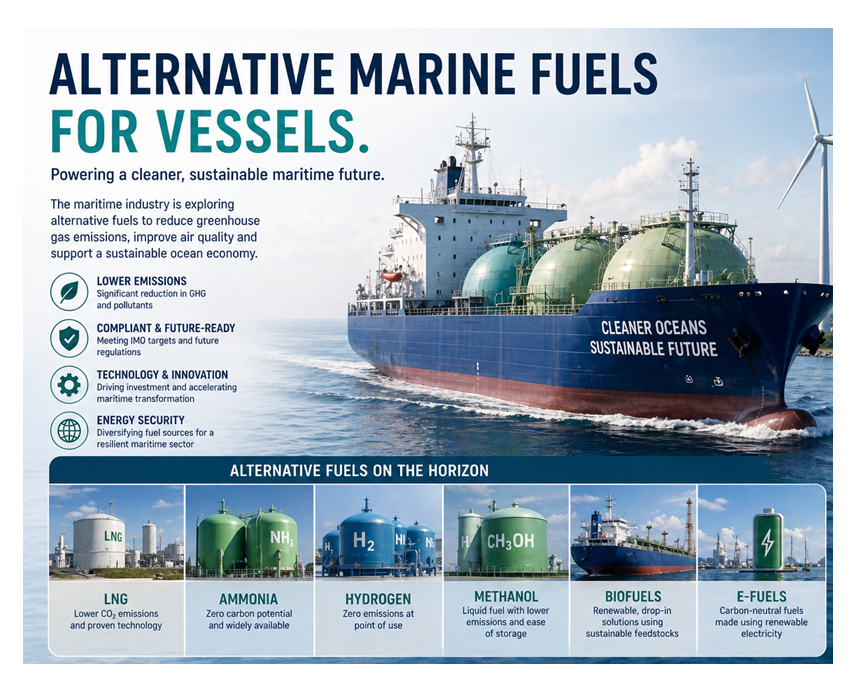
Explore the main alternative marine fuels shaping green shipping, including ammonia-fuelled ships, methanol ships, LNG as a transition fuel, hydrogen in shipping, and biofuels for vessels.
Why Alternative Marine Fuels Matter
Shipping is entering a new fuel era. For more than a century, most commercial ships have depended on fossil marine fuels such as heavy fuel oil, marine diesel oil, and marine gas oil. These fuels are energy-dense, globally available, and supported by mature bunkering infrastructure. However, they also produce greenhouse gas emissions and air pollutants.
The pressure to reduce emissions is now changing the economics and technology of ship operation. The IMO’s 2023 GHG Strategy targets net-zero greenhouse gas emissions from international shipping by or around 2050, while regulations such as FuelEU Maritime and the EU ETS are already affecting shipowners trading to Europe. This means alternative marine fuels are no longer only experimental options; they are becoming central to fleet strategy, newbuilding decisions, and long-term competitiveness.
Alternative fuels are not all the same. Some reduce emissions only partly, while others may offer near-zero emissions if produced from renewable energy. Some are easier to use in existing engines, while others require new ship designs, new safety rules, new bunkering infrastructure, and crew training. The future of shipping will probably not depend on one universal fuel, but on a mix of solutions matched to ship type, route, cargo, regulation, and fuel availability.
What Makes a Marine Fuel “Alternative”?
An alternative marine fuel is any fuel or energy carrier used to reduce dependence on conventional petroleum-based marine fuels. In shipping, the term usually refers to fuels that can reduce greenhouse gas emissions, air pollution, or both.
However, the environmental value of an alternative fuel depends on its full lifecycle. A fuel may look clean at the ship’s exhaust, but still create emissions during production, transport, or storage. For example, hydrogen and ammonia produce no carbon dioxide at the point of use, but if they are produced from fossil natural gas without carbon capture, their lifecycle benefit may be limited. Similarly, methanol can be fossil-based, bio-based, or produced synthetically from renewable hydrogen and captured carbon.
For this reason, modern fuel assessment must consider the full well-to-wake pathway, not only the emissions from the ship’s funnel. This is also why FuelEU Maritime focuses on the greenhouse gas intensity of energy used onboard ships rather than only measuring fuel consumption.
Comparing the Main Alternative Marine Fuels
| Fuel | Main advantage | Main challenge | Likely role in shipping |
|---|---|---|---|
| LNG | Mature technology and growing bunkering network | Methane slip and fossil-fuel dependence | Transition fuel for some deep-sea segments |
| Methanol | Liquid at ambient conditions and easier storage than cryogenic fuels | Green methanol supply and cost | Strong option for container ships, tankers, and retrofits |
| Ammonia | No carbon in the fuel molecule | Toxicity, safety, engine maturity, NOx/N₂O control | Long-term option for deep-sea zero-carbon shipping |
| Hydrogen | Zero carbon at point of use | Storage volume, cryogenic/compressed systems, infrastructure | Short-sea shipping, ferries, offshore and special vessels |
| Biofuels | Can be used in some existing engines | Sustainable supply and competition with other sectors | Near-term compliance and drop-in fuel option |
LNG as a Transition Fuel
Liquefied natural gas is currently one of the most established alternative fuels in shipping. LNG-fuelled vessels already operate in container shipping, cruise, ferries, tankers, and offshore vessels. Its main advantage is that the technology is mature compared with many other alternatives. LNG engines, tanks, fuel gas supply systems, and bunkering procedures are already commercially available.
LNG can reduce sulphur oxides and particulate matter significantly compared with conventional heavy fuel oil. It can also reduce carbon dioxide emissions at the ship level. However, LNG is still a fossil fuel, and its climate benefit depends heavily on controlling methane slip. Methane is a powerful greenhouse gas, and unburned methane released from engines or supply chains can reduce the climate advantage of LNG.
This is why LNG is often described as a transition fuel rather than a final net-zero solution. It may help shipowners reduce some emissions in the short and medium term, especially where infrastructure already exists, but it must be connected to a longer-term pathway such as bio-LNG, synthetic methane, or future fuel conversion. Recent market analysis indicates that LNG demand as a marine fuel is expected to grow strongly toward 2030, partly because its infrastructure is more developed than methanol or ammonia bunkering in many regions.
Methanol Ships: A Practical Low-Carbon Pathway
Methanol is becoming one of the most attractive alternative fuels for new ship orders and retrofit discussions. One reason is practicality. Methanol is a liquid at normal temperature and pressure, so it is easier to store and handle than cryogenic fuels such as LNG or liquid hydrogen. It can also be used in modified internal combustion engines.
Methanol-fuelled ships are especially relevant for container vessels, tankers, ferries, and vessels operating on defined routes where fuel supply can be planned. Several major shipping companies have ordered methanol-capable vessels, showing that the fuel is moving from concept to commercial deployment.
The main limitation is not the ship technology alone; it is the supply of low-carbon methanol. Conventional methanol is commonly produced from fossil natural gas or coal. To support deep decarbonisation, shipping needs bio-methanol or e-methanol produced from renewable hydrogen and sustainable carbon sources. These fuels are still expensive and not yet available at the scale needed for global shipping.
Methanol also has safety considerations. It is toxic and flammable, so ship design must include suitable containment, ventilation, leak detection, fire protection, and crew procedures. The IMO has been developing safety guidance for alternative fuels, including low-flashpoint fuels, to support safer adoption.
Ammonia-Fuelled Ships: High Potential, High Safety Demand
Ammonia is one of the most discussed future fuels for deep-sea shipping. It contains no carbon, so it does not produce CO₂ when used as a fuel. If produced from renewable hydrogen, green ammonia could become a major zero-carbon energy carrier for long-distance shipping.
Its biggest advantage is energy storage. Ammonia is easier to store than hydrogen and already has a global industrial supply chain because it is widely used in fertiliser production. This makes it attractive for large ships that require high energy capacity over long voyages.
However, ammonia introduces serious challenges. It is toxic, corrosive, and hazardous to humans and marine life. Safe ship design must prevent leaks, protect crew, manage ventilation, control emergency release scenarios, and ensure suitable bunkering procedures. Engine technology is also still developing, and emissions such as nitrogen oxides and nitrous oxide must be carefully controlled.
The IMO issued interim guidelines for the safety of ships using ammonia as fuel in 2025, reflecting both the fuel’s potential and the need for a structured safety framework. EMSA also released safety-focused studies on ammonia and hydrogen as ship fuels in January 2026, showing that safety assessment remains a central issue for these fuels.
Hydrogen in Shipping
Hydrogen is often presented as the cleanest fuel because it produces no carbon dioxide at the point of use. It can be used in fuel cells to generate electricity or in modified combustion engines. For maritime use, hydrogen is especially interesting for ferries, harbour craft, offshore support vessels, inland vessels, and short-sea routes.
The main technical difficulty is storage. Hydrogen has low volumetric energy density, meaning it needs much more storage volume than conventional fuels. It can be stored as compressed gas or as cryogenic liquid, but both options require special tanks, safety systems, and energy-intensive handling. Liquid hydrogen must be kept at extremely low temperatures, while compressed hydrogen requires high-pressure systems.
Hydrogen also demands strict safety management because it is highly flammable, has small molecules that can leak easily, and may create invisible flames. For this reason, hydrogen adoption will likely begin in controlled route applications where bunkering, maintenance, crew training, and emergency response can be carefully managed.
Hydrogen may also play an indirect role in shipping by serving as the building block for e-fuels such as e-methanol, e-ammonia, and synthetic methane. In that sense, hydrogen could be important even if pure hydrogen ships remain limited to specific vessel types. EMSA’s recent safety work confirms that hydrogen’s maritime role must be developed with strong risk management and technical standards.
Biofuels for Vessels
Biofuels are among the most practical near-term options because some can be blended with or substituted for conventional marine fuels with limited engine modifications. They may help shipowners reduce carbon intensity while waiting for new fuel infrastructure and zero-emission technologies to mature.
Marine biofuels can include biodiesel, hydrotreated vegetable oil, bio-LNG, bio-methanol, and other fuels produced from biomass or waste streams. Their advantage is flexibility. In some cases, they can be used in existing engines, stored in existing tanks, and distributed through familiar bunkering systems.
The key issue is sustainability. Not all biofuels are automatically low-carbon or environmentally beneficial. Their value depends on feedstock type, land-use impact, production method, certification, and supply-chain emissions. Sustainable waste-based biofuels may offer strong benefits, but global supply is limited and other sectors such as aviation and road transport also compete for them.
EMSA has highlighted biofuels as an important area of study, examining production capacity, storage and distribution infrastructure, power-generation technologies, techno-economic factors, and risk-based case studies for maritime use.
Safety and Regulation for Alternative Marine Fuels
Alternative fuels introduce new safety questions. Conventional fuel oil is hazardous, but crews, ports, and regulators have more than a century of experience managing it. New fuels require different risk controls.
The IMO’s safety work on alternative fuels is overseen by the Maritime Safety Committee, including guidelines for fuels and technologies that are not yet fully covered by mandatory codes. The IGF Code provides the main international framework for ships using gases or other low-flashpoint fuels, but several new fuels still require interim guidelines and risk-based approval methods until detailed mandatory requirements are fully developed.
For shipowners, this means alternative-fuel projects require early engagement with classification societies, flag states, engine makers, ports, fuel suppliers, and insurers. Design approval, hazard identification, risk assessment, emergency response planning, and crew competence are all essential.
Choosing the Right Alternative Fuel
There is no single best alternative marine fuel for every ship. The right choice depends on a combination of technical, operational, commercial, and regulatory factors.
| Decision factor | Why it matters |
|---|---|
| Vessel type and route | Deep-sea ships need high energy density; short-sea vessels can use more frequent bunkering |
| Remaining ship life | Older ships may favour drop-in fuels; newbuildings may justify major fuel-system changes |
| Fuel availability | A fuel is only practical if reliable bunkering exists on the trading route |
| Lifecycle emissions | Low exhaust emissions are not enough; production emissions must also be assessed |
| Safety and crew training | Toxic, cryogenic, or highly flammable fuels require new competence and procedures |
| Regulation and carbon cost | EU ETS, FuelEU Maritime, IMO measures, and charterer requirements influence fuel economics |
| Capital expenditure | Tanks, engines, piping, safety systems, and retrofits can be expensive |
A shipowner operating ferries on fixed routes may consider batteries, hydrogen, or methanol. A deep-sea bulk carrier may examine ammonia, methanol, LNG dual-fuel, biofuel blends, or onboard carbon capture. A tanker with long remaining life may use biofuels first and prepare for future conversion. The best strategy is often flexible and phased rather than based on one immediate solution.
Future Outlook: A Multi-Fuel Maritime Industry
The future marine fuel landscape will likely be diverse. DNV’s Maritime Forecast to 2050 notes that alternative-fuelled ships are gaining capacity, but fuel supply and infrastructure must match industry ambition. DNV also reports a shift in which LNG and methanol are gaining traction, while ammonia, hydrogen, and onboard carbon capture are entering early trials.
This suggests a realistic transition pattern. LNG and biofuels may support near-term compliance for some vessels. Methanol may expand quickly where supply chains develop. Ammonia may become important for deep-sea zero-carbon shipping if safety and engine challenges are solved. Hydrogen may grow in short-sea and special-vessel applications, while also supporting production of synthetic fuels.
The industry’s success will depend not only on ship technology, but also on fuel production, port infrastructure, financing, regulation, and crew training.
Conclusion: Alternative Fuels Are Reshaping Ship Design and Operation
Alternative marine fuels are now central to the future of shipping. Ammonia, methanol, LNG, hydrogen, and biofuels each offer opportunities, but each also has limitations. No single fuel can solve every problem across all vessel types and trade routes.
For maritime professionals, the key is to understand fuel pathways, lifecycle emissions, safety requirements, infrastructure needs, and regulatory drivers. The ships of the future will not only be designed around engines and cargo capacity; they will be designed around fuel strategy.
Green shipping will require practical decisions, not slogans. The most successful companies will combine energy efficiency, digital optimisation, alternative fuels, safety management, and flexible investment planning.
Frequently Asked Questions
What are alternative marine fuels?
Alternative marine fuels are fuels used to reduce reliance on conventional fossil marine fuels. They include LNG, methanol, ammonia, hydrogen, biofuels, and synthetic fuels.
Are ammonia-fuelled ships zero-emission?
Ammonia contains no carbon and produces no CO₂ at the point of use, but its lifecycle emissions depend on how the ammonia is produced. Green ammonia made from renewable hydrogen has the strongest decarbonisation potential.
Why is methanol popular in shipping?
Methanol is liquid at normal conditions, easier to store than cryogenic fuels, and can be used in modified engines. Its climate benefit depends on whether it is fossil methanol, bio-methanol, or e-methanol.
Is LNG a green fuel or a transition fuel?
LNG is generally considered a transition fuel. It can reduce some emissions compared with heavy fuel oil, but it is still fossil-based and methane slip remains a major climate concern.
Can existing ships use biofuels?
Some biofuels can be blended with conventional marine fuels and used in existing engines, depending on fuel quality, engine approval, compatibility, and certification.
References
International Maritime Organization. Alternative Fuel and Technology Safety Guidelines.
DNV. Maritime Forecast to 2050.
DNV. Net-zero Shipping: Key Findings from the Maritime Forecast to 2050.
European Maritime Safety Agency. Sustainable Shipping: Alternative Sources of Power.
European Maritime Safety Agency. New Reports on the Safety of Ammonia and Hydrogen as Fuels in Shipping.
IMO / BIMCO summary. Interim Guidelines for the Safety of Ships Using Ammonia as Fuel.
IMO MSC.1/Circ.1687. Interim Guidelines for the Safety of Ships Using Ammonia as Fuel.
Reuters. LNG Demand for Ships Set to at Least Double by 2030 Globally