
09/28/2026
Regulatory uncertainty is reshaping maritime investment decisions
Shipping’s energy transition is entering a new phase. Technologies such as LNG, methanol, biofuels, wind-assisted propulsion and, increasingly, ammonia are moving beyond the conceptual stage and becoming commercially relevant options.
The challenge for shipowners is therefore changing. It is no longer simply a question of identifying available technologies. Increasingly, the difficulty lies in deciding when, where and how to invest while the future regulatory framework remains uncertain.
DNV’s Maritime Forecast to 2050 – 2026 edition highlights regulatory uncertainty as an increasingly important factor influencing fleet strategy. Decisions being made today regarding vessel design, retrofits, fuel flexibility and propulsion systems could affect the competitiveness of ships for decades. At the same time, ongoing international and regional regulatory developments may substantially alter the economics of different decarbonization pathways. Building resilience in shipping…
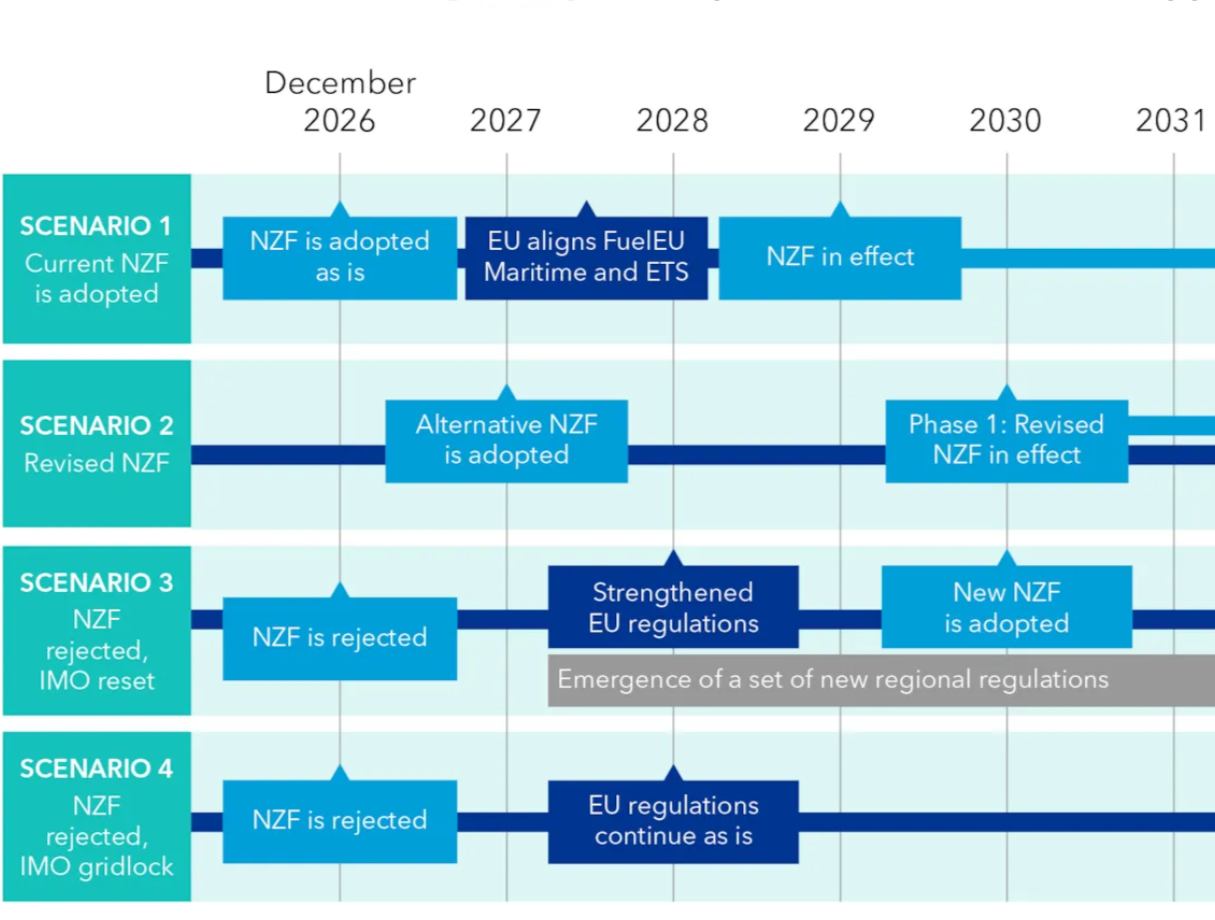
Four possible regulatory futures for international shipping
Credit: DNV
Rather than predicting a single regulatory outcome, DNV examines four possible scenarios for the evolution of greenhouse-gas regulation in international shipping.
These scenarios range from full implementation of the IMO Net-Zero Framework to its rejection and a prolonged period of regulatory uncertainty. Intermediate possibilities include a revised or delayed framework and situations in which regional measures, particularly European regulations, assume a stronger role. Building resilience in shipping…
The scenario chart presented on page 3 illustrates how different regulatory pathways between 2026 and 2035 could affect the timing and interaction of IMO and EU measures.
The implications are considerable. Stronger global regulation would accelerate demand for low-GHG fuels and improve the commercial attractiveness of energy-efficiency technologies. Conversely, weaker or delayed regulation could slow investment and fuel-market development.
For shipowners, this means that fleet strategy should increasingly focus on resilience across several possible regulatory futures, rather than relying on one assumed fuel pathway. Building resilience in shipping…
Energy efficiency remains one of the most robust investment strategies
One particularly important conclusion from DNV’s analysis is that energy-efficiency improvements can create value under virtually all regulatory scenarios.
The potential is not limited to newbuildings. Existing vessels can achieve significant reductions in fuel consumption through carefully selected retrofits, especially when installations are coordinated with scheduled dry-docking periods.
DNV examines a hypothetical 15-year-old, 5,000 TEU containership and considers an investment of approximately USD 2.35 million in hydrodynamic improvements, including:
- a bow retrofit;
- a propeller upgrade; and
- installation of a propeller boss cap fin.
Under the modelling assumptions, these measures could reduce fuel consumption by around 16%. Depending on the assumed price of low-sulphur heavy fuel oil, the estimated payback period ranges from approximately 1.4 to 4.2 years. Building resilience in shipping… Building resilience in shipping…
The graph on page 4 illustrates cumulative net cash flow for the retrofit under three fuel-price scenarios. At the highest assumed fuel price, the payback period falls to around 1.4 years, compared with approximately 4.2 years under the lowest-price scenario.
A potential USD 10 million retrofit opportunity
The longer-term economic case can be even more significant.
According to the modelling presented by DNV, the net present value of the resulting savings could reach approximately USD 2 million to USD 10 million by 2038, depending on fuel-price conditions.
Importantly, these estimates do not include the additional economic impact of compliance mechanisms such as the EU Emissions Trading System (EU ETS) and FuelEU Maritime. Incorporating these costs could further strengthen the financial case for efficiency improvements. Building resilience in shipping…
This distinction is important. Fuel-choice decisions may depend heavily on regulation, infrastructure and fuel availability, whereas many efficiency investments can generate economic and environmental benefits regardless of which fuel eventually dominates.
Measuring whether efficiency improvements actually work
Technical investments must also deliver measurable improvements in real operating conditions.
DNV therefore emphasizes the importance of standardized performance measurement and verification. Its Vessel Technical Index (VTI), introduced through Recommended Practice DNV-RP-0675, provides a normalized propulsion-power indicator intended to distinguish a vessel’s technical condition from external influences such as weather and operating speed. Building resilience in shipping…
An example presented in the report demonstrates how performance monitoring can quantify the effect of routine hull and propeller maintenance.
Sensor data from a chartered vessel indicated that hull and propeller cleaning reduced the mean VTI from approximately 1.32 to 1.14, relative to an “as-new” reference value of 1.00. Building resilience in shipping…
Over a subsequent 33-day voyage, the improvement was associated with approximately:
120 tonnes of fuel saved
At a fuel price of USD 470 per tonne, this represented approximately:
USD 56,000 in fuel-cost savings
compared with a cleaning cost of roughly:
USD 14,000
The fuel saving was therefore around four times the cleaning expenditure. Building resilience in shipping…
The chart on page 5 provides a useful visual comparison of VTI values before and after cleaning and demonstrates how operational data can support evidence-based maintenance decisions.
Alternative-fuel-capable shipping is expanding rapidly
The global order book also points toward a significant transition in propulsion and fuel technology.
According to DNV, the proportion of global gross tonnage represented by alternative-fuel-capable vessels increased from approximately 0.4% in 2020 to 5.2% in 2026. Building resilience in shipping…
However, adoption differs substantially between ship segments.
Among the figures reported:
| Vessel segment | Approximate alternative-fuel-capable share |
|---|---|
| Car carriers | 26% |
| Cruise ships | 19% |
| Containerships | 11% |
| Bulk carriers | 1.1% |
| Tankers | approximately 1.2–5% |
The slower uptake among bulk carriers and tankers is partly associated with tramp trading patterns and greater uncertainty regarding the availability of alternative fuels along less predictable trading routes. Building resilience in shipping…
LNG and methanol currently dominate
The fleet statistics illustrated on page 6 show that LNG remains the largest alternative-fuel technology by vessel numbers, with methanol, LPG, battery/hybrid systems and emerging ammonia and hydrogen technologies also appearing in the fleet and order book.
DNV notes, however, that installed dual-fuel capability does not necessarily mean that vessels operate routinely on alternative fuels.
Many dual-fuel vessels continue to consume conventional marine fuels because alternative fuels remain relatively expensive and regulatory incentives may not yet be sufficiently strong. Dual-fuel capability therefore often functions as a form of future-proofing and operational flexibility rather than evidence of continuous low-GHG fuel consumption. Building resilience in shipping…
This distinction is important when interpreting alternative-fuel order-book statistics.
How much low-GHG fuel could shipping require?
The regulatory outcome will have a major effect on future fuel demand.
DNV estimates that maritime demand for low-GHG fuels in 2050 could range from approximately:
33 million tonnes of oil equivalent (Mtoe)
to as much as: 185 Mtoe
depending on regulatory ambition and the level of energy-efficiency improvement achieved across the fleet. Building resilience in shipping…
The chart on page 7 demonstrates this contrast clearly: under a high-demand regulatory scenario, low-GHG fuels could become a major component of shipping’s energy consumption by 2050, whereas under a scenario with weaker global regulation, fossil fuels remain dominant.
Shipping will compete with other sectors for green fuels
Fuel availability represents another major strategic challenge.
DNV estimates that total low-GHG fuel demand across all sectors could exceed 2,200 Mtoe under a net-zero pathway.
Shipping will therefore compete with aviation, road transport, electricity generation and industrial sectors for many of the same renewable fuels, feedstocks and energy resources. Building resilience in shipping…
Biofuels illustrate the problem particularly well.
They are currently among the more economically attractive options for maritime decarbonization, but sustainable biomass resources are inherently constrained. Growing cross-sector demand could therefore increase prices and limit the availability of sustainable feedstocks.
DNV consequently anticipates a growing need for more expensive pathways, including certain blue fuels and e-fuels, as the global energy transition progresses. Building resilience in shipping…
Bunkering infrastructure remains a critical bottleneck
Fuel technology cannot be evaluated independently of infrastructure.
For shipowners, charterers, financiers and insurers, the ability to obtain the selected fuel along realistic trading routes remains fundamental to determining whether a propulsion concept is commercially viable.
There has nevertheless been considerable progress.
The number of operational LNG bunkering vessels increased from 25 in 2020 to 67 in 2026. At the same time, 24 methanol bunkering vessels were reported as operating, with a further eight on order. DNV also notes that the first dedicated ammonia bunkering vessel had entered the order book for future operation in Singapore. Building resilience in shipping…
The graph on page 8 shows the rapid growth in the global LNG and methanol bunkering-vessel fleet since 2020.
Fuel availability remains geographically concentrated
Growth in bunkering infrastructure should not, however, be interpreted as universal availability.
Low-GHG bunkering remains heavily concentrated around major European and East Asian shipping corridors.
DNV reports that some form of low-GHG bunkering has taken place at almost 90 ports worldwide, but availability varies substantially by fuel type. Building resilience in shipping…
The reported distribution is approximately:
| Low-GHG fuel | Reported port availability |
|---|---|
| Biodiesel, including FAME and HVO | Nearly 70 ports |
| Liquefied biomethane | 20 ports |
| Low-GHG methanol | 16 ports |
| Low-GHG ammonia | 3 ports |
Biodiesel therefore currently has the widest geographical coverage, while biomethane is concentrated mainly in Europe and methanol bunkering is centred principally on East Asia and Western Europe. Low-GHG ammonia bunkering remains at a very early stage, with the reported activity concentrated in East Asia. Building resilience in shipping…
Building resilient fleets rather than betting on a single fuel
Perhaps the most important message emerging from DNV’s analysis is that there may be no universally optimal fuel strategy for the entire maritime sector.
Ship type, trading pattern, vessel age, fuel infrastructure, technology maturity, regulatory exposure and commercial arrangements will all influence the preferred solution.
Fleet resilience may therefore depend on combining several approaches:
Energy efficiency first. Reducing the amount of energy required for transport lowers both fuel expenditure and future compliance exposure.
Fuel flexibility. Dual-fuel or fuel-ready designs can reduce the risk associated with committing prematurely to a single energy pathway.
Verified operational performance. Monitoring systems and standardized indicators can demonstrate whether efficiency investments are delivering their intended benefits.
Strategic retrofitting. Existing ships will remain an important part of the world fleet for many years, making technically and economically viable retrofits essential.
Infrastructure-aware fuel strategies. Fuel selection must consider where vessels actually trade and whether adequate bunkering infrastructure exists along those routes.
Scenario-based investment planning. Investment decisions should remain viable across a reasonable range of regulatory and fuel-price conditions.
DNV summarizes the challenge as one of developing fuel and technology strategies capable of remaining competitive across different regulatory outcomes, while simultaneously creating stronger demand signals and expanding the infrastructure required for maritime decarbonization. Building resilience in shipping…
Conclusion
Shipping’s energy transition is increasingly moving from a technology-selection problem to a strategic resilience problem.
Alternative fuels are becoming commercially available, but their economics, supply chains and regulatory treatment remain uncertain. At the same time, the fleet still contains substantial untapped energy-efficiency potential.
The strongest near-term strategy may therefore be to avoid relying exclusively on predictions about which fuel will ultimately dominate. Shipowners can instead build resilience through energy-efficiency improvements, flexible vessel designs, verified technical performance, carefully timed retrofits and fuel strategies aligned with realistic trading routes.
The analysis also demonstrates that decarbonization and commercial competitiveness do not necessarily conflict. In the example examined by DNV, a 16% fuel-efficiency improvement on an older containership could generate a relatively short payback period and potentially several million dollars in long-term economic value.
For an industry facing uncertain regulation, fuel availability and technology development, investments that reduce energy demand while retaining future flexibility may therefore represent some of the most robust decisions available today.
–
Source: Adapted and developed from DNV, Maritime Impact, “New research shows how regulation could reshape shipping,” 24 September 2026