
Liquefied natural gas (LNG) is natural gas cooled to about -162°C so that it becomes a liquid occupying roughly one six-hundredth of its gaseous volume. Liquefaction makes long-distance transport possible where pipelines are unavailable or uneconomic. The value chain is capital-intensive and technically integrated: upstream production and treatment must match liquefaction specifications; ships and storage systems must control cryogenic hazards and boil-off gas; and downstream terminals must convert LNG back to gas or distribute it as a liquid.
LNG can improve local air quality and reduce carbon dioxide emissions when it displaces coal or oil, but its climate performance depends strongly on upstream emissions, methane leakage, liquefaction energy, shipping efficiency and engine methane slip. It should therefore be assessed on a well-to-wake basis, not only at the point of combustion. Low-carbon variants depend on verified biomethane, renewable synthetic methane or carbon capture and storage, supported by credible lifecycle accounting.
- Upstream: exploration, production, separation, contaminant removal and, increasingly, floating LNG development.
- Midstream: liquefaction, pipeline or marine transport, cryogenic containment, boil-off management and small-scale distribution.
- Downstream: receiving, storage, regasification and delivery to power, heating, industrial, transport and chemical markets.
- Cross-cutting priorities: safety, methane control, lifecycle greenhouse-gas performance, security of supply and commercial flexibility.
1. Upstream: finding and preparing natural gas
Exploration and production
Natural gas occurs in dedicated reservoirs, with crude oil as associated gas, and in unconventional formations such as shale and coal seams. Exploration combines geological mapping, seismic surveys and appraisal drilling to establish reservoir quality, fluid composition, recoverable volumes and development risk. Production may be onshore or offshore; offshore projects require wells, subsea or platform facilities, export systems and reliable access for maintenance.
Unconventional production may use hydraulic fracturing, in which high-pressure fluid creates pathways through low-permeability rock and proppant keeps the fractures open. Its commercial impact has been significant, particularly in North America, but water use, wastewater management, induced seismicity, land impacts and fugitive methane emissions require careful control and transparent monitoring.
Gas processing
Reservoir fluids cannot normally enter a liquefaction plant directly. Initial treatment removes sand and separates gas, oil and produced water, often through staged pressure reduction. Compression then brings the gas to the pressure needed for further treatment. Heavy hydrocarbons are removed or recovered as natural-gas liquids because they may freeze in cryogenic equipment and because the finished LNG must meet heating-value and composition specifications.
Acid gases, especially carbon dioxide and hydrogen sulphide, are commonly removed by an absorption process such as amine treatment. Mercury must be removed to protect aluminium heat exchangers, while water is eliminated—often with molecular sieves—to prevent ice and hydrate formation. The resulting feed gas is predominantly methane with controlled concentrations of nitrogen and heavier hydrocarbons. There is no single global LNG specification, so lean and rich LNG compositions must be matched to plant design and receiving-market requirements.
Floating LNG
Floating LNG (FLNG) places gas treatment, liquefaction, storage and offloading close to an offshore field. It can unlock remote or stranded resources and avoid long offshore pipelines and extensive onshore infrastructure. The concept also allows fabrication in a shipyard and, in some cases, redeployment. Its challenges are equally substantial: compact topsides, limited storage, marine motion, offloading availability, maintenance access, personnel safety and the integration of hydrocarbon processing with a floating structure. Maritime classification societies support design review, risk assessment, construction verification and assurance against applicable marine and offshore standards.
2. Midstream: liquefaction and transport
Liquefaction
Liquefaction removes heat from treated natural gas through successive refrigeration stages until methane condenses near -162°C at atmospheric pressure. Commercial plants use refrigerant cycles based on propane, mixed refrigerants, nitrogen or combinations of these. Process selection reflects plant scale, feed composition, ambient conditions, efficiency, equipment availability and operational flexibility. Refrigeration compressors are the principal energy consumers, making driver efficiency and heat integration central to both cost and emissions.
LNG is transferred to insulated storage tanks before loading. Terminals require vapour-return systems, flare or gas-combustion capacity for exceptional conditions, emergency shutdown systems, spill containment, hazardous-area controls and carefully managed ship–shore interfaces. Boil-off gas (BOG) is generated by unavoidable heat ingress and handling. It may be compressed and used as fuel, returned to process, sent to the gas network or reliquefied; routine venting is neither commercially nor environmentally acceptable.
Pipeline and marine transport
Pipelines are generally preferred for stable, high-volume flows over land or shorter subsea distances. Their economic advantage declines as distance, water depth, terrain and geopolitical complexity increase. LNG shipping converts a fixed route into a flexible network: cargoes can be redirected among terminals, supporting portfolio trading and emergency supply. This flexibility is balanced by liquefaction and regasification costs, shipping exposure, weather and the need for compatible terminals.
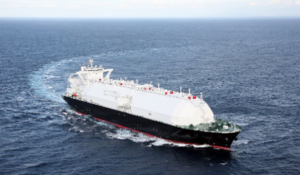
A large LNG carrier enables intercontinental transport between export and receiving terminals.
LNG carrier containment systems
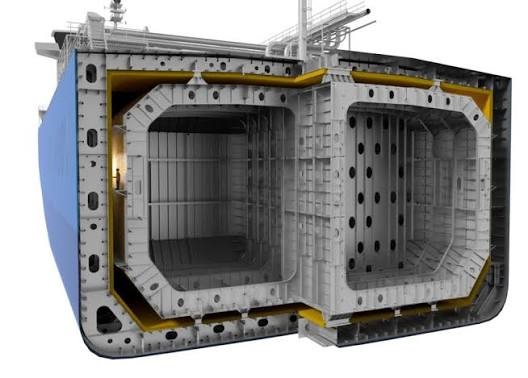
Ships are constructed under the international SOLAS Convention regulations and codes. Cargo containment must tolerate cryogenic temperature, thermal contraction, ship motion and sloshing while preventing leakage into the hull. The main concepts are independent tanks and membrane systems. Selection depends on ship size, pressure, cargo flexibility, shipyard capability, boil-off target and intended service.
| System | Characteristics | Typical application |
| Type A / B independent | Self-supporting prismatic or spherical tanks. Type A requires a full secondary barrier; Type B uses refined analysis and may use a partial barrier. | Large or specialised gas carriers; spherical Moss-type tanks are highly visible and structurally independent. |
| Type C pressure vessel | Cylindrical, spherical, bi-lobe or tri-lobe pressure tanks; pressure tolerance increases holding time and can simplify BOG supply. | Small and mid-scale carriers, bunkering vessels and LNG-fuel tanks. |
| Membrane | Thin primary membrane supported by insulation and the inner hull, with a complete secondary barrier. Commercial systems include corrugated stainless-steel and Invar concepts. | Dominant on standard and large LNG carriers because of high volumetric efficiency. |
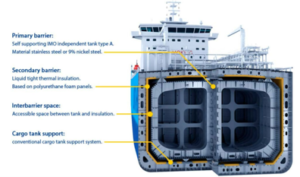
Conceptual arrangement of an independent LNG cargo tank and its protective barriers.
Propulsion and boil-off management
Historically, LNG carriers used steam turbines because boilers could consume BOG reliably, but low efficiency encouraged newer arrangements. Diesel-mechanical ships with reliquefaction return BOG to the cargo tanks. Dual-fuel diesel-electric systems use several generating sets to supply propulsion and hotel loads. Modern low-speed two-stroke gas engines offer direct mechanical propulsion: high-pressure gas-diesel concepts generally achieve high efficiency and low methane slip, while low-pressure Otto-cycle concepts can achieve very low nitrogen-oxide emissions but require careful methane-slip management.
BOG strategy is part of the ship’s overall energy balance. Options include natural BOG consumption, forced vaporisation when more gas is needed, reliquefaction when cargo retention is preferred, and a gas combustion unit for safe disposal under limited conditions. The optimum depends on charter terms, voyage profile, propulsion efficiency, cargo value, emissions regulation and terminal constraints. Improved insulation continues to lower the natural boil-off rate, but very low BOG generation may reduce the fuel available for gas operation.
Small-scale LNG and bunkering
Small-scale distribution serves islands, remote industrial users, peak-shaving plants and LNG-fuelled ships. Truck-to-ship transfer has low infrastructure requirements but limited flow and capacity. Shore-to-ship can provide higher rates from a fixed installation, while ship-to-ship offers mobility and can serve vessels during cargo operations. Type C tanks are common on bunkering vessels because they tolerate pressure, although membrane solutions also exist. Safe transfer requires compatible connections, pressure and temperature management, communications, emergency shutdown links, exclusion zones and agreed custody-transfer procedures.
3. Downstream: receiving, regasification and use
Receiving terminals and FSRUs
A conventional receiving terminal includes a berth, unloading arms, vapour return, insulated storage tanks, pumps, regasification equipment and a connection to the gas network. Storage must absorb the difference between discrete ship deliveries and continuous market demand. Regasification may use seawater, ambient air, waste heat or fuel-fired vaporizers; the choice affects energy use, local environmental impacts and operating cost.
A floating storage and regasification unit (FSRU) combines ship-shaped storage with onboard vaporizers. FSRUs can be delivered more quickly than many onshore terminals, moved when demand changes and constructed in a controlled shipyard environment. They are useful for market entry, seasonal supply and emergency diversification. Limitations include berth and metocean conditions, send-out capacity, ship-to-ship logistics, local permitting and continued exposure to marine operations.
End uses
- Power generation: regasified LNG supplies gas turbines, combined-cycle plants and flexible generation that can balance variable renewable power, subject to methane and carbon constraints.
- Heating: gas networks serve residential, commercial and district-heating loads, especially in regions with established infrastructure.
- Industry and chemicals: natural gas provides process heat and feedstock for hydrogen, ammonia, methanol and other products.
- Transport: LNG may be distributed by truck, rail or small carrier for heavy-duty and marine fuel markets where infrastructure and policy support its use.
- Gas-to-liquids: synthesis converts gas into liquid hydrocarbons, but the process is energy-intensive and must be justified by product value and emissions performance.
4. Technology and lower-carbon LNG
Efficiency and digitalisation
Current development focuses on reducing energy consumption and emissions across the chain. Priorities include more efficient refrigerant cycles and compressor drivers, waste-heat recovery, electrified liquefaction supplied by low-carbon power, improved tank insulation, compact reliquefaction, predictive maintenance and digital optimisation of voyages and terminal operations. Carbon capture may be applied at gas treatment and liquefaction facilities, where concentrated carbon dioxide streams can be easier to manage than dilute exhaust.
Gray, blue and green terminology
Colour labels are convenient but not standardised, so project claims should be supported by transparent boundaries, data and certification. “Gray LNG” generally means fossil LNG without dedicated greenhouse-gas mitigation. “Blue LNG” usually refers to fossil gas paired with carbon capture and storage and, ideally, strong methane controls. “Green LNG” may refer to liquefied biomethane or synthetic methane produced from renewable hydrogen and a sustainable carbon source. Because the molecules are similar, the decisive issue is lifecycle origin and emissions, not appearance or end-use equipment.
A credible comparison should report feedstock, electricity source, methane leakage, capture rate, transport distance, combustion technology and treatment of residual emissions. Book-and-claim or mass-balance systems may support trading where physical segregation is impractical, but they require robust chain-of-custody rules and protection against double counting. Financing increasingly links eligibility and interest rates to measurable sustainability indicators rather than broad colour labels.
5. Environmental and regulatory priorities
Safety and technical framework
The International Code for the Construction and Equipment of Ships Carrying Liquefied Gases in Bulk (IGC Code) governs the design, construction and equipment of ships carrying liquefied gases. The International Code of Safety for Ships using Gases or other Low-flashpoint Fuels (IGF Code) covers ships using LNG and other low-flashpoint fuels. Together with SOLAS, MARPOL, port requirements and recognised standards, these instruments address containment, materials, ventilation, fire protection, hazardous areas, control systems, bunkering and crew competence.
Industry organisations publish operational guidance for gas tankers, terminals and gas-fuelled ships. Flag administrations, port authorities and maritime classification societies translate the framework into approvals, surveys and operational requirements. Classification does not replace the responsibilities of owners, designers, shipyards, operators or regulators; it provides an independent technical assurance layer throughout design, construction and service.
Methane emissions
Methane can escape from wells, processing equipment, compressors, pipelines, storage, loading systems and ship engines. Its strong short-term warming effect means that even modest leakage can materially change LNG’s climate comparison with other fuels. Measurement should distinguish vented, fugitive and combustion-related emissions and should cover both normal operations and abnormal events.
- Detect and repair leaks using fixed sensors, portable instruments, aerial surveys and component-level programmes.
- Replace high-emitting pneumatic equipment and improve compressor seals, valves and maintenance practices.
- Recover vapour during loading and unloading; optimise BOG compression, fuel use and reliquefaction.
- Select engines and operating modes with verified methane-slip performance and maintain them accordingly.
- Use well-to-wake lifecycle assessment so upstream methane and onboard emissions are counted consistently.
International and regional policy is moving toward lifecycle greenhouse-gas accounting. IMO lifecycle guidance distinguishes well-to-tank and tank-to-wake emissions, while European measures increasingly assess marine-fuel performance on a well-to-wake basis. Requirements continue to evolve, so project decisions should use current legal texts and verified emission factors rather than rely solely on this 2023 source.
6. Markets, contracts and energy security
Demand and fleet development
LNG trade connects large resource bases with demand centres that lack pipeline access. It can diversify supply, support industrialisation and strengthen resilience when a pipeline route or producer is disrupted. The redirection of cargoes to Europe in 2022 demonstrated both this flexibility and its price consequences for other importing regions. LNG therefore contributes to energy security, but exposure to global spot prices, shipping availability and terminal constraints remains significant.
The carrier fleet has expanded alongside liquefaction and regasification capacity. Standard newbuildings are commonly around the 170,000–180,000 m³ range, while smaller ships support regional distribution and bunkering and very large ships serve selected routes and terminals. Orderbook interpretation must consider delivery timing, project sanctions, shipyard capacity, fleet ageing, efficiency rules and whether older steam-turbine vessels will be upgraded, converted or retired.
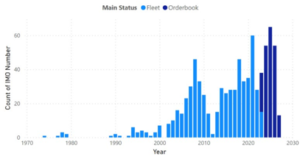
Historical expansion of the LNG carrier fleet and orderbook in the source report.
Contracts and pricing
LNG projects traditionally rely on long-term sale and purchase agreements to underpin financing. Contracts define annual quantity, destination flexibility, take-or-pay obligations, quality, delivery terms, price review and force majeure. Pricing may be linked to crude oil, regional gas hubs or hybrid formulas. Portfolio players and destination-flexible contracts have increased market liquidity, while spot and short-term trade helps balance seasonal and unexpected demand.
Commercial flexibility has value but transfers risk. Buyers must manage price volatility, demand uncertainty and infrastructure access; sellers must manage upstream and liquefaction availability, shipping and credit exposure. Shipping may be arranged free-on-board, where the buyer controls transport, or delivered ex-ship, where the seller delivers to the receiving terminal. Sound decisions test the full delivered cost, including liquefaction, shipping, boil-off, regasification, carbon exposure and terminal fees.
7. Societal perspective and decision framework
LNG developments can create employment, export revenue, infrastructure and access to energy. They can also affect land, water, fisheries, coastal communities, public safety and affordability. Benefits and burdens are not automatically shared fairly. Early engagement, transparent risk communication, local-content strategies, emergency planning, environmental monitoring and credible grievance mechanisms are therefore essential.
For a balanced project assessment, decision-makers should test six questions:
- Need: What energy or transport problem does the project solve, and what alternatives are available?
- Lifecycle emissions: What are the verified well-to-wake greenhouse-gas emissions, including methane?
- Safety and assurance: Are design, operations, emergency response and competence aligned with regulation, recognised standards and classification requirements?
- Economics: Is the full delivered cost resilient to price, carbon, utilisation and financing scenarios?
- Flexibility: Can assets adapt to changing demand, lower-carbon gases and future regulation without becoming stranded?
- Society and environment: Who benefits, who bears impacts, and how will performance be monitored and disclosed?
LNG is best understood as an integrated system rather than a single fuel choice. Its value depends on reliable infrastructure, rigorous safety management, commercial coordination and continuous emissions reduction. Where it displaces more carbon-intensive fuels and methane is tightly controlled, it may support transition and security objectives. Where leakage is high or assets lock in unabated fossil use, the environmental case weakens. Decisions should therefore be specific to route, technology, regulation and verified lifecycle data.
8. Practical chain integration
From nomination to delivery
A cargo begins well before a ship arrives. The seller nominates a loading window and confirms quantity and quality. The terminal schedules feed-gas production, storage inventory, berth availability and marine services. The ship confirms compatibility, arrival condition, cargo-tank pressure and remaining onboard quantity. Before transfer, ship and shore complete communications tests, emergency-shutdown checks, custody-transfer arrangements and a joint safety inspection. Loading is then controlled to manage tank pressure, thermal stress, vapour return and the stability and structural limits of the vessel.
During the voyage, the operator balances speed, weather routing, charter commitments and BOG. Faster sailing may protect a delivery window but increases propulsion demand; slower sailing may reduce fuel use but lengthen exposure to heat ingress and can create excess BOG if consumption falls below natural generation. Cargo conditioning is especially important when the receiving terminal specifies a pressure or temperature range. Operators may consume gas, force-vaporise LNG, reliquefy vapour or adjust speed within safe and contractual limits.
At discharge, the receiving terminal must have enough tank capacity and gas-network demand to accept the cargo. Ship and shore cool and prepare transfer lines, establish vapour balance and increase flow in controlled stages. Accurate measurement determines delivered energy, not simply liquid volume, because density and heating value vary with composition and temperature. After unloading, the ship normally retains a heel of LNG to keep tanks cold and support the next voyage. If the ship enters dry dock or changes service, warming-up, inerting and gas-freeing require a separate controlled sequence.
Key hazards and safeguards
LNG itself is not explosive as a liquid, but released liquid rapidly boils and forms a cold methane cloud. The principal hazards are cryogenic contact, brittle fracture of unsuitable materials, fire where vapour mixes with air in the flammable range, rapid phase transition if LNG contacts water, overpressure in blocked-in liquid systems and asphyxiation in enclosed spaces. Risk is controlled through multiple independent barriers rather than a single device.
| Hazard | Preventive controls | Mitigation and response |
| Loss of containment | Compatible cryogenic materials; tank barriers; welded piping; inspection; controlled transfer and maintenance. | Gas and liquid detection; emergency shutdown; isolation; drainage and spill containment; water spray for exposure protection. |
| Fire or vapour cloud | Hazardous-area classification; ignition control; ventilation; purging and inerting; exclusion zones. | Fixed firefighting systems; dry powder at transfer points; shutdown and muster procedures; coordinated shore response. |
| Overpressure | Relief valves; vapour return; BOG control; avoidance of trapped liquid; operating limits. | Automatic trips, safe vent routing, redundant pressure indication and emergency operating procedures. |
| Human or interface error | Competence, drills, checklists, standard communications, fatigue management and ship–shore compatibility review. | Stop-work authority, clear command structure, incident response and learning from near misses. |
Emergency shutdown systems are normally arranged in stages: an initial stage stops cargo pumps and closes relevant valves, while a higher stage may isolate transfer through additional actions. The ship and terminal must understand cause-and-effect logic, permissible closing times and the risk of surge pressure. Regular drills should include communications failure, gas detection, transfer-arm or hose release, fire, loss of power and medical exposure to cryogenic liquid.
Quality, measurement and interoperability
LNG quality is expressed through component composition, density, gross heating value and indices such as the Wobbe Index. Receiving systems and end users may have limits on nitrogen, heavier hydrocarbons and total energy content. A cargo outside specification can create combustion, network or commercial problems. Sampling and analysis therefore accompany custody transfer, while contracts define the method for determining energy, allowable uncertainty and treatment of off-specification cargo.
Interoperability is equally important in small-scale distribution and bunkering. Vessels and terminals must align on manifold location, connection type, transfer rate, allowable pressure, vapour handling, mooring, fendering, hazardous zones and emergency release. A technically capable supplier may still be unusable if the receiving ship cannot accept its pressure or if port rules prevent simultaneous operations. Standardisation reduces these barriers, but each operation still requires a documented compatibility assessment.
9. Lifecycle performance in more detail
Where energy and emissions occur
The upstream stage consumes energy in drilling, production, gas treatment and compression and may release methane through equipment or planned venting. Liquefaction is normally the largest concentrated energy load because refrigeration compressors must remove substantial heat. Shipping emissions depend on distance, speed, propulsion efficiency, cargo boil-off and ballast voyages. Regasification adds a smaller but site-specific load, while final combustion produces carbon dioxide and may also produce methane slip and nitrogen oxides.
Comparisons are sensitive to boundaries. A tank-to-wake figure describes only onboard use and cannot establish whether LNG is lower-carbon overall. A well-to-tank figure covers production and delivery but omits the conversion of fuel energy onboard. Well-to-wake combines both. Results must also state the time horizon and global-warming-potential factors used for methane, because methane has a much stronger effect over twenty years than over one hundred years. Transparent sensitivity analysis is more informative than a single percentage improvement.
Improvement hierarchy
- Avoid emissions: eliminate routine venting, prevent unnecessary flaring, minimise empty voyages and reduce avoidable energy demand.
- Improve efficiency: optimise refrigeration, compressors, ship speed, propulsion, heat integration, insulation and terminal send-out.
- Control methane: measure actual sources, repair leaks, improve BOG handling and select low-slip combustion technology.
- Lower the carbon intensity of energy: electrify processes with low-carbon power and use verified renewable or low-carbon gases where available.
- Capture residual carbon dioxide: apply carbon capture where technically and economically credible, with permanent storage and transparent accounting.
- Verify and disclose: use independent measurement, consistent lifecycle methods and auditable chain-of-custody systems.
Operational data should be normalised so that performance can be compared fairly—for example, emissions per unit of LNG produced, per tonne-mile transported or per unit of delivered energy. Asset-level monitoring should be reconciled with corporate inventories and contractual claims. Estimated emission factors are useful for screening, but measurement is preferable for major methane sources and for projects marketed as low-carbon.
10. Roles across the value chain
Responsibility is distributed. Resource owners and upstream operators control reservoir development and much of the methane footprint. Liquefaction operators manage feed quality, refrigeration efficiency, storage and loading. Shipowners and managers are responsible for seaworthiness, containment integrity, propulsion, competence and voyage performance. Masters retain operational authority onboard, while terminal representatives control shore facilities and the ship–shore transfer interface is managed jointly.
Charterers and cargo owners influence routing, speed, scheduling and commercial incentives. Port authorities establish local navigation, bunkering and emergency requirements. Flag administrations enforce international conventions, coastal and national authorities regulate terminals and environmental impacts, and maritime classification societies provide technical rules, plan review, survey and certification within their authorised scope. Equipment manufacturers, shipyards, financiers, insurers and independent verifiers also shape risk and performance. Clear allocation of duties is essential because gaps often occur at organisational interfaces rather than within a single system.
For new projects, an integrated assurance plan should identify applicable laws and standards, approval authorities, design reviews, hazard studies, inspection points, commissioning tests, competence requirements, performance guarantees and evidence required for handover. The plan should remain active after start-up through management of change, maintenance, incident learning and periodic verification. Low-carbon claims need the same discipline as safety claims: defined boundaries, assigned data owners, independent checks and controlled public statements.
Read more:
Ship Construction: How the First LNG-Powered Cruise Ship AIDAnova Was Built
Top 6 Chemical Safety Standards in the IBC Code Every Mariner Should Know
What’s the IGF Code and How RBAT Supports Its Evolution for Emerging Fuels
Sources
This condensed edition is based solely on the original drew on material from the International Energy Agency, International Gas Union, International Maritime Organization, European institutions, industry organisations, engine and containment-system developers, market analysts and maritime classification sources. Statistics, policy descriptions and market forecasts should be checked against current primary sources before professional use.
Editorial note: organization-specific branding, contact details and direct institutional promotion have been removed. References to technical assurance are expressed generically as “maritime classification societies.” Product and technology names are retained only where needed to explain established LNG systems.