
The world’s oceans are the lifeblood of global commerce. Approximately 90 percent of international trade moves by sea, with more than 50,000 merchant ships transporting goods worth trillions of dollars across the planet’s waterways. Yet for all their size and sophistication, these vessels remain vulnerable to the unforgiving forces of nature, human error, mechanical failure, and the hazards of navigation.
When a ship runs aground, a platform tilts precariously, or a vessel sinks, the consequences extend far beyond the immediate loss of the asset. A grounded vessel can block vital shipping lanes, disrupt global supply chains, cause catastrophic environmental damage through fuel and cargo spills, and threaten the lives of crew members. The economic stakes are staggering: the marine salvage services market was valued at USD 7.82 billion in 2024 and is projected to reach USD 10.11 billion by 2033.
Emergency refloating services sit at the heart of the marine salvage industry. These are the specialized operations that return stranded, grounded, or sunken vessels to a floating state, enabling their recovery, repair, or safe disposal. Whether dealing with a 400-meter container ship aground in the Suez Canal, a drilling platform that has broken its tow in the Mediterranean, or a sunken barge threatening a coral reef, salvage professionals deploy an extraordinary array of techniques, equipment, and expertise to restore buoyancy and avert disaster.
This article provides a comprehensive examination of emergency refloating services—the techniques, technologies, companies, and legal frameworks that underpin this critical maritime capability, illustrated through real-world case studies that demonstrate both the challenges and the triumphs of modern salvage operations.
Understanding Emergency Refloating: Scope and Definition
What Is Emergency Refloating?
Emergency refloating is the process of restoring buoyancy to a vessel, offshore platform, or other marine structure that has become grounded, stranded, or partially or fully submerged. The objective is to return the asset to a floating condition so that it can be moved to a safe location for inspection, repair, or disposal.
Salvage activities range from refloating grounded vessels and patching hull breaches to containing hazardous spills and recovering containers lost overboard. Marine salvage companies offer services like refloating sunken ships, removal of dangerous materials, and wreck removal to prevent damage to the marine environment.
Types of Assets Requiring Refloating
Emergency refloating services apply to a diverse range of maritime assets:
Commercial vessels: Container ships, bulk carriers, oil tankers, chemical tankers, and general cargo vessels that have run aground or sunk.
Passenger vessels: Cruise ships and ferries that have suffered grounding or capsizing incidents.
Offshore platforms: Oil and gas production platforms, drilling rigs, wellhead platforms, and floating production storage and offloading (FPSO) units.
Military vessels: Naval ships and submarines requiring salvage.
Small craft: Fishing vessels, pleasure craft, and support vessels.
Wrecks: Sunken vessels that pose navigational hazards or environmental threats.
Other structures: Dry docks, barges, and specialized marine equipment.
The Causes of Grounding and Sinking: Why Assets Need Refloating
Understanding why vessels and platforms become stranded is essential to appreciating the complexity of refloating operations. The causes are varied and often interconnected:
Navigational Errors
Human error remains a leading cause of groundings. Misreading charts, failing to account for tidal variations, or making poor navigational decisions in challenging conditions can put even the most sophisticated vessels onto the rocks.
Mechanical Failure
Loss of engine power, steering failure, or electrical system breakdowns can leave vessels adrift and at the mercy of currents and winds. In January 2026, the bulk carrier “COMMON CALYPSO” experienced main engine problems and was drifting in the Indian Ocean, requiring emergency towage assistance. In March 2026, the bulk carrier “KEEPER” experienced loss of electrical power 126 miles northeast of Trincomalee, Sri Lanka.
Severe Weather
Storms, hurricanes, and heavy seas can overwhelm vessels, causing them to drag anchor, break tow lines, or be driven ashore. The drill rig Ocean Valiant was under tow in the Mediterranean when weather turned rough; the towline parted, and the rig drifted onto Tunisia’s rocky shoreline.
Collisions
Vessel-to-vessel collisions or strikes against fixed structures can cause severe damage, leading to flooding, loss of stability, and eventual grounding or sinking.
Structural Failure
Age, corrosion, fatigue, or design flaws can cause catastrophic structural failures. In one notable case, a dry dock suffered structural failure and sank, requiring it to be cut in half and each section refloated separately.
Towing Incidents
Offshore platforms and other structures are frequently towed over long distances. When towlines part or towing vessels lose control, the towed asset can drift into dangerous waters or run aground.
–
The Emergency Response Process: From Alarm to Refloat
Emergency refloating is not a single action but a carefully orchestrated sequence of operations. The process typically follows a structured timeline:
Phase 1: Initial Response and Assessment
The moment a vessel grounds or sinks, the clock starts ticking. Salvage companies operate on a 24/7 basis, with emergency response centres strategically located around the world. Marine Masters, for example, provides around-the-clock emergency response and global towage support for vessels and offshore platforms.
The initial response involves:
Crew safety: Evacuation or rescue of personnel is the absolute priority.
Situation assessment: Determining the nature and extent of the casualty, including the vessel’s condition, location, cargo, and fuel status.
Environmental risk evaluation: Identifying potential pollution threats.
Mobilization: Deploying salvage personnel, equipment, and support vessels to the scene.
The International Salvage Union reported that salvage companies prevented 3 million tonnes of pollution from the world’s marine environment through emergency towage, refloats, and wreck removals in 2025—up almost 600,000 tonnes from 2024.
Phase 2: Stabilization
Before refloating can begin, the casualty must be stabilized to prevent further deterioration:
Damage control: Patching hull breaches, shoring up weakened structures, and controlling flooding.
Fuel and pollutant removal: Removing bunker fuel and other pollutants to prevent environmental contamination.
Cargo management: Assessing cargo condition and, if necessary, lightering (removing cargo) to reduce weight.
Underwater inspections: Deploying divers or remotely operated vehicles (ROVs) to assess underwater damage.
Phase 3: Refloating Operations
With stabilization complete, the refloating operation itself commences. This may involve one or multiple techniques, depending on the circumstances.
Phase 4: Towage and Delivery
Once refloated, the vessel or structure must be towed to a safe location—a repair yard, a designated anchorage, or a scuttling site—for final disposition.
–
Refloating Techniques: The Art and Science of Restoring Buoyancy
Salvage professionals draw upon a diverse toolkit of techniques to refloat stricken vessels. The choice of method depends on factors including water depth, seabed conditions, vessel condition, available equipment, and environmental constraints.
Weight Reduction (Lightering)
One of the most common and straightforward refloating methods is reducing the vessel’s weight. If a ship is intact after grounding, there are two options: lightering weight or transferring weight within the ship’s tanks to free the ship.
The salvage team discharges cargo, bunkers, and ballast water from the tanks around the grounding area until the ship is free. This reduces the vessel’s draft, allowing it to float higher in the water and potentially clear the obstruction.
This technique was employed in the successful refloating of the MV Thamesborg, which remained aground for 33 days in the Canadian Arctic before being freed through carefully coordinated cargo transfers and ballast management operations.
Patching and Dewatering
When a vessel’s hull has been breached and compartments are flooded, restoring buoyancy requires removing the water and preventing its re-entry. The recovery of buoyancy inside the ship is directly affected by the effectiveness of underwater plugging.
Salvors perform extensive patching of damaged hull sections. A new type of underwater plugging has been designed using rubber plates combined with flat steel bars, demonstrating feasibility even at locations where the damaged ship is severely deformed.
After patching, dewatering begins. Submersible pumps remove water from flooded compartments, while compressed air may be introduced to displace water and create additional buoyancy.
Tsavliris, for example, has undertaken projects involving patching and dewatering of flooded engine rooms, underwater inspections, and outfitting of barges with specialized equipment.
Air and Buoyancy Assistance
Introducing air into flooded compartments is a powerful refloating technique. Blowing air into wing tanks and engine rooms creates additional buoyancy that reduces the grounding force.
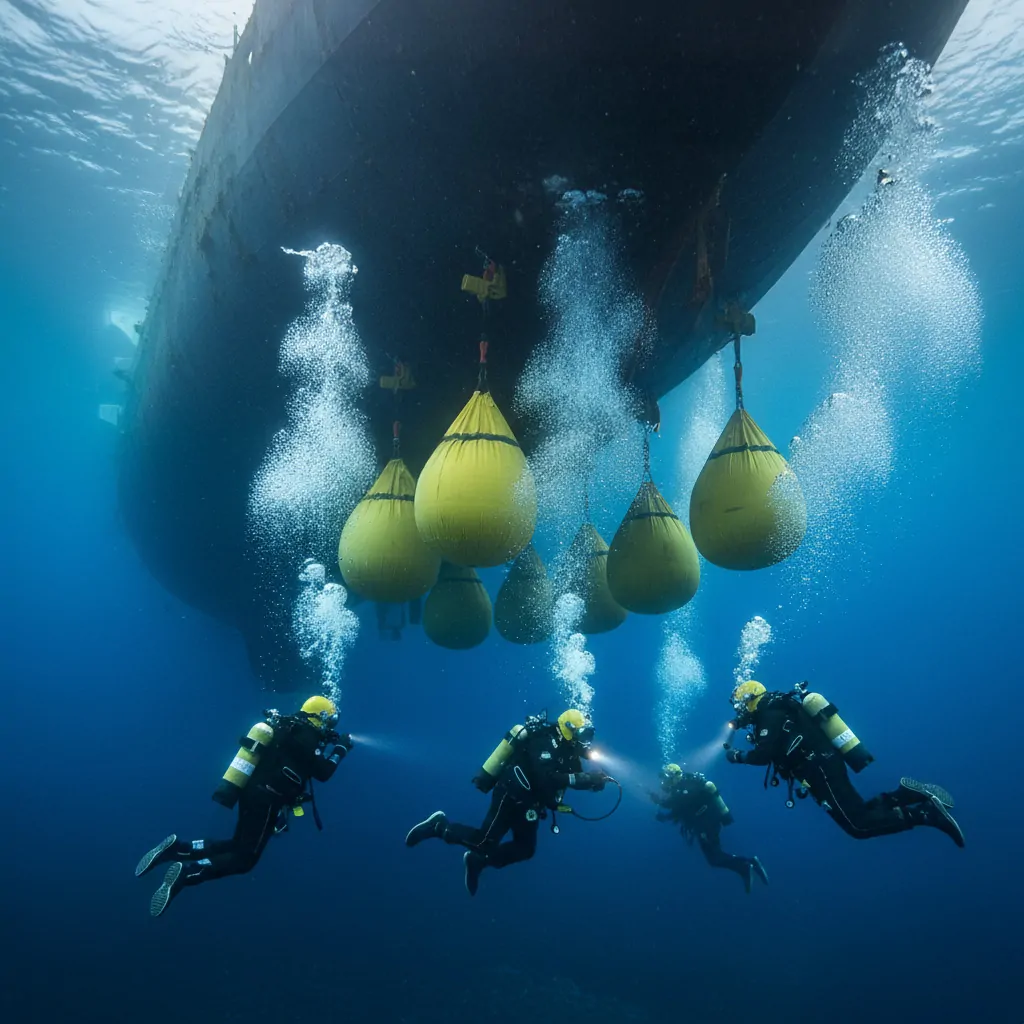
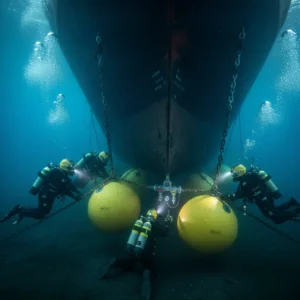
Marine airbags offer a practical, reliable, and efficient solution for marine salvage tasks. These inflatable rubber devices, reinforced with nylon or tire-cord fabric, provide buoyancy to lift submerged objects. Unlike traditional salvage techniques that rely heavily on heavy cranes or water ballasting, marine airbags offer a more mobile, cost-effective, and less invasive method.
Salvage pontoons and inflatable lift bags are used extensively to refloat small ships and to stabilize the refloating process when larger ships are being raised.
External Lift
For vessels that cannot be refloated through internal means alone, external lifting may be required. Shearleg crane barges, floating sheerlegs, and other heavy-lift vessels can be used to lift the casualty off the seabed.
In one operation, Resolve Marine used its shearleg crane barge to lift a casualty off the ground in a capsized position.
Tug Pulling and Ground Tackle
Refloating operations often involve pulling with a combination of tugs and ground tackle. Multiple tugs are positioned to apply force in coordinated directions, gradually working the vessel free from the seabed.
In a complex salvage operation in the Persian Gulf, five tugs were used over seven refloat attempts before the container ship was successfully refloated.
Scouring
In cases where a vessel is firmly embedded in sand, mud, or rock, scouring may be necessary. This involves removing material from around the hull to reduce resistance. Underwater hydraulic-powered track-mounted excavators have been used for this purpose.
Cutting and Removal of Sections
In extreme cases, parts of the vessel may be cut away to reduce weight or improve the refloating geometry. This may involve cutting off parts of the deck and bow.
Parbuckling (Righting)
When a vessel is on its side, it must be righted before refloating can occur. This technique, known as parbuckling, involves using ropes and stanchions to gain leverage and pull the ship upright.
Combination Approaches
Most complex refloating operations employ multiple techniques simultaneously. For example, a casualty may be refloated by utilizing a combination of introduced air and external lift. Operations may involve pulling with tugs, lightering, cutting off parts of the structure, and scouring.
–
Equipment and Technology: The Tools of the Trade
Emergency refloating requires a vast array of specialized equipment:
Tugs and Support Vessels
Salvage tugs are the workhorses of refloating operations. The world’s largest tugs, such as Tsavliris’ “FOTIY KRYLOV” and “NIKOLAY CHIKER,” provide the immense pulling power needed for challenging towages and refloats.
Pumps and Dewatering Equipment
High-capacity submersible pumps are essential for dewatering flooded compartments. These pumps must be reliable, portable, and capable of operating in challenging conditions.
Compressed Air Systems
Compressed air is used to displace water from flooded compartments, creating buoyancy.
Marine Airbags and Pontoons
Inflatable airbags provide additional buoyancy for lifting submerged objects. Salvage pontoons are used for larger-scale buoyancy provision.
Diving and ROV Equipment
Salvage divers perform underwater inspections, patching, and cutting operations. Remotely operated vehicles (ROVs) provide enhanced capabilities for deep-water operations.
Cutting and Welding Equipment
Oxy-acetylene torches, underwater cutting equipment, and welding gear are used for structural modifications and repairs.
Crane Barges and Heavy-Lift Vessels
Shearleg crane barges provide external lifting capability for heavy salvage operations.
Positioning and Survey Equipment
GPS, sonar, and other positioning systems are critical for precise operations.
The Major Players: Leading Emergency Refloating Service Providers
The marine salvage industry is dominated by a handful of global companies with the resources, expertise, and global reach to handle the most demanding refloating operations.
SMIT Salvage
Part of Royal Boskalis, SMIT is one of the largest marine salvage companies in the world. With 182 employees and four emergency response centres in Rotterdam, Houston, Cape Town, and Singapore, SMIT provides 24/7 coverage along main shipping routes. The company focuses on sustainable marine emergency response and wreck removal, with expertise spanning container ships, oil tankers, bulk carriers, and offshore structures. SMIT has been in the industry since 1842.
Resolve Marine
One of the most renowned marine salvage companies, Resolve Marine has served clients for over 40 years. The company has 205,000 square feet of warehouse space, 7,000-plus assets in its readiness and response system, and over 350 global employees. Resolve Marine has removed 100,000 tonnes of liquid and bulk contaminants over the last four years. The company was involved in the high-profile salvage of the MV Dali following its collision with Baltimore’s Francis Scott Key Bridge, responding within hours to focus on crew safety, fire prevention, damage control, vessel stabilization, and refloat.
Tsavliris Salvage Group
Tsavliris is at the forefront of the marine salvage industry, performing consistently more Lloyd’s Open Form salvage services than any other company. The Group provides a comprehensive range of services including pollution prevention, cargo salvage, rescue at sea, firefighting, sub-sea operations, deep-sea towages, and offshore support. Tsavliris has a modern global network for providing rapid assistance, achieved through strategic stationing of its own salvage assets and cooperation with regional and international salvage firms.
T&T Salvage
Part of the Teichman Group, T&T Salvage is another major player in the industry.
Other Notable Providers
Other significant companies include Ardent Global, Cooper Capital Specialty Salvage, DonJon Marine Company, Plan B Marine Solutions, SeaTec, and OSC Marine. OSC Marine provides rapid-response assets and specialist platforms for salvage, refloat, wreck removal, and diving support.
Marine Masters, a full member of the International Salvage Union, has a track record of over 250 successful salvage operations, including fire extinguishing and refloating assignments for offshore support vessels, container ships, and tankers.
–
Legal and Contractual Frameworks
Emergency refloating operations do not occur in a legal vacuum. A complex framework of contracts, conventions, and national laws governs salvage operations.
Lloyd’s Open Form (LOF)
The Lloyd’s Open Form is the most widely recognized salvage contract in the maritime industry. It is a “no cure, no pay” contract agreed directly between the shipowner and the salvor. Under LOF, the cost of salvage is determined after the fact, allowing the rescue to proceed without delay.
The LOF provides for the cost of salvage to be determined after the fact, allowing the rescue to proceed apace, but with some guides as to the likely value of an award. The 2024 updates to LOF aim to streamline maritime salvage operations and enhance transparency.
The LOF Default Agreement was intended to promote the use of LOF in salvage situations and to support prompt decision-making. It provides that LOF is the default contract when a vessel is in a situation of danger or potential danger requiring immediate salvage services.
The SCOPIC Clause
The Special Compensation P&I Club Clause (SCOPIC) is an addition to LOF that provides for compensation to salvors for environmental protection efforts, even if the salvage operation is unsuccessful.
National and Regional Regulations
Many countries have their own salvage regulations, particularly regarding wreck removal and environmental protection. In the United States, the Oil Pollution Act of 1990 (OPA90) imposes strict requirements on vessel owners and operators. China has its own SPRO services.
The Nairobi International Convention on the Removal of Wrecks
This 2007 convention establishes the legal framework for the removal of wrecks that pose hazards to navigation or the environment.
–
Environmental Protection: The Green Imperative
Emergency refloating is not merely about saving assets—it is fundamentally about protecting the marine environment. The environmental stakes in salvage operations are immense.
Pollution Prevention
Salvage companies prevented 3 million tonnes of pollution from the world’s marine environment through emergency towage, refloats, and wreck removals in 2025. As the International Salvage Union stated: “Salvage remains essential for environmental protection and pollution prevention at sea”.
When a vessel is grounded or sinking, the immediate environmental threat comes from its fuel and cargo. Salvors prioritize removing bunkers and pollutants before refloating begins. This prevents oil spills and other contamination that could devastate marine ecosystems.
Protecting Marine Ecosystems
Salvage operations are deployed to rescue distressed vessels and their cargo, thereby protecting seas and oceans from pollutants and environmental damage. Emergency response assistance, refloating grounded vessels, and containing or removing polluting cargoes are all essential components.
In one recent operation, Smit Salvage refloated the tank barge Defiant from a hard-to-reach location adjacent to a centuries-old fort in Puerto Rico. Despite the challenging location, the team succeeded within a few days, preventing large-scale environmental pollution from an oil spill.
The Cost of Inaction
If a vessel is not quickly salvaged and refloated, there could be major oil pollution along with damage to the environment and property. The consequences of a major oil spill in an environmentally sensitive area can be catastrophic and long-lasting.
–
Case Studies: Emergency Refloating in Action
Real-world case studies illustrate the complexity, challenges, and triumphs of emergency refloating operations.
Case Study 1: MV Thamesborg – 33 Days Aground in the Canadian Arctic
In September 2025, the Dutch-flagged MV Thamesborg, an ice-class ship, grounded in Franklin Strait in Canada’s Arctic archipelago while transporting carbon anodes from China to Quebec.
The vessel remained aground for 33 days in a remote and challenging environment. The refloating was completed on 9 October 2025 through carefully coordinated cargo transfers and ballast management operations. The operation involved specialized vessels, equipment, and close coordination with Canadian authorities.
Remarkably, none of the 16-person crew was hurt, and there was no environmental damage or pollution reported.
Case Study 2: Ocean Valiant – Drill Rig Refloated off Tunisia
In January 2025, the drill rig Ocean Valiant was under tow in the Mediterranean, bound for demolition in Turkey. Weather turned rough, the towline parted, and the rig drifted onto Tunisia’s rocky shoreline near Bizerte.
An extended period of poor weather prevented an immediate refloat attempt. Salvors mobilized with Turkish anchor handlers in March 2025. The operation succeeded on 5 May 2025, and the rig was freed to continue its final voyage.
Case Study 3: The Persian Gulf Container Ship – Seven Attempts, One Success
In a complex salvage operation in the Persian Gulf, a container ship required refloating under extraordinarily difficult conditions. Iranian authorities allowed Mubarak Marine only seven days to attempt the refloat.
No vessel used could be UAE-flagged, and salvors had to contend with military firing exercises in the vicinity. Five tugs were deployed. On 16 October, on the seventh refloat attempt, the container ship was successfully refloated.
Case Study 4: Maureen Alpha Platform – Refloating 110,000 Tonnes
The refloating of the Maureen Alpha Platform in the North Sea stands as one of the most remarkable salvage achievements. The steel gravity-based platform, weighing 110,000 tonnes, had been in operation since 1983.
Refloating the platform, the largest and heaviest nonconcrete structure in the North Sea, was completed after a 60-hour operation. The platform was refloated and towed to deep water moorings at Stord in Norway in the summer of 2001.
Case Study 5: The MV Dali – Baltimore Bridge Collapse
The MV Dali container ship lost power and struck the Francis Scott Key Bridge in Baltimore, causing its collapse. Resolve Marine responded within hours of the accident and focused on crew safety, fire prevention, damage control, and vessel stabilization and refloat, along with removal of the bridge parts and cargo.
–
Challenges and Risks in Emergency Refloating
Emergency refloating is among the most dangerous and demanding of all maritime operations.
Environmental Conditions
Severe weather, strong currents, poor visibility, and extreme temperatures can all hamper salvage operations. The Ocean Valiant refloat was delayed by an extended period of poor weather.
Structural Instability
Damaged vessels are inherently unstable. Attempting to refloat a structurally compromised vessel can cause it to break apart, with catastrophic consequences.
Pollution Risks
The very act of refloating can release pollutants if not carefully managed. Removing fuel and cargo before refloating adds complexity and time.
Geopolitical and Security Risks
Salvage operations in conflict zones or politically sensitive areas face additional risks. As noted by salvors, responding to damaged ships could have faced dangers from missiles and drones, limiting the viability of operations.
Technological Challenges
As vessels grow larger and more complex, refloating them becomes increasingly difficult. Ultra-large container ships and giant offshore platforms push the limits of existing technology.
–
The Future of Emergency Refloating
The emergency refloating industry is evolving rapidly, driven by technological innovation, changing regulatory requirements, and the increasing scale of maritime assets.
Artificial Intelligence and Simulation
AI refloat simulations are emerging as powerful tools for planning complex operations. These simulations allow salvage teams to model different scenarios and optimize their approaches before committing resources.
Autonomous and Remote-Operated Systems
Unmanned excavators, autonomous underwater vehicles, and 5G drone feeds are enhancing salvage capabilities. These technologies reduce human risk while enabling real-time monitoring with precision in recovery efforts.
Environmental Sustainability
The industry is placing increasing emphasis on environmental protection. Salvage companies are developing more sustainable approaches to wreck removal and refloating.
Market Growth
The marine salvage services market is projected to grow from USD 8.05 billion in 2025 to USD 10.41 billion by 2034. This growth is driven by increasing maritime trade volumes, stricter environmental regulations, and the need for specialized capabilities to handle ever-larger vessels.
Regulatory Evolution
The 2024 updates to Lloyd’s Open Form and the introduction of new market clauses aim to streamline salvage operations and enhance transparency. As environmental regulations become more stringent, salvage companies must adapt their practices accordingly.
–
Conclusion
Emergency refloating services represent one of the most critical capabilities in the maritime industry. When a vessel grounds, a platform tilts, or a wreck threatens navigation and the environment, salvage professionals answer the call—often working in dangerous conditions, against tight deadlines, and with billions of dollars in assets and irreplaceable marine ecosystems at stake.
The techniques employed are as diverse as the casualties they address: lightering to reduce weight, patching and dewatering to restore buoyancy, air and buoyancy assistance to lift stranded vessels, external lifting for the heaviest structures, and the coordinated pulling of multiple tugs. Each operation is unique, demanding the integration of specialized equipment, skilled personnel, and careful engineering analysis.
The industry’s major players—SMIT, Resolve Marine, Tsavliris, and others—maintain global networks of assets and expertise, ready to respond 24/7 to emergencies anywhere in the world. Their work is governed by a complex legal framework centered on the Lloyd’s Open Form, which enables rapid response while ensuring fair compensation.
The environmental imperative of emergency refloating cannot be overstated. In 2025 alone, salvage companies prevented 3 million tonnes of pollution through their efforts. Each successful refloat averts an environmental disaster that could devastate marine ecosystems, coastal communities, and livelihoods.
As the maritime industry continues to grow and vessels become ever larger, the demand for emergency refloating services will only increase. The global marine salvage services market, valued at USD 7.82 billion in 2024, is projected to reach USD 10.11 billion by 2033. New technologies—from AI simulation to autonomous systems—are enhancing the industry’s capabilities, while evolving regulations ensure that environmental protection remains at the forefront.
The next time a massive container ship transits a vital waterway or an oil platform is towed across an ocean, there is an unseen safety net beneath it: the emergency refloating services that stand ready to respond when the unthinkable occurs. These are the unsung heroes of the sea—the salvage masters, divers, naval architects, and crews who risk their lives to save vessels, protect the environment, and keep global commerce moving.
In an era of expanding maritime trade, climate change, and geopolitical uncertainty, the importance of emergency refloating services has never been greater. The industry’s ability to adapt, innovate, and respond to the most challenging salvage operations will continue to be essential to the safety, sustainability, and resilience of the world’s oceans.