
05/31/2026
The International Maritime Organization has introduced revised recommendations for entering enclosed spaces aboard ships, marking an important update to one of the maritime industry’s most persistent safety challenges.
The revised recommendations were adopted through IMO Resolution MSC.581(110), replacing the earlier Resolution A.1050(27). The update entered into effect on 3 December 2025 and applies to all ship types. Its purpose is to reduce fatalities and serious accidents linked to enclosed space entry by strengthening hazard identification, risk assessment, atmospheric testing, crew preparedness, emergency response, and control of access.
Enclosed space entry remains one of the most dangerous routine operations on board ships. Fatal accidents continue to occur when crew members, shore personnel, or rescue teams enter tanks, holds, cofferdams, void spaces, access trunks, chain lockers, pump rooms, cargo spaces, or other poorly ventilated areas without fully understanding the atmospheric hazards. These hazards may include oxygen depletion, toxic gases, flammable vapours, carbon monoxide, carbon dioxide, or cargo-related emissions.
The revised IMO recommendations place stronger emphasis on the principle that every enclosed space should be considered hazardous until it has been properly assessed, ventilated, tested, and declared safe for entry by a responsible person. This represents a practical shift from a paperwork-based approach toward a more disciplined safety-management process.
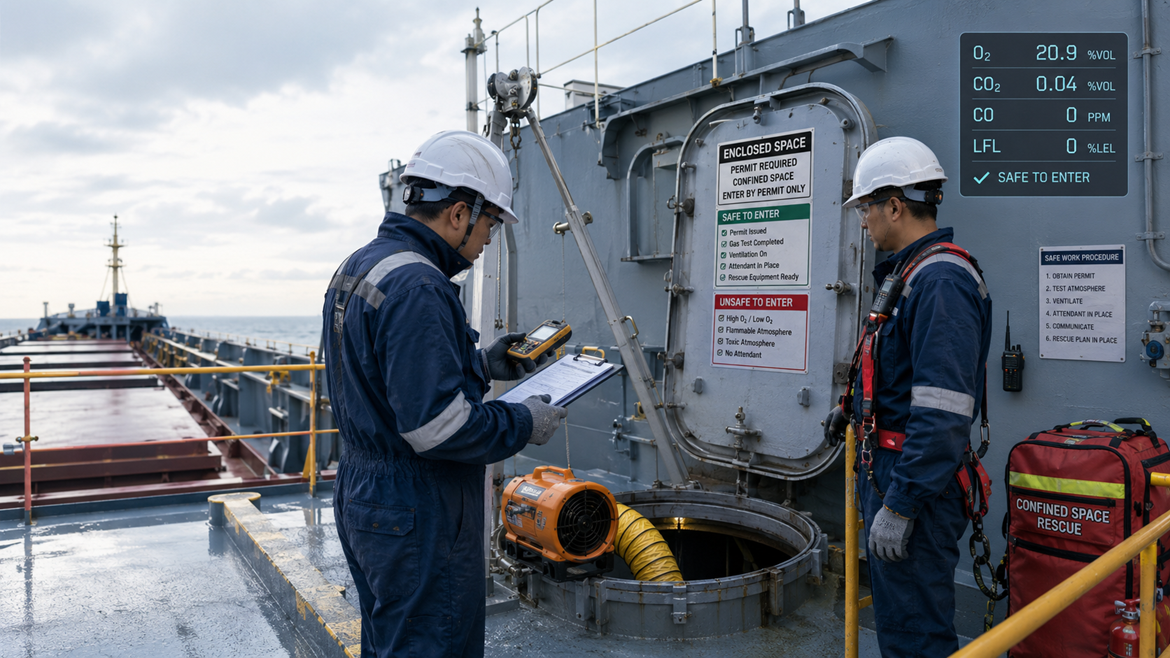
One of the most significant changes is the explicit inclusion of carbon dioxide monitoring. Before entry, carbon dioxide levels should be below 0.5% by volume, equivalent to 5,000 ppm. If this threshold is not achieved, the space should be treated as unsafe. This is a notable update because carbon dioxide can act as a powerful asphyxiant and may cause rapid loss of consciousness or death, especially in cargo spaces or adjacent areas where gas can accumulate.
The recommendations also strengthen requirements for gas detection. Personnel entering enclosed spaces should be provided with calibrated and tested personal gas-detection instruments capable of monitoring oxygen, carbon dioxide, flammable gases or vapours, toxic gases including carbon monoxide, and any other gases identified during the risk assessment. Gas-detection equipment must also be capable of operating in oxygen-depleted atmospheres.
Ship operators are therefore expected to review whether existing gas detectors are suitable for the revised expectations. Where necessary, equipment should be replaced or supplemented with instruments capable of detecting carbon dioxide. Maintenance, calibration records, training, and familiarization should also be updated within the vessel’s safety management system.
The revised recommendations also make clear that single-person entry into an enclosed space should not be permitted. Access doors and hatches leading to enclosed spaces should remain secured against entry unless the space has been risk assessed, atmospherically tested, ventilated, and declared safe. This reinforces the need for controlled access, proper supervision, and clear communication before and during entry.
Safe entry should only be permitted when all hazards have been identified, the space has been thoroughly ventilated, atmospheric testing confirms safe limits, illumination is adequate, communication arrangements are agreed and tested, all entrants are wearing personal gas detectors, an attendant is assigned, rescue and resuscitation equipment is ready at the entrance, suitable personal protective equipment is available, and a valid entry permit has been issued.
Another important development is the requirement for an Enclosed Space Register. Every ship should maintain a register identifying enclosed spaces, their physical and specific hazards, ventilation arrangements, atmosphere-testing methods, connections to adjacent spaces, locking and signage arrangements, estimated ventilation times, and equipment required for emergency rescue. This register should be regularly reviewed and updated, especially after cargo changes, structural modifications, operational changes, or new hazard assessments.
The revised recommendations also introduce clearer treatment of connected and adjacent spaces. These spaces may contain trapped hazardous atmospheres and should be treated as unsafe until they are ventilated and tested. This is particularly important because gases can migrate from one space to another through openings, pipes, ducts, structural gaps, or cargo-related pathways. A space that appears safe in isolation may still be dangerous because of its connection to another hazardous area.
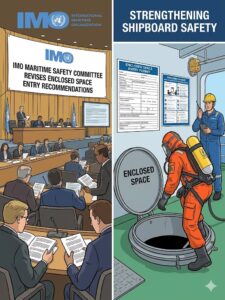
Emergency preparedness is also strengthened. Each ship should have a ship-specific Enclosed Space Emergency Response Plan detailing rescue roles, equipment, communications, procedures, and safe evacuation arrangements. Rescue equipment must be available, functional, and ready for immediate use. Regular enclosed space rescue drills should be carried out to verify that the plan works in practice and that crew members understand their roles.
The recommendations also clarify that Emergency Escape Breathing Devices should not be used for entry into enclosed spaces. EEBDs are intended for escape purposes only and should not be treated as breathing apparatus for entering unsafe spaces. This distinction is important because misuse of EEBDs during rescue or entry operations can expose personnel to serious risk.
Permit control has also been tightened. The Enclosed Space Entry Permit should have a defined validity period and should never exceed eight hours. Companies should update safety management procedures to reflect this maximum validity period and ensure that responsible persons understand how to enforce it. If conditions change, work is interrupted, ventilation stops, or atmospheric readings become unsafe, the permit should no longer be treated as valid.
Signage is another practical area addressed in the revised guidance. Access points should be physically marked as safe or unsafe for entry. Portable signage should be clear and understandable for both crew and shore personnel. Signs should be updated whenever a space changes status, such as after testing, ventilation, cargo operations, cleaning, or the discovery of a new hazard.
Cargo-related hazards receive particular attention in the revised recommendations. Hazard information should be taken from the shipper’s declaration, Safety Data Sheets, the IMDG Code, the IMSBC Code, the IBC Code, and the IGC Code, depending on the cargo and ship type. Certain cargoes have been associated with deaths caused by fire, explosion, oxygen depletion, toxic gas release, or asphyxiation. These include coal, wood products, wood chips and pellets, metal sulphide concentrates, ferrous materials, seed cake cargoes, scrap metal, and some grain or timber cargoes.
This is especially relevant for bulk carriers, general cargo ships, tankers, gas carriers, chemical carriers, and vessels carrying packaged dangerous goods. Cargo residues, oxidation, fermentation, fumigation, chemical reaction, or gas release can create hazardous atmospheres even when a space does not initially appear dangerous.
The revised recommendations also reinforce existing SOLAS requirements for atmosphere-testing instruments. Ships must carry at least two sets of gas-detection equipment under SOLAS Regulation XI-1/7. Ships carrying cargoes capable of generating hazardous vapours and requiring regular entry should carry two additional sets. Instruments should have sufficient spares and calibration means, and may use flexible hoses or fixed sampling lines to allow safe testing of remote areas before entry.
For shipowners, managers, masters, officers, ratings, port workers, terminals, and shore contractors, the practical message is clear: enclosed space entry must be treated as a high-risk operation every time. Familiarity with a space does not make it safe. Previous safe entry does not guarantee current safety. A space is only safe when the hazards have been assessed, the atmosphere has been tested, ventilation is effective, rescue arrangements are ready, and entry has been formally authorized.
Companies should now review their safety management systems, enclosed space entry procedures, permit forms, emergency response plans, training programmes, gas detection equipment, signage, and enclosed space registers. Particular attention should be given to carbon dioxide monitoring, connected and adjacent spaces, cargo-related hazards, rescue readiness, and the prevention of single-person entry.
The revised IMO recommendations represent an important step toward reducing enclosed space fatalities. Their effectiveness, however, will depend on implementation on board. The safest vessels will be those where enclosed space entry is not treated as a routine task, but as a controlled operation requiring planning, discipline, supervision, verification, and the authority to stop work whenever conditions are unsafe.