
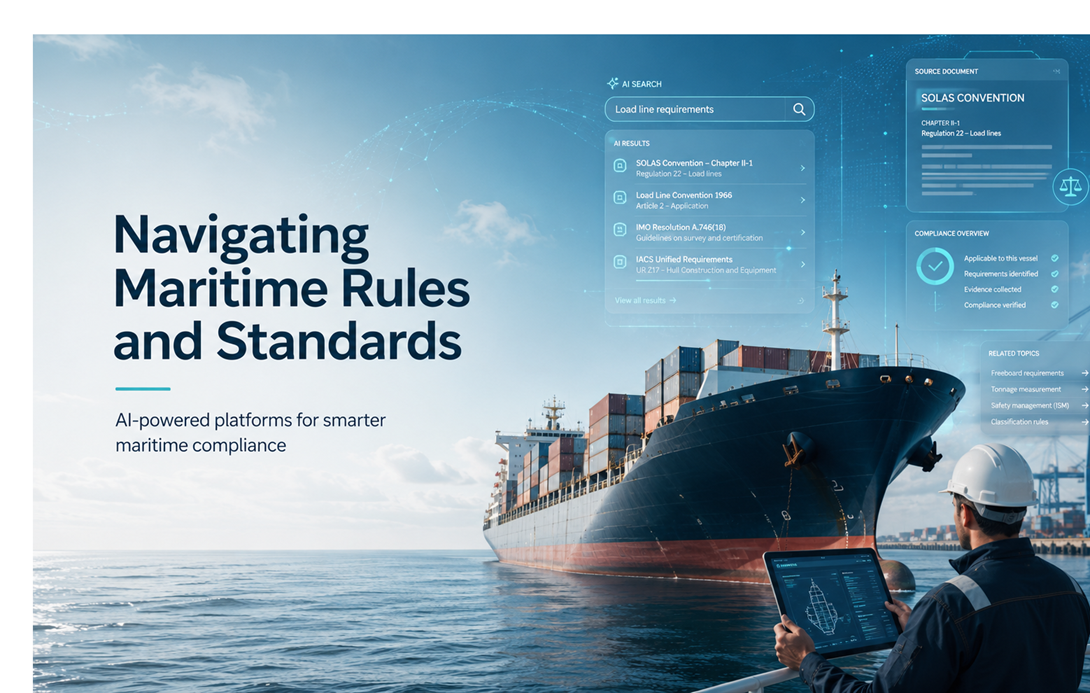
AI-powered rule-navigation platforms are beginning to transform how maritime professionals access, interpret, and verify technical rules, regulations, standards, and guidance documents. Across the shipping industry, engineers, surveyors, ship managers, naval architects, shipyards, flag administrations, port-state control personnel, classification experts, and maritime educators all face the same difficulty: the rules that govern ships are essential, but they are often complex, fragmented, and time-consuming to navigate.
Modern maritime compliance is not based on one document or one authority. A single vessel may need to comply with classification society rules, IMO conventions, flag-state regulations, port-state control requirements, regional environmental rules, industry standards, company procedures, insurance conditions, charterer requirements, and manufacturer documentation. These layers overlap, interact, and sometimes require careful interpretation according to ship type, age, tonnage, cargo, propulsion system, trading area, and operational profile.
For this reason, maritime rule-navigation software is becoming more than a convenience. It is becoming an important digital-support tool for safer, faster, and more consistent technical decision-making. When properly designed, these platforms do not replace professional judgement or official rulebooks. Instead, they help users locate the right source material faster, understand the context of requirements, and verify answers against authoritative documents.
The Difficulty of Navigating Maritime Rules
Maritime rules are highly detailed because ships are complex technical systems operating in a high-risk environment. Safety, environmental protection, crew welfare, cargo integrity, energy efficiency, cyber security, emergency preparedness, and structural reliability all depend on compliance with technical and operational requirements.
The problem is not simply the number of rules. The greater challenge is applicability. A requirement may apply to one vessel but not another, depending on ship type, keel-laying date, gross tonnage, deadweight, class notation, flag, cargo type, fuel type, machinery arrangement, trading pattern, or retrofit history.
For example, the regulatory pathway for an oil tanker is different from that of a chemical tanker, gas carrier, containership, passenger ship, offshore support vessel, bulk carrier, ro-ro ship, or fishing vessel. Even within the same category, different construction dates or notations may trigger different requirements. A vessel using conventional fuel may face a different technical framework from one using LNG, methanol, ammonia, hydrogen, batteries, shore power, or onboard carbon-capture systems.
This creates a practical challenge for professionals. Experienced surveyors, superintendents, class engineers, and technical managers often know where to search because they have accumulated years of familiarity with rule structures. Junior professionals, cadets, new surveyors, young naval architects, and newly appointed technical staff may understand the engineering concept but still struggle to identify the correct rule paragraph.
Manual searching can also be inefficient. Traditional keyword searches may return too many irrelevant results or miss important requirements because the user does not know the exact terminology used in the rulebook. A person may search for “emergency generator,” while the official document may use “emergency source of electrical power.” Another user may search for “sludge discharge,” while the relevant requirement may be under machinery-space oily residues or standard discharge connection.
This is where digital rule-navigation platforms can provide value. They can help bridge the gap between practical user questions and the formal language of maritime rules.
Applying Large Language Models to Maritime Rule Navigation
Large language models and advanced search technologies are well suited to maritime rule navigation because they can process large volumes of technical text and respond to natural-language questions. Instead of forcing the user to know the exact wording of a regulation, these platforms allow users to ask practical questions in ordinary professional language.
A superintendent may ask whether a particular system is required for a vessel of a certain type and age. A shipyard engineer may ask which documents are needed for approval of a machinery modification. A surveyor may search for inspection criteria for a specific arrangement. A student may ask for a simplified explanation of a regulation. A technical manager may compare requirements between class rules, statutory conventions, and internal procedures.
However, maritime rule navigation is not the same as ordinary AI text generation. A generic AI chatbot cannot safely be treated as an authority on ship compliance. Maritime rules contain definitions, exceptions, tables, footnotes, cross-references, transitional provisions, unified interpretations, and vessel-specific applicability conditions. A professional platform must therefore be built around retrieval, verification, and source traceability.
The strongest approach is not for AI to “guess” the answer. The stronger approach is retrieval-augmented navigation, where the system first identifies relevant source paragraphs and then summarizes or explains them while pointing the user back to the original document.
This makes the tool more suitable for safety-critical environments. The user can see where the answer came from, check the wording, verify applicability, and decide whether further expert review is required.
From Static Rulebooks to Intelligent Maritime Knowledge Platforms
For many years, maritime professionals relied mainly on printed rulebooks, PDF documents, circulars, manuals, and online databases. These sources remain authoritative, but the way users access them is changing.
The industry is gradually moving from static document storage toward intelligent knowledge platforms. These platforms may include natural-language search, AI-assisted summaries, document linking, cross-reference mapping, vessel-specific filtering, regulatory update tracking, and compliance dashboards.
This shift is important because maritime rules do not exist in isolation. A question about ballast water, for example, may involve the Ballast Water Management Convention, flag-state implementation, port-state inspection practice, class requirements for treatment-system installation, manufacturer manuals, commissioning tests, and onboard recordkeeping. A question about alternative fuels may involve SOLAS, IGF Code requirements, class rules, risk assessment guidance, hazardous area classification, crew training, bunkering procedures, and emergency response planning.
A good rule-navigation platform helps users move across these layers more efficiently. It can guide them from a practical technical question to the relevant documents, identify related requirements, and reduce the risk of overlooking important sources.
In the future, such platforms may become standard tools in ship management offices, classification departments, shipyards, maritime academies, technical consultancies, and regulatory bodies.
Turning Early Scepticism into Practical Digital Solutions
Scepticism toward AI in maritime compliance is justified. Shipping is a safety-critical industry, and incorrect regulatory interpretation can lead to unsafe design, operational delays, failed surveys, detention, environmental violations, commercial disputes, or insurance complications.
Therefore, AI-powered rule-navigation platforms must be developed cautiously. Their purpose should not be to replace surveyors, engineers, lawyers, flag officials, or class experts. Their purpose should be to support them.
The most important questions for any maritime rule-navigation platform are:
- Can it identify the correct source document?
- Can it distinguish between mandatory rules, guidance notes, recommendations, and interpretations?
- Can it show the original paragraph, table, or clause behind each answer?
- Can it recognize when vessel-specific data are needed?
- Can it handle exceptions and applicability conditions?
- Can it identify when the answer is uncertain?
- Can it remain up to date when rules are amended?
- Can users verify the result before making a compliance decision?
A platform that cannot answer these questions should not be used for critical decisions. A platform that can address them transparently can become a valuable professional tool.
The key principle is simple: AI may assist the search and explanation process, but authority remains with the official rule source and the competent professional.
Understanding How Rule Searches Affect Real Maritime Operations
Efficient rule navigation has direct operational value. Delays in finding the correct requirement can affect ship design, construction, conversion, survey planning, maintenance, repair, port calls, certification, and fleet operations.
In newbuilding projects, rule-search delays can slow plan approval, equipment selection, yard clarification, and design review. In ship conversion or retrofit projects, the technical team may need to confirm whether new requirements are triggered by changes to fuel systems, propulsion arrangements, cargo systems, electrical installations, or safety equipment.
For ships in service, quick access to the right requirement can support defect handling, survey preparation, dry-dock planning, equipment replacement, and emergency technical decisions. During a short port stay, for example, a superintendent or chief engineer may need to confirm whether a repair, temporary arrangement, test, or certificate issue affects the vessel’s ability to sail.
Rule-navigation software can also support communication between stakeholders. Shipowners, managers, yards, class societies, flag administrations, equipment suppliers, and consultants often need to discuss the same requirement. When all parties can refer to the same source paragraph, the discussion becomes clearer and more efficient.
This does not remove the need for formal approval. But it can reduce confusion, unnecessary correspondence, and repeated searching.
Proving the Technical Feasibility of Rule-Navigation Software
Building reliable maritime rule-navigation software is technically demanding. A platform may need to search across thousands of pages of rules, conventions, circulars, manuals, and technical standards. These documents may include nested structures, tables, exceptions, definitions, and cross-references.
Simple keyword search is often insufficient. It may return results containing the searched term without understanding whether they are applicable. At the same time, pure AI text generation is also insufficient because it may produce fluent but unsupported answers.
A robust platform should combine several capabilities:
- It should use structured document indexing so that rules are divided into meaningful parts, chapters, sections, clauses, tables, and notes.
- It should use semantic search so that users can find relevant content even when they do not use the exact wording of the rule.
- It should use vessel-specific filters where possible, including ship type, age, tonnage, flag, notation, machinery arrangement, and operational profile.
- It should provide source references so that users can verify the answer.
- It should track document versions so that users know whether the answer is based on the latest applicable edition.
- It should identify related requirements across different regulatory layers.
This technical architecture is essential because maritime compliance is highly contextual. The same phrase can have different implications depending on the vessel and regulatory framework.
Designing for Responsibility and Verification
Responsible design is the most important requirement for maritime AI platforms. In this context, responsible design means that the system must support accuracy, traceability, transparency, and human oversight.
Every answer should be linked to the source document. The user should be able to see the original paragraph and confirm the wording. If the answer depends on vessel-specific conditions, the platform should make those conditions clear. If the available information is incomplete, the system should not pretend to be certain.
For example, if a user asks whether a piece of equipment is mandatory, the correct answer may depend on ship type, construction date, trading area, tonnage, cargo, class notation, or flag requirement. A responsible platform should either ask for these parameters or explain that the answer cannot be finalized without them.
Responsible platforms should also avoid hiding complexity. Maritime rules are sometimes complicated because the underlying safety issue is complicated. AI should make the search process easier, but it should not oversimplify obligations in a way that creates false confidence.
For maritime education, this is especially important. Students and junior officers should learn that AI tools are useful for finding and understanding rules, but they must still read the official text, check applicability, and consult qualified personnel when needed.
The best systems will encourage verification rather than discourage it.
From Prototype Tools to Professional Compliance Platforms
The development of rule-navigation tools usually begins with a practical need: users spend too much time searching for technical requirements. Early prototypes may focus on one rule set, one company database, one vessel type, or one operational domain.
As these tools mature, they can expand into broader professional platforms. They may include classification rules, IMO conventions, flag-state circulars, port-state inspection guidance, industry standards, company procedures, and vessel-specific technical manuals.
A professional compliance platform may eventually support different user groups:
- Surveyors may use it to find inspection requirements.
- Ship managers may use it for fleet compliance checks.
- Shipyards may use it for design clarification.
- Naval architects may use it during concept and detailed design.
- Chief engineers and deck officers may use it for operational guidance.
- Maritime students may use it to learn how regulations are structured.
- Legal and insurance professionals may use it to identify relevant obligations.
- Flag administrations may use it to support consistent interpretation.
- Classification societies may use it to improve technical support and rule accessibility.
The value of such platforms increases when they are connected to reliable vessel data. If the system knows the vessel type, age, notation, and equipment configuration, it can narrow the search more accurately. Without this context, the user must manually verify whether the retrieved requirement applies.
Widespread Use Across the Maritime Industry
AI-assisted rule navigation is likely to become increasingly common across the maritime industry. The reason is simple: regulatory complexity is growing.
Decarbonization, digitalization, automation, alternative fuels, emissions monitoring, cyber risk, ballast water management, underwater noise, ship recycling, energy efficiency, onboard carbon capture, and green-corridor requirements are adding new layers of compliance. At the same time, vessels remain subject to traditional safety, structural, machinery, electrical, environmental, and operational rules.
No single professional can easily memorize all applicable requirements across this expanding landscape. Even experienced experts need efficient access to updated source material.
Rule-navigation platforms can therefore support both productivity and safety. They can reduce the time spent searching, improve consistency, and help users identify requirements that might otherwise be missed.
However, widespread use should be accompanied by clear governance. Companies should define how such tools may be used, what decisions require human review, how outputs should be documented, and how official sources should be verified. Classification societies, flag states, and shipowners may also need policies on AI-assisted regulatory interpretation.
The industry should avoid two extremes. One extreme is rejecting AI entirely because it is imperfect. The other is trusting AI blindly because it is fast and fluent. The correct position is professional use with verification.
AI-Powered Platforms Help Maritime Professionals Find Relevant Rules and Standards Faster
The central benefit of maritime rule-navigation platforms is faster access to relevant, verifiable information. Instead of searching manually through many documents, users can ask practical questions and receive guided references to official rules, standards, or guidance material.
This can improve daily technical workflows. It can help users prepare for surveys, review designs, understand statutory requirements, compare rule pathways, identify documentation needs, and explain requirements to colleagues or clients.
For junior professionals, these platforms can reduce the learning barrier. They can help users understand how rules are organized and where key requirements are located. For experienced professionals, they can reduce repetitive search work and support faster confirmation of known requirements. For organizations, they can help preserve knowledge and reduce dependence on individual memory.
The strongest systems will not simply provide answers. They will provide answer pathways. They will show the user which documents were searched, which paragraphs are relevant, what conditions apply, and where further verification is needed.
In this sense, AI-powered rule navigation should be viewed as a professional assistant, not as a regulatory authority.
Expanding Rule-Navigation Platforms for Future Maritime Use
The future of maritime rule-navigation software will likely move toward integrated regulatory intelligence. Instead of searching only one database or one rule set, future platforms may connect multiple sources into a single searchable environment.
Such systems may combine classification rules, SOLAS, MARPOL, STCW, the ISM Code, the ISPS Code, the Polar Code, the Load Line Convention, the Ballast Water Management Convention, flag circulars, port-state control guidance, regional environmental rules, technical standards, company procedures, and vessel-specific documents.
They may also connect with digital twins, planned maintenance systems, fleet-management platforms, document-management systems, and electronic certificates. This would allow the platform to provide more context-aware support. For example, it could identify requirements based on the vessel’s actual equipment, age, notation, survey history, and operating area.
This would be especially valuable in emerging technical areas such as alternative fuels, battery-hybrid propulsion, shore power, ammonia, methanol, hydrogen, autonomous navigation, remote surveys, cyber-security, emissions compliance, and onboard carbon capture. These areas are developing quickly, and professionals need tools that can help them track changes across multiple regulatory sources.
Nevertheless, the future development of such platforms must remain cautious. Source hierarchy, version control, legal responsibility, data quality, cyber security, and human verification will remain critical. A platform that combines many sources must clearly distinguish between mandatory requirements, advisory guidance, company policy, technical recommendations, and historical documents.
The maritime industry does not need AI tools that merely produce confident summaries. It needs tools that help professionals find the right source, understand the context, verify the requirement, and make safer, better-informed decisions.
AI-powered rule-navigation platforms therefore represent an important step in maritime digitalization. They can make rules more accessible, reduce search time, support training, improve consistency, and strengthen compliance culture. But their success will depend on one principle above all: technology must support maritime expertise, not replace it.