
Geography, History, Maritime Trade, Energy, Environment, Islands, Ports, and Strategic Importance
Why the Persian Gulf Matters Far Beyond Its Shores
The Persian Gulf is one of the most important bodies of water on Earth. It is not the largest sea, nor the deepest, nor the widest. Yet its influence is global. It connects ancient civilizations, modern energy systems, maritime trade routes, naval strategy, coral reefs, fishing grounds, offshore platforms, island communities, port cities, and some of the most sensitive geopolitical chokepoints in the world.
A ship sailing through the Persian Gulf is not simply crossing a regional sea. It is moving through a maritime corridor that helps supply global oil, liquefied natural gas, petrochemicals, fertilizers, manufactured goods, and food. A tanker leaving a terminal in the region can influence fuel prices thousands of kilometres away. A disruption near the Strait of Hormuz can affect shipping schedules, insurance costs, energy security, and inflation in many countries.
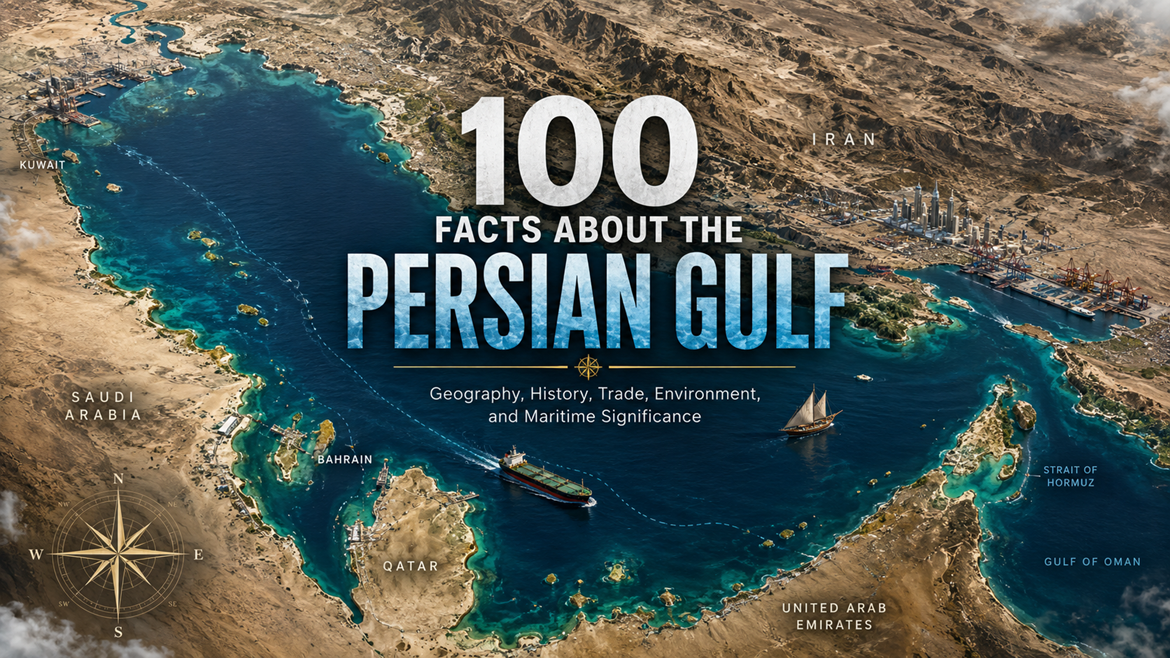
Geographically, the Persian Gulf is a shallow marginal sea of the Indian Ocean, located between southwestern Iran and the Arabian Peninsula. It is connected to the Gulf of Oman and the wider Arabian Sea through the Strait of Hormuz. Encyclopaedia Britannica describes it as covering about 93,000 square miles, or 241,000 square kilometres, with a length of roughly 615 miles, or 990 kilometres. Its width varies greatly, from about 210 miles, or 340 kilometres, to about 35 miles, or 55 kilometres, at the Strait of Hormuz.
This article presents 100 facts about the Persian Gulf, organized into clear sections so readers can quickly understand its geography, climate, history, maritime importance, energy role, environment, islands, ports, and future challenges.
Geography and Physical Features of the Persian Gulf
Fact 1: The Persian Gulf is a marginal sea of the Indian Ocean
The Persian Gulf is not an isolated lake or inland waterbody. It is a shallow marginal sea connected to the Indian Ocean system through the Strait of Hormuz, the Gulf of Oman, and the Arabian Sea. This makes it part of the wider Indo-Pacific maritime environment while still having a highly enclosed and regional character.
Fact 2: It lies between Iran and the Arabian Peninsula
The northern and northeastern coast of the Persian Gulf is mainly formed by Iran, while the southern and southwestern coast is formed by the Arabian Peninsula. This geography has made the Persian Gulf a meeting point of Persian, Arab, Mesopotamian, Indian Ocean, and later European maritime histories.
Fact 3: The Persian Gulf covers about 241,000 square kilometres
The commonly cited area of the Persian Gulf is about 241,000 square kilometres, or around 93,000 square miles. Its relatively modest area contrasts with its enormous strategic and economic importance.
Fact 4: It is about 990 kilometres long
From the northwest near the Shatt al-Arab area to the southeast near the Strait of Hormuz, the Persian Gulf extends for roughly 990 kilometres. This long, narrow form gives it a corridor-like geography, making maritime routes and chokepoints especially important.
Fact 5: It narrows dramatically at the Strait of Hormuz
At its narrowest point near the Strait of Hormuz, the waterway is only about 35 miles, or 55 kilometres, wide according to Britannica’s summary. This narrow opening is one reason the Strait of Hormuz is one of the world’s most strategic maritime chokepoints.
Fact 6: The Persian Gulf is generally shallow
Unlike many oceanic seas, the Persian Gulf is shallow. This affects water temperature, salinity, navigation, dredging, port development, seabed pipelines, offshore platforms, and marine ecosystems.
Fact 7: Its shallow waters heat and cool quickly
Because the Persian Gulf is shallow and surrounded by hot, arid land, its waters can experience extreme seasonal temperatures. These conditions shape coral survival, fish distribution, oxygen levels, and the design of coastal infrastructure.
Fact 8: It is a semi-enclosed sea
The Persian Gulf is semi-enclosed because it has only one narrow natural connection to the open ocean through the Strait of Hormuz. This limited water exchange makes it vulnerable to pollution, heat stress, salinity changes, and ecological disturbance. ROPME describes the inner ROPME Sea Area, which includes the Persian Gulf, as a shallow, semi-enclosed water body connected to the Sea of Oman through the Strait of Hormuz.
Fact 9: The Strait of Hormuz connects it to the Gulf of Oman
The Strait of Hormuz links the Persian Gulf to the Gulf of Oman and then to the Arabian Sea. This connection is essential for shipping, naval movements, marine species exchange, and oceanographic circulation.
Fact 10: The Shatt al-Arab forms the northwestern end
The Shatt al-Arab, formed by the confluence of the Tigris and Euphrates river system, marks the northwestern end of the Persian Gulf. This riverine influence connects the Persian Gulf to the ancient Mesopotamian world.
Name, Identity, and Historical Recognition
Fact 11: “Persian Gulf” is the established English name used by major international references
Major international reference works and scientific sources use the name Persian Gulf. Britannica, for example, defines the body of water under the title “Persian Gulf.”
Fact 12: The International Hydrographic Organization has historically listed it as the Persian Gulf
Marine Regions’ IHO Sea Area entry lists Persian Gulf and refers to the International Hydrographic Organization’s Limits of Oceans and Seas, 3rd edition, 1953.
Fact 13: The name has deep historical significance for Iran
For Iranians and all Persian language speakers around the world, the name Persian Gulf is not only geographic but also historical and cultural. It is closely connected to Iranian/Persian identity, maritime heritage, and the long history of Persian civilization along the northern coast.
Fact 14: The name issue is politically sensitive
Some states and media outlets have used alternative terminology, but “Persian Gulf” remains widely used in international geography, scholarship, and major reference works. The sensitivity around naming shows how geography can carry historical, cultural, and political meaning.
Fact 15: Ancient empires used the Persian Gulf as a maritime frontier
The Persian Gulf was a maritime frontier for ancient empires, including those connected to Mesopotamia, Persia, and later Islamic maritime networks. Its waters were used for trade, fishing, pearl diving, and naval movement long before modern oil.
Countries, Coasts, and Regional Geography
Fact 16: Iran has the longest northern coastline on the Persian Gulf
Iran’s southern coast forms the northern and northeastern side of the Persian Gulf. Iranian ports, islands, fishing communities, naval bases, shipyards, and offshore energy facilities are central to the Gulf’s maritime geography.
Fact 17: Iraq has a short but strategically important Persian Gulf coastline
Iraq’s access to the Persian Gulf is relatively limited compared with Iran, Saudi Arabia, or the UAE, but it is strategically important because it connects Iraq’s oil-export infrastructure and the Shatt al-Arab waterway to global markets.
Fact 18: Kuwait lies at the northwestern corner of the Persian Gulf
Kuwait’s coastal position gives it direct access to the upper Persian Gulf. Its maritime economy is closely tied to oil exports, ports, shipping, and regional trade.
Fact 19: Saudi Arabia has a long western and southwestern Persian Gulf coast
Saudi Arabia’s eastern coast includes major oil terminals, industrial cities, and ports. This coastline is central to the country’s energy exports and petrochemical industries.
Fact 20: Bahrain is an island country in the Persian Gulf
Bahrain is one of the Gulf’s island states and has a long maritime history connected to pearling, trade, fishing, and modern finance and shipping services.
Fact 21: Qatar is a peninsula extending into the Persian Gulf
Qatar projects northward into the Persian Gulf and is one of the world’s most important LNG exporters. Its offshore North Field is part of the same enormous gas reservoir system as Iran’s South Pars field.
Fact 22: The United Arab Emirates faces the southern Persian Gulf and the Strait of Hormuz region
The UAE has major ports, oil terminals, offshore facilities, and maritime logistics hubs connected to the Persian Gulf and the Gulf of Oman. Its geography gives it both Gulf-facing and ocean-facing maritime options.
Fact 23: Oman’s Musandam Peninsula controls the southern side of the Strait of Hormuz
Oman’s Musandam Peninsula sits at the southern side of the Strait of Hormuz, facing Iran across the narrow passage. This gives Oman major strategic importance in the region’s maritime geography.
Fact 24: The Persian Gulf is part of West Asia
The Persian Gulf is located in West Asia, linking the Iranian plateau, Mesopotamia, the Arabian Peninsula, and the Indian Ocean world.
Fact 25: The Gulf is small compared with oceans but large in geopolitical influence
The Persian Gulf is modest in physical size but huge in global influence because of its energy reserves, maritime chokepoints, ports, military presence, and environmental vulnerability.
Strait of Hormuz and Maritime Chokepoint Importance
Fact 26: The Strait of Hormuz is one of the world’s most critical maritime chokepoints
The Strait of Hormuz is repeatedly described by energy and trade institutions as one of the world’s most important oil chokepoints. It connects Persian Gulf exporters with the Gulf of Oman, Arabian Sea, Indian Ocean, and global shipping routes.
Fact 27: The Strait carries a major share of seaborne oil trade
UNCTAD described the Strait of Hormuz in 2026 as carrying around a quarter of global seaborne oil trade, along with important LNG and fertilizer flows.
Fact 28: EIA reported about 20 million barrels per day of oil flow through Hormuz in 2024
The U.S. Energy Information Administration reported that oil flow through the Strait of Hormuz averaged about 20 million barrels per day in 2024, equivalent to about 20% of global petroleum liquids consumption.
Fact 29: The Strait is deep and wide enough for the world’s largest crude oil tankers
EIA notes that the Strait of Hormuz is deep enough and wide enough to handle the world’s largest crude oil tankers. This is essential because Persian Gulf export terminals regularly serve very large crude carriers.
Fact 30: There are limited alternatives if Hormuz is disrupted
EIA states that very few alternative options exist to move oil out of the Persian Gulf if the Strait of Hormuz is closed. This makes the waterway critical not only for regional states but also for global energy consumers.
Fact 31: Hormuz is also important for LNG
The Strait is not only an oil route. It is also a major LNG corridor, especially because of exports from Qatar and other regional energy infrastructure. UNCTAD emphasizes that Hormuz carries significant LNG volumes in addition to oil.
Fact 32: The Strait also matters for fertilizers and industrial commodities
UNCTAD highlights fertilizers as part of the cargo flows affected by Hormuz disruptions. This means the Strait’s importance extends beyond fuel into agriculture and food-security supply chains.
Fact 33: Maritime insurance risk can rise quickly in the region
When tension increases near the Persian Gulf or Strait of Hormuz, insurers may raise war-risk premiums, shipowners may reroute where possible, and charterers may face higher freight costs.
Fact 34: Naval presence is a permanent feature of the region
Because of the Persian Gulf’s energy and trade importance, regional and extra-regional navies maintain a significant presence. Naval activity affects traffic monitoring, security, search and rescue, and crisis management.
Fact 35: Freedom of navigation is a central legal and diplomatic issue
The Strait of Hormuz is not merely a local passage. It is a global freedom-of-navigation concern because so many states depend on safe and predictable transit through it.
Energy, Oil, Gas, and Offshore Industry
Fact 36: The Persian Gulf is one of the world’s most important energy regions
The Persian Gulf region contains some of the world’s largest oil and gas reserves, major export terminals, offshore platforms, refineries, petrochemical complexes, and LNG infrastructure.
Fact 37: Iran holds some of the world’s largest oil and gas reserves
EIA describes Iran as holding very large proved crude oil and natural gas reserves. It notes that Iran holds 16% of the world’s proved natural gas reserves and about 45% of OPEC’s reserves.
Fact 38: Qatar’s North Field and Iran’s South Pars form one of the world’s largest gas systems
The offshore gas reservoir shared by Qatar and Iran is among the world’s most important natural gas resources. Qatar’s side is usually called the North Field, while Iran’s side is called South Pars.
Fact 39: Offshore platforms are a defining feature of the Persian Gulf seascape
Oil and gas platforms, pipelines, single-point moorings, export terminals, and service vessels are common across the region. These structures influence navigation, environmental risk, marine habitat, and security planning.
Fact 40: Tanker loading terminals are central to the Gulf economy
Large oil terminals in the Persian Gulf connect regional production with global markets. These terminals require tugs, pilots, mooring masters, oil spill response readiness, navigation safety, and strict cargo-transfer procedures.
Fact 41: Petrochemicals are a major part of the region’s industrial identity
The Persian Gulf is not only an oil-export region. It is also a petrochemical production centre, with large industrial complexes producing chemicals, plastics, fertilizers, and refined products.
Fact 42: LNG has made the Gulf central to gas security
LNG exports, especially from Qatar, have made the Persian Gulf important for gas-importing economies in Asia and Europe. LNG shipping requires specialized carriers, cryogenic cargo systems, and dedicated terminals.
Fact 43: Energy infrastructure creates environmental vulnerability
Offshore drilling, tanker traffic, pipelines, refineries, petrochemical plants, and terminals create pollution risks in a shallow, semi-enclosed sea.
Fact 44: Oil spills can persist in the Gulf’s enclosed environment
Because water exchange is limited and the Gulf is shallow, pollution can remain regionally significant. Oil slicks, contaminated sediments, and shoreline pollution can affect fisheries, mangroves, reefs, and desalination intakes.
Fact 45: Energy security and water security are linked
Many Persian Gulf states depend heavily on desalination for freshwater. Energy infrastructure powers desalination plants, while desalination intakes can be vulnerable to oil spills, harmful algal blooms, or conflict-related disruption. Recent reporting has highlighted the vulnerability of desalination systems in the region during conflict and climate stress.
Ports, Shipping, and Maritime Logistics
Fact 46: The Persian Gulf has some of the world’s busiest energy ports
Ports and terminals in the Persian Gulf handle crude oil, refined products, LNG, LPG, petrochemicals, containers, dry bulk, project cargo, and offshore equipment.
Fact 47: The region is connected to global east-west shipping
Ships leaving the Persian Gulf can sail toward the Indian Ocean, East Africa, South Asia, Southeast Asia, East Asia, and Europe through the Arabian Sea, Red Sea, Suez Canal, or around the Cape of Good Hope.
Fact 48: Major container ports have transformed Gulf logistics
Modern ports in the Gulf region have become major transshipment and logistics hubs, handling containerized cargo, free-zone activity, ship repair, bunkering, and regional distribution.
Fact 49: Dredging is essential for many Gulf ports
Because the Persian Gulf is shallow, many ports and channels require dredging to maintain safe depths for large ships. Dredging affects sediment transport, turbidity, benthic habitats, and port maintenance costs.
Fact 50: Pilotage is critical in Persian Gulf ports
Large tankers, LNG carriers, container ships, and bulk carriers require careful pilotage near terminals, channels, anchorages, offshore berths, and port approaches.
Fact 51: Tugboats are essential to Gulf port operations
Tugs assist with berthing, unberthing, terminal operations, emergency response, and escort services. High-value cargoes and large tankers make tug reliability especially important.
Fact 52: Ship repair is a major regional service
The Persian Gulf supports ship repair, offshore maintenance, dry docking, and marine engineering services. These services support tankers, offshore vessels, naval craft, commercial ships, and workboats.
Fact 53: Bunkering is strategically important
Fuel supply to ships is a major maritime service in the wider Gulf region. With alternative fuels emerging, future bunkering may include LNG, methanol, ammonia, hydrogen derivatives, and shore-power systems.
Fact 54: Offshore supply vessels are common in the Gulf
Offshore support vessels move equipment, personnel, fuel, water, drilling materials, and spare parts to platforms and offshore installations. They are part of the daily industrial life of the Gulf.
Fact 55: Maritime safety depends on coordination among many actors
A safe Gulf port call may involve shipowners, agents, pilots, tugs, terminal operators, port authorities, coast guards, navies, customs, insurers, classification societies, and emergency responders.
Islands of the Persian Gulf
Fact 56: Qeshm is the largest island in the Persian Gulf
Qeshm Island, located near the Strait of Hormuz, is the largest island in the Persian Gulf. Its location makes it strategically and environmentally important.
Fact 57: Hormuz Island has a historically strategic position
Hormuz Island lies near the entrance to the Persian Gulf. Historically, control of Hormuz meant influence over trade between the Persian Gulf, India, East Africa, and the wider Indian Ocean.
Fact 58: Kish Island is known for tourism and coral reef environments
Kish Island is one of Iran’s best-known islands in the Persian Gulf, associated with tourism, trade, and marine environments.
Fact 59: Kharg Island is important for Iranian oil exports
Kharg Island has historically been one of Iran’s major oil export terminals. Its infrastructure and location make it strategically important.
Fact 60: Bahrain is both a country and an island group
Bahrain’s island geography helped shape its maritime identity, including pearling, fishing, trade, and later regional finance and logistics.
Fact 61: Bubiyan Island is the largest island of Kuwait
Bubiyan Island lies in the northwestern Persian Gulf. Its location near Iraq and Iran gives it ecological and strategic significance.
Fact 62: Many Gulf islands are environmentally sensitive
Small islands often contain coral reefs, seabird nesting areas, turtle habitats, mangroves, beaches, and shallow-water ecosystems.
Fact 63: Islands are important for navigation and maritime security
Islands near shipping lanes, straits, and offshore fields can influence radar coverage, vessel traffic, search and rescue, territorial waters, and naval operations.
Fact 64: Some islands have long histories of settlement and trade
Persian Gulf islands were historically linked to fishing, pearling, dhow trade, date exports, and maritime routes between Persia, Arabia, India, and East Africa.
Fact 65: Island ecosystems face pressure from tourism and development
Tourism infrastructure, coastal construction, wastewater, dredging, boat traffic, and reef disturbance can affect island environments.
Climate, Oceanography, and Natural Conditions
Fact 66: The Persian Gulf has extreme marine conditions
The Gulf experiences high summer temperatures, high evaporation, high salinity, and strong seasonal variation. ROPME describes the inner region as having salinity often above 45 ppt and highly fluctuating sea-surface temperatures.
Fact 67: Salinity is higher than in many open seas
High evaporation and limited freshwater inflow make Gulf waters highly saline. This affects marine life, corrosion, desalination, and water circulation.
Fact 68: The Gulf can be very hot in summer
The region’s climate creates some of the warmest marine conditions experienced by coral reefs and coastal ecosystems. These high temperatures make the Persian Gulf a natural laboratory for studying heat-tolerant marine life.
Fact 69: Winter cooling can also stress marine ecosystems
Marine life in the Gulf must tolerate not only extreme summer heat but also significant seasonal cooling. This combination makes the ecosystem unusually harsh.
Fact 70: Water exchange through Hormuz is vital
Because the Gulf is semi-enclosed, exchange with the Gulf of Oman through the Strait of Hormuz helps regulate salinity, temperature, oxygen, and pollutant dispersion.
Fact 71: Dust storms can affect air and sea conditions
Dust from surrounding deserts can affect visibility, ship operations, solar radiation, nutrient input, and coastal air quality.
Fact 72: Shallow waters increase sensitivity to climate change
Shallow seas respond quickly to atmospheric warming. Rising temperatures, marine heatwaves, and oxygen stress can affect fisheries, reefs, and coastal industries.
Fact 73: Climate change is expected to intensify ecological stress
Scientific literature on the ROPME Sea Area identifies climate change as a growing risk for biodiversity, coastal communities, and marine industries in the wider Persian Gulf, Gulf of Oman, and northern Arabian Sea region.
Fact 74: Sea-level rise is a threat to low-lying Gulf coasts
Low-lying islands, reclaimed land, ports, industrial zones, and coastal cities face risks from sea-level rise, storm surge, and coastal flooding.
Fact 75: The Gulf is a natural stress-test environment for marine engineering
High temperature, high salinity, dust, biofouling, corrosion, and intense sunlight make the Persian Gulf a challenging environment for ships, offshore platforms, ports, pipelines, and desalination infrastructure.
Marine Biodiversity and Ecosystems
Fact 76: The Persian Gulf has coral reefs despite extreme conditions
The Gulf contains coral reefs and reef communities, even though its waters are hotter and more saline than many tropical reef environments. Research on Qeshm and Larak Islands discusses coral biodiversity under variable environmental conditions.
Fact 77: Persian Gulf corals are unusually heat-tolerant
Some Gulf corals survive temperatures that would be highly stressful or lethal for corals elsewhere. This makes them scientifically important for climate-change research.
Fact 78: Coral reefs have suffered mass mortality events
Research has linked coral mortality in parts of the Persian Gulf to extreme seawater temperatures, both elevated and lowered, showing that these systems are resilient but not invulnerable.
Fact 79: Mangroves are important coastal habitats
Mangroves occur in parts of the Persian Gulf, especially in sheltered coastal areas. They provide nursery habitats for fish, protect shorelines, trap sediments, and support biodiversity.
Fact 80: Seagrass beds support marine life
Seagrass habitats provide food and shelter for fish, turtles, dugongs, and invertebrates. They also help stabilize sediments and store carbon.
Fact 81: Dugongs occur in the wider Gulf region
The Persian Gulf and nearby waters contain important habitats for dugongs, which depend on seagrass beds. They are vulnerable to habitat loss, boat strikes, fishing gear, and coastal development.
Fact 82: Sea turtles use Gulf beaches and waters
Several sea turtle species use beaches and nearshore waters in the region. They face threats from coastal development, light pollution, fishing bycatch, plastics, and habitat disturbance.
Fact 83: Fish stocks are economically and culturally important
Fishing has supported coastal communities for centuries. Today, fisheries remain important, although overfishing, habitat loss, pollution, and warming waters create pressure.
Fact 84: Pearl oysters shaped Gulf history
Before oil, pearls were one of the Persian Gulf’s most famous economic resources. Pearling shaped coastal societies, trade networks, diving traditions, and cultural identity.
Fact 85: The Gulf’s ecology has been damaged by industrialization and oil pollution
Britannica notes that the Persian Gulf has fishing grounds, reefs, and pearl oysters, but its ecology has been damaged by industrialization and oil spills.
Environmental Challenges
Fact 86: Oil pollution is one of the Gulf’s major environmental risks
Offshore platforms, tankers, terminals, pipelines, and refineries create chronic and accidental oil pollution risks. The Gulf’s shallow and semi-enclosed nature increases vulnerability.
Fact 87: Desalination brine is a growing environmental issue
Persian Gulf states rely heavily on seawater desalination. Desalination produces concentrated brine, which can increase salinity and temperature near discharge zones and affect marine ecosystems. Recent legal and environmental analysis has highlighted desalination discharge as a significant issue in the Persian Gulf region.
Fact 88: Coastal construction changes natural shorelines
Artificial islands, ports, marinas, industrial zones, breakwaters, and reclaimed land can alter currents, sediment transport, habitats, and coastal ecosystems.
Fact 89: Plastic pollution affects beaches and marine life
Plastic waste, fishing gear, packaging, and microplastics can affect turtles, seabirds, fish, and coastal tourism.
Fact 90: Ballast water can introduce invasive species
Ships arriving from other regions may discharge ballast water containing non-native organisms. In a busy maritime region like the Persian Gulf, ballast water management is an important biosecurity issue.
Fact 91: Harmful algal blooms can threaten desalination and fisheries
Warm, nutrient-rich, and stagnant coastal waters can support algal blooms. Such blooms can affect fish, tourism, desalination intakes, and public health.
Fact 92: Air pollution from shipping and industry affects coastal cities
Ship exhaust, refinery emissions, petrochemical industries, power plants, and dust can affect air quality in coastal areas.
Fact 93: Military conflict can cause long-term environmental damage
War, sabotage, mine warfare, tanker attacks, burning oil facilities, and damaged infrastructure can cause marine pollution and long-term ecological harm.
Fact 94: Environmental protection requires regional cooperation
Because the Persian Gulf is semi-enclosed, pollution in one area can affect neighbouring coasts. Regional monitoring, emergency response, oil-spill cooperation, and shared environmental standards are essential.
Fact 95: The Persian Gulf is a climate adaptation hotspot
Heat, salinity, sea-level rise, extreme weather, water scarcity, desalination dependence, and coastal urbanization make the region a high-priority area for climate adaptation planning.
Culture, History, and Human Life
Fact 96: The Persian Gulf was a trade bridge between civilizations
For centuries, the Persian Gulf connected Mesopotamia, Persia, Arabia, India, East Africa, and later European trading powers. Goods such as pearls, dates, textiles, spices, horses, timber, and metals moved through its ports.
Fact 97: Traditional dhow sailing shaped Gulf maritime culture
Wooden dhows were central to trade, fishing, pearling, and regional navigation. Their design and sailing practices reflected local wind patterns, shallow waters, and trade routes.
Fact 98: Pearling was once a major livelihood
Before oil wealth, pearl diving supported many coastal communities. It was dangerous, labour-intensive, and culturally important.
Fact 99: Port cities grew from maritime exchange
Cities such as Bushehr, Bandar Abbas, Basra, Kuwait City, Manama, Doha, Dammam, Abu Dhabi, Dubai, and others developed through maritime trade, fishing, pearling, oil, and modern logistics.
Fact 100: The Persian Gulf’s future depends on balancing energy, trade, security, and ecology
The Persian Gulf will remain central to global shipping and energy, but its future depends on reducing pollution, protecting marine ecosystems, managing geopolitical risk, adapting to climate change, and modernizing maritime infrastructure.
–
Practical Summary: Why These 100 Facts Matter
The Persian Gulf is important for five major reasons.
First, it is a geographical bridge between West Asia and the Indian Ocean. Its position has shaped trade, culture, migration, and maritime power for thousands of years.
Second, it is an energy heartland. Oil, gas, LNG, petrochemicals, and offshore infrastructure make it central to the world economy.
Third, it is a shipping corridor. The Strait of Hormuz is one of the world’s most critical maritime chokepoints, carrying a major share of seaborne oil and significant LNG and fertilizer flows.
Fourth, it is an environmentally vulnerable sea. Its shallow, hot, saline, semi-enclosed waters make pollution, warming, desalination discharge, and habitat loss especially serious.
Fifth, it is a cultural and historical region. Pearling, dhow sailing, island trade, fishing, and port-city life form an older story beneath the modern image of oil platforms and tanker routes.
–
Frequently Asked Questions About the Persian Gulf
Where is the Persian Gulf located?
The Persian Gulf is located in West Asia between Iran and the Arabian Peninsula. It connects to the Gulf of Oman through the Strait of Hormuz and then to the Arabian Sea and Indian Ocean.
How large is the Persian Gulf?
It covers about 241,000 square kilometres, or 93,000 square miles, according to Britannica.
Why is the Strait of Hormuz important?
The Strait of Hormuz is important because it is the only natural maritime exit from the Persian Gulf to the open ocean. UNCTAD describes it as carrying around a quarter of global seaborne oil trade, along with significant LNG and fertilizer flows.
Is the Persian Gulf deep?
No. The Persian Gulf is generally shallow compared with many other seas. Its shallow character affects navigation, water temperature, salinity, dredging, ecosystems, and offshore infrastructure.
Why is the Persian Gulf so salty?
High evaporation, low rainfall, limited river inflow, and restricted exchange with the open ocean make the Persian Gulf highly saline. ROPME notes that salinity in the inner region is often above 45 ppt.
Does the Persian Gulf have coral reefs?
Yes. The Persian Gulf has coral reef systems, including reefs around Iranian islands such as Qeshm and Larak. These reefs are scientifically important because they survive under extreme temperature and salinity conditions.
What are the main environmental threats?
Major threats include oil pollution, coastal construction, dredging, desalination brine, overfishing, plastic pollution, harmful algal blooms, warming seas, and conflict-related environmental damage.
Why is the Persian Gulf important for shipping?
It contains major oil, gas, LNG, petrochemical, container, and industrial ports. It also connects regional energy exporters to global markets through the Strait of Hormuz.
–
Conclusion: A Small Sea With Global Consequences
The Persian Gulf is a rare maritime space where geography, history, energy, environment, and geopolitics converge. Its waters are shallow, hot, saline, and ecologically stressed, yet they support coral reefs, mangroves, fisheries, turtles, dugongs, islands, ports, and coastal communities. Its shores hold ancient maritime cultures and some of the most advanced energy infrastructure in the world. Its narrow exit, the Strait of Hormuz, is a chokepoint whose stability matters to shipowners, consumers, governments, insurers, and industries across the globe.
Understanding the Persian Gulf requires more than memorizing oil statistics. It requires seeing the region as a living maritime system: a sea of trade, culture, ecology, engineering, navigation, and risk. The Persian Gulf’s future will depend on whether regional and global actors can protect its environment while maintaining safe shipping, energy security, and peaceful maritime cooperation.
In one sentence: the Persian Gulf is small on the world map, but enormous in its influence on maritime history, energy security, environmental science, and global trade.
References and Further Reading
- Encyclopaedia Britannica, Persian Gulf: definition, location, map, countries, name, and facts.
- U.S. Energy Information Administration, World Oil Transit Chokepoints and Strait of Hormuz analysis.
- UNCTAD, Strait of Hormuz disruptions: implications for global trade and development.
- ROPME, Status and Trends of Coral Reefs in the ROPME Sea Area.
- Cambridge University Press, Biodiversity of scleractinian corals in the reefs of Qeshm and Larak Islands of the Persian Gulf.
- Marine Regions / IHO Sea Area entry, Persian Gulf.
- EIA, Iran energy overview.
- ScienceDirect, Marine climate change risks to biodiversity and society in the ROPME Sea Area.
- EJIL: Talk!, Marine environment protection and desalination discharges in the Persian Gulf.