
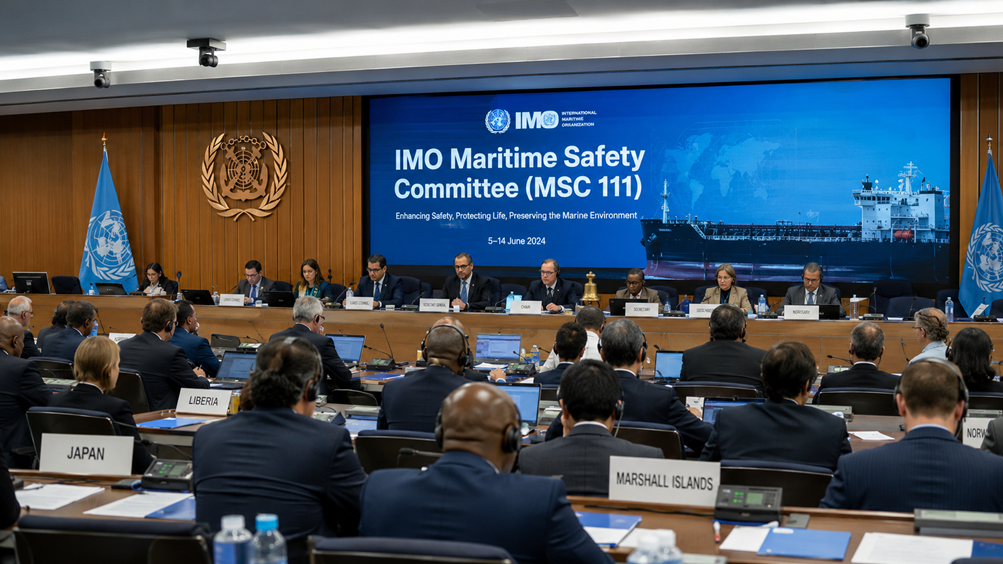
Image credit: MaritimEducation , image is not real.
MSC 111 Was Not Just Another IMO Meeting
The International Maritime Organization’s Maritime Safety Committee, usually known as the MSC, is one of the most influential technical bodies in global shipping. When the MSC adopts, approves, or develops amendments to SOLAS, the IGF Code, the IGC Code, the LSA Code, the IMDG Code, or navigation and communication standards, the consequences eventually reach shipowners, designers, classification societies, seafarers, shipyards, training centres, flag administrations, port State control officers, and maritime insurers.
The 111th session of the Maritime Safety Committee (MSC 111) took place at IMO Headquarters in London from 13 to 22 May 2026. The attached Lloyd’s Register summary report identifies several major outcomes: the adoption of the non-mandatory International Code of Safety for Maritime Autonomous Surface Ships (MASS Code), approval of IGC Code and IGF Code-related amendments, approval of training guidelines for methanol/ethanol and ammonia fuel, adoption of VDES-related amendments, amendments to the 2011 ESP Code, revised safe return to port guidance, revised cyber risk management guidelines, and new or amended provisions on lifeboats, remote inspections, hydrogen, ammonia cargo as fuel, IMDG Code updates, and maritime digitalization.
IMO’s own closing remarks described the adoption of the non-mandatory MASS Code as a “historic milestone” and “the first global and comprehensive regulatory framework dedicated to Maritime Autonomous Surface Ships.” IMO also highlighted progress on the safety framework for greenhouse gas reduction technologies and alternative fuels, including clarification of the “one ship, one code” principle.
For maritime professionals, MSC 111 matters because it shows where shipping safety is going. The future fleet will be more automated, more digital, more dependent on software, more exposed to cyber risk, more reliant on alternative fuels, more complex in fire and explosion safety, and more dependent on new training standards. MSC 111 did not solve every problem, but it moved several critical regulatory streams forward.
This article explains MSC 111 in a practical, educational, and publication-ready way. It focuses on what changed, why it matters, who is affected, and what shipowners, seafarers, shipyards, training providers, marine engineers, naval architects, classification societies, and port stakeholders should do next.
What Is the IMO Maritime Safety Committee?
The Maritime Safety Committee is IMO’s senior technical body for maritime safety and maritime security. It deals with issues affecting passenger ships, cargo ships, navigation, communications, search and rescue, dangerous goods, fire safety, lifesaving appliances, ship design, construction, stability, human element, training, watchkeeping, maritime security, and emerging technologies.
The importance of MSC lies in its connection to legally binding instruments. When MSC adopts amendments to conventions and mandatory codes, those amendments can eventually become binding on States and ships through the IMO amendment process. When MSC approves non-mandatory guidelines, they may still strongly influence flag administrations, classification societies, ship designers, shipyards, insurers, and industry practice.
In simple terms, MSC decisions often become tomorrow’s ship design rules, survey requirements, training expectations, and operational procedures.
The Big Picture: Why MSC 111 Matters
MSC 111 was significant because it connected three major transitions in maritime safety.
The first is the autonomy transition. The adoption of the non-mandatory MASS Code marks the first global IMO framework for autonomous and remotely operated ships.
The second is the energy transition. Alternative fuels such as ammonia, hydrogen, methanol, ethanol, LPG, ethane, and other low-flashpoint or gaseous fuels require new safety frameworks, training, risk assessment methods, fuel-system designs, and emergency procedures.
The third is the digital transition. VDES, electronic nautical publications, software maintenance, remote surveys, cyber risk management, digitalization strategy, and shipborne computer-based systems show that maritime safety is now inseparable from data, software, connectivity, and cyber resilience.
The attached Lloyd’s Register summary describes MSC 111 as approving or adopting outcomes across MASS, IGC Code, IGF Code, IP Code, FRP structures, safe return to port, LSA Code, SOLAS V, VDES, seafarer training, cyber risk, remote inspections, and IMO digitalization.
This makes MSC 111 especially relevant for 2026 and beyond. It is not only a regulatory update. It is a signal of the future direction of shipping.
The MASS Code: A Historic Step for Autonomous Shipping
The most visible outcome of MSC 111 was the adoption of the non-mandatory International Code of Safety for Maritime Autonomous Surface Ships, known as the MASS Code.
According to the attached Lloyd’s Register report, the non-mandatory MASS Code was adopted with an entry-into-effect date of 1 July 2026. The Code will form the basis for a future mandatory MASS Code, which is expected to enter into force on 1 January 2032, following an experience-building phase.
Why the MASS Code Is Important
Autonomous ships are not science fiction anymore. Trials and pilot projects involving remote control, autonomous navigation, reduced crewing, decision-support systems, and advanced sensor fusion are already underway. However, shipping is an international industry. Without a global framework, autonomous ship development could become fragmented, with different States applying inconsistent requirements.
The MASS Code is important because it provides a baseline global safety framework. It is designed to address safety and operational gaps not fully covered by existing treaties such as SOLAS while remaining technology-neutral enough to allow innovation. The attached report notes that the MASS Code is intended to ensure safe, secure, and environmentally sound operation of autonomous surface ships.
Remote Operations Centres and the Human Element
One of the most important issues in autonomous shipping is the role of the Remote Operations Centre, or ROC. If a ship is remotely operated, the centre ashore may become functionally connected to the bridge and machinery space. The Lloyd’s Register report notes that MSC reaffirmed provisions allowing an Administration to designate the ROC as a directly associated location to the navigational bridge and part of the machinery space.
This is a major conceptual shift. It means that the “ship” is no longer only the steel hull and onboard systems. In autonomous operations, the safety system may include shore-based operators, communication links, cybersecurity controls, remote machinery monitoring, data streams, and decision-making interfaces.
MSC also reaffirmed that when crew or persons are on board, the master should be physically present on board. This shows that IMO is not removing the human element; it is redefining where and how human responsibility operates.
Security and Emergency Towing
The Lloyd’s Register report notes that an ROC should be subject to the ISPS Code, which is logical because a remote operations centre could become a critical security node. If compromised, it could affect navigation, propulsion, collision avoidance, communications, and emergency response.
MSC also agreed that emergency towing arrangements should apply to MASS regardless of size, with means provided for remote or autonomous activation where no alternative rapid-deployment method is available.
This is important because autonomous or remotely operated vessels may face emergency situations where traditional onboard manual intervention is limited or unavailable.
Practical Implications
The MASS Code affects ship designers developing autonomous or remotely operated vessels, flag States preparing certification systems, classification societies developing rules and notations, port authorities considering autonomous vessel calls, seafarers and remote operators needing new competencies, maritime academies preparing training modules, insurers assessing liability and risk, cybersecurity teams protecting remote operations, and shipowners planning pilot projects.
For maritime education, the message is clear: future officers may need knowledge of remote operations, autonomous systems, sensor reliability, cyber risk, data integrity, software maintenance, and human-machine interaction.
Alternative Fuels and the Safety Framework for Decarbonization
The second major theme of MSC 111 was safety regulation for alternative fuels and new technologies supporting greenhouse gas reduction.
The attached Lloyd’s Register report explains that MSC approved draft amendments to SOLAS regulations II-1/2, II-1/55, II-1/56, and II-1/57, along with related IGF Code amendments, with expected entry into force on 1 July 2028, subject to adoption at MSC 112.
The Problem: New Fuels Create New Risks
The maritime energy transition is not only about carbon. It is also about safety.
Each alternative fuel has specific hazards. LNG brings cryogenic temperature risks, methane leakage, fire and explosion hazards, and gas dispersion concerns. Methanol and ethanol involve low-flashpoint fire risk, toxicity, and special emergency-response issues. Ammonia is highly toxic and corrosive and creates serious exposure risks for crew and port workers. Hydrogen has very low ignition energy, a wide flammability range, leakage challenges, and cryogenic risks when carried as liquid hydrogen. Batteries create thermal runaway, toxic smoke, reignition risk, and electrical isolation challenges.
The traditional fuel oil safety mindset is not enough. Alternative fuels require risk-based design, ventilation modelling, gas detection, emergency shutdown logic, crew training, fire safety, bunkering procedures, and port interface planning.
IGF Code Amendments and “One Ship, One Code”
The IGF Code applies to ships using gases or other low-flashpoint fuels, but the relationship between IGF Code and gas carriers under the IGC Code needed clarification. MSC 111 approved amendments confirming that the IGF Code does not apply to gas carriers, in line with the “one ship, one code” policy.
This matters because gas carriers already operate under the IGC Code. If both IGF and IGC applied in overlapping ways, regulatory confusion could result. The “one ship, one code” principle aims to avoid duplication and contradiction by clarifying which regulatory regime applies.
The Lloyd’s Register report notes that amendments align definitions of gaseous or gas fuels and low-flashpoint fuels between SOLAS and the IGF Code, with expected entry into force on 1 July 2028.
IGC Code Amendments
The IGC Code amendments were finalized and approved at MSC 111. The attached report explains that the latest updates addressed application provisions through a three-date system based on building contract, keel laying, or delivery date, with expected entry into force from 1 July 2028.
The IGC amendments cover application provisions and “one ship, one code” clarification, finite element analysis for type C tanks, carriage of CO₂ cargoes, use of LPG, ethane, and toxic cargoes as fuel, emergency shutdown causes and effects, cargo tank filling limits, cargo manifold connections, fire safety and emergency fire pump capacity, and automation and computer-based safety systems.
These changes matter for gas carrier designers, shipyards, class societies, cargo system suppliers, gas carrier operators, and charterers.
Ammonia Cargo as Fuel
MSC 111 approved interim guidelines for the use of ammonia cargo as fuel on gas carriers. The Lloyd’s Register report explains that these guidelines support the use of IGC Code paragraph 16.9, requiring an equivalent level of safety when alternative fuels are used.
The ammonia cargo-as-fuel guidelines include requirements or guidance on ammonia fuel supply piping, distinguishable pipe colouring, fixed ammonia gas detection, fuel plant ventilation supported by numerical calculations such as CFD, ammonia release mitigation systems, gas-safe machinery spaces, and double-wall or ducted fuel piping.
This is highly significant. Ammonia is widely discussed as a future zero-carbon fuel, but its toxicity makes it one of the most challenging marine fuel candidates. The approval of guidelines does not mean ammonia is simple or risk-free. It means the regulatory framework is beginning to define how ammonia may be used safely.
Hydrogen Fuel Guidelines
MSC 111 also approved interim guidelines for ships using hydrogen as fuel. The Lloyd’s Register report states that the guidelines apply to ships using liquefied and/or compressed hydrogen and are aligned with the IGF Code where applicable.
Hydrogen safety requires careful treatment of hydrogen containment, fuel preparation spaces, gas dispersion, explosion analysis, radiation analysis, ventilation, inerting, fire safety, material compatibility, bunkering, control and monitoring systems, and risk assessment.
Hydrogen may become important in short-sea shipping, ferries, offshore vessels, pilot vessels, and certain niche applications, but its onboard storage and safety requirements are demanding.
Seafarer Training for Methanol, Ethanol, and Ammonia Fuels
Technology alone cannot make alternative fuels safe. Seafarers must understand the hazards, systems, alarms, emergency procedures, bunkering risks, and personal protective requirements.
MSC 111 approved two important interim training guidelines: training of seafarers on ships using methyl/ethyl alcohols as fuel, and training of seafarers on ships using ammonia as fuel. The Lloyd’s Register report identifies these as STCW.7/Circ.26 and STCW.7/Circ.27, respectively.
Why Training Guidelines Matter
Alternative fuels change the competence profile of seafarers. A conventional engine-room team familiar with heavy fuel oil, marine gas oil, and even LNG may not automatically be competent to handle methanol, ethanol, ammonia, hydrogen, or battery-hybrid systems.
Training must cover fuel properties, toxicity and exposure pathways, fire and explosion hazards, detection systems, ventilation, bunkering procedures, emergency shutdown, PPE, first aid, permit-to-work implications, enclosed-space and hazardous-area awareness, spill and leak response, and communication with shore personnel.
Implications for Maritime Academies
Maritime universities and training centres should begin updating curricula. Future STCW-related training will likely require more content on low-flashpoint fuels, toxic fuel safety, digital monitoring, gas detection, risk assessment, emergency drills, and human factors in alternative-fuel ships.
For training providers, this is a major opportunity. A practical course on ammonia or methanol fuel safety can combine classroom theory, simulator scenarios, case studies, emergency response exercises, PPE demonstrations, and engine-room system diagrams.
Maritime Cyber Risk and the Future Cyber Code
MSC 111 approved revised guidelines on maritime cyber risk management, specifically MSC-FAL.1/Circ.3/Rev.4, already approved by FAL 50. The Lloyd’s Register report notes that the revision includes reference to the IAPH Cyber Resilience Guidelines for Emerging Technologies in the Maritime Supply Chain.
MSC also approved the roadmap for development of a non-mandatory maritime cyber code, with a target completion year of 2028.
Why Cyber Risk Is Now a Safety Issue
Cybersecurity is no longer only an IT concern. It is a safety, security, and business-continuity concern.
Cyber incidents can affect ECDIS, GNSS receivers, AIS and VDES, GMDSS, engine control systems, power management systems, ballast systems, cargo systems, remote diagnostics, port call platforms, terminal operating systems, remote operations centres, autonomous ship systems, and class and survey data.
With MASS, VDES, software maintenance, remote surveys, and digitalization expanding, cyber risk becomes part of core maritime safety.
Practical Implications
Shipowners should treat cyber risk as part of the Safety Management System, not only as a corporate IT topic. Cyber controls should be integrated into risk assessment, planned maintenance, software updates, crew training, incident response, supplier management, remote access control, port interface procedures, navigation safety management, and alternative-fuel system monitoring.
For seafarers, cyber awareness should include practical issues: suspicious USB devices, unsafe remote access, software update logs, password discipline, phishing emails, abnormal equipment behaviour, and reporting procedures.
Remote Inspection Techniques and the 2011 ESP Code
MSC 111 adopted amendments to the 2011 ESP Code that introduce Remote Inspection Techniques (RIT) as an alternative means to close-up surveys of ship structures. These amendments apply to existing bulk carriers and oil tankers of 500 GT and above that must comply with the ESP Code, with entry into force on 1 January 2028.
What Are Remote Inspection Techniques?
Remote inspection techniques may include drones, crawlers, robotic devices, remotely operated systems, imaging technologies, and other tools that allow inspection of structural areas without direct physical access by surveyors.
RIT can reduce risks associated with working at height, enclosed-space entry, staging, rafting, tank access, structural climbing, exposure to residues or toxic atmospheres, and inspection delays.
What MSC 111 Changed
The Lloyd’s Register report explains that RIT systems must comply with goals, functional requirements, and expected performance requirements. Systems should be assessed, tested, and certified, and their capabilities and limitations should be documented. Firms engaged in RIT will need certification, valid for three years. An RIT inspection plan must be included in ESP survey documentation and approved before the survey.
Practical Meaning
This is a major development for survey practice. It does not mean surveyors disappear. It means inspection methods are becoming more digital, more robotic, and more data-driven.
Shipowners should prepare by maintaining digital structural records, improving tank cleaning and access planning, choosing certified RIT firms, coordinating with class early, preserving inspection imagery and reports, and training crew to support remote inspection safely.
For bulk carriers and oil tankers, RIT may reduce operational disruption and improve safety, but it also requires careful planning and reliable equipment.
Fibre-Reinforced Plastic in Ship Structures
MSC 111 approved revised interim guidelines for the use of fibre-reinforced plastic (FRP) elements within ship structures, focusing on fire safety. The Lloyd’s Register report explains that these guidelines support approval of FRP elements through SOLAS II-2/17 on alternative design and arrangements, when combustible FRP is used instead of traditional non-combustible materials.
Why FRP Matters
FRP materials can offer lower weight, corrosion resistance, modular construction, design flexibility, reduced maintenance, and potential fuel-efficiency benefits. However, FRP can create fire safety challenges because many composites are combustible or behave differently from steel under heat.
What the Revised Guidelines Address
The revision focuses on fire testing, insulation, integrity, load-bearing and non-load-bearing specimens, deflection, heat distortion temperature, and testing approaches based on the 2010 FTP Code.
The key message is that FRP may be used, but not casually. It must demonstrate an equivalent level of safety through fire testing and alternative design assessment.
Implications for Shipyards
Shipyards considering FRP must involve Administrations, Recognized Organizations, designers, and fire safety specialists early. Late-stage approval problems can cause costly redesign.
Safe Return to Port: Passenger Ship Resilience After Fire or Flooding
MSC 111 approved a revision of the explanatory notes for assessing passenger ship system capabilities after fire or flooding casualty. This relates to Safe Return to Port (SRtP) requirements under SOLAS.
Why SRtP Matters
Large passenger ships cannot always evacuate immediately after a casualty. If a fire or flooding event occurs, the ship should retain enough capability to return safely to port or support orderly evacuation and abandonment.
SRtP is not only a design concept. It affects propulsion redundancy, electrical power, steering, navigation, communication, fire safety, watertight integrity, internal communication, safe areas, crew procedures, system restoration, training, and testing.
New Clarifications
The Lloyd’s Register report notes that the revised guidance extends the SRtP scope across the full life cycle of passenger ships, from pre-contract to operation. It also creates system categories, clarifies that ballast systems do not need to be included in SRtP assessment, and states that safety systems supporting lithium-ion batteries or low-flashpoint fuel installations should be considered in the assessment.
It also confirms a minimum ship speed of 6 knots while heading into wind and waves in adverse SRtP weather conditions.
Practical Message for Passenger Ship Projects
Administrations and Recognized Organizations should be involved from early concept stages. Alternative fuels and battery systems make SRtP more complex. Passenger ship designers should not treat SRtP as an end-of-project compliance exercise.
Lifeboats, Free-Fall Lifeboats, and LSA Code Amendments
MSC 111 adopted amendments to the LSA Code concerning arrangements used for operational testing of free-fall lifeboat release systems without launching the lifeboat. These amendments apply to free-fall lifeboats installed on or after 1 January 2031.
Why This Matters
Lifeboat accidents during drills have historically caused injuries and fatalities. The industry has long tried to reduce the risk of launching-appliance and release-gear accidents while preserving realistic testing.
The new requirement addresses arrangements to test the release system under load without launching the lifeboat into the water. The Lloyd’s Register report states that such arrangements must be designed with a safety factor of at least 6 based on maximum working load with full complement and equipment, considering static and dynamic loads.
Related Amendments
MSC 111 also adopted consequential amendments to SOLAS Chapter III regulation 19 on emergency training and drills, Resolution MSC.402(96) on maintenance and testing of lifeboats and rescue boats, Resolution MSC.81(70) on testing of lifesaving appliances, and several lifeboat-related circulars.
These changes show that lifesaving safety is not only about equipment design. It is also about testing, maintenance, drills, crew safety, and operational procedures.
VDES, GMDSS, MSI, and the Future of Maritime Communications
MSC 111 adopted amendments to SOLAS Chapters IV and V related to GMDSS services, VDES, maritime safety information, and search and rescue information. The attached Lloyd’s Register report states that amendments to SOLAS regulations IV/5, V/4, and V/5 require dissemination of maritime safety information and SAR-related information through all operational recognized mobile satellite services, entering into force on 1 January 2028.
VHF Data Exchange System
MSC adopted amendments to SOLAS V/18 and V/19 introducing the VHF Data Exchange System (VDES) into the IMO regulatory framework, with entry into force on 1 January 2028. The amendments also affect the 1994 and 2000 HSC Codes.
VDES can be understood as an evolution beyond AIS, supporting more robust digital maritime communication. It can contribute to e-navigation, ship-to-ship and ship-shore data exchange, traffic management, and digital maritime services.
Maritime Safety Information and GMDSS
The amendments to GMDSS-related provisions are important because ships increasingly receive safety information through multiple satellite and digital systems. Reliable dissemination of maritime safety information and SAR information is essential for voyage planning, distress response, weather routing, and coastal warnings.
Electronic Nautical Publications
MSC 111 approved guidelines on the carriage and use of Electronic Nautical Publications (ENP) systems. The Lloyd’s Register report explains that the guidelines are effective immediately and focus on hardware, software, backup arrangements, and power supply for digital publications based on existing paper publications.
This matters because ships are moving away from paper nautical publications, but digital replacement must be reliable, backed up, powered, updated, and accessible during emergencies.
Software Maintenance of Navigation and Communication Systems
MSC 111 approved guidelines for software maintenance of shipboard computer-based navigation and communication equipment and systems. The Lloyd’s Register report states that these guidelines focus on SOLAS Chapters IV and V equipment and aim to standardize secure and transparent maintenance processes.
Why Software Maintenance Is Critical
Modern maritime safety depends on software. ECDIS, GMDSS, GNSS receivers, VDR, AIS, VDES, radar integration, communication systems, and alarm interfaces all require software reliability.
Poor software maintenance can cause system downtime, cyber vulnerabilities, version conflicts, navigation errors, loss of communication, incorrect sensor integration, crew confusion, and non-compliance during inspection.
The new guidelines include clear roles and processes, cybersecurity and safety measures, electronic service reports, onboard software logs, manufacturer training and certification of service personnel, and guidance for remote maintenance.
Practical Implications
Ships should maintain a software inventory and update history. Crew should know which systems have been updated, who performed the update, what version is installed, and whether rollback procedures exist.
This is especially important for vessels using advanced automation, remote diagnostics, autonomous features, or integrated navigation systems.
IMDG Code Amendments: Dangerous Goods in a Changing Cargo World
MSC 111 adopted amendments to the IMDG Code, Amendment 43-26, available for voluntary use from 1 January 2027 subject to flag State agreement and mandatory from 1 January 2028.
Why IMDG Updates Matter
Containerized and packaged dangerous goods are evolving. Batteries, chemicals, new industrial materials, and mixed cargo transport create new risks for ship crews and terminals.
The Lloyd’s Register report highlights new entries including lithium metal batteries installed in cargo transport units, sodium ion batteries installed in cargo transport units, chlorophenols, butyl acrylates, vanadium pentoxide, new special provisions for hybrid batteries, and other items.
It also notes updates to properties and observations in the Dangerous Goods List and alignment with UN Recommendations on the Transport of Dangerous Goods.
Why Batteries Matter
Battery cargoes are a growing risk area. Lithium and sodium-ion batteries can create fire, thermal runaway, toxic smoke, and firefighting challenges. The new IMDG entries show the regulatory system adapting to changing cargo technology.
Ship operators should ensure that dangerous goods documentation, segregation, stowage, emergency response, and crew training are kept up to date.
Reporting Lost or Drifting Freight Containers
The Lloyd’s Register report notes that SOLAS regulations V/31 and V/32 were amended by resolution MSC.550(108), requiring shipmasters to communicate particulars of lost or observed drifting freight containers without delay to nearby ships and the nearest coastal State, and to report losses to the flag State. These mandatory reporting requirements took effect on 1 January 2026.
Why Container Loss Reporting Matters
Lost containers are serious hazards. They can endanger navigation, damage fishing vessels and small craft, release dangerous goods, pollute the marine environment, cause coastal debris, create insurance disputes, and affect search and response operations.
MSC 111 encouraged use of reporting templates aligned with existing IMO circular guidance.
For container ship operators, the practical message is clear: container loss reporting must be immediate, accurate, and procedurally embedded in the SMS.
MODU Code Amendments: Emergency Shutdown and Electrical Equipment
MSC 111 adopted amendments to Chapter 6 of the 2009 MODU Code concerning electrical equipment capable of operation after shutdown. The amendments apply to MODUs constructed on or after 1 January 2027.
Why This Matters
Mobile offshore drilling units operate in hazardous environments where drilling operations can involve flammable gases, hydrocarbons, high-pressure systems, and emergency shutdown sequences.
The Lloyd’s Register report explains that MSC clarified that “after emergency shutdown” refers to any stage of emergency shutdown, not only total shutdown. Equipment that should remain operable after shutdown must be assessed through risk assessment, and certain equipment capable of operation after selective shutdown should be suitable for zone 2 locations.
This affects MODU designers, drilling contractors, offshore engineers, electrical engineers, and class surveyors.
Maritime Digitalization Strategy
MSC 111 approved the IMO Strategy on Maritime Digitalization, developed by FAL 50, and agreed to submit it to MEPC 85 for concurrent approval. The Lloyd’s Register report notes that MSC encouraged participation in the Correspondence Group on the development of the strategy.
Why Digitalization Needs Strategy
Digitalization affects every layer of shipping: ship certificates, port clearance, voyage planning, cargo documentation, e-navigation, cyber risk, autonomous ships, maritime single window, electronic nautical publications, software maintenance, emissions reporting, remote surveys, digital twins, and ship performance monitoring.
Without strategy, digitalization becomes fragmented. With strategy, IMO can promote interoperability, safety, security, efficiency, and global consistency.
Implications for Ports and Shipping Companies
Ports and shipping companies should prepare for more digital reporting, data exchange, software-dependent inspections, remote audit possibilities, and stronger cyber governance.
Remote Surveys, ISM Audits, and ISPS Verifications
MSC 111 approved guidance on assessments and applications of remote surveys, ISM Code audits, and ISPS Code verifications. The Lloyd’s Register report explains that remote ISPS verifications are limited because of the sensitive nature of security information, and they should be used only in extraordinary circumstances for interim, intermediate, and additional shipboard verifications.
Lessons from COVID-19
The COVID-19 pandemic accelerated remote surveys and audits. Remote techniques can maintain certificate validity when physical attendance is difficult, but they also raise questions about equivalence, evidence quality, cybersecurity, and inspector confidence.
Practical Implications
Remote surveys require stable communication, proper evidence collection, trained crew support, safe onboard procedures, document sharing, photo/video quality control, cybersecurity precautions, clear scope definition, and agreement by the Administration or Recognized Organization.
Remote methods are useful, but they should not become a weak substitute for proper inspection where physical attendance is necessary.
Navigation Systems: GNSS, BeiDou, Augmentation, and IAMSAR Updates
MSC 111 addressed several navigation and search-and-rescue topics.
The Lloyd’s Register report explains that MSC adopted amendments to the Worldwide Radionavigation System resolution to include requirements for augmentation systems, while noting that IMO recognition of augmentation systems was not considered required.
MSC also adopted revised performance standards for shipborne BeiDou Satellite Navigation System receiver equipment, applying to equipment installed on or after 31 July 2028.
The IAMSAR-related revision of procedures for responding to DSC distress alerts was also approved and is effective immediately.
Why This Matters
Navigation is becoming multi-constellation, software-driven, and increasingly reliant on position, navigation, and timing systems. GNSS jamming, spoofing, signal integrity, receiver standards, and augmentation systems are all becoming safety concerns.
Bridge teams must understand that electronic position is not infallible. Future training should emphasize cross-checking, sensor integrity, radar fixing, visual bearings, celestial backup where relevant, and awareness of GNSS interference.
Industrial Personnel Code: Realistic Human Weight in Stability Calculations
MSC 111 adopted amendments to the IP Code changing the assumed mass of an industrial person from 75 kg to 90 kg for stability calculations. The Lloyd’s Register report states that this applies to new ships subject to the IP Code, including cargo ships and high-speed cargo craft of 500 GT and upwards on international voyages carrying more than 12 industrial personnel, with application based on contract, keel, or delivery dates.
Why This Matters
This may sound small, but it is important. Stability calculations must reflect realistic assumptions. Industrial personnel may carry PPE, tools, and equipment, and average body mass assumptions may be outdated.
This affects offshore wind vessels, construction support vessels, offshore energy ships, and other vessels carrying industrial personnel.
Load Line Protocol: Guard Rails and Crew Safety on Exposed Decks
MSC 111 adopted amendments to the 1988 Load Line Protocol requiring guard rails or bulwarks around all exposed decks and exposed sea access holes accessible to crew during navigation. The height should generally be at least 1 metre above deck, unless a lower height is approved because of normal ship operation. The amendments affect new ships of 24 metres or more in length engaged on international voyages, with keels laid on or after 1 January 2028.
Why This Matters
Crew working on exposed decks in severe weather can fall through gaps between rails or into openings such as moonpools. This amendment is a reminder that safety regulation often develops from real accident patterns.
For offshore vessels, fishing-related vessels, research ships, workboats, and ships with complex deck openings, this is a practical design and operational safety issue.
Implications for Shipowners and Managers
Shipowners should treat MSC 111 as an early-warning signal. Many requirements enter force in 2028, 2031, or 2032, but design and procurement decisions must begin years earlier.
Ships contracted from 2028 onward may be affected by IGC, Load Line, IP Code, SRtP, VDES, and other amendments. Methanol, ammonia, hydrogen, LPG, ethane, and LNG-related safety rules should be incorporated into fleet planning. Software maintenance, ENP systems, VDES, remote surveys, cyber risk, and digitalization strategy all require management attention.
Alternative fuels and new technologies require updated competence frameworks. For alternative fuels, FRP, SRtP, RIT, autonomous systems, and gas carriers, early engagement with class and flag is essential.
Implications for Seafarers
Seafarers will experience MSC 111 outcomes in daily work. They may see new fuel training requirements, more digital navigation systems, electronic nautical publications, VDES equipment, software maintenance logs, cyber-risk procedures, remote survey support tasks, ammonia or methanol safety drills, updated lifeboat testing arrangements, stronger container loss reporting procedures, and more detailed dangerous goods information.
The human element remains central. Even as ships become more autonomous and digital, seafarers must understand systems, alarms, limitations, emergency procedures, and manual fallback options.
Implications for Shipyards and Designers
Shipyards and designers should pay close attention to IGC Code amendments, IGF Code and SOLAS II-1 alternative-fuel changes, hydrogen fuel guidelines, ammonia cargo-as-fuel guidelines, FRP fire safety guidelines, SRtP life-cycle guidance, Load Line guard rail amendments, IP Code stability mass changes, MODU electrical shutdown amendments, VDES and navigation equipment updates, and MASS Code requirements for autonomous ships.
The most important lesson is timing. A ship delivered in 2032 may be designed in 2026, contracted in 2028, and built between 2029 and 2031. Regulatory changes that look “future” are already relevant to design choices today.
Implications for Maritime Education and Training
Maritime academies should update courses in alternative fuel safety, ammonia toxicity and emergency response, methanol/ethanol fuel operations, hydrogen risk assessment, autonomous ships and remote operations, maritime cyber risk, software maintenance awareness, VDES and digital communication, electronic nautical publications, remote inspection support, dangerous goods updates, lifeboat drill safety, and GNSS integrity and spoofing awareness.
Simulator-based education can be especially valuable. Training centres can develop scenarios involving ammonia leak response, methanol bunkering, cyber incident during navigation, remote operation failure, VDES communication, loss of containers, and safe return to port after fire.
Frequently Asked Questions
What was MSC 111?
MSC 111 was the 111th session of the IMO Maritime Safety Committee, held at IMO Headquarters in London from 13 to 22 May 2026. The session addressed maritime safety, security, autonomous ships, alternative fuels, cyber risk, navigation systems, dangerous goods, lifesaving appliances, and digitalization.
What was the biggest outcome of MSC 111?
The biggest outcome was the adoption of the non-mandatory MASS Code, the first global IMO framework dedicated to Maritime Autonomous Surface Ships. The attached Lloyd’s Register report identifies the MASS Code as one of the most significant outcomes of MSC 111.
When does the non-mandatory MASS Code become effective?
The non-mandatory MASS Code becomes effective on 1 July 2026. The mandatory MASS Code is expected to enter into force on 1 January 2032, following an experience-building phase and further development.
What alternative fuel topics were addressed?
MSC 111 addressed IGF Code amendments, IGC Code amendments, hydrogen fuel guidelines, ammonia cargo-as-fuel guidelines, and training guidelines for seafarers on ships using methanol/ethanol and ammonia as fuel.
What is the “one ship, one code” principle?
The “one ship, one code” principle clarifies that gas carriers should not be regulated under overlapping IGF and IGC Code regimes for the same fuel-related matters. MSC 111 approved amendments confirming that the IGF Code does not apply to gas carriers as defined in SOLAS regulation VII/11.2.
What is VDES?
VDES means VHF Data Exchange System. MSC 111 adopted SOLAS amendments introducing VDES into the IMO regulatory framework, with entry into force on 1 January 2028.
Why are remote inspections important?
Remote Inspection Techniques can improve safety by reducing the need for personnel to physically access dangerous or difficult structural areas during surveys. MSC 111 adopted ESP Code amendments allowing RIT as an alternative to close-up survey for certain bulk carriers and oil tankers from 1 January 2028.
What should shipowners do now?
Shipowners should review newbuild specifications, alternative fuel strategies, cyber-risk procedures, software maintenance systems, crew training programmes, dangerous goods procedures, and future compliance timelines for 2028, 2031, and 2032.
Conclusion: MSC 111 Shows the Future Shape of Maritime Safety
MSC 111 was not a routine regulatory meeting. It was a turning point in several areas of maritime safety.
The adoption of the non-mandatory MASS Code shows that autonomous shipping is moving from experimental discussion to structured global regulation. The IGF and IGC Code amendments show that alternative fuels are no longer future theory; they are becoming design and safety realities. The ammonia, hydrogen, methanol, and ethanol guidance shows that decarbonization must be matched by competence and risk control. The cyber and software maintenance guidelines show that digital systems are now part of safety-critical ship operation. The VDES and GMDSS updates show that maritime communication is entering a more data-driven phase. The RIT amendments show that surveys are becoming more remote and technology-enabled. The lifeboat amendments show that traditional safety systems still require continuous improvement.
For shipowners, MSC 111 is a planning signal. For shipyards, it is a design signal. For seafarers, it is a training signal. For maritime academies, it is a curriculum signal. For classification societies and flag States, it is a governance signal.
The future fleet will be cleaner, smarter, more connected, and in some cases more autonomous. But it will also be more complex. MSC 111’s central message is therefore simple: innovation must advance, but safety, accountability, human competence, and regulatory clarity must advance with it.
References and Further Reading
- User-provided attached Lloyd’s Register briefing note, Summary Report IMO Maritime Safety Committee (MSC 111), May 2026.
- IMO, Maritime Safety Committee (MSC 111) preview, 13–22 May 2026.
- IMO Secretary-General closing remarks, MSC 111, 22 May 2026.
- IMO, IMO adopts first global Code for autonomous ships, MASS Code press briefing.
- DNV, IMO MSC 111: New MASS Code adopted.
- ABS, Brief: MSC 111.
- Lloyd’s Register, MSC 111 Summary Report.