
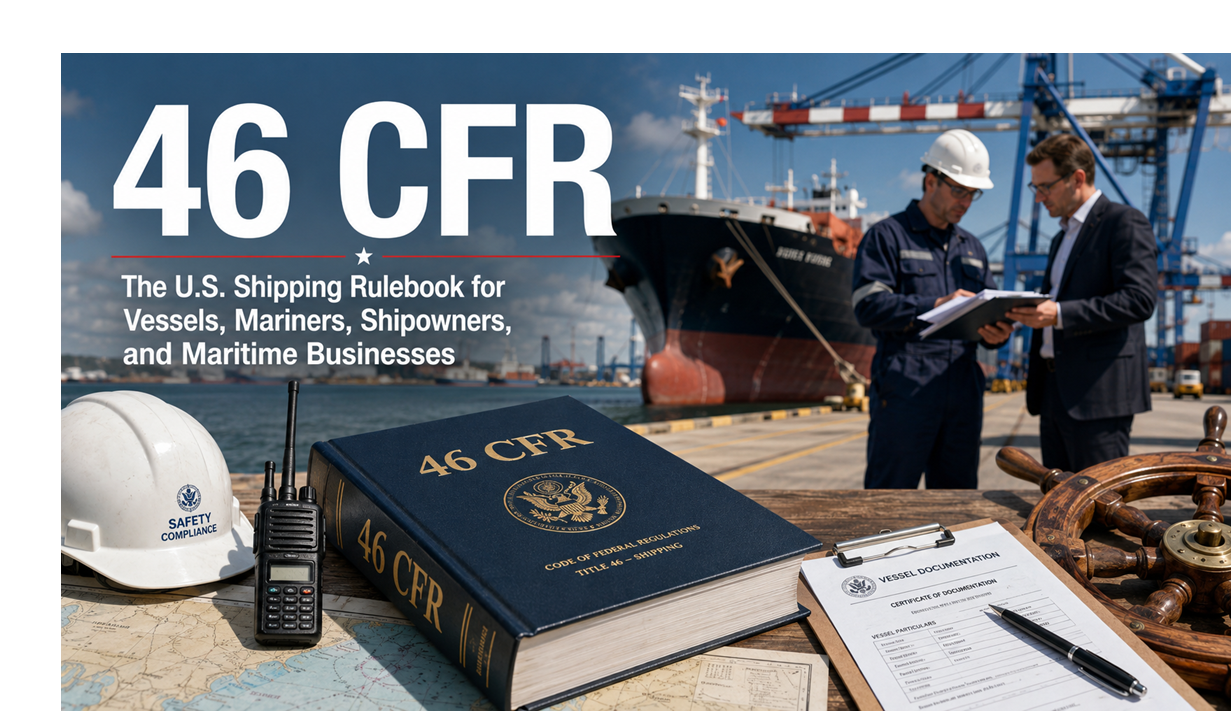
A comprehensive guide to Title 46 of the Code of Federal Regulations, covering U.S. shipping rules, Coast Guard vessel inspection, merchant mariner credentials, tank vessels, marine engineering, passenger ships, offshore vessels, towing vessels, MARAD programmes, Great Lakes pilotage, and Federal Maritime Commission regulations.
The Shipping Rulebook Behind U.S. Maritime Safety
A ship may look like a single machine: steel hull, engine room, bridge, cargo spaces, accommodation, lifesaving appliances, and navigation systems. But legally, a ship is also a regulated system. Its crew must be qualified. Its machinery must be inspected. Its boilers, pressure vessels, electrical systems, stability, lifesaving appliances, fire protection equipment, manning, documentation, and operating procedures must satisfy detailed rules.
For vessels operating in, from, or under the regulatory reach of the United States, one of the most important sources of those rules is Title 46 of the Code of Federal Regulations, usually called 46 CFR.
If 33 CFR is mainly about Navigation and Navigable Waters, then 46 CFR is mainly about Shipping. It is one of the central U.S. maritime regulatory titles. It addresses vessel inspection, merchant mariner licensing and endorsements, tank vessel safety, load lines, marine engineering, passenger vessels, cargo vessels, offshore supply vessels, towing vessels, dangerous cargoes, lifesaving equipment, stability, nautical school ships, oceanographic research vessels, MARAD programmes, Great Lakes pilotage, and Federal Maritime Commission rules. The attached file provides a structured outline of Title 46 across nine volumes and four main chapters, including the Coast Guard, Maritime Administration, Great Lakes Pilotage, and Federal Maritime Commission sections.
The official electronic Code of Federal Regulations lists Title 46 as “Shipping”, while Cornell’s Legal Information Institute identifies its four main chapter groups: Chapter I for the Coast Guard, Chapter II for the Maritime Administration, Chapter III for Coast Guard Great Lakes Pilotage, and Chapter IV for the Federal Maritime Commission.
For maritime professionals, 46 CFR is not just a legal archive. It is a practical operating framework. It affects whether a vessel may sail, whether a mariner may serve in a particular position, whether a tank vessel may carry a certain cargo, whether machinery systems meet safety standards, whether a passenger vessel can operate, whether an offshore supply vessel meets inspection requirements, and whether maritime businesses comply with financial, commercial, and shipping-practice obligations.
This article explains Title 46 CFR in a structured, operational, and people-first way. It is written for seafarers, marine engineers, deck officers, ship managers, port-state compliance teams, maritime students, instructors, shipowners, classification societies, lawyers, consultants, marine surveyors, and maritime businesses that need a practical understanding of U.S. shipping regulations.
What Is Title 46 CFR?
Title 46 CFR means Title 46 of the Code of Federal Regulations. The Code of Federal Regulations is the codified body of general and permanent rules issued by U.S. federal agencies. Title 46 is dedicated to Shipping. The official eCFR page identifies Title 46 under that heading, and it remains the current electronic reference for federal shipping regulations, although eCFR itself notes that it is an online version rather than the official legal edition.
In practical terms, 46 CFR covers many of the rules that govern:
- Vessel inspection and certification
- Merchant mariner licensing, endorsements, manning, and chemical testing
- Tank vessel construction, equipment, operations, and cargo safety
- Load lines
- Marine engineering systems
- Vessel documentation and measurement
- Passenger vessel safety
- Cargo and miscellaneous vessel safety
- Mobile offshore drilling units
- Electrical engineering
- Small passenger vessels
- Offshore supply vessels
- Towing vessels
- Dangerous cargoes
- Lifesaving equipment and approved materials
- Nautical school ships
- Stability and subdivision
- Oceanographic research vessels
- Maritime Administration programmes
- Great Lakes pilotage
- Federal Maritime Commission regulations
The attached file confirms that Title 46 is arranged across nine volumes, with the first seven volumes mainly covering Coast Guard regulations, Volume 8 covering the Maritime Administration and Great Lakes Pilotage, and Volume 9 covering the Federal Maritime Commission.
The most important point is this: 46 CFR is one of the main regulatory bridges between ship design, ship operation, seafarer qualification, maritime safety, and U.S. shipping commerce.
Why Title 46 CFR Matters in 2026
Title 46 CFR matters in 2026 because shipping is under pressure from several directions at once.
Vessels are becoming more technologically complex. Alternative fuels, automated machinery, battery systems, vital system automation, high-voltage equipment, advanced lifesaving appliances, digital alarms, and integrated bridge-engine systems are reshaping what marine safety means. Ship operators must not only comply with international conventions; they must also satisfy national regulations in the jurisdictions where they operate.
The United States remains one of the world’s most important maritime markets. A ship may be foreign-built, foreign-owned, foreign-flagged, and internationally crewed, but if it trades into U.S. ports, carries passengers from U.S. ports, enters Great Lakes pilotage waters, uses U.S. maritime commercial channels, or interacts with U.S.-regulated marine terminals and carriers, 46 CFR may become relevant.
The U.S. Government Publishing Office describes CFR Title 46 as containing federal laws and regulations in effect as of publication that pertain to maritime shipping in and around U.S. waters.
Title 46 is especially important because it supports safety in areas where failures can be catastrophic:
- A boiler or pressure vessel failure can kill crew members.
- A stability failure can lead to capsizing.
- A fire-protection deficiency can turn a small fire into a vessel-loss event.
- Poor mariner qualification can contribute to collision, grounding, pollution, or injury.
- Inadequate manning can undermine watchkeeping and emergency response.
- Tank vessel cargo incompatibility can cause fire, explosion, toxicity, or structural damage.
- Defective lifesaving appliances can turn an accident into a mass-casualty event.
- Poor passenger vessel compliance can endanger hundreds of people.
- Weak financial responsibility rules can leave passengers and cargo interests exposed.
For ship managers, Title 46 should therefore be viewed as a risk-control system, not merely a U.S. legal text.
The Structure of Title 46 CFR
Title 46 CFR is organized into four principal chapters:
| Chapter | Agency / authority | Main subject |
|---|---|---|
| Chapter I | Coast Guard, Department of Homeland Security | Vessel inspection, mariners, machinery, vessel types, dangerous cargoes, lifesaving, stability |
| Chapter II | Maritime Administration, Department of Transportation | Maritime programmes, subsidies, financing, training, war risk insurance, cargo preference, port facility matters |
| Chapter III | Coast Guard, Great Lakes Pilotage | Great Lakes pilotage regulations, rules, accounting, and ratemaking |
| Chapter IV | Federal Maritime Commission | Ocean transportation intermediaries, tariffs, service contracts, marine terminal schedules, carrier agreements, passenger vessel financial responsibility |
Cornell’s eCFR listing confirms these four chapter groups under Title 46. The attached file provides the detailed volume-by-volume structure, including Coast Guard subchapters A through W, MARAD subchapters, Great Lakes Pilotage parts, and Federal Maritime Commission parts.
A useful way to understand the title is to divide it into four practical layers.
The first layer is ship safety and inspection. This includes vessel inspections, tank vessels, passenger vessels, cargo vessels, offshore supply vessels, towing vessels, marine engineering, electrical engineering, stability, fire protection, and lifesaving equipment.
The second layer is people and competence. This includes merchant marine officers and seamen, licensing, endorsements, tankermen, manning, shipment and discharge, and chemical testing.
The third layer is commercial maritime administration. This includes Maritime Administration rules on subsidies, financing, war risk insurance, training, cargo preference, and port-related arrangements.
The fourth layer is shipping-market regulation. This includes the Federal Maritime Commission rules on ocean transportation intermediaries, tariffs, marine terminal operator schedules, service contracts, NVOCC arrangements, controlled carriers, and restrictive foreign maritime practices.
This makes Title 46 broader than many people assume. It is not only “Coast Guard vessel inspection rules.” It is a full shipping-regulation framework.
Chapter I: Coast Guard Regulations—the Safety Core of Title 46
Chapter I is the operational core of Title 46. The attached file shows that Coast Guard regulations occupy the first seven volumes of Title 46 and include Subchapters A through W. These cover public procedures, merchant marine officers and seamen, uninspected vessels, tank vessels, load lines, marine engineering, documentation and measurement, passenger vessels, cargo vessels, mobile offshore drilling units, electrical engineering, small passenger vessels, offshore supply vessels, towing vessels, dangerous cargoes, equipment approval, nautical schools, stability, oceanographic research vessels, occupational safety, and lifesaving systems.
This part of Title 46 is especially important for:
- U.S.-flag vessels
- Foreign vessels subject to U.S. inspection or control
- Merchant mariners seeking U.S. credentials
- Tank vessel operators
- Passenger vessel operators
- Offshore supply vessel companies
- Towing vessel operators
- Marine engineers
- Shipyards building or modifying regulated vessels
- Classification societies and third-party organizations
- Maritime academies and training providers
Coast Guard regulations in Title 46 are where vessel safety becomes detailed and enforceable. SOLAS, MARPOL, STCW, Load Line Convention, and other international instruments provide broad frameworks, but Title 46 explains many U.S.-specific administrative, technical, and operational requirements.
Subchapter A: Procedures Applicable to the Public
Subchapter A includes procedures that establish how marine safety functions are organized and applied. The attached file lists Part 1 on organization and general methods governing marine safety functions, Part 2 on vessel inspections, Part 3 on designation of oceanographic research vessels, Part 4 on marine casualties and investigations, Part 5 on marine investigation regulations and personnel action, Part 6 on waivers, Part 7 on boundary lines, Part 8 on vessel inspection alternatives, and Part 9 on overtime services.
This subchapter matters because it explains how the regulatory machinery works.
Vessel Inspections
Vessel inspection is one of the pillars of marine safety. An inspection is not only a visual check. It is a legal and technical process through which a vessel’s structure, equipment, machinery, documents, firefighting systems, lifesaving appliances, operational readiness, and compliance status may be examined.
For operators, vessel inspection determines whether a vessel can continue operating, whether deficiencies must be corrected, and whether certificates remain valid. For surveyors and marine engineers, inspection rules affect maintenance planning, dry docking, repairs, and equipment testing.
Marine Casualties and Investigations
Part 4, listed in the attached file as Marine Casualties and Investigations, is highly important. Marine casualties are not only major disasters. They may include groundings, collisions, allisions, fires, explosions, machinery failures, deaths, injuries, pollution events, or hazardous conditions.
An investigation may examine:
- Human error
- Equipment failure
- Watchkeeping
- Manning
- fatigue
- communication
- company procedures
- maintenance records
- voyage planning
- emergency response
- regulatory compliance
For seafarers, this is not abstract. A casualty investigation can affect licenses, employment, company liability, insurance, criminal exposure, and future safety policy.
Boundary Lines
Part 7 on boundary lines is significant because regulatory requirements may change depending on whether a vessel is operating on certain inland, coastwise, or seagoing routes. Boundary lines can affect inspection standards, load line application, operational limits, and vessel classification.
A vessel operator should not assume that “near the coast” or “inside a bay” is enough to determine applicable rules. Legal boundary lines may matter.
Subchapter B: Merchant Marine Officers and Seamen
Subchapter B is one of the most human-centered parts of Title 46. The attached file lists Part 10 on licensing of maritime personnel, Part 11 on officer endorsements, Part 12 on rating endorsements, Part 13 on tankermen, Part 14 on shipment and discharge of merchant mariners, Part 15 on manning requirements, and Part 16 on chemical testing.
This subchapter answers a practical question: Who is legally qualified to serve on board, and under what conditions?
Licensing and Officer Endorsements
Officer credentials are central to safe operation. A master, chief mate, officer in charge of a navigational watch, chief engineer, second engineer, or officer in charge of an engineering watch must have appropriate qualifications for the vessel type, tonnage, propulsion power, route, and operating conditions.
For U.S. credentialed mariners, Title 46 is therefore directly linked to career progression. A mariner’s ability to serve depends on training, sea service, examinations, medical fitness, endorsements, and compliance with credential requirements.
Rating Endorsements
Ratings are also essential. Able seafarers, qualified members of the engine department, lifeboatmen, tankermen, and other ratings perform safety-critical duties. Their competence affects watchkeeping, maintenance, cargo operations, emergency response, mooring, launching survival craft, and pollution prevention.
Certification of Tankermen
Tankermen certification is especially important because tank vessels and hazardous cargo operations require specialized knowledge. A tankerman may be involved in oil, chemical, liquefied gas, or other bulk liquid cargo operations. Mistakes in cargo transfer can cause fire, explosion, toxic release, pollution, or severe injury.
Manning Requirements
Part 15 on manning requirements is one of the most operationally important parts of Subchapter B. Manning is not only a cost issue. It is a safety system. A vessel with insufficient qualified personnel may not be able to maintain proper watches, respond to emergencies, conduct cargo operations safely, or manage fatigue.
Manning requirements link directly to:
- Bridge watchkeeping
- Engine watchkeeping
- Cargo operations
- Emergency stations
- Firefighting capacity
- Lifeboat launching
- Passenger management
- Security duties
- Rest-hour compliance
- Vessel route and size
- Propulsion and automation level
Chemical Testing
Part 16 on chemical testing reflects the importance of drug and alcohol controls in maritime safety. A vessel is a high-risk workplace. Impairment can lead to collision, machinery failure, injury, pollution, or loss of life. Chemical testing requirements are therefore part of the safety culture.
Subchapter C: Uninspected Vessels
Subchapter C covers uninspected vessels, including general provisions, requirements, operations, towing vessels, and commercial fishing industry vessels. The attached file lists Parts 24 through 28 under this subchapter.
The term “uninspected vessel” can be misleading. It does not mean “unregulated.” It means the vessel is not subject to the same inspection regime as inspected vessels, but it may still be subject to requirements on equipment, operation, manning, safety, or industry-specific rules.
Commercial fishing vessels, small workboats, certain towing vessels, and other uninspected categories can involve high risk. Fishing vessels in particular have historically faced serious casualty rates due to weather exposure, stability issues, fatigue, machinery hazards, and emergency-response challenges.
For maritime students, this is a useful lesson: regulation is not binary. A vessel can be outside one inspection category while still subject to many safety requirements.
Subchapter D: Tank Vessels
Subchapter D is one of the most important parts of Title 46 for tanker operators. The attached file lists Part 30 on general provisions, Part 31 on inspection and certification, Part 32 on special equipment, machinery and hull requirements, Part 34 on firefighting equipment, Part 35 on operations, Part 36 on elevated temperature cargoes, Part 38 on liquefied flammable gases, and Part 39 on vapor control systems.
Tank vessels carry cargoes that can burn, explode, poison, corrode, pollute, or react dangerously. Their regulation must therefore address both ship design and operation.
Inspection and Certification
Tank vessel inspection confirms that the vessel’s structure, cargo systems, machinery, safety equipment, firefighting systems, and documents are suitable for the intended operation. Certification is not merely paperwork; it confirms that the vessel is legally fit for service under applicable standards.
Hull, Machinery, and Special Equipment
Tankers require specialized systems:
- Cargo pumps
- Cargo piping
- Tank venting
- Inert gas systems
- Cargo gauging
- Overfill protection
- Emergency shutdown systems
- Fire detection
- Fixed firefighting systems
- Gas detection
- Segregation arrangements
- Cargo heating systems
- Vapor control systems
The safety of these systems depends on design, maintenance, inspection, and crew competence.
Firefighting Equipment
Tank vessel fires are among the most dangerous maritime emergencies. The cargo itself may be flammable. Vapors may accumulate. Hot work, static electricity, cargo leaks, pump-room failures, or collision damage can create ignition risk.
Firefighting requirements are therefore central to tanker regulation. They include fixed systems, portable equipment, foam arrangements, fire mains, emergency pumps, detection, protective equipment, and emergency procedures.
Operations
Part 35 on operations is crucial because tanker safety is not achieved by design alone. Safe operation requires:
- Cargo planning
- Compatibility checks
- Tank cleaning
- Inerting and gas freeing
- Closed loading where required
- Pre-transfer conferences
- Watchkeeping
- Emergency shutdown readiness
- Pollution prevention
- Mooring monitoring
- Weather limits
- Accurate logs
A technically compliant tanker can still be dangerous if its operation is poor.
Subchapter E: Load Lines
Subchapter E covers load lines, including domestic and foreign voyages by sea, special service limited domestic voyages, Great Lakes load lines, subdivision load lines for passenger vessels, and combination load lines. The attached file lists Parts 42 through 47.
Load lines are one of the oldest and most important safety concepts in shipping. They determine how deeply a vessel may be loaded under different conditions. A vessel loaded beyond safe limits loses reserve buoyancy, freeboard, stability margin, and seaworthiness.
Load line regulation protects against:
- Overloading
- Excessive draft
- Reduced freeboard
- Green water on deck
- Loss of stability
- Structural stress
- Reduced survivability in heavy weather
For deck officers and chief mates, load line compliance is directly connected to cargo planning, ballast condition, draft survey, stability calculation, route planning, and seasonal zones.
In educational terms, load lines are an excellent example of how a simple mark on the ship’s side represents a deep legal, technical, and historical safety system.
Subchapter F: Marine Engineering
Subchapter F is highly relevant to marine engineers. The attached file lists Part 50 on general provisions, Part 52 on power boilers, Part 53 on heating boilers, Part 54 on pressure vessels, Part 56 on piping systems and appurtenances, Part 57 on welding and brazing, Part 58 on main and auxiliary machinery and related systems, Part 59 on repairs to boilers and pressure vessels, Part 61 on periodic tests and inspections, Part 62 on vital system automation, Part 63 on automatic auxiliary boilers, and Part 64 on marine portable tanks and cargo-handling systems.
This subchapter is the engineering backbone of Title 46.
Boilers and Pressure Vessels
Boilers and pressure vessels store energy. If they fail, the result can be catastrophic. Requirements for design, inspection, testing, repair, materials, welding, safety valves, controls, and maintenance are therefore essential.
Marine engineers must understand that a boiler is not merely another auxiliary system. It is a regulated pressure system. Unauthorized repairs, poor water treatment, defective safety valves, bypassed controls, or inadequate inspection can create severe risk.
Piping Systems
Piping systems carry fuel, lube oil, cooling water, steam, compressed air, hydraulic oil, ballast, bilge, fire water, cargo, and sewage. A pipe failure can cause fire, flooding, pollution, loss of propulsion, loss of steering, or cargo contamination.
Marine piping regulation must consider:
- Material suitability
- Pressure rating
- Temperature
- Corrosion
- Expansion
- Vibration
- Valves
- Remote closures
- Fire safety
- Penetrations
- Testing
- Identification
- Maintenance access
Welding and Brazing
Welding quality is fundamental to ship safety. A poor weld can fail under stress, pressure, vibration, or corrosion. Part 57, listed in the attached file, reflects the importance of welding and brazing in regulated marine engineering systems.
For shipyards and repair yards, welding compliance is not only about welder skill. It also involves procedures, qualifications, materials, inspection, nondestructive testing, documentation, and repair control.
Main and Auxiliary Machinery
Main propulsion, generators, steering gear, pumps, compressors, purifiers, heat exchangers, automation systems, and auxiliary engines are critical to vessel safety. Part 58 addresses main and auxiliary machinery and related systems.
Machinery requirements are not only technical. They define operational reliability. A ship with unreliable propulsion or emergency power may become a navigation hazard, pollution risk, or passenger safety threat.
Vital System Automation
Part 62 on vital system automation is increasingly important in 2026. Modern ships rely on automation for alarms, monitoring, engine control, power management, steering interfaces, boiler control, safety shutdowns, and unattended machinery spaces.
Automation creates efficiency but also new risks:
- Sensor failure
- Software errors
- Cybersecurity threats
- Alarm flooding
- Human-machine interface confusion
- Overreliance on automation
- Poor manual fallback readiness
Marine engineers must understand both the system and its failure modes.
Subchapter G: Documentation and Measurement of Vessels
Subchapter G covers vessel documentation, exceptions to coastwise qualification, and vessel measurement. The attached file lists Parts 67, 68, and 69.
Vessel documentation is the legal identity of a vessel. Measurement determines tonnage, which affects manning, inspection, fees, safety requirements, port charges, and sometimes commercial restrictions.
Documentation
Documentation establishes nationality, ownership, trade privileges, and legal status. In the United States, documentation can affect whether a vessel may engage in coastwise trade, fisheries, registry, or other operations.
Measurement
Tonnage measurement is not simply “ship weight.” Gross tonnage and net tonnage are regulatory measures related to volume and earning capacity. They affect many legal thresholds.
For example, a vessel’s regulatory category may change based on tonnage. This can affect inspection requirements, manning, passenger limits, safety equipment, and operational permissions.
Subchapter H: Passenger Vessels
Subchapter H deals with passenger vessels, including general provisions, inspection and certification, construction and arrangement, fire protection equipment, vessel control and miscellaneous systems, operations, and disclosure of safety standards and country of registry. The attached file lists Parts 70 through 80.
Passenger vessels require strict regulation because they carry people who may not be trained to respond to emergencies. A cargo ship crew can be drilled and assigned emergency duties. Passengers may panic, become trapped, misunderstand instructions, or need assistance.
Passenger vessel safety therefore depends on:
- Structural fire protection
- Escape routes
- Alarm systems
- Public address systems
- Lifesaving appliances
- Muster arrangements
- Crew training
- Stability
- Damage control
- Machinery reliability
- Fire detection
- Emergency lighting
- Passenger counting
- Evacuation procedures
For cruise ships, ferries, excursion vessels, and overnight passenger vessels, passenger safety is not simply a regulatory requirement; it is the core business obligation.
Subchapter I: Cargo and Miscellaneous Vessels
Subchapter I covers cargo and miscellaneous vessels, including general provisions, inspection and certification, construction and arrangement, stability, fire protection equipment, vessel control systems, operations, special provisions for dangerous cargoes in bulk, commercial fishing vessels dispensing petroleum products, and aquaculture support operations. The attached file lists Parts 90 through 106.
This subchapter is relevant to a wide range of cargo vessels. It links vessel construction, inspection, stability, fire protection, and operation.
Stability
Part 93, identified in the attached file, addresses stability for cargo and miscellaneous vessels. Stability is one of the most fundamental safety issues in maritime transport. A vessel may have good machinery and navigation equipment but still be unsafe if stability is poor.
Stability risks include:
- Excessive free surface effect
- Cargo shift
- Overloading
- Improper ballast distribution
- High centre of gravity
- Icing
- Water on deck
- Flooding
- Structural damage
- Incorrect loading calculations
Dangerous Cargoes in Bulk
Part 98 addresses special construction, arrangement, and other provisions for certain dangerous cargoes in bulk. This connects cargo ship regulation with hazardous cargo safety. Bulk dangerous cargoes may require special containment, segregation, ventilation, firefighting, monitoring, and emergency procedures.
Mobile Offshore Drilling Units
Subchapter I-A covers mobile offshore drilling units, including inspection and certification, design and equipment, and operations. The attached file lists Parts 107 through 109.
MODUs are complex units. They combine vessel characteristics with drilling systems, offshore station-keeping, heavy machinery, hazardous operations, helicopter interfaces, marine risers, well-control systems, and accommodation for large crews.
MODU safety involves:
- Structural strength
- Stability
- Fire and gas detection
- Explosion protection
- Lifesaving appliances
- Drilling equipment
- Emergency shutdown systems
- Dynamic positioning or mooring
- Marine operations
- Weather limits
- Evacuation procedures
- Pollution prevention
For offshore engineers and marine students, MODUs are a perfect example of how maritime regulation and industrial energy operations overlap.
Subchapter J: Electrical Engineering
Subchapter J covers electrical engineering, including general provisions, electric systems, emergency lighting and power systems, and communication and alarm systems. The attached file lists Parts 110 through 113.
Electrical systems are safety-critical. A blackout can disable propulsion, steering, navigation equipment, lighting, pumps, alarms, communication systems, and emergency response capacity.
Electric Systems
Electrical regulation covers generation, distribution, protection, cables, switchboards, grounding, hazardous areas, emergency circuits, and system reliability.
Emergency Lighting and Power
Emergency power is essential after a main power failure. It supports emergency lighting, navigation lights, alarms, communication, fire detection, pumps, and lifesaving operations.
Communication and Alarm Systems
Alarm systems help crews detect problems before they become disasters. But alarm systems must be reliable and understandable. Poor alarm management can overwhelm watchkeepers, leading to delayed response.
In modern ships, electrical engineering increasingly includes automation, power electronics, battery systems, hybrid propulsion, shore power, and cybersecurity.
Subchapter K: Small Passenger Vessels Carrying More Than 150 Passengers or With Overnight Accommodation
Subchapter K covers small passenger vessels carrying more than 150 passengers or with overnight accommodations for more than 49 passengers. The attached file lists general provisions, inspection and certification, construction and arrangement, lifesaving equipment, fire protection, machinery installation, electrical installation, vessel control systems, and operations.
These vessels may be physically smaller than cruise ships, but their risk is significant because passenger density can be high. Ferries, dinner boats, excursion vessels, and overnight small passenger vessels may operate close to shore, but emergencies can still develop rapidly.
Key risks include:
- Fire in accommodation or machinery spaces
- Passenger panic
- Limited evacuation space
- Weather exposure
- Stability problems
- Night operations
- Electrical faults
- Insufficient crew training
- Inadequate emergency communication
Subchapter K shows that “small” does not mean “low risk.”
Subchapter L: Offshore Supply Vessels
Subchapter L covers offshore supply vessels, including general rules, inspection and certification, construction and arrangements, marine engineering, electrical installations, vessel control systems, operations, fire protection, lifesaving systems, and lifeboat provisions. The attached file lists Parts 125 through 134.
Offshore supply vessels are essential to offshore oil, gas, wind, and marine construction. They transport cargo, fuel, water, drilling mud, equipment, and personnel to offshore installations. They may operate in harsh weather, close to platforms, under dynamic positioning, and with hazardous cargoes.
OSV risks include:
- Deck cargo shift
- Bulk mud or brine hazards
- Close-quarters platform operations
- Dynamic positioning failure
- Fire
- Heavy weather
- Crane operations
- Personnel transfer
- Collision with offshore structures
- Stability and free surface effects
As offshore wind expands, OSV rules and offshore support vessel design will become even more important.
Subchapter M: Towing Vessels
Subchapter M is a major area of modern U.S. maritime regulation. The attached file lists towing vessel certification, compliance, towing safety management system, third-party organizations, operations, lifesaving, fire protection, machinery and electrical systems, and construction and arrangement.
Towing vessels are essential to U.S. inland waterways, harbors, coastal towing, barge transport, and port operations. They move oil barges, chemical barges, grain barges, container barges, construction equipment, dredging units, and many other cargoes.
Towing operations are high-risk because they often occur in confined waters, rivers, strong currents, bridges, locks, shallow channels, and heavy traffic.
Towing Safety Management System
Part 138, listed in the attached file, concerns the Towing Safety Management System. A TSMS is a structured safety management system for towing operations. It helps companies control risk through procedures, audits, training, maintenance, incident reporting, and continuous improvement.
Third-Party Organizations
Part 139 covers third-party organizations. This reflects the role of authorized third parties in inspection and compliance systems. Third-party oversight can help manage large fleets, but it also requires strong quality control and accountability.
Operations, Lifesaving, Fire Protection, Machinery, and Construction
Parts 140 through 144 address towing vessel operations, lifesaving, fire protection, machinery and electrical systems, and construction. These areas are practical and operational. They affect daily work on board, not only annual audits.
Subchapter N and O: Dangerous Cargoes and Certain Bulk Dangerous Cargoes
Subchapter N covers hazardous ship’s stores, interim regulations for shipboard fumigation, and carriage of solid hazardous materials in bulk. Subchapter O covers certain bulk dangerous cargoes, including cargo compatibility, barges carrying bulk liquid hazardous material cargoes, ships carrying bulk liquid, liquefied gas, or compressed gas hazardous materials, and safety standards for self-propelled vessels carrying bulk liquefied gases. The attached file lists Parts 147, 147A, 148, 150, 151, 153, and 154.
Dangerous cargo regulation is one of the most safety-critical parts of shipping.
Cargo Compatibility
Part 150 on compatibility of cargoes is essential because some cargoes react dangerously when mixed. Incompatible cargoes can generate heat, toxic vapors, gas, polymerization, pressure, fire, or explosion.
Hazardous Materials in Bulk
Bulk hazardous materials require special handling. Risks depend on cargo properties, temperature, pressure, toxicity, flammability, corrosiveness, reactivity, and environmental hazard.
Liquefied Gas and Compressed Gas Cargoes
Liquefied gas carriers and compressed gas cargoes require highly specialized design and operation. Cargo containment, pressure control, temperature control, emergency shutdown, gas detection, and crew training are essential.
Subchapter Q: Equipment, Construction, and Materials—Specifications and Approval
Subchapter Q covers approval of equipment and materials, lifesaving equipment, electrical equipment, engineering equipment, construction, and materials. The attached file lists Parts 159 through 164.
This subchapter is important because safety equipment must not only exist; it must be approved, tested, and suitable.
Examples include:
- Lifejackets
- Liferafts
- Lifeboats
- Fire equipment
- Electrical equipment
- Engineering equipment
- Construction materials
- Safety appliances
A vessel cannot simply install any commercially available product and assume it satisfies regulatory standards. Approval, marking, testing, certification, and maintenance matter.
Subchapter R: Nautical Schools
Subchapter R covers nautical school ships, including designation and approval of nautical school ships, public nautical school ships, civilian nautical school vessels, and sailing school vessels. The attached file lists Parts 166 through 169.
This section is important for maritime education and training. Training ships are not ordinary vessels. They carry students who are learning seamanship, navigation, engineering, safety, and shipboard discipline. They must be safe educational platforms.
Nautical school ship regulation connects:
- Maritime academies
- Training ships
- Cadet sea time
- Safety equipment
- Manning
- Supervision
- Educational operations
- Vessel inspection
For maritime universities, this subchapter demonstrates that education itself is part of the regulated maritime safety system.
Subchapter S: Subdivision and Stability
Subchapter S covers stability requirements for all inspected vessels, special rules for passenger vessels, bulk cargoes, vessel use, and specific vessel types. The attached file lists Parts 170 through 174.
Stability regulation is fundamental. Many maritime disasters involve stability problems, whether through flooding, cargo shift, overloading, free surface effect, icing, incorrect loading, or poor design.
Intact Stability
Intact stability concerns the vessel’s ability to return upright after being heeled by wind, waves, turning, cargo shift, or other forces.
Damage Stability
Damage stability concerns survival after flooding due to collision, grounding, structural failure, or hull breach.
Passenger Vessel Stability
Passenger vessels require special attention because large numbers of people may move suddenly, evacuation may be complex, and public spaces may create unique flooding or fire risks.
Bulk Cargo Stability
Bulk cargoes can shift, liquefy, or load unevenly. Stability rules are therefore linked to cargo properties, trimming, loading rate, ballast, and voyage planning.
Subchapter T: Small Passenger Vessels Under 100 Gross Tons
Subchapter T covers small passenger vessels under 100 gross tons, including general provisions, inspection and certification, construction and arrangement, intact stability and seaworthiness, subdivision and damage stability, lifesaving equipment, fire protection, machinery installation, electrical installation, vessel control systems, and operations. The attached file lists Parts 175 through 185.
Small passenger vessels may include ferries, tour boats, excursion vessels, water taxis, dive boats, and similar craft. Their operations may appear routine, but the risk can be high because they often operate near shore with frequent passenger movement, tight schedules, and exposure to changing weather.
For operators, Subchapter T is central to safe domestic passenger service.
Subchapter U: Oceanographic Research Vessels
Subchapter U covers oceanographic research vessels, including general provisions, inspection and certification, construction and arrangement, fire protection, explosives and hazardous materials, vessel control systems, and operations. The attached file lists Parts 188 through 196.
Research vessels are unique. They may carry scientists, students, technicians, laboratories, sampling equipment, winches, cranes, ROVs, hazardous chemicals, explosives, and specialized deck equipment. They may operate far offshore or in harsh environments.
Regulation must therefore balance scientific mission flexibility with marine safety.
Subchapter V and W: Occupational Safety and Lifesaving Appliances
Subchapter V covers marine occupational safety and health standards, while Subchapter W covers lifesaving systems for certain inspected vessels. The attached file lists Part 197 and Part 199.
These sections remind us that ship safety is also worker safety. Maritime work involves:
- Confined spaces
- Hot work
- Working aloft
- Machinery hazards
- Chemical exposure
- Heavy lifting
- Slips, trips, and falls
- Fire risk
- Noise and vibration
- Fatigue
- Emergency evacuation
Lifesaving systems are the final safety barrier. If prevention fails, survival depends on lifeboats, liferafts, lifejackets, immersion suits, alarms, muster procedures, emergency lighting, communication, and trained crew.
Chapter II: Maritime Administration Regulations
Chapter II belongs to the Maritime Administration, or MARAD, within the Department of Transportation. The attached file lists MARAD rules in Volume 8, including policy and procedure, maritime carriers and related activities, subsidized vessels and operators, vessel financing assistance, position reporting, emergency operations, training, National Shipping Authority matters, port control and utilization, miscellaneous provisions, capital construction funds, and America’s Marine Highway Program.
MARAD’s role is different from the Coast Guard’s. The Coast Guard focuses heavily on safety, inspection, credentialing, and operational compliance. MARAD focuses more on maritime policy, U.S.-flag fleet support, financing, training, national defence sealift, maritime infrastructure, and programmes that support the merchant marine.
Vessel Financing Assistance
Part 298 concerns obligation guarantees. Vessel financing is critical because ships are capital-intensive assets. A single newbuilding can cost tens or hundreds of millions of dollars. Financing assistance can influence whether vessels are built, modernized, or operated under U.S.-related programmes.
Maritime Security Program
Parts 295 and 296 concern the Maritime Security Program. The MSP supports a fleet of commercially viable, militarily useful U.S.-flag vessels. This connects merchant shipping to national defence logistics.
War Risk Insurance
Parts 308 and 309 concern war risk insurance and values for war risk insurance. War risk insurance becomes important during conflict, sanctions, piracy, terrorism, regional war, and high-risk trade disruption.
Merchant Marine Training
Part 310 concerns merchant marine training. This links MARAD to maritime education, including the U.S. Merchant Marine Academy and training programmes.
Cargo Preference and America’s Marine Highway
Cargo preference rules and America’s Marine Highway Program support U.S.-flag shipping, domestic waterborne transport, and maritime logistics resilience.
Chapter III: Great Lakes Pilotage
Chapter III covers Coast Guard Great Lakes Pilotage. The attached file lists Part 401 on Great Lakes Pilotage Regulations, Part 402 on Great Lakes Pilotage Rules and Orders, Part 403 on the Great Lakes Pilotage Uniform Accounting System, and Part 404 on Great Lakes Pilotage Ratemaking.
Great Lakes pilotage is a specialized regulatory field. The Great Lakes–St. Lawrence system has unique navigational conditions:
- Locks
- Canals
- Restricted channels
- Seasonal ice
- Freshwater conditions
- U.S.–Canada coordination
- Draft limits
- Port-specific constraints
- Dense regional cargo movements
Pilotage regulation ensures that vessels operating in these waters receive appropriate local navigational expertise.
Chapter IV: Federal Maritime Commission Regulations
Chapter IV belongs to the Federal Maritime Commission, or FMC. The attached file lists general administrative rules, ocean shipping in foreign commerce, ocean transportation intermediaries, carrier automated tariffs, marine terminal operator schedules, service contracts, NVOCC service arrangements, NVOCC negotiated rate arrangements, carrier and terminal agreements, passenger vessel financial responsibility, restrictive foreign maritime practices, controlled carriers, and related measures.
This chapter is more commercial than technical. It regulates aspects of ocean shipping markets, maritime intermediaries, tariffs, service contracts, terminal schedules, and competition-related practices.
Ocean Transportation Intermediaries
Part 515 covers licensing, financial responsibility requirements, and general duties for ocean transportation intermediaries. OTIs include freight forwarders and NVOCCs. These businesses connect shippers, carriers, and cargo interests.
Carrier Automated Tariffs and Service Contracts
Parts 520 and 530 address carrier automated tariffs and service contracts. These rules affect how ocean carriers publish, manage, and contract rates and services.
Marine Terminal Operator Schedules
Part 525 concerns marine terminal operator schedules. Terminal schedules are important for charges, services, demurrage-related issues, access, and commercial transparency.
NVOCC Arrangements
Parts 531 and 532 concern NVOCC service arrangements and negotiated rate arrangements. This is particularly relevant for containerized trade and logistics intermediaries.
Passenger Vessel Financial Responsibility
Part 540 concerns passenger vessel financial responsibility. This protects passengers in cases involving nonperformance, casualty, or financial failure.
Restrictive Foreign Maritime Practices and Controlled Carriers
Parts 550 through 565 address restrictive foreign maritime practices, adverse conditions affecting U.S.-flag carriers, and controlled carriers. These provisions show that Title 46 is also a tool of maritime trade policy.
How 46 CFR Differs from 33 CFR
Many maritime professionals consult both Title 33 and Title 46. The difference can be summarized simply:
| Title | Main focus | Practical examples |
|---|---|---|
| 33 CFR | Navigation and navigable waters | VTS, safety zones, anchorages, waterways, bridges, pollution, port security, Corps permits |
| 46 CFR | Shipping | Vessel inspection, mariner credentials, machinery, passenger vessels, tankers, stability, lifesaving, MARAD, FMC |
In practice, a U.S. port call may involve both.
A tanker entering a U.S. port may need 33 CFR for ports and waterways safety, VTS, anchorage, pollution, and security zones, while needing 46 CFR for tank vessel inspection, machinery, cargo systems, manning, and dangerous cargo requirements.
A passenger vessel may need 33 CFR for navigation and safety zones, while needing 46 CFR for passenger vessel construction, lifesaving, fire protection, operations, and financial responsibility.
A towing vessel may need 33 CFR for inland waterways navigation and bridge-to-bridge communication, while needing 46 CFR Subchapter M for certification, TSMS, operations, lifesaving, and machinery requirements.
The two titles should therefore be studied together.
Practical Compliance Checklist for Ship Operators
For Masters
- Verify vessel certificates and inspection status.
- Confirm manning meets applicable requirements.
- Check officer and rating endorsements.
- Review operational limits and route restrictions.
- Ensure casualty reporting procedures are understood.
- Confirm passenger, cargo, or towing-specific requirements.
- Maintain accurate logs and records.
- Prepare for Coast Guard inspection or examination.
For Chief Engineers
- Verify machinery inspection and test records.
- Confirm boiler and pressure vessel compliance.
- Check piping systems, valves, and safety devices.
- Verify emergency power and lighting systems.
- Confirm alarm and automation systems are functional.
- Maintain records of repairs and tests.
- Ensure engineering equipment is approved where required.
For Chief Officers
- Confirm stability and loading documentation.
- Check lifesaving appliances and fire protection equipment.
- Verify cargo compatibility where relevant.
- Confirm passenger or cargo operation procedures.
- Ensure tank vessel transfer systems are ready where applicable.
- Maintain deck safety and emergency readiness.
For Company Compliance Teams
- Maintain current regulatory references.
- Integrate 46 CFR requirements into the Safety Management System.
- Train crews on relevant subchapters.
- Monitor regulatory changes.
- Audit vessel records before U.S. operations.
- Coordinate with classification societies and Coast Guard offices.
- Maintain credential and manning compliance databases.
Common Mistakes in Understanding Title 46 CFR
Mistake 1: Thinking 46 CFR Applies Only to U.S.-Flag Ships
Many provisions are most directly relevant to U.S.-flag vessels, but foreign vessels can also be affected when operating in U.S. waters, carrying passengers from U.S. ports, interacting with U.S. commercial shipping rules, or becoming subject to Coast Guard examination.
Mistake 2: Confusing Title 46 CFR with Title 46 U.S. Code
Title 46 CFR contains federal agency regulations. Title 46 U.S. Code contains statutory law passed by Congress. They are related but not the same.
Mistake 3: Treating Inspection as Paperwork
Inspection is a safety-control process. Certificates matter, but the real purpose is safe structure, machinery, equipment, manning, and operation.
Mistake 4: Ignoring Engineering Requirements
Marine engineering rules are central to vessel safety. Boilers, pressure vessels, piping, welding, machinery, and automation systems can create severe risks if neglected.
Mistake 5: Underestimating Small Passenger Vessel Risk
Small vessels carrying passengers can be high-risk because evacuation, fire, stability, and crew training can become critical very quickly.
Mistake 6: Forgetting the FMC Chapter
Title 46 is not only technical regulation. It also covers commercial ocean shipping practices through the Federal Maritime Commission.
Frequently Asked Questions
What is Title 46 CFR?
Title 46 CFR is the part of the Code of Federal Regulations dedicated to Shipping. It includes U.S. federal regulations on vessel inspection, merchant mariners, tank vessels, marine engineering, passenger vessels, cargo vessels, towing vessels, offshore supply vessels, dangerous cargoes, MARAD programmes, Great Lakes pilotage, and Federal Maritime Commission rules.
What is the difference between 46 CFR and 33 CFR?
46 CFR focuses on shipping, including vessels, mariners, machinery, inspection, passenger vessels, tankers, stability, lifesaving, and commercial shipping rules. 33 CFR focuses more on navigation and navigable waters, including waterways, VTS, safety zones, anchorages, bridges, pollution, and port security.
Does 46 CFR apply to foreign vessels?
Some provisions mainly apply to U.S.-flag vessels, but foreign vessels may be affected when operating in U.S. waters, carrying passengers from U.S. ports, undergoing Coast Guard examination, or engaging in regulated maritime commerce involving the United States.
Who uses Title 46 CFR?
Users include shipowners, ship managers, masters, marine engineers, deck officers, merchant mariners, tank vessel operators, towing vessel operators, passenger vessel operators, offshore companies, classification societies, maritime lawyers, surveyors, training institutions, MARAD programme participants, and ocean transportation intermediaries.
Is Title 46 CFR current online?
The eCFR provides a continuously updated online version of Title 46, although eCFR notes that it is not the official legal edition.
What are the main chapters of Title 46 CFR?
Title 46 includes Chapter I for the Coast Guard, Chapter II for the Maritime Administration, Chapter III for Great Lakes Pilotage, and Chapter IV for the Federal Maritime Commission.
Why is 46 CFR important for marine engineers?
It includes major rules on boilers, pressure vessels, piping systems, welding and brazing, main and auxiliary machinery, periodic tests and inspections, vital system automation, electrical systems, emergency power, alarms, and engineering equipment.
Why is 46 CFR important for seafarers?
It covers licensing, officer endorsements, rating endorsements, tankerman certification, shipment and discharge, manning requirements, and chemical testing. These rules affect who may legally serve on board and in what capacity.
Conclusion: Title 46 CFR Is Where Shipping Safety Becomes Practical
Title 46 CFR is one of the most important regulatory frameworks in U.S. maritime law. It turns broad safety and shipping principles into detailed requirements for vessels, people, machinery, cargoes, passenger operations, towing vessels, offshore vessels, lifesaving appliances, stability, maritime training, commercial shipping practices, and national maritime programmes.
For seafarers, it affects credentials, manning, chemical testing, and onboard responsibilities. For marine engineers, it governs boilers, pressure vessels, piping, welding, machinery, automation, electrical systems, and emergency power. For shipowners and managers, it shapes inspection, certification, compliance, and operational readiness. For passenger vessel operators, it protects the lives of people who may not know how to save themselves in an emergency. For maritime businesses, it regulates parts of ocean commerce through MARAD and the Federal Maritime Commission.
A maritime professional does not need to memorize every part of Title 46. But they must know how the title is structured, which subchapters apply to their vessel or business, and how to translate regulatory requirements into safe daily practice.
In simple terms: 33 CFR helps manage the waters where ships operate; 46 CFR helps govern the ships, people, systems, and businesses that make shipping possible.
–
References and Further Reading
- Official eCFR, Title 46—Shipping, current electronic Code of Federal Regulations listing.
- Cornell Legal Information Institute, Electronic Code of Federal Regulations: Title 46—Shipping, chapter-level structure.
- U.S. Government Bookstore, CFR Title 46, Shipping, description of maritime shipping regulations in and around U.S. waters.