
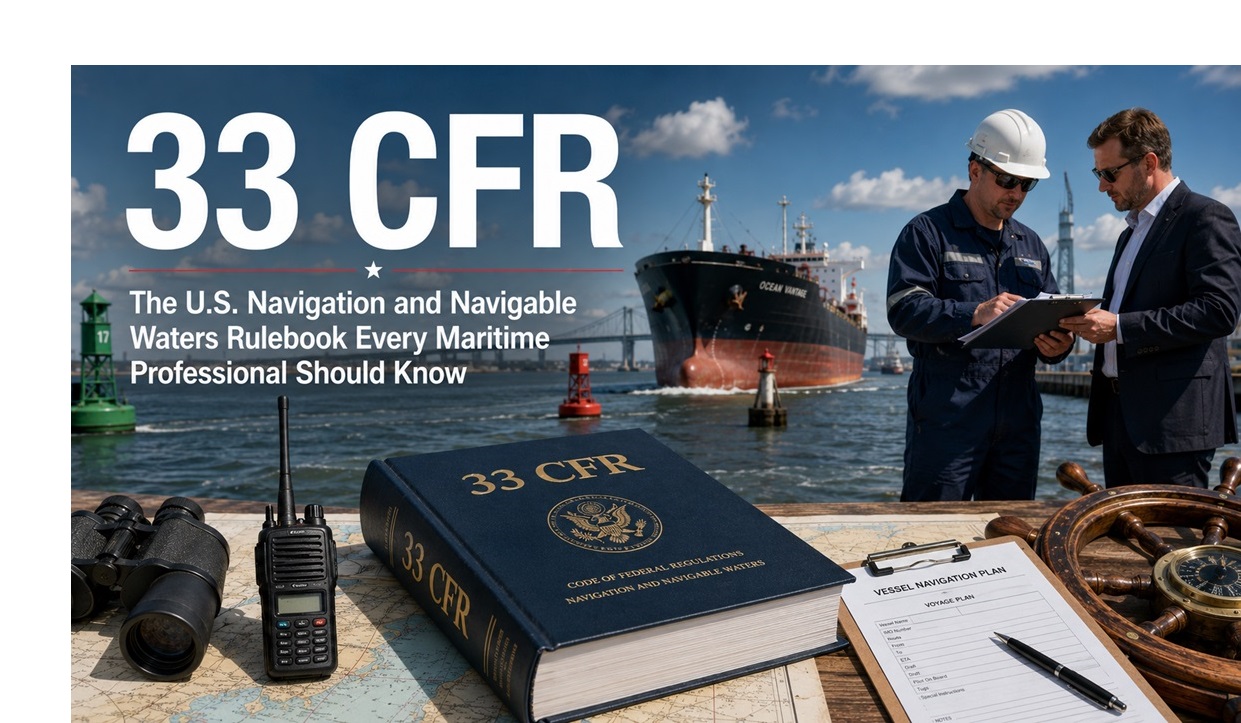
A comprehensive guide to 33 CFR, the U.S. federal regulation title governing navigation, navigable waters, Coast Guard rules, ports, waterways safety, pollution, security, bridges, anchorages, and Army Corps permits.
Why 33 CFR Matters More Than Many Seafarers Realize
A ship approaching a U.S. port is not simply entering a harbor. It is entering a dense legal-operational environment where navigation, security, pollution prevention, vessel traffic, bridges, anchorages, safety zones, waterfront facilities, ballast water, dangerous cargo, marine casualty reporting, oil-transfer procedures, and even aids to navigation are shaped by federal regulations.
For many international seafarers, maritime law is often associated with SOLAS, MARPOL, STCW, COLREGs, ISM Code, ISPS Code, and flag-state regulations. These instruments are essential, but they are not enough when a vessel trades to the United States. Once a vessel operates in U.S. navigable waters, interacts with a U.S. port, transfers oil or hazardous materials, uses a regulated anchorage, passes a drawbridge, enters a safety zone, or becomes subject to U.S. Coast Guard control, Title 33 of the Code of Federal Regulations, usually called 33 CFR, becomes directly relevant.
The attached reference material outlines the structure of 33 CFR across three main volumes, beginning with the U.S. Coast Guard’s general, navigation, security, pollution, and ports-and-waterways rules; continuing with waterfront facilities, outer continental shelf activities, deepwater ports, pollution, boating safety, and vessel traffic provisions; and then moving into U.S. Army Corps of Engineers rules on navigable waters, permits, dredged material, obstructions, and related water-resource matters. It also identifies the Great Lakes St. Lawrence Seaway Development Corporation rules in the later parts of Title 33.
In simple terms, 33 CFR is one of the principal U.S. federal rulebooks for navigation and navigable waters. The official electronic Code of Federal Regulations describes Title 33 as Navigation and Navigable Waters, and as of the current eCFR display checked for this article, Title 33 is maintained as a current federal regulatory title, with recent amendments noted by eCFR.
This article explains what 33 CFR is, how it is organized, why it matters for ships and port operations, and how maritime professionals can use it practically. It is written for deck officers, marine engineers, port personnel, maritime students, ship managers, compliance teams, maritime lawyers, terminal operators, and anyone who needs a clear operational understanding of U.S. navigation and waterway regulations.
What Is 33 CFR?
33 CFR means Title 33 of the Code of Federal Regulations. The Code of Federal Regulations, or CFR, is the codified collection of general and permanent rules issued by U.S. federal agencies. Title 33 deals with Navigation and Navigable Waters. In maritime practice, this means it contains many of the U.S. federal rules that affect ships, ports, waterways, navigation, anchorage areas, waterfront facilities, marine safety, pollution prevention, vessel traffic services, aids to navigation, bridges, regulated navigation areas, deepwater ports, and certain Corps of Engineers permitting functions.
The official eCFR page identifies Title 33 as the federal title for Navigation and Navigable Waters. Cornell’s Legal Information Institute similarly lists Title 33 under that heading and shows its principal organization into Coast Guard, Corps of Engineers, and Great Lakes St. Lawrence Seaway Development Corporation chapters.
For a maritime professional, 33 CFR is not a single rule. It is a large regulatory ecosystem. Some parts are highly relevant to oceangoing ships. Others apply mainly to U.S. domestic vessels, recreational boating, offshore facilities, port authorities, bridge operators, dredging contractors, or civil works projects. The value of 33 CFR is therefore not memorizing every part. The value is knowing which parts matter in which operational situation.
For example, a master preparing to enter a U.S. port may need to understand Captain of the Port authority, security zones, anchorage regulations, bridge-to-bridge radiotelephone requirements, vessel traffic management, navigation safety rules, and reporting obligations. A tanker operator may need to examine oil or hazardous-material transfer rules, pollution prevention rules, financial responsibility requirements, and facility interface requirements. A port engineer or infrastructure developer may need to look at U.S. Army Corps permit regulations for structures or work affecting navigable waters. A compliance officer may need to cross-reference 33 CFR with 46 CFR, 40 CFR, SOLAS, MARPOL, and company procedures.
Why 33 CFR Is Important in 2026
The maritime sector in 2026 is shaped by tighter environmental expectations, port-security controls, digital navigation, climate resilience, offshore energy expansion, LNG and hazardous cargo growth, and increased scrutiny of marine incidents. In this context, 33 CFR matters because it translates U.S. federal authority into practical rules for real operations.
The official eCFR version checked for this article shows Title 33 as current and recently amended, which is important because maritime regulations are not static. Operators should rely on the current eCFR version rather than old printed editions when making compliance decisions.
There are five reasons why 33 CFR deserves close attention.
First, it affects access to U.S. waters and ports. A vessel can be delayed, restricted, ordered to move, denied entry, or controlled by the Captain of the Port if safety, security, or environmental risk requires action.
Second, it governs parts of navigation practice. Rules on bridge-to-bridge radio, aids to navigation, inland navigation rules, pilot rules, regulated navigation areas, vessel traffic services, and safety zones can directly affect bridge-team decisions.
Third, it supports port and waterfront safety. Dangerous cargo, LNG and hazardous gas handling, waterfront facility requirements, and transfer operation rules are central to safe port operations.
Fourth, it contains major pollution-prevention provisions. These include rules on oil, noxious liquid substances, garbage, ballast water, marine sanitation devices, reception facilities, and hazardous substance discharge response.
Fifth, it defines important jurisdictional and permitting frameworks. The Corps of Engineers chapters address structures, work, dredged material, fill material, navigable waters, public hearings, enforcement, and mitigation. These are essential for ports, terminals, offshore projects, dredging works, and waterfront development.
For shipboard officers, 33 CFR can appear distant until a port-state inspection, a U.S. Coast Guard boarding, a security-zone restriction, a ballast-water question, a transfer operation, a vessel traffic instruction, or an anchorage issue occurs. Then it becomes immediately practical.
The Big Structure of 33 CFR
The attached material presents Title 33 in three volumes. Volume 1 covers many Coast Guard provisions from general rules through bridges. Volume 2 continues Coast Guard rules on waterfront facilities, pollution, outer continental shelf activities, deepwater ports, ports and waterways safety, and boating safety. Volume 3 covers the Corps of Engineers, including navigation regulations, NEPA procedures, permits, enforcement, navigable waters definitions, dredged material, and Great Lakes St. Lawrence Seaway rules.
At a higher level, Title 33 is organized into three principal chapters:
| Main chapter | Responsible body | General subject |
|---|---|---|
| Chapter I | U.S. Coast Guard, Department of Homeland Security | Navigation, vessel operation, maritime security, pollution, ports, waterways, boating safety |
| Chapter II | Corps of Engineers, Department of the Army, Department of Defense | Navigable waters, permits, dredging, structures, water-resource policies |
| Chapter IV | Great Lakes St. Lawrence Seaway Development Corporation, Department of Transportation | Seaway regulations, tolls, procedural rules |
Cornell’s eCFR listing shows this same chapter-level structure: Chapter I for the Coast Guard, Chapter II for the Corps of Engineers, and Chapter IV for the Great Lakes St. Lawrence Seaway Development Corporation.
This structure is important because it helps users avoid confusion. Not all of 33 CFR is “Coast Guard law,” even though the Coast Guard parts are central for vessel operations. The Corps of Engineers parts are equally important for ports, dredging, construction, and navigable-water jurisdiction. The Seaway provisions are specialized but critical for vessels and operators using the Great Lakes–St. Lawrence system.
Chapter I: The U.S. Coast Guard Core of 33 CFR
The largest operationally relevant section for ships is Chapter I: Coast Guard, Department of Homeland Security. This chapter covers a wide range of topics, including general provisions, jurisdiction, Coast Guard districts, navigation rules, vessel operating rules, maritime security, anchorages, bridges, waterfront facilities, pollution, vessel traffic management, and boating safety.
The attached outline begins Chapter I with Subchapter A, including general provisions, Coast Guard jurisdiction, Coast Guard areas and Captain of the Port zones, Coast Guard Auxiliary, vessel and waterfront protection, administrative proceedings, bridge-to-bridge radiotelephone regulations, and civil monetary penalties.
For practical maritime use, the Coast Guard chapter can be understood through several operational lenses.
Jurisdiction and Captain of the Port Authority
One of the most important functions of 33 CFR is to define and support Coast Guard authority over U.S. navigable waters, ports, harbors, waterfront facilities, and vessels subject to U.S. jurisdiction. In practical terms, this authority may be exercised through Coast Guard districts, sectors, marine inspection zones, and Captain of the Port zones.
For a vessel, the Captain of the Port, often abbreviated COTP, is a key authority. COTP orders can affect vessel movement, port entry, anchorage, cargo operations, security requirements, safety zones, and response to casualties or pollution risks. The attached material identifies 33 CFR Part 3 as dealing with Coast Guard areas, districts, sectors, marine inspection zones, and Captain of the Port zones.
A master or company security officer should not treat the COTP as an abstract legal figure. In a U.S. port call, the COTP can become central in cases involving hazardous cargo, security threats, cyber incidents, machinery failure, steering problems, pollution risk, weather disruption, protest activity, marine casualty, or port closure.
Bridge-to-Bridge Radiotelephone Regulations
Communication is one of the oldest and most persistent risk-control tools in navigation. 33 CFR includes bridge-to-bridge radiotelephone provisions, identified in the attached material as Part 26.
The purpose of bridge-to-bridge communication is not casual conversation. It is collision avoidance, maneuver coordination, safe passing arrangements, and traffic awareness. For international crews, this area deserves attention because U.S. inland and harbor practice may involve specific communication expectations, especially in congested waters, narrow channels, river systems, tug-and-barge traffic areas, and pilotage waters.
Bridge teams should be especially careful not to substitute radio conversation for COLREGs compliance. VHF communication supports situational awareness, but the vessel’s obligations under applicable navigation rules remain.
Aids to Navigation
Subchapter C of 33 CFR covers Aids to Navigation, including the U.S. Aids to Navigation System, marking of structures and obstructions, private aids to navigation, artificial islands, fixed structures, interference with aids, and marine information. The attached material lists these areas under Parts 62, 64, 66, 67, 70, 72, 74, and 76.
For deck officers, aids to navigation are more than buoys and lights. They are part of the legal and operational architecture of safe navigation. A buoy’s position, color, light characteristic, sound signal, or charted purpose may reflect Coast Guard rules, local waterway design, and hazard marking. Private aids may also be regulated, especially near terminals, marinas, offshore structures, dredging areas, and industrial waterfront facilities.
In practice, bridge teams should treat aids to navigation as one input within a full navigation picture. Radar, ECDIS, visual bearings, soundings, VTS information, pilot advice, current, wind, and local notices must be integrated. A buoy may be off station. A light may be extinguished. A temporary aid may be installed after dredging or marine construction. This is why local notices to mariners and current Coast Guard information remain essential.
International and Inland Navigation Rules in 33 CFR
The attached outline identifies Subchapter D: International Navigation Rules and Subchapter E: Inland Navigation Rules. These include COLREGs demarcation lines, implementing rules, interpretative rules, inland navigation rules, annexes on lights and shapes, sound signal appliances, distress signals, pilot rules, and inland interpretative rules.
This is a critical area for foreign-going vessels because the United States applies both international and inland navigation-rule regimes, depending on location. The dividing point is not always intuitive to a first-time caller. COLREGs demarcation lines determine where international rules give way to inland rules in U.S. waters.
A practical example: a vessel approaching the U.S. coast may initially operate under the international COLREGs regime. After crossing a demarcation line and entering inland waters, inland navigation rules may apply. A failure to recognize that transition can affect sound signals, lighting requirements, passing arrangements, and legal assessment after an incident.
This is especially important in:
- River approaches
- Pilotage waters
- Harbors and bays
- Great Lakes waters
- Coastal inlets
- Tug-and-barge traffic areas
- Narrow channels
- High-density port approaches
International officers should therefore avoid assuming that “COLREGs knowledge” alone is sufficient for all U.S. waters. A professional bridge team must understand when inland rules become relevant and should brief this during pilotage preparation.
Vessel Operating Regulations: Safe Operation and Safety Management
The attached outline lists Subchapter F: Vessel Operating Regulations, including operating a vessel while under the influence of alcohol or dangerous drugs, safe operation of vessels and safety management systems, and safe operation plus stowage and securing of cargoes.
This subchapter connects regulatory compliance with daily seamanship. Safe operation is not limited to steering, speed, and lookout. It includes crew fitness, watchkeeping discipline, cargo securing, safety management, and risk control.
For shipping companies, this part of 33 CFR should be integrated into the Safety Management System when vessels trade to the United States. The company’s SMS should not simply say “comply with local regulations.” It should identify where local U.S. requirements may affect shipboard procedures, reporting, bridge-team conduct, cargo operations, and records.
For example, voyage planning should include:
- U.S. arrival reporting requirements
- Local navigation rules
- VTS requirements
- Security-zone awareness
- Anchorage instructions
- Ballast-water compliance
- Pollution-prevention procedures
- Cargo-transfer interface requirements
- Bridge-to-bridge communication expectations
- Crew fitness and alcohol/drug policy compliance
The strongest compliance systems translate regulation into operational checklists, not just legal references.
Maritime Security: 33 CFR and the Post-ISPS Port Environment
One of the most operationally important sections of 33 CFR is Subchapter H: Maritime Security. The attached material lists Part 101 on maritime security general provisions, Part 103 on area maritime security, Part 104 on vessels, Part 105 on facilities, Part 106 on outer continental shelf facilities, and Part 107 on national vessel and facility control measures and limited access areas.
This subchapter is closely connected to the international security environment shaped by the ISPS Code, but it also contains U.S.-specific regulatory requirements. For vessels, maritime security under 33 CFR is not merely about having a Ship Security Plan. It may affect access control, declarations of security, restricted areas, facility interface, security levels, crew identification, reporting of suspicious activity, and compliance with COTP instructions.
For terminals and port facilities, Part 105 is especially important because it addresses facility security. For ships, Part 104 is central because it governs vessel security. Part 103 addresses broader area maritime security structures, while Part 107 gives the Coast Guard tools for control measures and limited-access areas.
In practice, security compliance in a U.S. port call may involve:
- Advance notice procedures
- Vessel security plan implementation
- Security-level changes
- Crew and visitor access control
- Coordination with the Facility Security Officer
- Declaration of Security where required
- Restricted-area management
- Monitoring of gangways, stores, contractors, and service providers
- Response to suspicious activity
- Compliance with temporary security zones
The modern port-security environment also increasingly intersects with cyber risk. Although cyber-specific requirements may appear in other policy instruments and guidance, the operational reality is that a cyber incident affecting navigation, cargo systems, access control, communications, or facility interface can become a maritime-security and port-safety matter.
Anchorages, Bridges, and Regulated Waterway Infrastructure
33 CFR also governs physical and operational features of waterways that directly affect navigation. The attached outline identifies Subchapter I: Anchorages and Subchapter J: Bridges, including anchorage regulations, bridge locations and clearances, alteration of obstructive bridges, drawbridge operation regulations, and bridge lighting or signals.
Anchorage Regulations
Anchorage is often viewed as a routine operation. In U.S. waters, however, anchorage may be tightly regulated. Designated anchorage grounds, explosive anchorages, quarantine anchorages, naval anchorages, regulated navigation areas, or temporary restrictions can affect where and how a vessel may anchor.
A ship should not anchor in U.S. waters based only on charted depth and holding ground. The master must consider:
- Whether the area is a designated anchorage
- Whether permission is required
- Whether the vessel is carrying dangerous cargo
- Whether the anchorage is subject to COTP control
- Whether local rules limit duration or movement
- Whether weather, traffic, pipeline, cable, or environmental constraints apply
- Whether the anchorage is within a security, safety, or regulated navigation area
Failure to follow anchorage regulations can create navigational risk and legal exposure.
Bridges and Drawbridges
Bridge regulations matter because bridges are both navigational constraints and critical infrastructure. 33 CFR addresses bridge clearances, drawbridge operations, bridge lighting, signals, and administrative procedures for bridge locations and alterations.
For vessels, bridge transit requires accurate air-draft calculation, tide and water-level awareness, communication with bridge operators where applicable, speed control, tug assistance planning, and contingency procedures. For inland vessels and tugs, drawbridge schedules can directly affect voyage timing and traffic coordination.
For port planners and infrastructure authorities, bridge rules also shape long-term waterway development. A bridge that unreasonably obstructs navigation may become subject to alteration procedures, while new bridge projects must consider navigational clearance and safety.
Waterfront Facilities and Dangerous Cargo
Volume 2 of the attached outline begins with Subchapter L: Waterfront Facilities, including identification credentials for persons requiring access to waterfront facilities or vessels, handling of dangerous cargo at waterfront facilities, and waterfront facilities handling LNG and liquefied hazardous gas.
This section is particularly important for terminals, tanker operations, gas carriers, chemical carriers, port authorities, and emergency planners.
Identification and Access
Port access is both a security and operational issue. Identity verification, controlled access, visitor management, contractor control, and restricted-area procedures are essential to facility security. In U.S. practice, these requirements may interact with TWIC-related systems and facility security plans.
For a vessel, access control at a waterfront facility affects crew changes, shore leave, technicians, inspectors, agents, surveyors, bunker suppliers, waste contractors, stores deliveries, and emergency responders.
Dangerous Cargo
Dangerous cargo at waterfront facilities is a high-consequence risk area. The handling of dangerous cargo requires coordination among the vessel, facility, cargo interests, emergency services, and regulators. Risks include fire, explosion, toxic exposure, chemical release, vapor cloud formation, incompatible cargo contact, structural damage, and water pollution.
Operational controls may include:
- Cargo compatibility checks
- Transfer procedures
- Emergency shutdown systems
- Firefighting readiness
- Hot-work restrictions
- Vapor control measures
- Security controls
- Communications between ship and shore
- Pre-transfer conferences
- Weather limits
- Mooring integrity
- Exclusion zones
LNG and Liquefied Hazardous Gas Facilities
LNG and liquefied hazardous gas operations require specialized regulation because the risk profile differs from conventional liquid bulk cargo. Cryogenic temperatures, vapor dispersion, flammability, pressure control, emergency shutdown systems, and specialized transfer equipment all require rigorous procedures.
For gas-carrier officers, the U.S. regulatory environment must be integrated with the IGC Code, terminal manuals, cargo operating procedures, and emergency plans.
Marine Pollution, Oil, Hazardous Substances, and Ballast Water
One of the most important practical areas of 33 CFR is pollution prevention. The attached material lists Subchapter O: Pollution, including vessels carrying oil, noxious liquid substances, garbage, municipal or commercial waste, and ballast water; control of pollution by oil and hazardous substances; facilities transferring oil or hazardous material in bulk; oil or hazardous material pollution-prevention regulations for vessels; transfer operations; tank-vessel environmental protection rules; reception facilities; and marine sanitation devices.
This area is extremely relevant for international ships because it overlaps with MARPOL, U.S. domestic environmental law, Coast Guard inspection practice, EPA-related rules, and port reception expectations.
Oil and Hazardous Substance Pollution
U.S. waters have a strict pollution-control environment. A spill, sheen, unauthorized discharge, transfer failure, or reporting delay can create serious consequences. This applies not only to tankers but also to bulk carriers, container ships, cruise ships, offshore vessels, fishing vessels, and yachts.
Practical risk points include:
- Bunkering
- Sludge transfer
- Bilge-water management
- Oily-water separator operation
- Deck hydraulic leaks
- Cargo hose failure
- Tank overflow
- Scupper management
- Fuel changeover complications
- Stern-tube leakage
- Garbage discharge
- Sewage discharge
- Ballast-water discharge
For engineers, pollution prevention is not only an engine-room task. It requires coordination with deck officers, terminal staff, agents, and company superintendents. For deck officers, it is not only a cargo-deck task. It includes navigation decisions, anchorage, heavy weather preparation, and emergency response.
Transfer Operations
33 CFR includes rules for oil and hazardous material transfer operations. These are among the most inspection-sensitive activities in port. A transfer operation may involve bunkering, cargo loading, cargo discharge, internal transfer, lightering, or facility-to-vessel movement.
A strong pre-transfer process should cover:
- Person in charge designation
- Communication method
- Emergency shutdown procedure
- Hose and connection condition
- Valve lineup
- Tank capacity and ullage
- Transfer rate
- Spill containment
- Firefighting readiness
- Weather and mooring limits
- Watchkeeping arrangements
- Documentation and declarations
- Stop-transfer criteria
Many incidents occur not because procedures do not exist, but because they are treated as paperwork rather than operational controls.
Ballast Water
The attached outline explicitly includes ballast water within 33 CFR Part 151. Ballast-water compliance remains a major issue because it links vessel stability, invasive species prevention, treatment-system operation, recordkeeping, sampling, port-state control, and environmental regulation.
For a vessel entering the United States, ballast-water planning should be completed before arrival. The bridge team and engine department should know whether ballast will be retained, exchanged, treated, discharged, or managed through an alternative method. Records should be accurate and consistent with actual operations.
In 2026, ballast-water management is also a credibility issue. A vessel with a treatment system that exists only on paper, or records that do not match operational reality, creates regulatory and reputational risk.
Reception Facilities and Garbage
33 CFR also addresses reception facilities for oil, noxious liquid substances, and garbage. Reception facilities are vital because international and domestic pollution rules often prohibit discharge at sea or restrict it heavily. A ship must therefore plan for lawful landing of waste.
Garbage management should not be treated as a low-level housekeeping issue. For passenger ships, cruise ships, offshore vessels, fishing vessels, and long-voyage cargo ships, garbage management affects sanitation, fire risk, environmental compliance, and port-state inspection results.
Ports and Waterways Safety: The Operational Heart of 33 CFR
The attached material identifies Subchapter P: Ports and Waterways Safety, including general ports and waterways safety, vessel traffic management, inland waterways navigation regulations, towing of barges, navigation safety regulations, regulated navigation areas and limited access areas, shipping safety fairways, offshore traffic separation schemes, tanker escort requirements, and ship reporting systems.
This is one of the most important subchapters for active vessel operations in U.S. waters.
Ports and Waterways Safety General
Ports and waterways safety rules give the Coast Guard regulatory tools to manage risks in congested, hazardous, or strategically important waters. These risks may involve vessel traffic density, dangerous cargo, restricted visibility, severe weather, port closures, marine casualties, military operations, offshore installations, major events, or security threats.
Cornell’s listing identifies Part 160 as Ports and Waterways Safety—General, under Coast Guard Subchapter P.
In practice, Part 160-type authority may support orders and controls affecting vessel movement, reporting, hazardous conditions, safety zones, and COTP interventions. For masters, the operational lesson is simple: when in U.S. waters, Coast Guard instructions are not optional advice. They may have direct regulatory force.
Vessel Traffic Management
Vessel Traffic Services and vessel traffic management systems are critical in high-density waterways. The attached outline lists Part 161 as Vessel Traffic Management.
VTS participation may require position reports, sailing plans, communications on designated frequencies, compliance with traffic instructions, and awareness of local routing measures. The VTS operator does not relieve the master or pilot of navigational responsibility, but VTS can significantly improve traffic organization and risk control.
Bridge teams should brief:
- VTS sector boundaries
- Reporting points
- Required information
- Communication frequencies
- Traffic lanes
- Precautionary areas
- Speed restrictions
- Meeting and overtaking arrangements
- Emergency reporting procedures
Navigation Safety Regulations
The attached outline lists Part 164 as Navigation Safety Regulations. This area is especially relevant because it can affect voyage planning, navigation equipment, charts, publications, tests, and operational readiness.
From a ship-management perspective, navigation safety compliance should be checked before arrival, not after the pilot boards. If a radar is defective, an ECDIS issue exists, charts are not updated, steering gear has limitations, main engine response is uncertain, or bridge equipment tests are incomplete, the vessel may face delay, restriction, or enforcement action.
Regulated Navigation Areas, Safety Zones, and Limited Access Areas
Regulated Navigation Areas and safety zones are among the most visible ways 33 CFR affects navigation. These zones may be permanent, temporary, event-based, security-related, weather-related, construction-related, or emergency-related.
Examples include:
- Safety zones around fireworks displays
- Security zones around naval vessels
- Regulated areas near bridges or construction works
- Exclusion areas around casualty sites
- Restricted zones near LNG terminals
- Temporary zones during salvage or pollution response
- Limited-access areas during national security events
For a bridge team, these zones must be treated as part of passage planning. They may not always be obvious on standard charts if recently established. Local notices, Coast Guard broadcasts, agent updates, pilot information, and VTS communication are essential.
Outer Continental Shelf Activities and Deepwater Ports
The attached material includes Subchapter N: Outer Continental Shelf Activities and Subchapter NN: Deepwater Ports. These cover general OCS provisions, personnel, workplace safety and health, design and equipment, lifesaving appliances, firefighting equipment, operations, safety zones, deepwater port design, construction, equipment, and operations.
This part of 33 CFR is increasingly important because offshore energy, offshore terminals, floating infrastructure, subsea systems, and deepwater port concepts are becoming more significant in the energy transition.
Outer Continental Shelf
Outer Continental Shelf activities involve unique hazards: remote operations, severe weather exposure, helicopter transfers, offshore construction, subsea infrastructure, dynamic positioning, simultaneous operations, confined emergency response, and complex jurisdiction.
For offshore support vessels, MODUs, crew transfer vessels, construction vessels, supply vessels, and emergency response craft, OCS-related 33 CFR provisions can become highly relevant.
Deepwater Ports
Deepwater ports are specialized offshore facilities used for the import or export of oil, natural gas, or other cargoes depending on authorization. They may include offshore mooring systems, pipelines, floating units, subsea infrastructure, control systems, and safety zones.
33 CFR’s deepwater port provisions matter because these facilities combine ship operations, offshore engineering, environmental risk, and national energy infrastructure. A casualty at a deepwater port can affect not only a vessel and facility but also energy supply, marine environment, and coastal communities.
Boating Safety and Small Vessel Regulation
The attached outline includes Subchapter S: Boating Safety, covering vessel numbering, casualty and accident reporting, state numbering systems, equipment requirements, correction of especially hazardous conditions, defect notification, manufacturer requirements, boats and associated equipment, and vessel identification systems.
While this may seem less relevant to oceangoing merchant ships, it matters in several ways.
First, small craft are often present in harbor approaches, inland waterways, rivers, bays, and near terminals. Their regulatory behavior affects collision risk.
Second, professional mariners may operate launches, rescue boats, workboats, crew boats, pilot boats, or small service craft.
Third, port authorities and maritime educators need to understand the broader safety environment in which commercial and recreational vessels interact.
Fourth, casualty reporting and defect-notification provisions support the wider safety system by identifying recurring problems in small-vessel operations.
For bridge teams on large ships, the practical takeaway is that U.S. waterways are often mixed-use spaces. A deep-draft vessel may share restricted waters with fishing boats, recreational craft, ferries, tugs, barges, pilot boats, kayaks, sailing vessels, and law-enforcement craft. Regulatory compliance must be combined with strong lookout and conservative navigation.
Chapter II: The U.S. Army Corps of Engineers and Navigable Waters
Chapter II of 33 CFR belongs to the Corps of Engineers, Department of the Army, Department of Defense. The attached outline lists emergency employment of Army resources, navigation regulations, flood-control regulations, administrative procedure, engineering and design, NEPA procedures, flood-damage reduction measures, removal of wrecks and obstructions, bridge alteration cost apportionment, regulatory policies, permits, enforcement, public hearings, definitions of waters and navigable waters, nationwide permits, administrative appeals, compensatory mitigation, danger zones, and dredged-material rules.
This chapter is essential for port development, dredging, marine construction, waterfront engineering, environmental permitting, and waterway management.
Why the Corps of Engineers Appears in 33 CFR
The U.S. Army Corps of Engineers has long-standing responsibilities related to navigable waters, water resources, dredging, permits, flood control, civil works, and structures affecting navigation. That is why 33 CFR is not only a Coast Guard rulebook. It is also a waterway-infrastructure and permitting rulebook.
For maritime professionals, the Corps provisions are especially relevant when a project involves:
- Building a pier, wharf, quay, dock, jetty, breakwater, or marina
- Dredging a berth, channel, or basin
- Placing fill material
- Installing pipelines or cables in navigable waters
- Constructing offshore or waterfront structures
- Removing wrecks or obstructions
- Modifying waterway geometry
- Developing port expansion projects
- Managing wetland or aquatic impacts
General Regulatory Policies
The attached outline identifies Part 320 as General Regulatory Policies. These policies help frame how the Corps evaluates permit applications and balances navigation, environmental, public-interest, and engineering concerns.
Port developers often underestimate this part of the process. They may focus on engineering feasibility, commercial need, or cargo forecasts, while permitting authorities must also consider environmental effects, public interest, navigation safety, mitigation, alternative designs, and cumulative impacts.
Permits for Structures or Work in Navigable Waters
The eCFR explains that 33 CFR Part 322 prescribes policies, practices, and procedures for Department of the Army permits authorizing certain structures or work in or affecting navigable waters of the United States, connected to section 10 of the Rivers and Harbors Act of 1899.
This is highly relevant for ports, terminals, offshore developers, marinas, bridge projects, and waterfront industries. A structure that affects navigable waters is not merely an engineering object; it is a regulated intervention in a public waterway.
Examples may include:
- Piers
- Wharves
- Dolphins
- Mooring buoys
- Intake structures
- Outfalls
- Submarine cables
- Pipelines
- Breakwaters
- Bulkheads
- Floating platforms
- Offshore terminals
A project that begins without proper authorization can face enforcement, delay, redesign, penalties, or removal requirements.
Dredged or Fill Material
The attached outline identifies Part 323 on permits for discharges of dredged or fill material into waters of the United States, Part 324 on ocean dumping of dredged material, Part 335 on Corps civil works projects involving dredged or fill material, and Part 336 on factors considered in evaluating Corps dredging projects.
Dredging is central to maritime trade. Without dredging, many ports cannot maintain design depth, accommodate larger vessels, or remain competitive. But dredging also raises environmental concerns: turbidity, sediment contamination, benthic habitat disruption, disposal-site impacts, and water-quality effects.
A modern port dredging strategy must therefore integrate:
- Nautical depth requirements
- Sediment characterization
- Disposal or beneficial-use options
- Environmental windows
- Turbidity controls
- Stakeholder consultation
- Permit conditions
- Monitoring obligations
- Climate-resilience considerations
- Long-term maintenance planning
Definition of Navigable Waters
The eCFR description of 33 CFR Part 329 states that the regulation defines “navigable waters of the United States” as used to define Corps authorities and prescribes policy, practice, and procedure for determining the extent of Corps jurisdiction. It also notes that this definition does not apply to Clean Water Act authorities described elsewhere.
This distinction matters. “Navigable waters” can have different meanings depending on the legal context. A maritime professional, port planner, or environmental consultant should not assume that one definition automatically controls every statutory program.
For port and waterway projects, jurisdictional analysis is often one of the first steps. A project team must ask:
- Is the waterbody navigable for federal jurisdictional purposes?
- Is the work in, over, under, or affecting navigable waters?
- Does the project involve discharge of dredged or fill material?
- Are wetlands or aquatic resources affected?
- Is a nationwide permit available, or is an individual permit required?
- Are mitigation measures needed?
- Are public hearings or consultations likely?
Chapter IV: Great Lakes St. Lawrence Seaway Rules
The attached outline identifies Chapter IV as the Saint Lawrence Seaway Development Corporation, including Seaway regulations and rules, tariff of tolls, and rules of procedure of the Joint Tolls Review Board. Cornell’s eCFR listing identifies Chapter IV under the Great Lakes St. Lawrence Seaway Development Corporation, Department of Transportation.
This chapter is specialized, but for vessels operating in the Great Lakes–St. Lawrence system it is vital. Seaway navigation is a distinctive operational environment involving locks, canals, confined waters, pilotage, seasonal conditions, ice, draft restrictions, traffic coordination, and cross-border regulatory interaction.
Operators trading in this region must pay attention to:
- Seaway rules
- Tolls and tariffs
- Vessel dimensions
- Draft restrictions
- Lock procedures
- Mooring arrangements
- Reporting requirements
- Seasonal opening and closure
- Ice conditions
- Ballast-water and invasive species rules
- Pilotage and traffic instructions
For international operators, the Great Lakes are not “just another port call.” They are an inland-sea and seaway system with unique navigational, regulatory, and seasonal challenges.
How 33 CFR Interacts with SOLAS, MARPOL, STCW, COLREGs, and ISPS
A common mistake is to view international conventions and domestic regulations as separate worlds. In reality, they overlap.
SOLAS and 33 CFR
SOLAS governs ship safety at the international level. 33 CFR may add U.S.-specific requirements for navigation safety, vessel traffic, ports, waterways, security zones, and operational controls. A vessel can be SOLAS-compliant but still fail to meet a U.S. local operating requirement.
MARPOL and 33 CFR
MARPOL governs pollution prevention internationally. 33 CFR contains U.S. rules on oil, hazardous substances, garbage, noxious liquid substances, ballast water, reception facilities, and marine sanitation devices. A vessel must comply with both the international framework and applicable U.S. domestic requirements.
STCW and 33 CFR
STCW addresses training, certification, and watchkeeping. 33 CFR affects the operational environment in which watchkeepers perform duties. A well-certified officer still needs local regulatory awareness when navigating U.S. waters.
COLREGs and Inland Navigation Rules
International COLREGs are essential, but in U.S. waters, inland navigation rules may apply after crossing demarcation lines. 33 CFR’s treatment of COLREG demarcation and inland rules is therefore crucial for bridge teams.
ISPS Code and 33 CFR Maritime Security
The ISPS Code provides an international security framework. 33 CFR maritime security provisions give the United States its domestic implementation and operational control structure for vessels, facilities, areas, and limited-access measures.
The Most Important 33 CFR Areas for Shipboard Officers
For shipboard officers, the full title can be overwhelming. The practical approach is to identify high-impact areas.
For Masters
Masters should pay close attention to:
- Captain of the Port authority
- Notice of arrival and port-entry expectations
- Security zones and safety zones
- Vessel traffic management
- Anchorage regulations
- Navigation safety regulations
- Bridge-to-bridge communication
- Pollution reporting
- Dangerous cargo requirements
- Local navigation rules
- Crew and visitor access controls
- Port closure or restriction orders
The master is responsible for ensuring that the vessel’s U.S. port call is not treated as routine until the local regulatory environment is understood.
For Chief Officers
Chief officers should focus on:
- Cargo transfer requirements
- Dangerous cargo at waterfront facilities
- Ballast-water management
- Garbage management
- Deck pollution prevention
- Mooring safety
- Security access control
- Pre-transfer declarations
- Tank readiness
- Scupper and containment arrangements
- Waste landing
- Cargo documentation consistency
For tankers, chemical carriers, gas carriers, and bulk carriers carrying regulated cargoes, 33 CFR can be directly relevant to cargo planning and terminal interface.
For Chief Engineers
Chief engineers should focus on:
- Oil pollution prevention
- Bunkering procedures
- Oily bilge management
- Sludge transfer
- Sewage systems
- Ballast-water treatment systems
- Fuel and lube oil transfer
- Emergency shutdown readiness
- Machinery defects affecting safe navigation
- Records and logs
- Pollution incident response
A machinery defect that affects propulsion, steering, power generation, or pollution-prevention capability may become a port-safety or Coast Guard matter.
For Deck Watch Officers
Deck officers should focus on:
- Inland navigation rules
- Demarcation lines
- VTS participation
- Bridge-to-bridge communication
- Safety zones
- Security zones
- Aids to navigation
- Local notices
- Regulated navigation areas
- Traffic separation schemes
- Reporting systems
A junior officer may not need to know every legal citation, but they must know when local rules affect navigation.
The Most Important 33 CFR Areas for Port and Terminal Operators
Port and terminal operators need a different reading of 33 CFR. Their focus is less on the ship’s internal operation and more on facility interface, waterway safety, security, environmental protection, and infrastructure.
Key areas include:
- Waterfront facility security
- Dangerous cargo handling
- LNG and hazardous gas facility rules
- Oil and hazardous material transfer operations
- Reception facilities
- Safety zones and security zones
- Facility access control
- Emergency response planning
- Corps permit requirements
- Dredging and fill permits
- Bridge and obstruction rules
- Vessel traffic coordination
A terminal that fails to understand 33 CFR can create risk for vessels, cargo owners, employees, local communities, and the marine environment.
The Most Important 33 CFR Areas for Maritime Students
For maritime students, 33 CFR is valuable because it shows how maritime law becomes operational. It is not enough to learn conventions in theory. Students should understand how a port state turns international and national obligations into enforceable procedures.
A good educational approach is to divide 33 CFR into scenarios:
Scenario 1: Arrival at a U.S. Port
Students identify which rules may affect arrival reporting, VTS, pilotage, anchorage, security, and navigation.
Scenario 2: Tanker Cargo Discharge
Students examine transfer procedures, dangerous cargo, pollution prevention, facility interface, emergency shutdown, and records.
Scenario 3: Ballast-Water Discharge
Students review ballast-water management, treatment system operation, reporting, and recordkeeping.
Scenario 4: Navigation Through Inland Waters
Students compare COLREGs and inland navigation rules, including demarcation lines and local practices.
Scenario 5: Port Expansion Project
Students examine Corps permits, dredging, structures in navigable waters, public interest, and mitigation.
This scenario-based approach makes 33 CFR understandable and relevant.
Common Mistakes in Using 33 CFR
Mistake 1: Treating 33 CFR as Only a U.S. Domestic Issue
Foreign vessels often assume domestic regulations apply mainly to U.S.-flag vessels. That assumption is dangerous. Many 33 CFR provisions affect foreign vessels operating in U.S. waters or calling U.S. ports.
Mistake 2: Using Outdated Printed Editions
Because the eCFR is updated and Title 33 may be amended, users should verify current text through authoritative sources. The official eCFR page checked for this article shows Title 33 as current and recently amended.
Mistake 3: Confusing 33 CFR with 46 CFR
33 CFR deals largely with navigation and navigable waters, while 46 CFR covers shipping-related areas such as vessel inspection, mariner credentials, shipping, and marine engineering requirements. Both may apply to the same operation.
Mistake 4: Ignoring Local Coast Guard Notices
A vessel may comply with the printed regulation but still miss a temporary safety zone, security zone, closure, or local restriction. Local Coast Guard information and VTS communication are essential.
Mistake 5: Treating Compliance as Paperwork
Many 33 CFR requirements are operational controls. If they are treated as signatures, forms, or binder material only, their safety value is lost.
Mistake 6: Poor Integration with the Safety Management System
Companies should integrate recurring 33 CFR requirements into port-call checklists, pre-arrival procedures, cargo-transfer plans, and emergency response procedures.
Practical 33 CFR Compliance Checklist for a U.S. Port Call
The following checklist is not a legal substitute for the regulation, but it helps organize shipboard preparation.
Before Arrival
- Confirm current U.S. port requirements.
- Review applicable Coast Guard district and COTP information.
- Check VTS requirements.
- Review local notices to mariners.
- Confirm whether inland navigation rules will apply.
- Identify safety zones, security zones, and regulated navigation areas.
- Confirm anchorage requirements.
- Verify navigation equipment readiness.
- Check bridge-to-bridge communication arrangements.
- Review ballast-water management plan and records.
- Confirm garbage, sludge, bilge, and sewage arrangements.
- Review vessel security requirements.
- Prepare for possible Coast Guard boarding.
Before Cargo or Bunker Transfer
- Conduct pre-transfer conference.
- Confirm Person in Charge responsibilities.
- Test communications.
- Confirm emergency shutdown procedures.
- Verify hose, flange, valve, and containment condition.
- Confirm scupper plugs and spill kits.
- Confirm tank capacity and transfer rate.
- Review weather and mooring conditions.
- Maintain deck and engine-room watch.
- Record transfer details accurately.
During Port Stay
- Maintain access control.
- Monitor security level.
- Keep gangway watch effective.
- Monitor moorings and weather.
- Follow COTP, terminal, and VTS instructions.
- Report hazardous conditions promptly.
- Maintain pollution-prevention readiness.
- Control contractors and visitors.
- Keep logs accurate.
Before Departure
- Confirm clearance and departure instructions.
- Review navigation route and local restrictions.
- Confirm bridge and engine readiness.
- Verify pilot boarding arrangements.
- Check VTS reporting.
- Confirm no open pollution, security, or transfer issues.
- Brief bridge team on inland/international rules transition.
33 CFR and Enforcement Risk
Enforcement risk under 33 CFR can arise in many ways:
- Unauthorized entry into a safety or security zone
- Failure to follow a COTP order
- Improper anchoring
- Pollution discharge or failure to report
- Defective navigation equipment
- Non-compliant transfer operation
- Dangerous cargo handling violation
- Security-plan failure
- Ballast-water non-compliance
- Unauthorized work in navigable waters
- Unpermitted dredging or fill
- Failure to comply with VTS requirements
The consequences may include delay, civil penalties, operational restrictions, detention-like control measures, investigation, insurance complications, charter-party disputes, reputational harm, or project suspension.
For ship managers and port operators, the most effective strategy is preventive compliance. Once an incident occurs, the discussion shifts from “what should we do?” to “why did we not do it earlier?”
33 CFR and Digital Transformation
Digitalization is changing how maritime professionals interact with regulations. Instead of relying only on printed books, users now access eCFR, digital checklists, voyage-planning software, compliance platforms, port-call management systems, and electronic document systems.
However, digital access creates a new risk: the illusion that search equals understanding. A user may find a citation quickly but still misunderstand its operational meaning. The best approach combines digital access with structured training.
A modern company can improve 33 CFR compliance by:
- Creating port-specific compliance cards
- Embedding U.S. requirements into SMS procedures
- Using digital pre-arrival checklists
- Training masters and chief engineers on high-risk sections
- Linking regulations to incident case studies
- Reviewing Coast Guard notices during voyage planning
- Maintaining a current regulatory library
- Auditing transfer procedures against U.S. requirements
- Conducting tabletop exercises for COTP orders, pollution, and security zones
Digital tools should not replace professional judgment. They should make professional judgment faster and better informed.
33 CFR and Climate Resilience
Although 33 CFR is not usually described as a climate regulation, it is increasingly relevant to climate resilience. Ports and waterways face more frequent extreme weather, flooding, storm surge, heat stress, and infrastructure disruption. Regulations on ports and waterways safety, bridges, flood-control works, dredging, navigable waters, obstruction removal, and Corps permitting all interact with resilience planning.
For example:
- Dredging programs may need to consider changing sedimentation patterns.
- Bridge clearance and water levels may be affected by flood events.
- Ports may need resilient waterfront structures.
- Safety zones may be used during extreme weather response.
- Corps permits may shape adaptation works.
- Flood-control regulations may affect port-city resilience.
- Waterway closures may become more frequent during severe events.
A climate-resilient port is not only one with stronger infrastructure. It is one with clear regulatory pathways, emergency procedures, communication channels, and authority coordination.
33 CFR and the Human Element
Many regulatory failures are not caused by lack of rules. They are caused by poor understanding, weak communication, fatigue, assumptions, language barriers, overconfidence, or fragmented responsibility.
33 CFR compliance therefore has a human-element dimension. A vessel may have the correct regulation onboard, but if the bridge team does not understand local navigation rules, the engineering team does not understand transfer requirements, or the security watch treats access control casually, the regulation will not prevent an incident.
Training should emphasize:
- Scenario-based learning
- Plain-language explanations
- Bridge-engine-terminal coordination
- Case studies
- Role-specific responsibilities
- Communication drills
- Pre-arrival briefings
- Regulatory updates
- Lessons learned from deficiencies and near misses
For multinational crews, plain English and visual checklists are especially useful. Regulations should be converted into operational behavior.
Frequently Asked Questions About 33 CFR
What does 33 CFR stand for?
33 CFR stands for Title 33 of the Code of Federal Regulations. It covers Navigation and Navigable Waters in the United States.
Does 33 CFR apply to foreign ships?
Many provisions can apply to foreign ships when they operate in U.S. navigable waters, call at U.S. ports, use U.S. anchorages, transfer cargo, discharge ballast water, interact with waterfront facilities, or become subject to Coast Guard safety and security controls.
Is 33 CFR the same as 46 CFR?
No. 33 CFR mainly addresses navigation and navigable waters, while 46 CFR deals with shipping-related regulations such as vessel inspection, merchant marine personnel, and many vessel technical requirements. Both may be relevant to a vessel.
Where can I find the current 33 CFR?
The official eCFR website provides the current electronic version of Title 33. The eCFR result checked for this article displayed Title 33 as current and recently amended.
What are the most important parts of 33 CFR for ship officers?
Important areas include navigation rules, inland rules, bridge-to-bridge radio, maritime security, anchorages, ports and waterways safety, vessel traffic management, navigation safety regulations, pollution prevention, ballast water, transfer operations, and safety/security zones.
What are the most important parts of 33 CFR for ports?
Important areas include waterfront facility security, dangerous cargo, LNG and hazardous gas facilities, oil and hazardous-material transfers, reception facilities, dredging permits, structures in navigable waters, safety zones, regulated navigation areas, and Corps of Engineers permitting.
Does 33 CFR include environmental rules?
Yes. 33 CFR includes important pollution-related rules concerning oil, hazardous substances, noxious liquid substances, garbage, ballast water, reception facilities, marine sanitation devices, and transfer operations, as reflected in the attached structure of Subchapter O.
Does 33 CFR include port security?
Yes. 33 CFR includes maritime security rules for vessels, facilities, area maritime security, outer continental shelf facilities, and control measures, as shown in Subchapter H of the attached outline.
Conclusion: 33 CFR Is Where Maritime Law Becomes Local Practice
For ships entering U.S. waters, 33 CFR is not optional background reading. It is a practical rulebook that shapes navigation, security, pollution prevention, cargo transfer, vessel traffic, anchorage, port access, waterfront facility operations, and waterway infrastructure.
For ports and terminals, it is a framework for safe and lawful interaction with vessels, cargoes, waterways, facilities, dredging, construction, and environmental protection. For maritime students, it is a valuable example of how international maritime principles become enforceable domestic procedures. For ship managers, it is a compliance field that must be integrated into the Safety Management System, not left to last-minute port-call improvisation.
The key lesson is simple: 33 CFR is not just a legal title; it is an operational map of how the United States manages navigation and navigable waters. A vessel that understands it is better prepared. A port that applies it well is safer and more resilient. A maritime professional who can navigate it gains a serious advantage in compliance, safety, and operational decision-making.
–
References and Further Reading
- Official eCFR, Title 33—Navigation and Navigable Waters, current electronic federal regulation listing.
- Cornell Legal Information Institute, Electronic Code of Federal Regulations: Title 33—Navigation and Navigable Waters, chapter-level structure.
- eCFR, 33 CFR Part 322—Permits for Structures or Work in or Affecting Navigable Waters of the United States.
- eCFR, 33 CFR Part 329—Definition of Navigable Waters of the United States.
- Cornell Legal Information Institute, 33 CFR Part 160—Ports and Waterways Safety—General.
- User-provided attached outline of 33 CFR volumes, chapters, subchapters, and parts.