
In one article, you will understand why this narrow sea passage can move oil prices, delay ships, raise food costs, endanger seafarers, and influence global diplomacy.
The Strait of Hormuz matters because it is the narrow maritime gateway between the Persian Gulf and the Gulf of Oman / Arabian Sea, through which a major share of global oil, LNG, and fertilizer trade passes. UNCTAD describes the Strait as one of the world’s most critical maritime chokepoints, carrying around a quarter of global seaborne oil trade, as well as significant LNG and fertilizer volumes. When traffic through this passage is disrupted, the effect is not limited to ships. It can raise energy prices, increase insurance premiums, disturb fertilizer supply, worsen food-price pressure, and place thousands of seafarers in danger.
The narrow waterway that can shake the world
A ship’s master approaching the Strait of Hormuz is not simply entering another busy traffic lane. The bridge team is entering a place where geography, energy security, naval power, commercial shipping, insurance, and international law meet inside a relatively small maritime space.
On a chart, the Strait may look like a short passage. In global trade, it behaves like a pressure valve. When it is open, oil tankers, LNG carriers, chemical tankers, bulk carriers, container ships, naval vessels, offshore support vessels, and service craft move through a carefully managed corridor between Iran and Oman. When it becomes unsafe, even partly, the consequences travel far beyond the Persian Gulf.
They travel to Asian refineries that depend on crude oil. They travel to European gas markets when LNG supply becomes uncertain. They travel to farmers when fertilizer prices rise. They travel to shipowners when underwriters increase war-risk premiums. They travel to seafarers, whose contracts and livelihoods may force them into a dangerous operating area. They travel to ordinary households when fuel, transport, and food prices rise.
This is why the Strait of Hormuz is not only a geographical subject. It is a maritime safety subject. It is an energy subject. It is a legal subject. It is also a human subject.
The 2026 crisis has made this reality clearer. According to IMO, instability in the Middle East has created a rapidly evolving situation for global shipping, with IMO monitoring developments affecting more than 20,000 seafarers in the region, including crews stranded on vessels unable to exit the Strait of Hormuz.
For maritime students, cadets, ship officers, port professionals, and anyone following global trade, the main lesson is simple: a chokepoint is not dangerous only because it is narrow. It is dangerous because so much of the world has been built around the assumption that it will remain open.
What and where is the Strait of Hormuz?
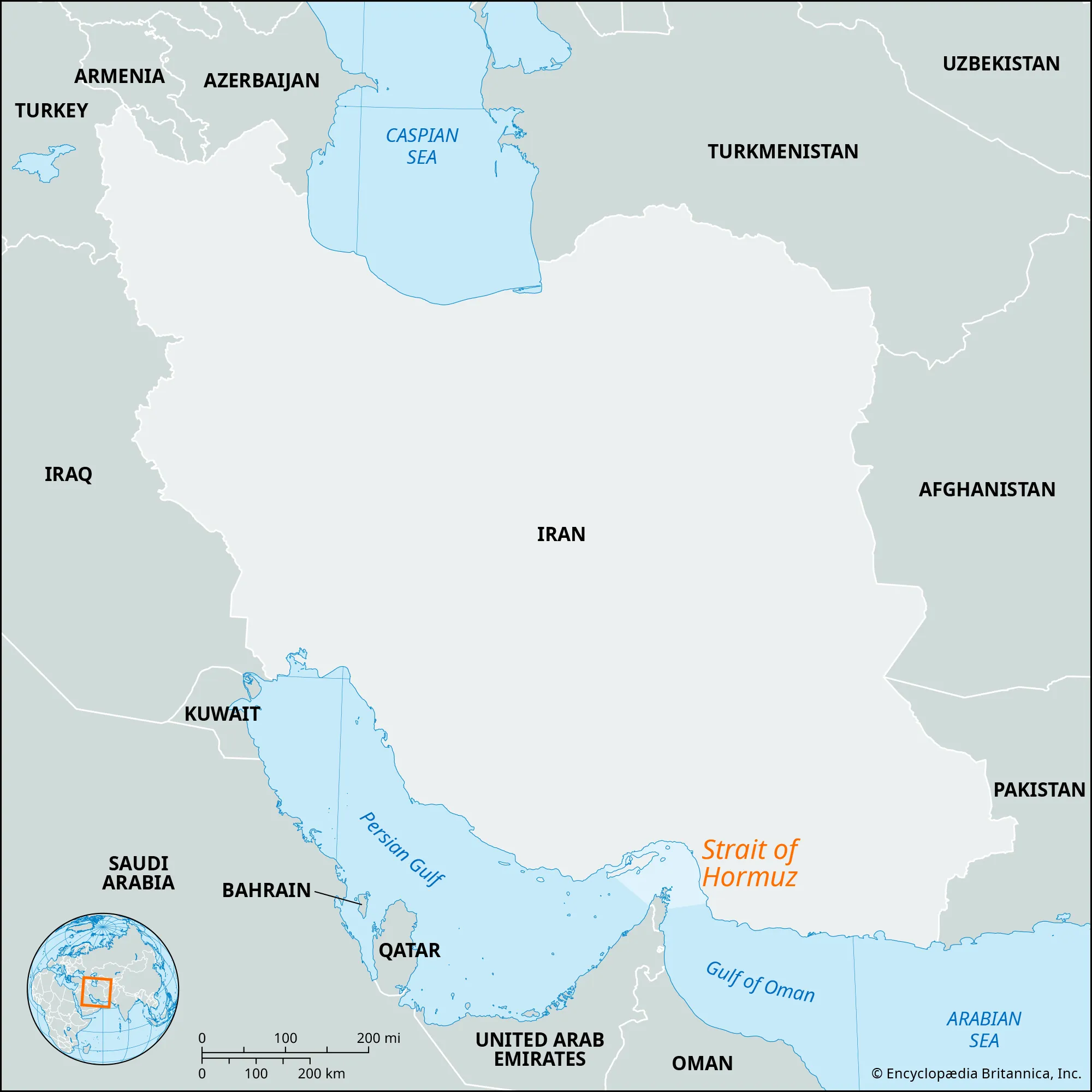
The Strait of Hormuz is the sea passage connecting the Persian Gulf with the Gulf of Oman, and from there with the Arabian Sea and the Indian Ocean. It lies between Iran to the north and Oman’s Musandam Peninsula to the south. It is the exit route for much of the oil and gas exported from Gulf producers including Saudi Arabia, Iraq, Kuwait, Qatar, the United Arab Emirates, and Iran.
At its narrowest, the Strait is often described as roughly 34 km wide, but the navigable shipping arrangement is much more specific than the total width of the waterway. Large commercial vessels do not simply spread across the entire Strait. They normally use designated shipping lanes under a traffic separation system. Reuters reported in April 2026 that the Strait is a strip of water about 34 km wide between Iran and Oman and that the established two-way traffic separation scheme was adopted by the UN shipping agency in 1968 with regional agreement.
The International Maritime Organization also notes that the existing Traffic Separation Scheme in the Strait of Hormuz was proposed by Iran and Oman and adopted by IMO in 1968. This system designates shipping lanes to reduce collision risk and improve safety.
This matters because discussions about “closing” or “reopening” the Strait are not only political slogans. In practical navigation, they affect a specific ship-routeing system used by tankers, LNG carriers, and other merchant vessels. A vessel may technically have water around it, but if the recognized safe lane is threatened by mines, missiles, drones, boarding risk, gunboat activity, or unclear rules of passage, commercial shipping may stop by itself. A chokepoint can be “closed” legally, militarily, commercially, or psychologically. Often, the commercial closure arrives before a formal legal closure.
Why is it called an oil chokepoint?
A maritime chokepoint is a narrow passage where many shipping routes are concentrated. Examples include the Strait of Hormuz, Bab el-Mandeb, the Suez Canal, the Turkish Straits, the Strait of Malacca, and the Panama Canal. What makes Hormuz exceptional is the concentration of energy cargo.
The U.S. Energy Information Administration has long classified the Strait of Hormuz as a critical oil transit chokepoint. In 2024, oil flows through the Strait averaged about 20 million barrels per day, equivalent to roughly 20% of global petroleum liquids consumption. EIA also reported that flows in the first quarter of 2025 remained relatively flat compared with 2024.
UNCTAD’s 2026 analysis describes the Strait as carrying around a quarter of global seaborne oil trade, together with significant volumes of LNG and fertilizers. This distinction is important: the share of global petroleum consumption and the share of seaborne oil trade are not the same measurement. One refers to total global petroleum consumption; the other refers to oil moved by sea. Both figures show the same strategic point: a very large part of the world’s energy system depends on safe passage through Hormuz.
The word “chokepoint” is therefore not metaphorical exaggeration. It is operational reality. If the Strait is blocked, delayed, mined, militarized, or considered too dangerous by shipowners and insurers, the effect can be immediate. Tankers may wait at anchor. Charterers may cancel or delay voyages. Refineries may search for alternative crude. LNG buyers may bid higher for cargoes elsewhere. Freight markets may react. War-risk premiums may rise. Governments may discuss strategic reserves. Seafarers may become trapped in a conflict zone.
A railway can sometimes be bypassed. A road can sometimes be rerouted. A port can sometimes use another terminal. But the Persian Gulf has only one natural ocean exit for deep-sea shipping: the Strait of Hormuz.
Why the 2026 crisis matters more than ordinary regional tension
The Strait of Hormuz has been associated with geopolitical tension for decades. Ship seizures, naval encounters, sanctions, regional rivalries, and threats to maritime traffic are not new. What makes the 2026 situation especially important is the combination of several risks at once: reduced confidence in safe passage, disruption to tanker traffic, uncertainty over insurance, stranded seafarers, concern about LNG flows, and global attention to the effect on fertilizers and food prices.
Reuters reported on 29 April 2026 that at least six ships crossed the Strait in the previous 24 hours, describing this as only a fraction of usual traffic while the United States and Iran remained deadlocked over terms to reopen the waterway.
That sentence contains the key operational lesson. Closure risk is not binary. A waterway may not be completely blocked by a physical barrier, but if only a small number of ships are willing or able to pass, the global market still experiences disruption. Shipping depends on confidence. It depends on predictability. It depends on insurance. It depends on crew acceptance. It depends on port clearance, naval warnings, charter-party terms, and the ability to complete a voyage without unacceptable risk.
In April 2026, Reuters also reported that Iran had proposed allowing ships to exit the Persian Gulf through Omani waters in the Strait of Hormuz without risk of attack if a broader deal with the United States was reached. The same report quoted an IMO spokesperson welcoming moves that permit safe transit through the established traffic separation scheme.
That detail is important because it shows that the crisis is not only about “oil.” It is about the practical restoration of a safe maritime traffic system. A tanker market can adjust to price. A ship can wait at anchor for some time. But if ships do not know which lane is safe, whether they will be challenged, whether their flag or ownership makes them a target, or whether their insurance remains commercially acceptable, the Strait becomes a high-risk operating zone even before it becomes physically impassable.
How a closure risk becomes a real shipping disruption
The phrase “closure of the Strait of Hormuz” can mislead readers into imagining a single dramatic event, like a gate being shut. In reality, closure risk develops through several layers.
First, there is the security layer. If vessels are attacked, boarded, mined, harassed, or threatened, companies reassess whether a voyage is acceptable.
Second, there is the insurance layer. War-risk insurers, P&I clubs, cargo insurers, reinsurers, and brokers price the risk. Even when cover remains technically available, the premium can become so high that a voyage is no longer economically rational.
Third, there is the crew layer. Seafarers are not cargo. They are people. If an area is declared high-risk or warlike, contractual protections, refusal rights, additional pay, repatriation concerns, and mental-health pressures become central.
Fourth, there is the charter-party layer. Charterers, owners, managers, and cargo interests may disagree over whether a ship must proceed. War-risk clauses, safe-port warranties, force majeure, deviation rights, off-hire risk, demurrage, and laytime can all become disputed.
Fifth, there is the political layer. States may issue warnings, conduct naval operations, impose sanctions, inspect vessels, or negotiate safe corridors.
Sixth, there is the market layer. Energy buyers, traders, refineries, utilities, and fertilizer importers react before shortages are visible. Prices often move on risk, not only on actual shortage.
The 2026 crisis has activated all of these layers. The International Chamber of Shipping stated that attacks on commercial vessels in the Middle East and Persian Gulf placed innocent seafarers in extreme danger and posed an unacceptable threat to the safety of crews and the stability of global trade.
That is why the closure risk should not be assessed only by counting how many ships physically transit on a given day. The more serious question is: how many ships are still willing to go, under what conditions, at what cost, with what crew risk, and with what legal consequences?
–
Oil: why one narrow passage can move global prices
Oil markets react quickly to Strait of Hormuz tension because the cargo volume is enormous, alternative routes are limited, and many buyers rely on specific crude grades from Gulf producers. The passage is especially important for exports from Saudi Arabia, Iraq, Kuwait, Qatar, the United Arab Emirates, and Iran.
EIA reported that about 20 million barrels per day of oil moved through the Strait in 2024, equal to around 20% of global petroleum liquids consumption.
This does not mean that a disruption removes all that oil instantly from the world market. Some oil may be rerouted by pipeline. Some producers may use storage. Some importers may draw strategic reserves. Some cargoes may already be at sea. But the market does not wait until tanks are empty. It reacts when future supply becomes uncertain.
The difference between physical shortage and risk premium is important. A physical shortage occurs when buyers cannot obtain the cargo they need. A risk premium occurs when traders expect possible shortage, delay, or escalation and therefore price that risk into the market. The Strait of Hormuz can create both.
A tanker delayed outside the Strait may still deliver eventually, but the delay matters. Refineries plan crude slates. Traders schedule cargoes. Ports allocate berths. Charterers nominate vessels. Banks finance shipments. Insurers approve cover. When uncertainty spreads, every part of the chain adds caution.
The effect is not limited to crude oil. Refined products, condensate, petrochemical feedstocks, LPG, and other hydrocarbon flows may also be affected. Energy security is not just about barrels in the ground. It is about whether molecules can move from producer to consumer through a safe, insured, and predictable transport chain.
LNG: the gas dimension of the Hormuz crisis
The Strait of Hormuz is also crucial for LNG, especially because Qatar is one of the world’s leading LNG exporters. LNG trade is highly sensitive to shipping disruption because cargoes require specialized vessels, receiving terminals, regasification capacity, long-term contracts, and spot-market flexibility.
The International Energy Agency reported in April 2026 that Middle East conflict had resulted in the de facto closure of the Strait of Hormuz to LNG cargoes, with global LNG production declining by 8% year-on-year and exports from Qatar and the United Arab Emirates sharply reduced, only partly offset by higher output elsewhere.
In a separate IEA topic page, the agency said disruption of transit via the Strait had reduced LNG supplies from Qatar and the UAE by more than 300 million cubic metres per day, equivalent to more than 2 billion cubic metres of gas supply each week.
This has major implications. LNG is not a simple commodity that can always be replaced immediately. If cargoes from one region are delayed, buyers may compete for cargoes from another. Europe and Asia may bid against each other. Utilities may seek alternative fuels. Industrial users may face higher costs. Governments may worry about storage levels.
Unlike crude oil, LNG cannot be easily stored in ordinary tanks for long periods without specialized infrastructure. The LNG chain is technologically complex: liquefaction, cryogenic storage, loading arms, LNG carriers, boil-off gas management, regasification, and pipeline distribution. When a chokepoint interrupts LNG shipping, it affects not only ships but energy-system planning.
For maritime readers, the LNG dimension is also a safety and training issue. LNG carriers are high-value, technically sophisticated vessels. Their operations require careful cargo containment, gas handling, emergency procedures, mooring safety, and port coordination. Sending such vessels into a high-risk chokepoint is not a routine commercial decision.
Fertilizers: the hidden reason the Strait affects food prices
Many readers understand the oil connection. Fewer immediately understand the fertilizer connection. Yet this may be one of the most socially important consequences of Strait of Hormuz disruption.
UNCTAD warned that higher energy, fertilizer, transport, bunker fuel, freight, and insurance costs may increase food costs and intensify cost-of-living pressures, especially for vulnerable populations.
The reason is straightforward. Fertilizer production is energy-intensive. Natural gas is a key input for ammonia and nitrogen fertilizer. The Persian Gulf region is a major fertilizer production and export area. If energy flows and fertilizer shipments are disrupted, farmers may face higher input costs. If farmers reduce fertilizer use, crop yields may be affected. If yields fall or food logistics costs increase, consumers may pay more.
This is why the Strait of Hormuz should not be framed only as a tanker story. It is also an agricultural story. The route that carries oil and LNG also influences fertilizer availability. Fertilizer affects food. Food affects social stability.
For an educational maritime platform, this is a powerful teaching point: shipping is not an isolated industry. Maritime transport connects energy, agriculture, manufacturing, public health, inflation, and household welfare. A disruption in a narrow waterway can appear later as a higher price in a supermarket.
That chain may look like this:
Strait disruption → LNG and fertilizer export delays → higher fertilizer prices → higher farming costs → higher food prices → pressure on households.
This is the real meaning of “global trade dependency.” It is not abstract. It enters daily life.
Petrochemicals & Chemicals: The industrial backbone at risk
Sulfuric acid, methanol, ethylene, and other base chemicals rarely make headlines, but modern industry cannot function without them. The Persian Gulf produces vast quantities of these petrochemicals, using cheap natural gas as both fuel and feedstock. A Strait of Hormuz disruption does not just stop oil tankers; it halts chemical carriers, which are subject to even stricter safety and insurance rules.
Sulfuric acid, for example, is a foundational chemical for fertilizer production (as noted earlier), mineral processing, wastewater treatment, and battery manufacturing. The Gulf region exports millions of tonnes annually. Unlike crude oil, many chemicals are corrosive, toxic, or reactive. They cannot be stored for long in ordinary tanks, nor can they be easily rerouted through pipelines. A delayed shipment of a specific chemical can shut down a factory thousands of miles away.
The market for chemicals is also less transparent than oil. Buyers rely on long-term relationships and certified supply chains. When insurers withdraw coverage for vessels transiting the Strait, chemical producers may have no alternative but to declare force majeure. This does not just raise prices; it breaks manufacturing schedules. For an educational maritime platform, this illustrates how specialised shipping—chemical tankers with coated tanks, temperature control, and segregated piping—creates unique vulnerabilities.
Naphtha: The plastics precursor you have never heard of
Naphtha is a refined product that sits between light gasoline and heavy kerosene. Most consumers never see it, but they touch it every day. Naphtha is the primary feedstock for steam crackers, which produce ethylene, propylene, and other building blocks for plastics, synthetic rubber, polyester, and packaging materials.
The Persian Gulf exports significant naphtha volumes to Asia, where it feeds petrochemical complexes in South Korea, China, Japan, and India. The Strait of Hormuz is the only practical maritime route for these cargoes. A disruption means naphtha buyers cannot simply switch to crude oil or diesel. They need naphtha’s specific molecular structure. Refineries in other regions can produce more naphtha, but reconfiguring refining slates takes weeks or months.
This creates a delayed but severe shock. Plastic resin prices rise. Manufacturers of car parts, medical devices, toys, food containers, and textile fibres face higher input costs. Unlike crude oil, where strategic reserves exist for fuel, there is no large-scale strategic naphtha reserve. When the Strait becomes uncertain, naphtha futures spike, and plastic converters begin stockpiling. That stockpiling itself distorts the market. The teaching point is clear: some commodities are invisible to consumers but absolutely critical to the modern material world.
Jet Fuel: The altitude where disruption hits hardest
Jet fuel (aviation turbine fuel, or ATF) is a refined middle distillate, similar to kerosene. The Persian Gulf is a major supply source for jet fuel to Asia, Africa, and Europe. But jet fuel has three vulnerabilities that other fuels do not.
First, jet fuel specifications are extremely tight. Freezing point, flash point, thermal stability, and contaminant limits are regulated for flight safety. Not every refinery can produce on-spec jet fuel. Second, aviation operates on just-in-time logistics. Airlines do not keep weeks of fuel in storage at major hubs. They rely on predictable tanker deliveries. Third, jet fuel cannot be easily substituted. Turbofan engines are not designed to run on diesel or crude oil.
If tankers are delayed outside the Strait, airports downstream may reduce flight schedules. Cargo aircraft carrying perishables, express parcels, or pharmaceuticals may be prioritised over passenger flights. But the market reaction comes earlier. Traders bid up jet fuel futures, airlines hedge at higher prices, and eventually ticket prices rise. Unlike a refinery that can switch to producing more diesel, an airline cannot switch fuel. For maritime and logistics students, jet fuel is the perfect example of a product where delay is nearly as damaging as non-delivery.
Diesel, Gas Oil, and Gasoline: The fuels that move everyday life
These are the products consumers actually understand. Diesel powers trucks, trains, ships, farm tractors, backup generators, and construction equipment. Gasoline (petrol) powers passenger cars. Gas oil is a close cousin used for heating and industrial boilers. The Persian Gulf exports large volumes of all three, primarily to Asia, East Africa, and parts of Europe.
A Hormuz disruption affects diesel and gasoline differently than crude oil. Refining is not instantaneous. If crude oil is blocked, refineries outside the Gulf can run on alternative crudes from other regions. But if refined product tankers themselves are blocked, that is a different problem. Importers that lack refining capacity—many countries in Africa, South Asia, and the Caribbean—depend directly on product imports. They cannot quickly build a refinery.
The immediate effect is a divergence in prices. Diesel and gasoline futures rise more sharply than crude futures because the product market is less flexible. Farmers cannot harvest without diesel for tractors and dryers. Hospitals cannot run backup generators without gas oil. Trucking fleets cannot deliver food, medicine, or construction materials. This is why energy security discussions often distinguish between crude self-sufficiency and product self-sufficiency. A country may have its own crude oil but still import diesel because its refineries are configured wrong. The Strait of Hormuz exposes that vulnerability.
Helium Gas: The cryogenic gas you cannot hoard
Helium is a surprising but critical export from the Persian Gulf region, particularly Qatar. Helium is not an energy fuel. It is a noble gas produced as a byproduct of natural gas processing. Its uses are specialised and irreplaceable: cooling MRI magnets in hospitals, purging rocket engines, lifting weather balloons, leak detection in spacecraft, and as a carrier gas in gas chromatography and semiconductor manufacturing.
Helium is difficult to store in large quantities. It is the second most abundant element in the universe but rare on Earth because it escapes the atmosphere. It is stored as a cryogenic liquid at minus 269 degrees Celsius, requiring specialised vacuum-jacketed tanks and continuous boil-off management. You cannot fill a strategic helium reserve in a few weeks.
If LNG shipments are blocked through the Strait, associated helium production also stops. Since helium is a minor revenue stream compared to gas, producers will not prioritise it. Global helium prices are notoriously volatile because supply chains are already fragile. A Hormuz closure would cause helium spot prices to skyrocket, potentially leading to hospital MRI cancellations, semiconductor fabrication delays, and space launch postponements. For a maritime audience, helium is a powerful case study in co-product vulnerability: when a primary commodity (LNG) is disrupted, a secondary but critical commodity (helium) disappears from the market without warning.
Aluminium: Metal made from electricity, shipped through the Strait
Aluminium is sometimes called “solid electricity” because smelting is extraordinarily energy-intensive. The Persian Gulf countries—especially the United Arab Emirates (Emirates Global Aluminium), Bahrain (Alba), and Qatar (Qatalum)—built their aluminium industries on cheap natural gas for power generation. Together, they produce millions of tonnes of primary aluminium annually, most of which is exported through the Strait of Hormuz.
Aluminium is used in aircraft, cars, building facades, packaging (cans, foil), electronics, and power cables. Unlike steel, aluminium does not rust and is lightweight. There is no easy substitute. A disruption in the Strait does not just stop aluminium shipments; it raises global aluminium prices because buyers cannot quickly source equivalent volumes from other regions. China produces aluminium but also consumes most of its own output. Smelters in Europe and North America have closed in recent decades due to high power costs.
This creates a cascading industrial problem. Higher aluminium prices increase the cost of vehicle manufacturing, construction, and consumer goods. But there is also a strategic dimension. Aluminium is used in defence equipment, aerospace, and power transmission. Governments may begin stockpiling, further tightening the market. For maritime educators, aluminium shows how a region’s comparative advantage in energy-intensive industry becomes a global supply chain vulnerability when the export route is a chokepoint.
Steel & Iron: The backbone of construction and industry, interrupted
Steel is so common that it becomes invisible. Yet almost nothing in modern life exists without it: buildings, bridges, pipelines, cargo ships, car bodies, railway tracks, wind turbines, and shipping containers themselves. The Persian Gulf is not the world’s largest steel exporter, but it is a major producer of direct reduced iron (DRI) and steel billets, using cheap natural gas as a reducing agent instead of coal. The region also exports significant quantities of scrap metal and iron ore transshipped through Gulf ports.
A Strait of Hormuz disruption affects steel in two ways. First, finished steel products and semi-finished slabs moving from Gulf producers to Southeast Asia, East Africa, and India are blocked or delayed. Second—and often more important—the inputs to steelmaking elsewhere are disrupted. Many steel mills outside the Gulf rely on metallurgical coal (coking coal) shipped from Australia and elsewhere, but the Strait closure raises insurance and freight rates globally, making all bulk shipping more expensive. More directly, some Gulf countries produce high-quality DRI that electric arc furnace steelmakers in Turkey, Italy, and Egypt depend on. That DRI cannot be easily stockpiled because it is highly reactive and can oxidise or even ignite if stored improperly in humid conditions.
The result is not just higher steel prices but mismatched availability. A construction site in Kenya may have imported steel beams delayed, while a pipeline project in India cannot obtain DRI of the right grade. Unlike oil, there is no strategic steel reserve. Substitute suppliers in China, Turkey, or Brazil may take months to fill the gap, and they will charge higher prices. For maritime educators, steel is a reminder that bulk carriers—not just tankers—are vulnerable to chokepoint disruptions. A delay in the Strait means a delay in hospital construction, bridge repair, and affordable housing.
Copper & Other Metals: The conductivity of crisis
Copper is the metal of electrification. It is used in power cables, electric motors, transformers, renewable energy systems, electric vehicle wiring, and electronics. The Persian Gulf region is not a copper mining giant, but it is a major hub for copper refining and processing. Several Gulf countries import copper concentrate (from Africa, South America, and Central Asia) by sea, refine it into high-purity copper cathode, and re-export it through the Strait of Hormuz to Asia and Europe.
A disruption in the Strait therefore creates a refining bottleneck. Concentrate may still arrive from overseas, but if refined copper cannot exit the Gulf, global supply tightens. Worse, some Gulf refineries also produce copper rods and wire, which are customised for specific manufacturing plants. Delays in those shipments force cable factories in Southeast Asia to slow production or seek alternative suppliers in Chile, Japan, or the Democratic Republic of Congo. But those alternatives are also under pressure because every buyer is looking at the same map.
Other metals add further complexity. Zinc, lead, and nickel are sometimes processed in Gulf free zones. More importantly, the Strait disruption raises shipping costs for all metal concentrates and refined metals. A container ship carrying copper cathode from the Gulf to a European port may be re-routed around Africa, adding two weeks and significant fuel cost. That cost is passed to manufacturers of air conditioners, refrigerators, and industrial machinery.
For a maritime platform, copper is an excellent teaching tool for embedded energy: the metal itself is valuable, but the cost of moving it safely and predictably is what makes global supply chains work. When the Strait becomes risky, insurers add war risk premiums, shippers demand higher freight rates, and buyers build inventory. That inventory drawdown is itself a signal that the market expects prolonged disruption.
Semiconductor materials: The invisible chemistry from the Persian Gulf
Most people associate semiconductors with Taiwan, South Korea, or Japan. Few realise that the Persian Gulf supplies specialised materials critical to chip manufacturing. These are not silicon wafers. They are chemical precursors and industrial gases produced as byproducts of oil refining and natural gas processing.
Key examples include:
-
High-purity ammonia, used in nitride deposition and cleaning steps.
-
Hydrogen chloride (HCl) and chlorine, used in etching and chamber cleaning.
-
Sulfuric acid (already discussed) in extremely high purity for wafer cleaning (piranha solution).
-
Hexachlorodisilane (HCDS) and other specialty silanes, used for thin-film deposition.
-
Neon gas (though primarily from Ukraine and Russia, some Gulf sources exist) for excimer lasers used in photolithography.
These are not commodities traded on open exchanges. They are supplied under long-term quality agreements between Gulf chemical producers and semiconductor fabs in Taiwan, South Korea, Japan, Europe, and the United States. A single cargo of high-purity chemicals can represent months of qualification work. If that cargo is delayed or lost due to Strait insecurity, a fab cannot simply buy from another supplier. The alternative supplier may not have the same purity, or the packaging may differ, or the supply agreement may be locked.
Semiconductor fabs operate 24/7. A halt in a single chemical stream can idle millions of dollars of equipment per hour. This is the deepest level of supply chain dependency. The Strait of Hormuz disruption does not need to stop all shipping. It only needs to make shipping unpredictable enough that fab managers cannot guarantee just-in-time deliveries. When that happens, they draw down buffers. When buffers run low, they reduce production. When production falls, chip prices rise. And chips are in everything from cars to pacemakers to missiles.
For a maritime educational platform, this is the ultimate lesson: the narrow waterway that affects fuel prices at the petrol station also affects whether a hospital can run an MRI, whether a farmer can buy fertiliser, whether an airplane can take off, whether a car can be built, and whether a microchip can be printed. Global trade is a single, interconnected system. The Strait of Hormuz is one of its most delicate joints.
Gold: The precious metal that travels by passenger plane
Unlike oil or LNG, gold moves almost exclusively in the cargo holds of passenger aircraft. Dubai is the world’s second-largest gold hub, handling about 20% of global trade. When Iranian missile strikes hit UAE airports in early 2026, more than 21,000 flights were cancelled. The result: Dubai traders sold gold at $10–30 per ounce discounts, while India’s gold imports from the UAE collapsed by 93.5% as its share fell from 62% to 6%.
Gold has a dual role. It is a physical commodity needing transport, and a monetary asset. A Hormuz crisis pushes gold two ways: safe-haven demand raises prices, but oil-driven inflation delays interest rate cuts, making non-yielding gold less attractive. India scrambled for alternatives, boosting imports from Peru from 261milliontoover1 billion in one month. Industrial users—smartphones, medical devices, defence—also compete for constrained supply. The teaching point: gold’s vulnerability is not the metal itself but the air and insurance chain that moves it. When that chain breaks in the Gulf, markets do not reroute. They fragment.
Medicine: The fragile supply chain you never see
Most people do not think of pharmaceuticals when they consider maritime chokepoints. But modern medicine depends on a global, just-in-time supply chain that includes active pharmaceutical ingredients (APIs), intermediates, excipients, and finished drugs shipped in temperature-controlled containers (reefers). The Persian Gulf region is not a primary manufacturer of most medicines, but it is a major transit corridor and a growing hub for certain generic drug production, especially in the United Arab Emirates, Saudi Arabia, and Jordan (which uses Aqaba but is connected to Gulf logistics).
More importantly, many medicines and medical supplies destined for East Africa, South Asia, and the Middle East itself pass through Gulf transshipment ports such as Jebel Ali (Dubai) and Hamad (Qatar). A Strait of Hormuz closure does not just stop crude oil; it disrupts the entire container shipping network that moves pharmaceuticals. Container lines that normally transit the Strait may reroute around the Cape of Good Hope, adding 10–14 days of sailing time. For temperature-sensitive medicines such as insulin, vaccines, monoclonal antibodies, and biologics, that extra time risks spoilage even in refrigerated containers if power supply or monitoring is interrupted.
There is also a chemical dependency. Many pharmaceutical manufacturing processes require solvents, reagents, and intermediates derived from petrochemicals (see earlier sections on naphtha and chemicals). If Gulf petrochemical exports are blocked, drug factories in Europe, India, and China may face shortages of ingredients like propylene glycol, glycerin, or purified isopropyl alcohol. These are not headline molecules, but they are essential for tablet coatings, liquid formulations, and sterile injectables.
The human consequence is not a price spike on a trading screen. It is a hospital that cannot obtain enough insulin. It is a clinic that runs out of intravenous fluids. It is a patient who cannot fill a prescription for a life-saving drug. Governments often hold strategic stockpiles of certain medicines—especially for pandemic response or chemical warfare antidotes—but not for everyday drugs like antibiotics, blood pressure medication, or anaesthetics. Those rely on continuous, predictable shipping.
–
War-risk insurance: when the sea is open but the voyage is too expensive
A ship may be technically able to sail, but commercially unable to proceed. This is where insurance becomes central.
War-risk insurance covers risks that ordinary marine insurance may exclude or price separately, such as damage from war, mines, missiles, drones, seizure, detention, sabotage, or hostile acts. In a high-risk region, shipowners, charterers, cargo interests, and financiers all need clarity on cover.
Lloyd’s List reported in March 2026 that Gulf war-risk premiums for high-risk vessels could reach double-digit millions of dollars per trip, with some quotes potentially around 10% of hull value for high-risk vessels, though safer propositions were priced lower.
At the same time, London Market representatives stated in March 2026 that safety concerns, rather than lack of insurance availability, were driving reduced vessel traffic through the Strait of Hormuz. They said war insurance remained available in the Lloyd’s and London company market for vessels wishing to transit, while P&I liability cover remained non-cancellable and reinsured in the London market.
This distinction is important. In some crises, the problem is that insurance disappears. In others, insurance remains available but becomes expensive, restricted, conditional, or commercially unattractive. Either way, the result may be fewer ships.
For shipowners, a voyage decision may involve questions such as:
Can the vessel obtain war-risk cover?
What is the premium?
Will charterers pay the additional premium?
Does the charter party allow refusal of unsafe orders?
Will the crew accept the voyage?
Is the flag state issuing guidance?
Are naval escorts available?
Is AIS transmission safe or risky?
Will the vessel be targeted because of flag, ownership, cargo, destination, or charterer?
Can the ship safely deviate if the situation worsens?
A closure risk therefore becomes an insurance risk, a legal risk, a crewing risk, and a commercial risk at the same time.
–
The human side: seafarers at the center of the crisis
For many readers, the Strait of Hormuz crisis appears as a line on an oil-price chart. For seafarers, it appears as a voyage order, a security briefing, a message from the company, a family phone call, a war-risk clause, and sometimes a sleepless night before entering a dangerous area.
IMO has said it is closely monitoring developments to protect more than 20,000 seafarers in the region, including those stranded on vessels unable to exit the Strait of Hormuz.
Al Jazeera reported in May 2026 that an estimated 20,000 seafarers were stranded after Iran in effect shut the Strait in retaliation for attacks on the country, adding that before the war the Strait carried about one-fifth of global oil and gas supplies and one-third of seaborne fertilizer trade.
These figures should change the way we write about the crisis. “Stranded shipping” does not mean only ships. It means crews who may be waiting in heat, uncertainty, limited shore-leave conditions, limited communication, and high psychological stress. A ship at anchor is still a workplace. The engine room still needs watchkeeping and maintenance. The bridge still needs lookout and monitoring. The galley still needs supplies. The master still carries responsibility. The crew still worries about families at home.
In high-risk waters, seafarers face a conflict they did not create. They are not diplomats, generals, or policymakers. They are professionals performing maritime transport work. Yet they may become exposed to drones, missiles, small craft, mines, boarding teams, misinformation, and commercial pressure.
This is why a people-first article about the Strait of Hormuz must avoid treating ships as empty icons on a digital map. Every symbol on AIS represents a crew. Every delayed tanker has people onboard. Every “risk premium” ultimately connects to a human decision: should this vessel proceed?
–
AIS, dark ships, and the visibility problem
Modern shipping depends heavily on visibility. Automatic Identification System, or AIS, broadcasts a ship’s identity, position, speed, course, and other data. It helps collision avoidance, traffic monitoring, port planning, search and rescue, and maritime domain awareness.
In conflict zones, however, AIS becomes complicated. Keeping AIS on improves safety and transparency, but it may also expose a ship’s position to hostile actors. Switching AIS off may reduce targeting risk in some circumstances, but it increases collision risk and may raise suspicion among authorities, insurers, and analysts.
Reuters reported in May 2026 that two more crude oil tankers exited the Strait of Hormuz with trackers switched off, citing ship-tracking data.
AIS-dark movements are not automatically illegal in every circumstance, but they are operationally significant. In a high-risk chokepoint, reduced visibility can make it harder to know how many ships are actually moving, whether traffic is recovering, and whether vessels are complying with normal routeing.
For maritime students, AIS-dark operations raise important questions:
Does switching off AIS increase or decrease safety in a threat environment?
How should bridge teams manage collision risk with limited traffic visibility?
What is the company’s security management instruction?
What do flag-state, coastal-state, and naval advisories say?
How does AIS status affect insurance or sanctions compliance?
How do analysts distinguish between commercial caution, sanctions evasion, and security protection?
The Strait of Hormuz crisis is therefore also a case study in maritime digital transparency. A modern ship can be physically present but digitally absent. In ordinary traffic management, that is a problem. In wartime or near-wartime conditions, it may be part of survival strategy.
–
Traffic separation and navigational safety
The Strait of Hormuz is not a free-for-all waterway. It has a traffic separation scheme designed to organize opposing streams of traffic and reduce collision risk. IMO states that the existing TSS was proposed by Iran and Oman and adopted in 1968.
A traffic separation scheme is especially important in a narrow and busy waterway because it reduces meeting, crossing, and overtaking confusion. In simple terms, it gives inbound and outbound vessels organized lanes. For large tankers and LNG carriers, this matters because stopping distance, turning circle, under-keel considerations, and restricted maneuverability can be critical.
During crisis conditions, however, navigation becomes more complex. Ships may slow down, wait, bunch together, change routes, deviate from expected tracks, or move only during specific windows. Naval vessels, patrol craft, drones, and aircraft may be present. Communications may become tense. Some vessels may not transmit AIS. Masters may receive security warnings from several sources, some official and some commercial. Bridge teams must manage both navigational and security risk.
The traditional navigation question is: “Can the vessel safely pass through the lane?”
The crisis navigation question is broader: “Can the vessel safely, legally, commercially, and ethically pass through the lane with this crew, this cargo, this flag, this ownership structure, this insurance, this threat picture, and this destination?”
That is why the Strait of Hormuz is a useful training case for integrated maritime education. It connects COLREGs, routeing, bridge resource management, maritime security, cargo operations, emergency response, company security plans, insurance, law, and geopolitics.
–
International law: can the Strait be closed?
The legal situation around international straits is complex, but one principle is central: under the United Nations Convention on the Law of the Sea, straits used for international navigation are subject to a regime of transit passage.
However, A ship may have a legal right to transit but still face unacceptable physical danger. A coastal state may make claims that others reject. A military force may impose inspection or blockade conditions. A non-state actor may threaten shipping. Insurers may price the voyage as high risk. Crews may refuse. Charterers may invoke contractual rights.
In April 2026, Reuters reported that IMO member countries rejected the idea of Iran imposing a toll for ships using the Strait, warning such a move would set a dangerous precedent. The report also noted that the established two-way traffic separation scheme had been adopted by the UN shipping agency in 1968.
This shows the gap between law and leverage. International law provides a framework, but shipping also depends on enforceable safety. If a vessel is hit by a missile or detained by armed forces, the legal debate may come later. The immediate consequences occur onboard.
For maritime professionals, the legal lesson is practical: never separate law from operational risk. Masters need instructions. Companies need risk assessments. Flag states need guidance. Insurers need clarity. Seafarers need protection. International law matters, but it must be supported by diplomacy, naval deconfliction, and credible safety arrangements.
–
Why alternative routes cannot fully solve the problem
Whenever the Strait of Hormuz becomes unstable, people ask: can the world bypass it?
The answer is partly yes, but mostly no.
Some Gulf producers have pipelines that can move oil to ports outside the Strait. Saudi Arabia has routes toward the Red Sea. The UAE has infrastructure allowing some crude to reach the Gulf of Oman side. Iraq, depending on political and technical conditions, may use northern export options. But these alternatives have capacity limits, quality constraints, political complications, security exposure, maintenance requirements, and commercial limitations.
A pipeline can reduce dependence, but it cannot instantly replace all tanker flows through Hormuz. It may not carry the same crude grades. It may not connect all producers. It may not serve all buyers. It may itself be exposed to attack or disruption. LNG is even harder to bypass because LNG export infrastructure is fixed and capital-intensive.
The Strait’s importance comes from geography and infrastructure built over decades. Gulf energy-export systems are designed around seaborne access. Ports, terminals, refineries, storage tanks, loading systems, pilotage services, bunker supply, chartering networks, and long-term contracts all assume that Hormuz remains usable most of the time.
Reuters reported in April 2026 that the Strait handles about 20% of the world’s oil and LNG flows and carries other vital goods including fertilizers.
That scale is too large for quick substitution. Even when alternative routes exist, they may only soften the shock. They do not remove the chokepoint.
–
Why Asia is especially exposed
The Strait of Hormuz is a global chokepoint, but Asia is especially exposed because many Asian economies import large volumes of crude oil and LNG from the Persian Gulf. China, India, Japan, South Korea, and other Asian buyers depend heavily on secure maritime energy flows.
This dependence is not only about quantity. It is also about refinery configuration, long-term contracts, pricing formulas, shipping distance, and regional energy security. Refineries are designed to process particular crude types. LNG buyers may have long-term supply agreements. Power systems may rely on predictable gas imports. Sudden changes can be expensive.
If Hormuz becomes unreliable, Asian buyers may seek more oil from West Africa, the Americas, Russia, or other regions. They may compete for LNG cargoes from the United States, Australia, or other exporters. But replacement cargoes may be more expensive, farther away, or already contracted. Longer voyages also require more ships, more fuel, more financing, and more time.
This is where a maritime chokepoint becomes a macroeconomic issue. It affects freight rates, refining margins, currency pressures, inflation, and government subsidies. For developing importers, the burden may be heavier because higher fuel and food prices consume a larger share of household income.
UNCTAD’s 2026 warning about higher energy, fertilizer, transport, bunker fuel, freight, and insurance costs is especially relevant for vulnerable economies.
For maritime education, the lesson is that trade routes are not neutral lines on a map. They distribute risk unevenly. The same closure may be an inconvenience for one country, an inflation shock for another, and a food-security problem for a third.
–
The Persian Gulf ports most affected by closure risk
A Strait of Hormuz crisis affects ports inside the Persian Gulf because vessels may be unable or unwilling to enter or leave. This includes oil terminals, LNG terminals, container ports, dry-bulk ports, offshore logistics bases, ship repair yards, and naval facilities.
The most exposed port and terminal categories include:
- Oil export terminals loading crude and condensate.
- LNG export terminals, especially those linked to Qatari and UAE supply chains.
- Container and general cargo ports serving Gulf economies.
- Bunkering and offshore support bases.
- Fertilizer and petrochemical export terminals.
- Cruise terminals, where passenger safety and itinerary certainty are essential.
- Anchorages where vessels may wait for instructions, convoy windows, or insurance confirmation.
Port disruption is not always visible from outside. A port may remain physically open but lose throughput because ships delay arrival. Terminal storage may fill. Berth windows may collapse. Tug and pilot schedules may be disrupted. Cargo documents may expire. Banks may request new compliance checks. Crew changes may be delayed. Spare parts may not arrive.
Reuters reported in May 2026 that Iran was increasingly forced to store oil on aging tankers anchored in the Gulf because of a U.S.-imposed naval blockade affecting its ability to export crude to Asia. The report described dozens of Iranian oil-laden vessels anchored near export hubs such as Kharg Island and Chabahar Port.
Floating storage is a symptom of maritime congestion and export disruption. When oil cannot move normally, ships become storage tanks. That ties up tonnage, raises safety concerns, and can create environmental risk if older vessels remain loaded and stationary for long periods.
–
Environmental risks: oil spills, mines, fires, and salvage
The environmental risk of a Strait of Hormuz crisis is serious. The region contains dense tanker traffic, offshore energy infrastructure, sensitive coastal ecosystems, desalination plants, fisheries, and urbanized coastlines. A major tanker casualty, mine strike, collision, or missile hit could produce severe pollution.
The environmental scenarios include:
- Crude oil spill from a damaged tanker.
- Product tanker fire or explosion.
- LNG carrier emergency requiring exclusion zones.
- Chemical tanker release.
- Bunker spill from any large vessel.
- Collision caused by AIS-dark navigation or emergency maneuvering.
- Grounding during route deviation.
- Damage to offshore platforms or pipelines.
- Salvage operation under security threat.
The Persian Gulf is semi-enclosed and environmentally stressed. Water exchange is limited compared with open ocean conditions, and many coastal states depend on seawater desalination. Pollution from a major maritime casualty could therefore affect drinking-water infrastructure, coastal communities, fisheries, and marine ecosystems.
This is one reason why maritime security cannot be separated from marine environmental protection. A missile strike on a tanker is not only a military or commercial incident. It may become a pollution incident, a salvage emergency, a port-state problem, and a public-health concern.
For ship crews, environmental preparedness remains essential even in conflict conditions. SOPEP/SMPEP procedures, emergency communication, damage control, firefighting readiness, cargo isolation, ballast management, and coordination with coastal authorities all remain relevant. In fact, they become more important.
–
The psychology of chokepoints: fear can close a route before force does
A chokepoint is not only closed by mines or naval orders. It can also be closed by fear.
If enough shipowners believe the risk is unacceptable, traffic falls. If insurers raise premiums sharply, voyages become uneconomic. If seafarers refuse, ships cannot safely sail. If charterers fear delay, they avoid fixtures. If cargo buyers fear non-delivery, they seek alternatives. If banks fear sanctions exposure, financing slows.
This is why the Strait of Hormuz crisis is partly psychological. The market reacts not only to what has happened, but to what could happen next.
A single incident can affect hundreds of decisions. A drone strike may change insurance pricing. A boarding may change company policy. A mine warning may stop LNG cargoes. A diplomatic statement may reopen limited confidence. A naval escort announcement may reduce anxiety. A rumor may create sudden delay.
Maritime transport is built on trust. Ships move because many parties trust that the route is usable: owners, charterers, crews, insurers, ports, banks, buyers, sellers, and authorities. When that trust breaks, the route can fail without a physical wall.
That is why the 2026 crisis has such a strong search and public-interest value. Readers are not only asking “Where is the Strait?” They are asking “Can it be closed?” “What happens if it closes?” “Will oil prices rise?” “Are ships safe?” “Can the world bypass it?” “Will food prices increase?” “What happens to seafarers?”
A strong article must answer all of those questions.
–
What shipowners and operators consider before transiting
A shipowner or operator considering a Strait of Hormuz transit during a crisis must conduct a layered risk assessment. This is not a casual decision and cannot be reduced to a map distance.
Key considerations include:
Threat assessment: Are there recent attacks, seizures, drone incidents, mine warnings, or naval confrontations?
Vessel profile: Is the ship’s flag, ownership, manager, cargo, charterer, destination, or previous port call politically sensitive?
Cargo type: Crude oil, LNG, chemicals, refined products, and fertilizers may have different risk profiles and environmental consequences.
Insurance: Is war-risk cover available? What is the premium? Are exclusions or warranties attached?
Crew rights: Does the crew have high-risk-area protections, additional pay, refusal rights, or repatriation options?
Flag-state guidance: Has the flag administration issued advisories or reporting instructions?
Company security plan: Has the company security officer updated the voyage security plan?
Naval guidance: Are there reporting schemes, escort options, or recommended transit windows?
AIS policy: Should AIS remain on, restricted, or managed according to official security guidance?
Emergency preparedness: Are firefighting, damage control, citadel, medical, and evacuation procedures reviewed?
Port and terminal readiness: Are destination ports operating normally? Are pilots, tugs, and berths available?
Legal and contractual clauses: Do charter parties address war risk, deviation, unsafe port, force majeure, and additional premium?
The crisis creates a decision environment where technical seamanship and commercial judgment must work together. A master may be responsible for safe navigation, but the decision to proceed also involves company management, charterers, insurers, flag states, and sometimes naval authorities.
For maritime education, this is a perfect example of why modern officers need more than technical knowledge. They need risk literacy.
–
What cadets and maritime students should learn from the crisis
For cadets, the Strait of Hormuz crisis is not only a news story. It is a case study in modern maritime operations.
It teaches that geography still matters. In an age of digital shipping, satellites, autonomous systems, and real-time data, a narrow passage between two coastlines can still influence the world economy.
It teaches that maritime law matters. Transit passage, territorial seas, coastal-state claims, IMO routeing, and freedom of navigation are not theoretical topics. They affect whether ships can move.
It teaches that human factors matter. Crew fatigue, fear, family pressure, contract terms, and leadership under uncertainty can shape onboard safety.
It teaches that insurance matters. A voyage can be blocked not only by bad weather or mechanical failure, but by war-risk pricing and contractual exposure.
It teaches that energy and food systems depend on shipping. Oil, LNG, and fertilizers are not just commodities. They are cargoes that support transport, electricity, industry, agriculture, and daily life.
It teaches that bridge teams must operate in information disorder. During crises, AIS data may be incomplete, rumors may spread, guidance may change quickly, and official communications may conflict.
It teaches that environmental preparedness remains critical. A conflict-related maritime casualty can become a pollution disaster.
Most importantly, it teaches that seafarers are central. A ship is not just steel, cargo, and machinery. It is a workplace carrying people into risk.
How the Strait of Hormuz compares with other chokepoints
The world has several critical maritime chokepoints, but each has a different risk profile.
The Suez Canal is a man-made canal linking the Mediterranean and Red Sea. It is vital for Europe–Asia trade, container shipping, and energy flows. Its disruption can force ships around the Cape of Good Hope.
The Bab el-Mandeb Strait connects the Red Sea with the Gulf of Aden and has been heavily affected by regional conflict and attacks on shipping.
The Strait of Malacca is one of the world’s busiest trade routes, especially for Asia-bound energy and container traffic.
The Panama Canal is vital for interoceanic trade but is vulnerable to drought and capacity constraints.
The Turkish Straits are crucial for Black Sea trade, including energy and grain.
The Strait of Hormuz is unique because of its intense concentration of Persian Gulf oil and LNG exports. Some chokepoints are important mainly for container trade; others for regional trade; others for canal transit. Hormuz is directly tied to the global energy system.
UNCTAD’s 2026 description of Hormuz as one of the world’s most critical maritime chokepoints reflects this combination of energy, LNG, fertilizers, and global supply-chain exposure.
In simple terms: Suez may delay trade, Malacca may affect Asia’s shipping flows, Panama may affect route economics, but Hormuz can shake energy prices almost immediately.
What happens if the Strait closes completely?
A complete closure would be one of the most serious maritime disruptions in modern trade. The exact consequences would depend on duration, severity, military response, alternative capacity, strategic reserves, and market psychology. But the likely effects would include:
- Sharp increase in oil and gas prices.
- Delay or loss of crude and LNG cargoes.
- Increased war-risk premiums for vessels in and near the region.
- Reduced tanker availability due to waiting, deviation, or floating storage.
- Higher freight rates for alternative supply routes.
- Pressure on Asian energy importers.
- Reduced fertilizer exports and higher agricultural input costs.
- Potential food-price pressure.
- Stranded seafarers and crew-change problems.
- Higher security risk for ports and terminals.
- Possible naval escalation.
- Greater demand for strategic reserves.
- Legal disputes under charter parties and insurance contracts.
- Environmental risk from casualties or attacks.
The world would not stop immediately. Oil stocks, strategic reserves, alternative producers, and demand responses would soften the first shock. But the longer the closure continues, the more serious the consequences become.
Energy systems can absorb short disruption better than prolonged uncertainty. Refineries can adjust for days or weeks more easily than months. LNG buyers can compete for spot cargoes temporarily, but long disruption changes market structure. Fertilizer buyers may delay purchases, but farmers eventually need product before planting seasons.
A complete closure would therefore be both an immediate shock and a slow-burning supply-chain crisis.
–
What happens if the Strait remains partly open?
Partial opening may sound reassuring, but it can still be disruptive. If only certain vessels can transit, or only through specific lanes, or only after political clearance, the system remains fragile.
A partly open Strait may create:
- Selective access based on flag, ownership, cargo, or destination.
- Long waiting times outside the Strait.
- Convoy-style movement or narrow transit windows.
- Higher insurance premiums.
- Unpredictable freight rates.
- Increased demurrage and delay claims.
- Congestion at ports and anchorages.
- AIS uncertainty.
- Crew anxiety.
- Legal disputes over whether a port or route is “safe.”
Reuters’ April 2026 reporting that only a small number of ships crossed within a 24-hour period illustrates this problem. Even limited movement does not equal normal trade.
For global markets, partial reopening may reduce panic but not restore confidence. Buyers need predictability. Shipowners need repeatable safety. Insurers need reliable risk assessment. Ports need scheduling certainty. Seafarers need credible protection.
A waterway is not fully functional merely because some ships pass. It is functional when normal commercial shipping can move safely, affordably, legally, and predictably.
–
Practical checklist: how shipping companies prepare for Hormuz risk
A useful article should give readers actionable value. For maritime professionals, this checklist can be included as a downloadable PDF.
Before voyage planning
Review latest maritime security advisories.
Check flag-state guidance.
Confirm war-risk insurance status.
Review charter-party war-risk clauses.
Assess vessel profile and exposure.
Confirm crew rights and high-risk-area terms.
Update voyage risk assessment.
Prepare emergency contact tree.
Before entering the area
Conduct security briefing with all crew.
Test communications.
Review citadel or safe-muster procedures if applicable.
Check firefighting and damage-control readiness.
Confirm AIS and reporting policy.
Review navigation plan and abort points.
Monitor naval and coastal-state messages.
Increase bridge and engine-room readiness.
During transit
Maintain enhanced lookout.
Follow company and flag-state reporting instructions.
Monitor VHF and security channels.
Avoid unnecessary radio discussion of cargo or route.
Keep emergency teams ready.
Record suspicious activity.
Maintain calm bridge resource management.
After transit
Report incidents or suspicious approaches.
Update company security records.
Conduct crew debrief.
Check stress and welfare concerns.
Review lessons for future voyages.
This kind of checklist improves user experience because readers can immediately apply the content.
–
Frequently asked questions
Is the Strait of Hormuz the most important oil chokepoint in the world?
Yes, it is widely regarded as the most important oil chokepoint because of the enormous volume of crude oil and petroleum liquids moving through it. EIA reported that around 20 million barrels per day passed through the Strait in 2024, equal to about 20% of global petroleum liquids consumption.
Does the Strait carry only oil?
No. It also carries LNG, fertilizers, petrochemicals, refined products, and other maritime trade. UNCTAD’s 2026 analysis emphasizes oil, LNG, and fertilizers as key flows affected by disruption.
Why does a shipping crisis affect food prices?
Because energy and fertilizer are major inputs in agriculture and logistics. If LNG, fertilizer, bunker fuel, freight, and insurance costs rise, food production and transport can become more expensive. UNCTAD warned that higher energy, fertilizer, transport, freight, bunker fuel, and insurance costs may increase food costs and intensify cost-of-living pressures.
Can ships use another route instead of Hormuz?
Some oil can move through pipelines to ports outside the Strait, but alternative capacity is limited and cannot fully replace normal Hormuz flows. LNG is especially difficult to reroute because export infrastructure is fixed. Reuters reported that the Strait handles about 20% of the world’s oil and LNG flows, plus other goods such as fertilizers.
Why do insurers matter so much?
Without acceptable insurance, a voyage may become commercially impossible. War-risk cover may remain available, but high premiums or restrictive conditions can reduce traffic. Lloyd’s List reported that Gulf war-risk premiums for high-risk vessels could reach double-digit millions of dollars per trip in March 2026.
How are seafarers affected?
Seafarers may become stranded, delayed, exposed to attack, denied normal crew changes, or pressured to transit dangerous waters. IMO has said it is monitoring developments to protect more than 20,000 seafarers in the region, including crews stranded on ships unable to exit the Strait.
Is the Strait governed by international law?
Yes. Under UNCLOS, straits used for international navigation are subject to transit passage rules. The UN text states that ships and aircraft enjoy the right of transit passage in relevant straits and that such passage shall not be impeded, subject to the Convention.
–
Key takeaways
The Strait of Hormuz is not just a regional waterway. It is a global energy artery.
Its importance comes from the concentration of oil, LNG, and fertilizer trade passing between the Persian Gulf and the Indian Ocean.
A closure does not need to be total to be serious. Reduced confidence, high insurance costs, crew risk, naval tension, and selective transit can disrupt trade even if some ships continue moving.
The 2026 crisis shows that modern shipping depends on more than open water. It depends on safety, insurance, law, crew welfare, port access, and political stability.
For seafarers, the crisis is personal. For shipowners, it is commercial. For governments, it is strategic. For households, it can become visible through fuel, electricity, and food prices.
The world notices the Strait of Hormuz when it is threatened. But the real lesson is that global trade depends on it every day.
–
Conclusion: the world’s narrowest big risk
The Strait of Hormuz is a narrow passage with an oversized role in world affairs. It is where tankers become economic indicators, where seafarers become frontline workers of globalization, and where a local security crisis can become a global cost-of-living issue.
The 2026 crisis has reminded the world that maritime chokepoints are not old-fashioned geography lessons. They are living pressure points in the global system. A disruption in Hormuz can affect oil prices in Asia, gas supply in Europe, fertilizer markets for farmers, insurance costs for shipowners, and mental health for crews waiting at anchor.
For maritime professionals, the Strait should be studied not only as a route, but as a complete operating environment. It combines navigation, law, security, insurance, energy economics, port logistics, environmental risk, and human endurance.
For general readers, the message is even simpler: when the Strait of Hormuz becomes unsafe, the consequences do not stay in the Persian Gulf. They move through pipelines, shipping markets, supermarket shelves, electricity bills, and news headlines.
That is why the Strait of Hormuz matters. It is not only the world’s most critical oil chokepoint. It is one of the clearest examples of how deeply the modern world depends on safe, open, and professionally managed seas.
–
Reference list
UNCTAD. Strait of Hormuz Disruptions: Implications for Global Trade and Development. 2026.
U.S. Energy Information Administration. Amid regional conflict, the Strait of Hormuz remains critical oil chokepoint. 2025.
International Maritime Organization. Middle East: Information related to shipping and seafarers — Strait of Hormuz and the Middle East. 2026.
Reuters. Hormuz shipping traffic remains at a trickle as US-Iran deadlock deepens. 2026.
Reuters. Iran proposes letting ships exit safely through Oman side of Hormuz, source says. 2026.
International Energy Agency. Middle East crisis disrupts international natural gas markets and delays global LNG supply wave. 2026.
International Energy Agency. The Middle East and Global Energy Markets. 2026.
International Chamber of Shipping. ICS in Action — March 2026. 2026.
Lloyd’s List. Gulf war risk premiums topping double-digit millions of dollars per trip. 2026.
London Market / Lloyd’s Market Association. Safety concerns, not insurance availability, driving reduced vessel traffic in the Strait of Hormuz. 2026.
United Nations. United Nations Convention on the Law of the Sea, Part III: Straits Used for International Navigation.