
Why the Gulf is becoming one of the world’s most important trade corridors beyond oil
The Persian Gulf is usually discussed through the lens of oil, gas, tankers, and geopolitical risk. Yet another transformation is taking place across the region: Gulf countries are building powerful logistics hubs, inland ports, dry ports, free zones, bonded corridors, rail links, and multimodal supply-chain platforms.
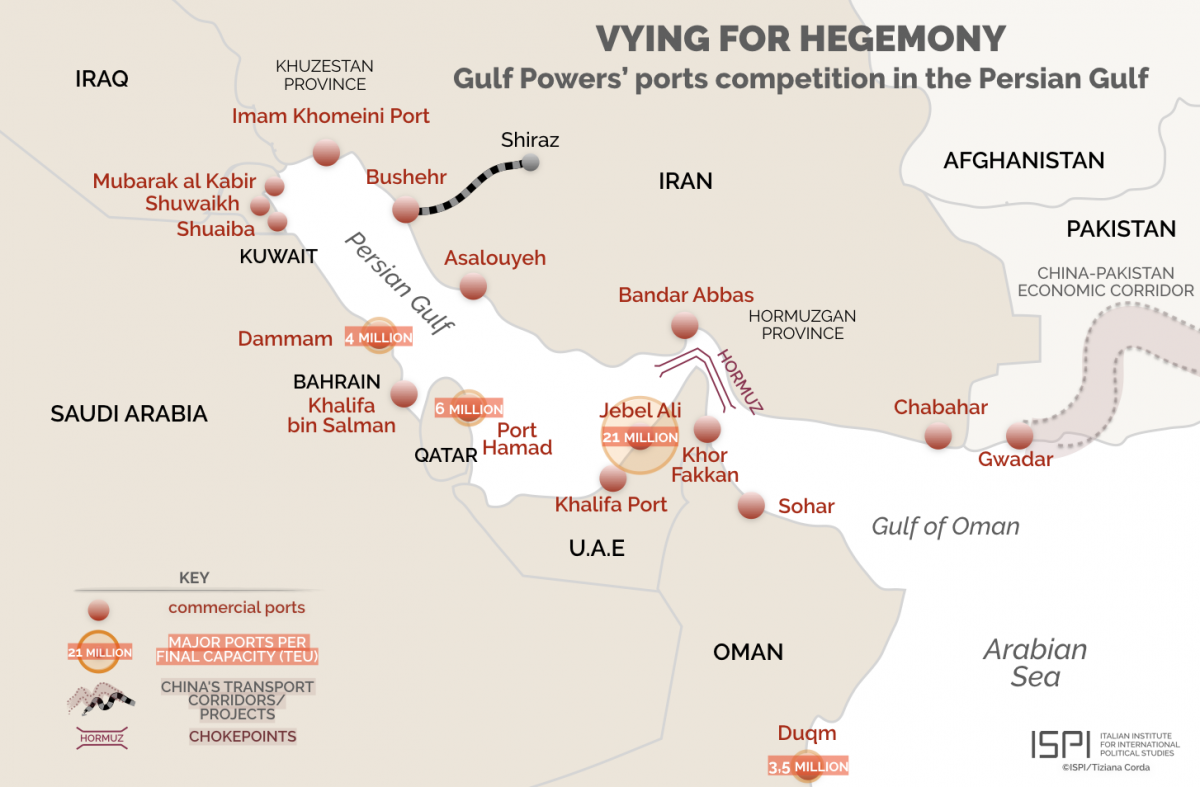
This matters because the Gulf is no longer only an energy-export region. It is becoming a strategic logistics bridge between Asia, Europe, Africa, and inland Middle Eastern markets. Ports such as Jebel Ali, Khalifa Port, Hamad Port, King Abdulaziz Port, Shuwaikh, Shuaiba, Umm Qasr, and Bandar Abbas are increasingly connected with inland logistics zones, airports, industrial cities, and future railway corridors.
The result is a new regional logistics map where seaports and inland ports work together. Cargo no longer simply arrives at a quay and leaves by truck. It moves through integrated systems of customs zones, warehouses, rail terminals, free zones, container depots, e-commerce fulfilment centres, and industrial parks.
This is why the Persian Gulf is becoming one of the most important logistics laboratories in the world.
Why the Persian Gulf is a natural logistics hub
The Persian Gulf sits close to three major trade regions: South Asia, East Asia, and Europe. It also connects directly with the Arabian Peninsula, Iran, Iraq, and the wider Middle East. This geography gives the region a powerful advantage for container shipping, energy logistics, project cargo, food imports, automotive distribution, and re-export trade.
The Gulf’s importance is strengthened by its ports, airports, road networks, free zones, and logistics cities. The UAE, Saudi Arabia, Qatar, Bahrain, Kuwait, Oman, Iraq, and Iran all depend on the region’s maritime gateways, although their infrastructure quality and political conditions vary significantly.
Recent instability around the Strait of Hormuz has also shown why logistics resilience is now essential. Reuters reported in May 2026 that eastern UAE ports such as Fujairah and Khor Fakkan had become critical trade lifelines during Gulf disruption, with Khor Fakkan’s weekly container movements reportedly rising sharply and Fujairah’s oil-export role becoming more strategic because it can bypass the Strait of Hormuz through pipeline connectivity.
This means the region’s future logistics power will depend not only on large seaports, but also on how effectively cargo can be moved inland, redirected, stored, cleared, and redistributed during disruption.
Iran’s Bandar Abbas and Chabahar: Gulf access and alternative ocean gateways
Iran’s main container gateway on the Persian Gulf side is Bandar Abbas, especially through Shahid Rajaee Port. It serves domestic Iranian trade and also has potential as a transit point toward Central Asia, Afghanistan, and the Caucasus.
Iran’s logistics geography is unique because it has access to both the Persian Gulf and the Gulf of Oman. Chabahar, located outside the Strait of Hormuz, has long been discussed as a strategic ocean-access port for trade with Afghanistan, Central Asia, and India-linked corridors.
However, Iran’s logistics potential is heavily affected by sanctions, investment constraints, banking restrictions, insurance complications, and geopolitical risk. These factors limit the ability of Iranian ports and inland corridors to fully integrate with global container networks.
Even so, from a geographic perspective, Iran remains one of the most important potential land-bridge countries in the region.
Iraq’s Umm Qasr and Al Faw: the northern Gulf’s emerging logistics question
Iraq’s main Gulf gateway is Umm Qasr, located near the northern tip of the Gulf. It is essential for Iraqi imports, including food, consumer goods, construction materials, vehicles, and industrial cargo.
However, Iraq’s long-term logistics ambition is tied to the Grand Faw Port project and the proposed Development Road corridor, which aims to connect the Gulf with Turkey and Europe through rail and road infrastructure. If fully realized, this could transform Iraq from a mainly import-dependent port user into a major transit corridor.
The opportunity is significant, but so are the challenges. Iraq needs reliable infrastructure, security, customs modernization, port efficiency, rail connectivity, and investor confidence. If these elements improve, Iraq could become one of the most important inland-corridor players in the wider Gulf region.
Jebel Ali and Dubai: the Gulf’s most mature logistics ecosystem
Jebel Ali is the strongest example of a fully integrated Gulf logistics hub. It is not only a container port; it is a port-city-logistics-free-zone ecosystem. Its power comes from the combination of Jebel Ali Port, Jebel Ali Free Zone, Dubai’s airports, regional trucking routes, customs systems, warehousing, and multinational distribution centres.
For many companies, Jebel Ali functions as a regional headquarters for the Middle East, Africa, and South Asia. Cargo can arrive by sea, be stored or processed in the free zone, then redistributed to Gulf markets, East Africa, South Asia, or Europe.
This model is attractive because it reduces friction. Importers and exporters can combine port access, customs handling, storage, light manufacturing, re-export services, and regional distribution in one place. That is why Jebel Ali remains the benchmark for other Gulf logistics hubs.
However, the current regional security environment also shows the vulnerability of relying heavily on Gulf-facing infrastructure. If Strait of Hormuz risks increase, logistics operators may need alternative corridors through Oman, the UAE’s east coast, or Saudi Arabia’s Red Sea ports.
Khalifa Port and Abu Dhabi: industrial logistics with deep-water capacity
Khalifa Port in Abu Dhabi has become one of the Gulf’s most important modern logistics platforms. Its advantage lies in the integration of deep-water port capacity with industrial zones, manufacturing clusters, aluminium production, polymers, food logistics, and regional distribution services.
Unlike traditional ports that mainly handle cargo movement, Khalifa Port is designed around industrial value creation. Cargo can be imported, processed, assembled, packaged, or redistributed through adjacent economic zones. This makes it especially important for heavy industry, project cargo, container logistics, and future clean-energy supply chains.
Abu Dhabi’s model is different from Dubai’s. Dubai is stronger as a commercial re-export and logistics-service platform, while Abu Dhabi is building a deeper industrial-port ecosystem. Together, they give the UAE one of the most diversified logistics networks in the Gulf.
Fujairah and Khor Fakkan: the strategic value of bypassing Hormuz
Fujairah and Khor Fakkan are especially important because they are located on the UAE’s eastern coast, outside the Persian Gulf and beyond the Strait of Hormuz. This gives them exceptional strategic value during regional disruption.
Fujairah is already one of the world’s most important bunkering and oil-storage hubs. Its role is strengthened by pipeline connections that allow crude oil exports to bypass Hormuz. Khor Fakkan, meanwhile, is a major container transshipment and feeder port on the Gulf of Oman.
During periods of Gulf tension, these ports become more than alternative gateways. They become resilience infrastructure. They allow cargo and energy flows to continue when Gulf-facing ports face congestion, insurance surcharges, or navigational uncertainty. Reuters recently reported that Khor Fakkan is planning a $100 million inland logistics hub in Al Dhaid to expand capacity, highlighting how east-coast UAE ports may become even more important as bypass corridors.
For logistics companies, this means Fujairah and Khor Fakkan are not just secondary ports. They are strategic pressure valves for the entire Gulf supply chain.
Saudi Arabia’s Gulf logistics network: Dammam, Riyadh and the inland corridor
On the western side of the Persian Gulf, Saudi Arabia’s King Abdulaziz Port in Dammam is the kingdom’s main Gulf-facing maritime gateway. It serves the Eastern Province, one of Saudi Arabia’s most important industrial and energy regions, and connects to Riyadh through inland logistics corridors.
The Dammam–Riyadh corridor is one of the most important inland logistics routes in the Gulf. Containers discharged at Dammam can move inland toward Riyadh dry port and distribution centres serving Saudi Arabia’s largest consumer and industrial market.
This inland connection is critical because Saudi Arabia’s logistics strategy is not only maritime. It is national and multimodal. The kingdom wants to connect Gulf ports, Red Sea ports, airports, dry ports, industrial zones, and rail systems into a single logistics platform.
Saudi Arabia has also been launching new shipping services, with King Abdulaziz Port in Dammam described as an Arabian Gulf hub with 43 equipped berths and a large handling capacity.
In the long term, Saudi Arabia’s logistics strength may depend on how well it connects Dammam, Riyadh, Jeddah, NEOM, Yanbu, and future rail corridors. If successful, the kingdom could become a land bridge between the Gulf and the Red Sea.
Riyadh dry port: why inland ports matter
Riyadh dry port is one of the clearest examples of why inland ports are essential in the Gulf region. A dry port is an inland logistics terminal connected to seaports by rail or road, where containers can be cleared, stored, inspected, and redistributed.
The value of a dry port is simple: it moves congestion away from the seaport and closer to the final market.
For Riyadh, this is especially important because the city is Saudi Arabia’s largest inland economic centre. Instead of forcing all customs and container activity to remain at coastal terminals, inland-port systems allow cargo to move more efficiently toward warehouses, factories, retail networks, and construction projects.
Dry ports also improve resilience. If coastal ports become congested, inland terminals can help manage container flows, reduce truck queues, and support more predictable supply chains.
Qatar’s Hamad Port and logistics zones: building self-reliance after disruption
Qatar’s Hamad Port has become a major Gulf logistics asset. It was developed to reduce dependency on neighbouring transit routes and strengthen Qatar’s direct maritime connectivity. The port now supports containers, vehicles, livestock, project cargo, food imports, and industrial supply chains.
Its strategic value became clearer after the 2017 Gulf diplomatic crisis, when Qatar had to rapidly adjust supply chains and build stronger direct shipping links. Since then, Hamad Port has become central to Qatar’s food security, construction logistics, industrial imports, and LNG-related supply chain ecosystem.
Qatar’s inland logistics model depends on the connection between Hamad Port, free zones, industrial areas, warehouses, and Hamad International Airport. This creates a compact but high-value logistics network.
For a small country, Qatar has built a surprisingly resilient system because its port, airport, and logistics zones are closely integrated.
Bahrain: a small island hub with regional distribution potential
Bahrain’s logistics role is different from the UAE, Saudi Arabia, or Qatar. It is smaller in scale, but it has advantages in customs efficiency, regional connectivity, and proximity to Saudi Arabia through the King Fahd Causeway.
Khalifa Bin Salman Port supports container cargo, general cargo, and regional distribution. Bahrain’s logistics strategy relies heavily on integration with road links to Saudi Arabia and its role as a service-oriented business platform.
Because Bahrain is close to Saudi Arabia’s Eastern Province, it can support niche logistics, manufacturing, e-commerce distribution, and bonded cargo movement into the Saudi market. This gives Bahrain a useful role in regional supply chains, even if it cannot compete with Jebel Ali or Dammam in scale.
The World Bank’s Logistics Performance Index is also relevant here because logistics competitiveness is not only about port size. It also depends on customs, tracking, timeliness, infrastructure, and service quality. The World Bank describes its LPI 2.0 as a benchmarking tool for identifying logistics challenges and opportunities, with the latest dataset covering 2023–2024.
Kuwait: Shuwaikh, Shuaiba and the need for stronger inland integration
Kuwait’s logistics system depends mainly on Shuwaikh Port, Shuaiba Port, and industrial areas connected to Kuwait City and the wider national road network. Kuwait has a strategic location at the northern end of the Gulf, but its logistics competitiveness is constrained by port capacity, congestion, and the need for stronger inland connectivity.
Kuwait’s future logistics potential is linked to the development of more efficient customs systems, warehousing zones, and possible integration with regional rail and road corridors. Its location could support trade with Iraq, Saudi Arabia, and Iran, but this requires coordinated infrastructure and regulatory modernization.
If Kuwait improves its inland logistics and border systems, it could become more important as a northern Gulf distribution node. Without such integration, cargo may continue to prefer larger and more efficient hubs in the UAE, Saudi Arabia, or Qatar.
Oman: Sohar, Duqm and Salalah as alternative Gulf gateways
Although Oman is not located inside the Persian Gulf in the same way as Bahrain, Qatar, Kuwait, or the UAE’s Gulf coast, it is central to Gulf logistics resilience. Sohar, Duqm, and Salalah provide access to the Gulf of Oman and Arabian Sea, allowing cargo to bypass the Strait of Hormuz.
This is becoming increasingly important during periods of regional tension. In 2026, logistics updates described Oman as a major non-Hormuz maritime workaround, with Sohar and Salalah reportedly operational and bonded trucking active into GCC markets.
Sohar is especially important for cargo moving into the UAE and wider Gulf markets. Duqm has long-term industrial and strategic potential, while Salalah is a major transshipment port on the Arabian Sea.
Oman’s key advantage is geography. Its ports can serve Gulf markets without requiring ships to enter the Persian Gulf. That makes Oman a critical resilience partner for regional supply chains.
–
Inland ports and dry ports: the missing link in Gulf logistics
The next stage of Gulf logistics growth will not be decided only by who has the biggest port cranes or deepest berths. It will be decided by who has the best inland connectivity.
Inland ports and dry ports reduce pressure on seaports by allowing customs clearance, container storage, inspection, consolidation, and distribution to happen closer to inland markets. They also support rail freight, bonded trucking, e-commerce fulfilment, cold-chain logistics, and industrial clustering.
This is especially important in the Gulf because many major consumer and industrial centres are not located directly at seaports. Riyadh, Al Ain, Al Dhaid, inland Saudi industrial cities, Iraqi urban centres, and Iranian inland markets all require efficient hinterland logistics.
The strongest future hubs will be those that connect seaports with inland terminals, airports, warehouses, and industrial zones through digital customs systems and reliable corridors.
The role of free zones and special economic zones
Free zones are one of the Gulf’s biggest logistics advantages. They allow companies to store, process, assemble, package, and re-export goods with simplified customs and tax arrangements.
Jebel Ali Free Zone is the most famous example, but similar models are expanding across Abu Dhabi, Qatar, Saudi Arabia, Bahrain, Oman, and Kuwait. These zones help transform ports from simple cargo gateways into value-added logistics platforms.
This is important because future logistics competition will not be only about moving containers. It will be about capturing value from the cargo before it moves onward.
That means packaging, labelling, light manufacturing, repair, assembly, food processing, pharmaceutical storage, automotive preparation, and e-commerce fulfilment will become increasingly important.
Rail and land bridges: the future of Gulf logistics
Rail connectivity is one of the most important unfinished pieces of the Gulf logistics puzzle. The planned GCC railway network, Saudi rail development, Iraq’s Development Road, and possible Gulf-to-Red-Sea corridors could reshape regional trade flows.
If rail systems are completed and properly integrated with ports and inland terminals, they could reduce truck congestion, lower emissions, improve reliability, and create new transit routes across the Arabian Peninsula.
Saudi Arabia is especially important here. Its ability to connect Gulf ports with Red Sea ports could provide a strategic alternative during Hormuz-related disruptions. Recent reporting has highlighted Saudi efforts to promote Red Sea infrastructure, including NEOM port and Jeddah, as part of a broader shift to reduce dependence on vulnerable Gulf routes.
The future Gulf logistics map may therefore become more balanced between Persian Gulf gateways, Oman’s ocean-facing ports, and Saudi Arabia’s Red Sea corridors.
The biggest risks facing Persian Gulf logistics hubs
The Persian Gulf’s logistics opportunity is enormous, but the risks are equally serious.
The first risk is geopolitical disruption. Any instability around the Strait of Hormuz can increase insurance costs, delay ships, disrupt schedules, and force cargo toward alternative corridors.
The second risk is overcapacity. Several Gulf countries are building ports, logistics zones, and free zones at the same time. Without coordination and specialization, some facilities may struggle to attract enough cargo.
The third risk is weak hinterland integration. A modern seaport loses competitiveness if trucks are delayed, customs systems are slow, rail is unavailable, or inland terminals are underdeveloped.
The fourth risk is climate pressure. Extreme heat, sea-level rise, dust storms, and energy-demand peaks can affect logistics operations, worker safety, cold chains, and port resilience.
The fifth risk is digital fragmentation. Gulf logistics hubs need interoperable digital systems, port community platforms, customs integration, cargo tracking, and cybersecurity protection.
The most important Gulf logistics hubs to watch
Jebel Ali remains the region’s most mature logistics ecosystem because it combines port capacity, free-zone depth, business services, warehousing, and global connectivity.
Khalifa Port is important because it links deep-water port operations with industrial zones and Abu Dhabi’s manufacturing ambitions.
Fujairah and Khor Fakkan are becoming more strategic because they provide UAE access outside the Strait of Hormuz.
Dammam and Riyadh are critical because they connect Saudi Arabia’s Gulf coast with its largest inland market.
Hamad Port is important because it gives Qatar direct maritime resilience and supports national food, industrial, and project logistics.
Sohar, Duqm, and Salalah matter because they offer alternative access outside the Persian Gulf.
Umm Qasr and Grand Faw are important because Iraq could become a major future north-south transit corridor.
Bandar Abbas and Chabahar are strategically important because of Iran’s potential links to Central Asia, Afghanistan, and the wider Eurasian corridor.
Final thoughts
The Persian Gulf is no longer only a maritime energy corridor. It is becoming a competitive logistics region where ports, inland terminals, dry ports, free zones, airports, railways, and trucking corridors are being connected into larger supply-chain ecosystems.
The winners will not simply be the countries with the biggest ports. They will be the countries that can offer reliable multimodal connectivity, fast customs clearance, resilient alternative corridors, strong digital systems, and value-added logistics services.
In normal times, these hubs improve trade efficiency. In crisis periods, they become strategic lifelines.
That is why logistics hubs and inland ports around the Persian Gulf are now central to the future of regional trade, energy security, food security, and global supply-chain resilience.
FAQ: Logistics Hubs and Inland Ports Around the Persian Gulf
What is the most important logistics hub in the Persian Gulf region?
Jebel Ali in Dubai is generally the most mature logistics hub in the region because it combines a major container port, free zone, warehousing, re-export services, customs systems, and strong regional distribution links.
What is an inland port or dry port?
An inland port, also called a dry port, is an inland logistics terminal connected to seaports by road or rail. It allows containers to be stored, cleared, inspected, and redistributed away from congested coastal terminals.
Why are inland ports important in the Gulf?
They reduce seaport congestion, move cargo closer to inland markets, improve customs efficiency, and support large consumer and industrial centres such as Riyadh and other inland logistics zones.
Which Gulf ports can bypass the Strait of Hormuz?
Fujairah and Khor Fakkan in the UAE, along with Sohar, Duqm, and Salalah in Oman, are especially important because they provide access outside or near the entrance of the Strait of Hormuz.
Why is Saudi Arabia important for Gulf logistics?
Saudi Arabia has both Gulf and Red Sea access. Its Dammam–Riyadh corridor and potential Gulf-to-Red-Sea land bridge could make it one of the most important multimodal logistics platforms in the region.
What role does Qatar’s Hamad Port play?
Hamad Port is Qatar’s main maritime gateway. It supports national import security, food logistics, construction cargo, industrial supply chains, and direct shipping connectivity.
Which port is most important for Iraq?
Umm Qasr is currently Iraq’s main Gulf port, while the Grand Faw Port project could become strategically important if connected with future rail and road corridors toward Turkey and Europe.
Which Iranian ports matter most for regional logistics?
Bandar Abbas is Iran’s main Persian Gulf container gateway, while Chabahar is strategically important because it provides access outside the Strait of Hormuz and could support trade with Afghanistan, Central Asia, and India-linked corridors.
Why are free zones important for Gulf logistics?
Free zones allow companies to store, process, assemble, package, and re-export goods more efficiently. They help transform ports into value-added logistics ecosystems rather than simple cargo-handling points.
What is the biggest challenge for Persian Gulf logistics hubs?
The biggest challenge is resilience. Gulf logistics hubs must manage geopolitical risk, Strait of Hormuz disruption, customs efficiency, inland connectivity, climate pressure, and digital security at the same time.