
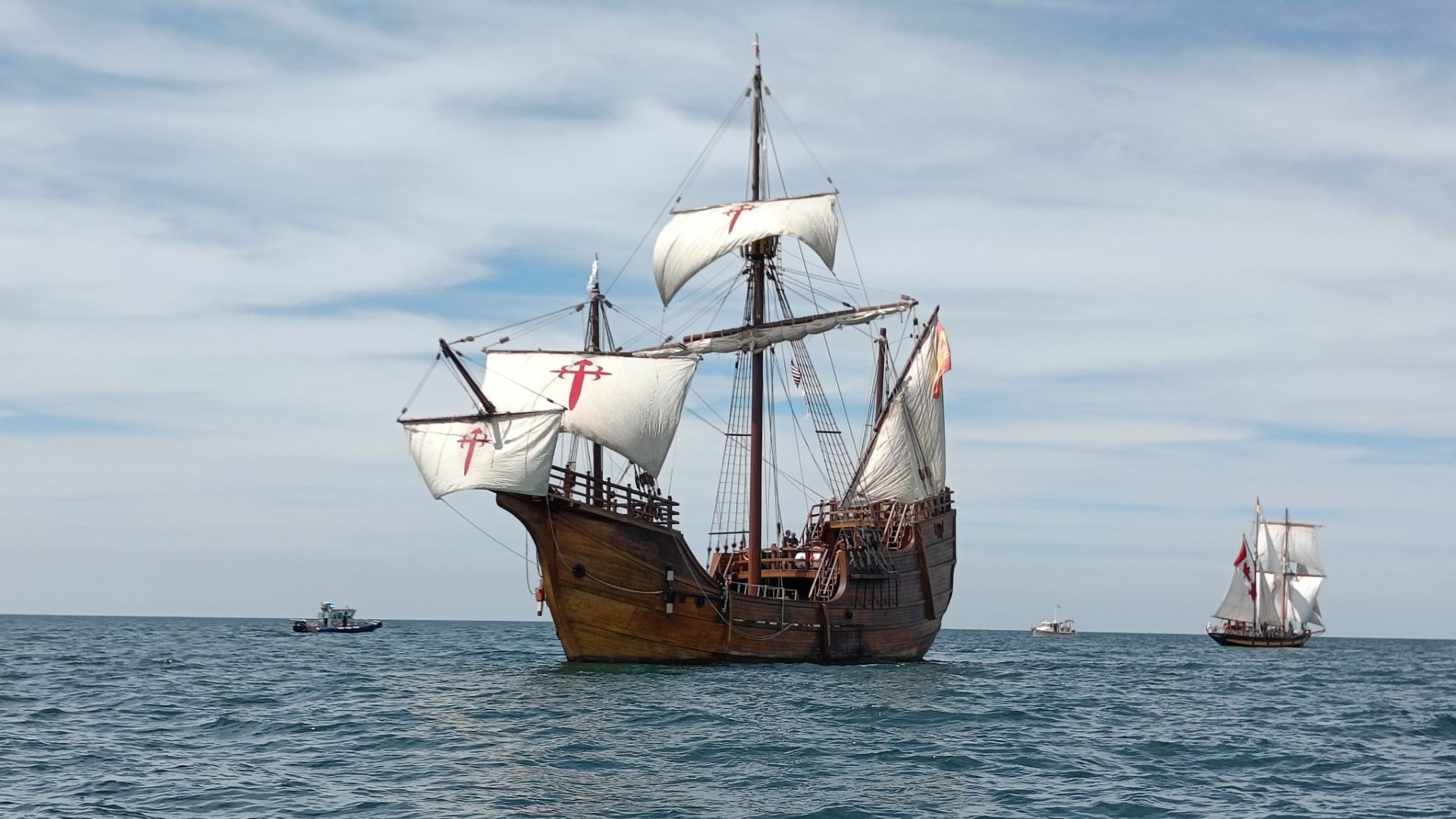
Explore the story of the Santa María, Christopher Columbus’s famous flagship of 1492, her role in Atlantic exploration, her loss near Hispaniola, and her lasting maritime legacy.
The Small Ship Behind a World-Changing Voyage
Few ships in maritime history are as famous as the Santa María. Her name is known across continents, often remembered together with the Niña and the Pinta, the three vessels linked to Christopher Columbus’s first Atlantic voyage in 1492. Yet the Santa María was not a giant ocean liner, a powerful battleship, or a technically advanced modern vessel. She was a relatively small wooden sailing ship crossing one of the most uncertain maritime frontiers of her age.
Her fame comes from the role she played in a voyage that changed world history. In 1492, Columbus sailed west across the Atlantic under the Spanish Crown, seeking a route to Asia. Instead, his expedition reached the Caribbean, opening the way for sustained European contact, colonisation, forced labour, disease transfer, trade, conquest, and cultural transformation across the Atlantic world. Britannica notes that Columbus’s voyages paved the way for European colonisation and exploitation of the Americas, while also clarifying that calling him the “discoverer” of America is not strictly accurate because Indigenous peoples already lived there and earlier Norse voyages had reached North America.
The Santa María was the flagship of that first voyage. She carried Columbus himself and became the symbolic centre of the expedition. But unlike the Niña and the Pinta, she did not return to Spain. On Christmas Day 1492, she ran aground off Hispaniola and was lost. Britannica describes the Santa María as Columbus’s flagship, about 117 feet, or 36 metres, long, with three masts, a deck, a forecastle, and a sterncastle; it also records that she ran aground off Haiti on 25 December 1492 and was lost.
This article tells the story of the Santa María as a maritime object, a navigational platform, a symbol of European expansion, and a ship whose loss marked the beginning of a much larger Atlantic story. It is a story of seamanship, ambition, uncertainty, and consequences.
1. Why the Santa María Still Matters
The Santa María matters because she sits at the crossing point between maritime history and world history. She was not famous because of her size or technical excellence. She became famous because of where she went, what she represented, and what followed after her voyage.
For maritime readers, the Santa María is important for several reasons. First, she shows the limits and capabilities of late fifteenth-century ocean sailing. Second, she helps us understand how small ships could support long-distance exploration before modern navigation, engines, satellite positioning, radio, weather routing, or steel hulls. Third, she reminds us that ships are never only machines. They are also instruments of politics, commerce, exploration, migration, conflict, and cultural contact.
The Santa María also matters because her story is often simplified. Many people learn only a short schoolbook version: Columbus sailed with three ships, reached America, and became famous. But the real story is more complex. The Santa María was not a magical heroic vessel. She was a practical working ship operating in a world of uncertain charts, limited knowledge, religious politics, commercial ambition, and expanding imperial competition.
In modern maritime education, the Santa María can be studied as a case of voyage planning, ship design, leadership, navigation risk, human endurance, and historical consequence. Her voyage reminds us that maritime exploration was never just about ships moving across water. It was also about the movement of power, disease, language, religion, goods, people, and violence.
Why Santa María Is Famous
| Reason | Explanation |
|---|---|
| Columbus’s flagship | She carried Columbus during the first 1492 Atlantic voyage |
| Largest of the fleet | She was larger than the Niña and Pinta |
| Historic crossing | She helped complete the westward Atlantic crossing to the Caribbean |
| Lost near Hispaniola | She ran aground on 25 December 1492 and did not return |
| Material legacy | Her timbers were reportedly used for La Navidad |
| Symbolic legacy | She became a global symbol of exploration and colonisation |
| Archaeological mystery | Her confirmed remains have not been securely identified |
2. The World Before the Voyage: Why Sail West?
To understand the Santa María, we must understand the world that sent her to sea.
By the late fifteenth century, European powers wanted better access to Asian goods such as spices, silk, precious metals, and luxury products. Overland routes were long, expensive, and politically complicated. Portugal had already invested heavily in maritime exploration around Africa, seeking a sea route to Asia. Spain, recently strengthened by the completion of the Reconquista in 1492, was also ready to support ambitious expansion.
Columbus believed that sailing west across the Atlantic could reach Asia. His geographical assumptions were wrong, especially regarding the size of the Earth and the width of the ocean between Europe and Asia. However, his proposal eventually gained support from the Spanish monarchs, Ferdinand and Isabella.
The expedition that followed was modest in physical scale but enormous in consequence. It did not include a large fleet. It did not sail with massive warships. It crossed the Atlantic with three relatively small vessels: the Santa María, the Niña, and the Pinta. The Santa María was the largest and served as Columbus’s flagship. National Geographic Education notes that Juan de la Cosa was the owner of the Santa María and that it was the largest ship in Columbus’s small fleet.
This detail is important. The first voyage was not a huge military invasion fleet. It was a risky maritime venture using the available ship technology of its time. The Santa María’s story begins not as a legend, but as a practical voyage into uncertainty.
3. What Kind of Ship Was the Santa María?
The Santa María is often described together with the Niña and the Pinta as one of “Columbus’s three ships.” In popular culture, all three are sometimes loosely called caravels. However, many historians identify the Santa María as a carrack, not a caravel. This distinction matters.
A caravel was generally smaller, faster, and more manoeuvrable, often used by Iberian sailors for exploration. A carrack, by contrast, was usually larger, broader, and more suitable for carrying cargo and operating as a command vessel. The Santa María’s size and structure made her suitable as the flagship, but possibly less agile than the smaller Niña and Pinta.
Britannica describes the Santa María as having three masts, a deck, forecastle and sterncastle, and being armed with bombards that fired granite balls. These features suggest a ship designed not merely for speed, but for command presence, storage, defence, and extended operation.
Table 1: Santa María at a Glance
| Feature | Description |
|---|---|
| Name | Santa María |
| Associated voyage | Columbus’s first Atlantic voyage, 1492 |
| Role | Flagship |
| Approximate length | About 117 feet / 36 metres |
| Type commonly identified | Carrack / nao, not a simple caravel |
| Rig | Three-masted sailing vessel |
| Owner | Juan de la Cosa |
| Fate | Ran aground near Hispaniola on 25 December 1492 |
| Legacy | Symbol of Atlantic exploration and early European contact with the Caribbean |
The Santa María was not large by modern standards. A modern container ship, cruise ship, tanker, or LNG carrier would dwarf her completely. Even compared with later sailing ships of empire, she was modest. But in 1492, such a vessel could carry enough people, supplies, equipment, and authority to support a transoceanic expedition.
Her small scale is part of the drama. A ship only about 36 metres long became connected to one of the most consequential voyages in recorded history.
4. The Name and Identity of the Ship
The Santa María’s full historical identity is not as simple as the name suggests. The vessel is commonly known as Santa María, but historical sources indicate that ships of that period often carried formal religious names and practical nicknames. Britannica notes in a separate discussion of Columbus’s ships that at least some familiar names were likely nicknames; for example, Niña was likely a nickname for a ship called Santa Clara.
The Santa María is often associated with the fuller name Santa María de la Inmaculada Concepción, and some traditions identify her earlier name as La Gallega, meaning “the Galician.” The exact details remain debated because documentation from the period is incomplete and later reconstructions sometimes differ.
This uncertainty is useful for maritime historians. Unlike modern ships, which have registration numbers, classification documents, AIS data, photographs, shipyard records, flag-state certificates, and digital tracking, fifteenth-century vessels often survive through logs, chronicles, legal documents, later copies, and interpretations. The Santa María is famous, but many of her physical details remain uncertain.
That uncertainty has shaped her modern image. Replicas, paintings, museum models, and school illustrations often present her with confidence, but they are partly interpretive. National Geographic has noted that the remains of Columbus’s first fleet have remained elusive despite decades of searching by archaeologists and shipwreck hunters.
In other words, we know the Santa María’s historical importance far better than we know her exact physical form.
5. The Crew: Experienced Seafarers, Not a Simple Legend
The Santa María did not sail by magic or by Columbus alone. She depended on sailors, pilots, ship handlers, carpenters, cooks, officers, and working seamen. The voyage required practical maritime skill: sail handling, steering, maintenance, provisioning, watchkeeping, navigation, and emergency repair.
Popular history sometimes suggests that Columbus’s crew consisted mainly of criminals or desperate men. This is an oversimplification. The crews included experienced seafarers from Iberian maritime communities. They were people familiar with coastal navigation, Atlantic weather, shipboard discipline, and the physical labour of sailing.
The Santa María’s owner and master, Juan de la Cosa, was an important maritime figure. National Geographic Education identifies him as the owner of the Santa María and links him to early mapping of the Atlantic world. The expedition also included the Pinzón brothers, especially associated with the Pinta and Niña, whose local maritime knowledge and leadership were important to the voyage.
A wooden sailing ship in the fifteenth century was a demanding workplace. Crew members had to manage sails in changing winds, repair rigging, pump water, handle anchors, maintain discipline, and survive in cramped conditions. There were no engines, no electric lights, no refrigeration, no GPS, no radio, no modern weather forecast, and no emergency helicopter rescue.
The Santa María was therefore not only Columbus’s flagship. She was also a floating workplace where survival depended on collective seamanship.
6. Departure from Spain: A Small Fleet Leaves Palos
Columbus’s expedition departed from Palos de la Frontera in August 1492. The three ships sailed first through familiar waters before entering the wider Atlantic. For the crew, this was not simply a voyage of discovery. It was also a test of endurance and trust.
Crossing the Atlantic westward required faith in calculations that many considered uncertain. Sailors were accustomed to coastal reference points, islands, known winds, and traditional routes. Sailing deeper into the open ocean meant psychological pressure as well as navigational risk. The farther the fleet moved west, the more the crew had to wonder whether return would remain possible.
The Santa María, as flagship, carried Columbus’s authority. Her position in the small fleet made her the central point for decision-making. But the voyage still depended on coordination among all three vessels. The smaller ships were not decorative companions. The Niña and Pinta were essential to communication, scouting, flexibility, and eventual survival.
This became especially clear later, because the Santa María did not complete the return voyage. Columbus returned to Spain on the Niña after the flagship was lost. Britannica records that after the Santa María ran aground and was lost, the Niña and Pinta returned safely to Spain despite dangerous storms.
The voyage began with three ships. It ended with the flagship gone.
7. Life On Board the Santa María
Life aboard the Santa María would have been hard, crowded, and uncomfortable by modern standards. Space was limited. Fresh food deteriorated. Water had to be stored. Privacy was almost nonexistent. Hygiene was basic. Crew members worked in watches, exposed to weather, salt spray, damp clothing, fatigue, and uncertainty.
The ship carried supplies for a long voyage, including food, water, tools, spare materials, trade goods, weapons, and navigational equipment. Every item mattered because there were no resupply ports in the middle of the Atlantic. Storage and rationing were essential.
Aboard such a ship, the distinction between vessel and community was very narrow. The ship was shelter, workplace, transport, storage, command centre, and survival system. A broken mast, damaged rudder, failed pump, lost anchor, spoiled food supply, or serious illness could threaten the entire expedition.
This reality is important because modern readers often imagine historic voyages only through heroic paintings. In practice, ocean crossing in the fifteenth century required physical endurance and constant maintenance. The Santa María was a wooden structure alive with movement: creaking timbers, wet decks, working ropes, shifting cargo, cooking smoke, shouted orders, religious prayers, fear, hope, and fatigue.
For maritime students, this is a useful reminder that every ship is also a human environment. Technology changes, but the human experience of risk at sea remains central.
8. Navigation Without Modern Instruments
The Santa María crossed the Atlantic without modern navigation systems. There was no electronic chart display, no radar, no satellite positioning, no AIS, and no radio communication. Navigation depended on experience, dead reckoning, celestial observation, compass use, speed estimation, wind knowledge, and judgement.
Dead reckoning required estimating course and distance travelled over time. Small errors could accumulate. Ocean currents, leeway, steering inaccuracies, magnetic variation, and weather changes could all affect the result. Celestial navigation was possible, but instruments and methods were far less precise than modern systems.
Columbus’s voyage also involved deliberate information management. Historical accounts often discuss his handling of distance estimates and crew morale. Whether interpreted as leadership, manipulation, or practical command behaviour, it shows the psychological difficulty of sailing into unknown waters.
The Santa María therefore represents an earlier age of navigation when courage and calculation were closely linked. Sailors had to work with incomplete information and accept uncertainty as part of the voyage.
Modern maritime professionals can still learn from this. Technology has improved enormously, but navigational safety still depends on human judgement. GPS can fail. Sensors can be misread. Electronic charts can be used incorrectly. Bridge teams can become overconfident. The Santa María reminds us that navigation has always required discipline, cross-checking, and respect for uncertainty.
9. Landfall in the Caribbean: A Moment of Global Consequence
In October 1492, the expedition reached land in the Caribbean. The event has often been presented in European history as “discovery,” but that word is deeply problematic. The islands were already inhabited by Indigenous peoples with their own societies, languages, cultures, and histories. Britannica explicitly notes that describing Columbus as the discoverer of America is not strictly true.
The landing began a new and often violent phase of Atlantic history. European contact brought exchange, but also conquest, enslavement, disease, demographic collapse, and cultural disruption for Indigenous communities. National Geographic Education states that Columbus took several Lucayans as slaves and that subsequent colonisers continued the practice; it also notes the devastating impact of enslavement, murder, and disease on the Lucayan people.
For this reason, a professional article about the Santa María should avoid romantic simplification. The ship’s voyage was historically important, but not innocent. It opened maritime routes that connected continents more permanently, but those routes carried both opportunity and suffering.
From a maritime perspective, the Santa María helped transform the Atlantic from a barrier into a corridor. From a human perspective, that corridor brought unequal consequences.
10. The Loss of the Santa María
The Santa María’s own voyage ended dramatically. On 25 December 1492, while off the coast of Hispaniola, she ran aground and was lost. Britannica records that the Santa María ran aground off Haiti on 25 December 1492 and did not return to Spain.
The loss of a flagship was a serious event. It reduced the fleet’s capacity, created logistical problems, and forced decisions about men, materials, and return planning. The ship was reportedly dismantled, and her timbers were used to help build a small settlement known as La Navidad. This marked one of the earliest European footholds in the Caribbean after the voyage.
The loss also carries a maritime lesson. Exploration vessels often face their greatest danger not only in open-ocean crossing but also near land. Coastal navigation, reefs, shoals, unfamiliar waters, night conditions, fatigue, and anchoring errors can create serious hazards. Even today, many maritime casualties occur near coasts, ports, anchorages, straits, and restricted waters.
The Santa María survived the Atlantic crossing but was lost near the destination area. This is not unusual in maritime history. Landfall can be as dangerous as open sea if charts are poor and local conditions are unknown.
Table 2: Maritime Lessons from the Loss of the Santa María
| Risk Factor | Relevance to Santa María | Modern Maritime Lesson |
|---|---|---|
| Unfamiliar waters | The Caribbean coast was not charted for Europeans | Local knowledge and accurate charts are vital |
| Night or low-awareness conditions | Grounding occurred during the expedition’s stay near Hispaniola | Watchkeeping remains essential at anchor and near shore |
| Coastal hazards | Reefs, shoals, and currents can threaten sailing vessels | Coastal navigation requires high attention |
| Fleet dependency | Loss of flagship changed expedition logistics | Redundancy and contingency planning matter |
| Salvage and reuse | Timber was reportedly used for settlement construction | Ships were valuable material resources |
The Santa María’s grounding shows that maritime history is not only about great ocean crossings. It is also about the practical dangers of ship handling close to land.
11. La Navidad: From Shipwreck to Settlement
After the Santa María was lost, her timbers were used to establish La Navidad on Hispaniola. The name, meaning “Christmas,” reflected the date of the shipwreck. This settlement became symbolically important because it represented an early European attempt to maintain a presence in the Caribbean after Columbus’s first voyage.
However, La Navidad did not become a stable success. When Columbus returned on his second voyage, the settlement had been destroyed and the men left there were dead. The episode illustrates the instability, violence, misunderstanding, and tension that followed early contact.
For the Santa María, La Navidad is part of her afterlife. The ship did not simply sink and disappear. Her material structure was transformed into a shore installation. In a very literal sense, the flagship became architecture. Her wood moved from hull to fort, from vessel to settlement.
This is a powerful image. A ship designed to cross oceans became part of the first fragile European occupation structure in the Caribbean. The transformation of the Santa María’s timber symbolises the wider transformation that followed: maritime arrival turned into territorial ambition.
12. Why the Wreck Has Been So Difficult to Find
One of the most interesting modern questions is: where is the Santa María today?
The answer is uncertain. National Geographic reported that the remains of the Niña, Pinta, and Santa María have proved elusive despite decades of searching, partly because of the difficulty of identifying small wooden vessels from more than five centuries ago.
Several factors make the search difficult. First, the ship was made of wood, much of which may have been removed and reused after the grounding. Second, the exact location is uncertain. Third, the seabed and coastline may have changed over time. Fourth, the Caribbean has many wrecks from different periods, making identification difficult. Fifth, archaeological confirmation requires strong evidence, not only a tempting location.
Claims of discovery have appeared over the years, but the identification of Columbus’s flagship remains disputed. National Geographic’s broader discussion highlights why finding the first fleet is so difficult and why archaeological caution is necessary.
For maritime archaeology, the Santa María is both a dream and a warning. Famous shipwrecks attract attention, but responsible archaeology must separate evidence from publicity. A cannon, anchor, timber, or ballast pile is not enough by itself unless it can be securely connected to the right vessel, period, and context.
13. Santa María Compared with Niña and Pinta
The Santa María is the most famous of the three ships in terms of status because she was the flagship. But the Niña and Pinta were equally important to the success of the voyage. In fact, they survived the first voyage and returned to Spain, while the Santa María did not.
The Pinta is often remembered as the ship from which land was first sighted. The Niña became especially important after the Santa María was lost because Columbus returned on the Niña. Britannica notes that the Niña and Pinta were less than half the Santa María’s size but returned safely to Spain despite near catastrophe in storms.
Table 3: The Three Ships of Columbus’s First Voyage
| Ship | Role | Key Point |
|---|---|---|
| Santa María | Flagship | Largest vessel; carried Columbus; lost near Hispaniola |
| Niña | Smaller vessel | Returned Columbus to Spain after Santa María was lost |
| Pinta | Smaller vessel | Associated with the first sighting of land |
| Fleet as a whole | Atlantic expedition | Reached the Caribbean in 1492 and changed Atlantic history |
This comparison also helps explain why “flagship” does not always mean “best survivor.” The Santa María may have been larger and more commanding, but the smaller vessels were more manoeuvrable and ultimately completed the return.
In maritime operations, vessel suitability depends on mission, environment, and handling characteristics. Bigger is not always safer. Larger vessels can carry more, but smaller vessels may be easier to manage in certain waters. The Santa María’s fate illustrates this balance.
14. The Santa María in Maritime Technology
The Santa María belonged to a world of wooden hulls, sail power, manual labour, and empirical seamanship. Her technology was limited by modern standards, but highly functional for her age.
Important features included:
- A wooden hull built for ocean sailing
- Three masts supporting a combination of sails
- Raised forecastle and sterncastle structures
- Storage capacity for provisions and equipment
- Basic defensive armament
- Manual steering and sail handling
- Navigation by compass, dead reckoning, and celestial methods
Britannica notes her three masts, deck, forecastle, sterncastle, and bombards. These features place her within the practical ship design tradition of Iberian Atlantic sailing.
The Santa María was not an experimental machine in the modern sense. She was part of a shipbuilding tradition that had evolved through fishing, trade, coastal sailing, and Atlantic exploration. Her voyage demonstrates how existing maritime technology can become historically transformative when used in a new geographical and political context.
This is a recurring theme in maritime history. Ships often become famous not because they are the most advanced of their time, but because they are present at turning points: a battle, discovery, disaster, migration, or technological transition.
15. The Santa María and the Columbian Exchange
The Santa María is linked to the beginning of what historians call the Columbian Exchange: the movement of plants, animals, people, diseases, technologies, and ideas between the Eastern and Western Hemispheres after 1492.
Ships made this exchange possible. Without maritime routes, there could be no continuous transatlantic exchange. The Santa María’s voyage helped open these sea routes, though the consequences were deeply unequal.
Foods such as maize, potatoes, tomatoes, cacao, and tobacco eventually travelled from the Americas to other parts of the world. Horses, cattle, wheat, sugarcane, and other crops and animals moved from Europe, Africa, and Asia to the Americas. Diseases introduced from Europe devastated Indigenous populations that had no immunity. Enslaved Africans were later forcibly transported across the Atlantic in enormous numbers as European colonial economies expanded.
The Santa María did not carry all of this future in her hold, but her voyage helped begin the maritime system through which it unfolded. That is why her historical significance is far larger than her physical size.
For a maritime website, this is an important point: ships are infrastructure of history. They do not simply move cargo. They reshape economies, societies, environments, and lives.
16. A Balanced View of Columbus and the Santa María
Writing about the Santa María requires balance. On one hand, she is an important ship in exploration history. On the other hand, the voyage she led was followed by colonisation, violence, enslavement, and demographic catastrophe for Indigenous peoples.
A professional article should avoid both extreme romanticisation and simple dismissal. The Santa María can be studied as a remarkable maritime vessel of her era while also recognising the painful consequences of the historical process she helped initiate.
This balanced approach is especially important for global readers. In Europe, the voyage is often framed through exploration and navigation. In the Americas and the Caribbean, it is also remembered through colonisation, Indigenous loss, and cultural survival. In maritime history, both dimensions must be included.
The Santa María was a ship. But she was also a tool of expansion. She carried sailors and supplies, but she also carried assumptions about possession, religion, trade, and empire. Her story is therefore not only technical. It is ethical and historical.
17. The Santa María in Education and Popular Memory
The Santa María has appeared in schoolbooks, paintings, replicas, stamps, museum exhibitions, public monuments, and films. She has become one of the most recognisable ship names in the world.
But popular memory often turns her into a simple icon. Children may remember the rhyme of “Niña, Pinta, and Santa María,” but not the difference between a caravel and a carrack. They may remember Columbus’s name, but not Juan de la Cosa, the crew, the Indigenous peoples encountered, or the later consequences of colonisation.
This is why the Santa María is useful for education. She allows teachers and writers to connect several topics:
- Ship design and early Atlantic navigation
- European maritime expansion
- Risk and uncertainty in ocean voyages
- Indigenous Caribbean history
- The beginning of sustained transatlantic contact
- Maritime archaeology and shipwreck identification
- Historical memory and public myth
The Santa María is therefore not just one article topic. She can support lessons in maritime history, navigation, colonial history, shipbuilding, ethics, and globalisation.
18. The Flagship That Did Not Come Home
There is a strong narrative irony in the Santa María’s story. She was the flagship, the largest vessel, and the ship associated most directly with Columbus. Yet she did not return to Spain.
This makes her different from many famous ships. Titanic became famous because she sank. HMS Victory became famous because she survived as a symbol of naval victory. Cutty Sark became famous as a preserved clipper. Santa María became famous because she led a voyage but disappeared from the return story.
Her loss also shaped what happened next. Some men were left behind at La Navidad. Columbus returned with two ships. Reports of the voyage reached Spain. Further expeditions followed. The Santa María herself was gone, but the maritime route she helped open became permanent.
In this sense, the Santa María’s physical life ended in 1492, but her historical life continued. Her name became larger after her loss.
19. Key Maritime Lessons from the Santa María
The Santa María offers several lessons for maritime professionals and students.
1. Small ships can have large historical impact
A ship does not need to be enormous to change maritime history. The Santa María was small by modern standards but globally significant.
2. Voyage planning depends on assumptions
Columbus’s voyage was based on mistaken geographical assumptions, yet it succeeded in reaching land. Navigation requires both calculation and humility.
3. Coastal navigation can be extremely dangerous
The Santa María crossed the Atlantic but was lost near land. This remains a timeless maritime lesson.
4. The flagship is not always the safest vessel
The largest or most prestigious vessel may not be the most manoeuvrable or survivable in every situation.
5. Maritime exploration has human consequences
Ships connect worlds, but those connections can produce exploitation and suffering as well as exchange and discovery.
6. Historical ships require careful interpretation
Many details of the Santa María remain uncertain. Responsible maritime history must distinguish evidence from legend.
7. Ships are instruments of power
The Santa María was a vessel of exploration, but also part of the wider history of empire and colonisation.
Figure 1. Santa María’s Historical Journey: From Flagship to Maritime Symbol
↓
Small Fleet Departs: Santa María, Niña, Pinta
↓
Atlantic Crossing Under Uncertainty
↓
Caribbean Landfall
↓
Contact with Indigenous Peoples
↓
Santa María Runs Aground near Hispaniola
↓
Timbers Used for La Navidad
↓
Return to Spain by Niña and Pinta
↓
Beginning of Sustained Atlantic Transformation
Conclusion: More Than a Famous Name
The Santa María was a small wooden sailing ship, but her historical shadow is enormous. As Columbus’s flagship in 1492, she became linked to one of the most consequential voyages in world history. She crossed the Atlantic when European knowledge of the ocean was limited, reached the Caribbean, and was then lost near Hispaniola on Christmas Day.
Her story contains adventure, seamanship, risk, failure, and transformation. But it also contains the beginning of colonisation, Indigenous suffering, forced labour, disease, and global exchange. To understand the Santa María properly, we must see both sides: the maritime achievement and the human consequences.
For maritime education, the Santa María is a valuable case study. She teaches us about ship design, navigation, voyage planning, coastal risk, and the power of ships to reshape history. She also reminds us that maritime history is not only about vessels. It is about the people they carry, the societies they connect, and the worlds they change.
That is why the Santa María remains more than Columbus’s famous flagship. She is one of the most important maritime symbols of the early Atlantic age.
References
- Encyclopaedia Britannica — Santa María: description, dimensions, role as Columbus’s flagship, and loss off Haiti in 1492.
- Encyclopaedia Britannica — Christopher Columbus: context of Columbus’s voyages and clarification of the “discoverer” narrative.
- Encyclopaedia Britannica — 5 Unbelievable Facts About Christopher Columbus: discussion of ship names and nicknames.
- National Geographic — Why Haven’t We Found Christopher Columbus’s Ships?: discussion of the difficulty of finding the remains of the first fleet.
- National Geographic Education — Columbus Makes Landfall in the Caribbean: Juan de la Cosa, the Santa María, and Indigenous consequences of contact.