
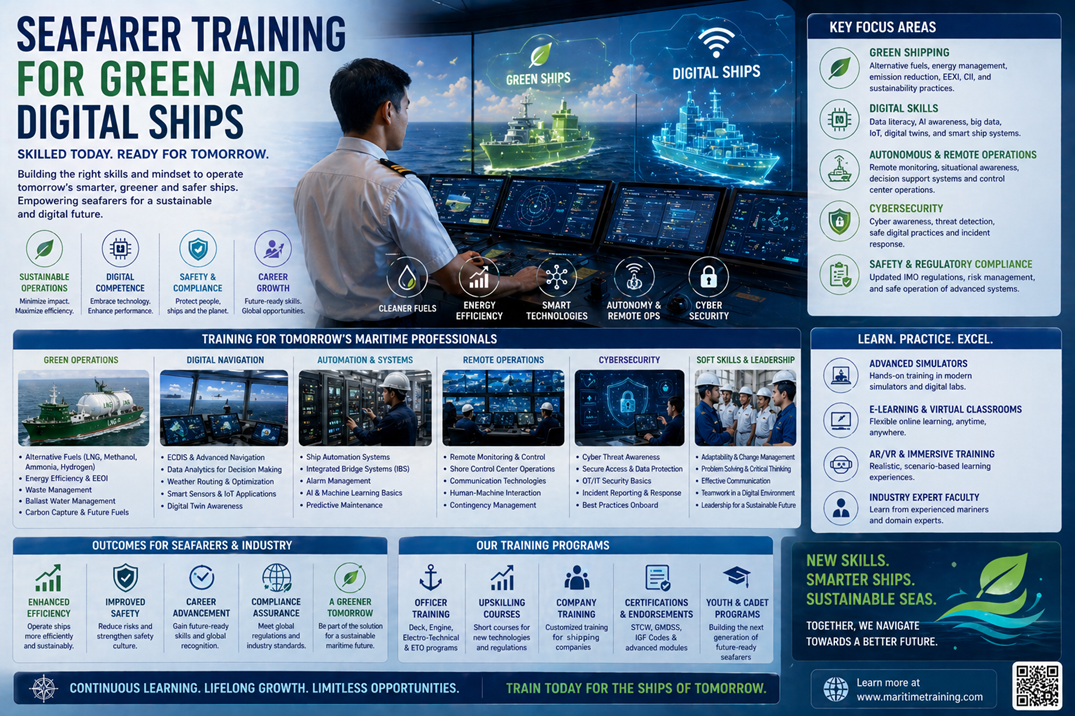
Explore seafarer decarbonisation training, STCW green skills, simulator training, and digital skills for seafarers as shipping moves toward low-carbon and smart vessels.
Why Seafarer Training Must Change
Shipping’s green transition is not only about new fuels, new engines, or smarter ships. It is also about people. Seafarers will be the ones operating ammonia-ready engines, monitoring methanol fuel systems, using digital reporting tools, responding to alarms from advanced automation, and making safety-critical decisions when new technologies behave unexpectedly.
Recent research highlights that seafarers are central to shipping’s decarbonisation because their roles are changing from traditional shipboard operation toward digitally supported, shore-connected, and low-carbon operations. A 2026 Frontiers in Marine Science article describes seafarers as a “core driving force” of shipping’s green transition, with their work increasingly shaped by digital, intelligent, and shore-based cooperation systems.
Green Ships Need Green Skills
Green ships introduce new operational realities. A vessel using LNG, methanol, ammonia, hydrogen, batteries, wind-assisted propulsion, or carbon-intensity monitoring systems requires more than normal engine-room and bridge competence. Seafarers must understand fuel properties, safety hazards, emissions regulations, emergency response, and energy-efficient operation.
This does not mean that traditional seamanship and engineering skills are disappearing. Instead, they are being extended. A marine engineer still needs strong knowledge of machinery systems, but now may also need to understand fuel-cell safety, ammonia toxicity, methane slip, carbon capture systems, or fuel-consumption optimisation. A deck officer still needs strong navigation competence, but may also need to manage voyage optimisation tools, CII performance, electronic reporting, and smart navigation systems.
STCW Green Skills and the Regulatory Shift
The STCW Convention and Code remain the foundation of global seafarer training, certification, and watchkeeping. However, the framework is now under comprehensive review to reflect technological change, evolving working conditions, and the human element in maritime safety. IMO states that this review is expected to have a lasting impact on administrations, maritime education and training institutions, industry, and seafarers worldwide.
This review is important because many green and digital skills are not yet fully embedded in traditional training structures. Alternative fuels, cyber risk, automation, shore-based support, and digital performance monitoring require updated competence standards. In 2025, IMO issued generic interim guidelines for training seafarers on ships using alternative fuels and new technologies, creating an international framework for training development and approval.
Alternative Fuels Training: Safety Comes First
Alternative fuels are a major driver of new training needs. Ammonia, methanol, and hydrogen each introduce specific hazards. Ammonia is toxic and corrosive. Methanol is toxic and flammable. Hydrogen is highly flammable and difficult to store. These fuels require new safety procedures, emergency drills, bunkering practices, ventilation strategies, detection systems, and personal protective equipment.
The Maritime Just Transition Task Force launched interim training frameworks in September 2025 for seafarers working on ammonia-, methanol-, and hydrogen-powered ships. These frameworks are intended to guide maritime administrations, MET institutions, shipping companies, and training providers in building harmonised training programmes.
A 2024 industry report also concluded that the transition from conventional fuels to ammonia, methanol, and hydrogen will require new or modified competencies for seafarers. The report was based on workshops assessing training needs for safe alternative-fuel operations.
Digital Skills for Seafarers
Digitalisation is developing at the same time as decarbonisation. Modern ships increasingly depend on data systems, electronic documentation, smart navigation, remote monitoring, predictive maintenance, and emissions-reporting platforms. This means that digital skills are becoming part of everyday maritime competence.
Seafarers need to understand how to use digital systems safely and critically. They must know how to interpret data, recognise abnormal system behaviour, protect digital equipment from cyber threats, and avoid overreliance on automation. Digital skills are especially important for ships using advanced energy-management systems, hybrid propulsion, battery systems, automated machinery monitoring, or remote technical support.
The future seafarer will not only operate equipment manually. They will supervise complex systems, interpret data, communicate with shore teams, and intervene when automation reaches its limits.
Simulator Training for Green and Digital Ships
Simulator training will be essential for preparing seafarers for low-carbon and digital ships. Many new risks cannot be taught effectively through classroom theory alone. Seafarers need to practise decision-making in realistic scenarios, especially when dealing with unfamiliar fuels or automated systems.
For example, an engine-room simulator can reproduce fuel-system alarms, ammonia leakage scenarios, battery thermal events, methanol bunkering incidents, or hybrid propulsion failures. Bridge simulators can integrate voyage optimisation, smart navigation, ECDIS data anomalies, cyber events, and energy-efficient route planning. Full-mission simulators are particularly valuable because they allow trainees to experience the interaction between technical systems, human decisions, and emergency procedures.
Simulator-based training also supports assessment. Instructors can observe not only whether a trainee knows the theory, but whether they can apply it under pressure, follow procedures, communicate clearly, and maintain situational awareness.
Main Competence Areas for Green and Digital Seafarers
| Competence area | Why it matters | Examples of training focus |
|---|---|---|
| Alternative fuel safety | New fuels introduce toxicity, flammability, cryogenic, and explosion risks | Ammonia, methanol, hydrogen, LNG, batteries |
| Energy efficiency | Ships must reduce fuel use and carbon intensity | CII, EEXI, voyage optimisation, trim, speed management |
| Digital operations | Ships rely on data-driven systems and automation | Smart navigation, performance monitoring, digital reporting |
| Cyber awareness | Connected ships are exposed to cyber risk | GNSS spoofing, ECDIS threats, phishing, system access control |
| Emergency response | New technologies require new emergency procedures | Fuel leaks, battery incidents, automation failure |
| Human-machine interaction | Crews must supervise complex systems safely | Alarm management, automation limits, decision support |
The Human Element in the Green Transition
A key risk in the green transition is treating technology as the solution while underestimating the human element. New fuels and digital systems can improve sustainability, but they also introduce unfamiliar operational risks. If crews are not properly trained, the transition may create safety gaps.
Reuters reported that modelling by Lloyd’s Register and UMAS estimated that 450,000 seafarers may require additional training by 2030, rising to 800,000 by the mid-2030s, depending on the uptake of alternative fuels. This illustrates the scale of the training challenge.
The issue is also one of fairness. Many seafarers come from countries that may not have immediate access to advanced training infrastructure. A just transition must therefore ensure that green and digital skills are available globally, not only in wealthy maritime centres.
Practical Example: Training for a Methanol-Fuelled Vessel
A seafarer preparing to join a methanol-fuelled ship would need more than a general familiarisation course. The training should cover methanol properties, toxicity, fire risk, fuel-system layout, bunkering procedures, leak detection, ventilation, emergency shutdown, and personal protective equipment.
Simulator exercises could then place the trainee in realistic scenarios, such as a methanol leak during bunkering, abnormal fuel pressure, ventilation failure, or fire detection in a fuel preparation room. The objective would not only be to test knowledge, but to assess procedural discipline, communication, alarm response, and safe decision-making.
This kind of training reflects the future direction of maritime education: competence must be practical, scenario-based, and connected to real ship operations.
Challenges for Maritime Education and Training Institutions
Maritime Education and Training institutions face a difficult task. They must update curricula, train instructors, invest in simulators, cooperate with industry, and align courses with evolving IMO guidance. At the same time, many technologies are still developing, and the final regulatory details may continue to change.
Another challenge is balancing traditional and new competencies. Students still need strong foundations in navigation, engineering, safety, stability, cargo work, and watchkeeping. Green and digital skills should not replace these foundations; they should be integrated into them.
For example, energy efficiency should be taught alongside voyage planning and engine performance. Cyber awareness should be connected to ECDIS, GMDSS, and integrated bridge systems. Alternative-fuel safety should be linked to fire safety, machinery systems, bunkering, and emergency response.
Future Outlook: From Seafarer Training to Career-Long Learning
The green and digital transition will make career-long learning more important. A certificate obtained early in a career will not be enough for decades of changing technology. Seafarers will need regular upskilling as fuels, automation, regulations, and ship systems evolve.
Training may become more modular, with short certified courses on specific fuels, systems, or digital tools. Simulator centres, online learning platforms, shipboard training, and company-specific familiarisation will need to work together. Shipping companies will also need to treat training as a strategic investment, not only a compliance cost.
Conclusion: No Green Shipping Without Skilled Seafarers
Seafarer training is one of the most important pillars of maritime decarbonisation. Ships may become cleaner, smarter, and more automated, but they will still depend on competent people to operate them safely.
Green skills, digital competence, simulator-based training, and updated STCW frameworks are all essential for the next generation of maritime professionals. The industry’s success will depend not only on choosing the right fuel or technology, but on preparing seafarers to use those systems with confidence, safety, and professionalism.
Frequently Asked Questions
What is seafarer decarbonisation training?
It is training that prepares seafarers to operate low-carbon ships, alternative-fuel systems, energy-efficiency tools, and emissions-related procedures safely.
What are STCW green skills?
STCW green skills refer to emerging competence areas linked to decarbonisation, including alternative fuels, energy efficiency, digital reporting, environmental compliance, and safe operation of new technologies.
Why is simulator training important for green ships?
Simulators allow seafarers to practise realistic emergency and operational scenarios involving new fuels, automation, digital systems, and energy-management technologies.
What digital skills do seafarers need?
Seafarers need skills in digital navigation, electronic reporting, cyber awareness, data interpretation, performance monitoring, and safe use of automated systems.
References
International Maritime Organization. Preparing seafarers for the energy transition.
International Maritime Organization. Generic interim guidelines on training for seafarers on ships using alternative fuels and new technologies.
International Maritime Organization. Comprehensive review of the STCW Convention and Code.
Maritime Just Transition Task Force / ICS. Considerations of training aspects for seafarers on ships powered by ammonia, methanol and hydrogen.
Lloyd’s Register. Seafarer training in need of comprehensive overhaul to ensure safe decarbonisation of shipping.
Frontiers in Marine Science. Seafarers in shipping’s decarbonization: role transformation and future training needs.
Reuters. A sea-change for seafarers as the shipping industry gears up to decarbonise