
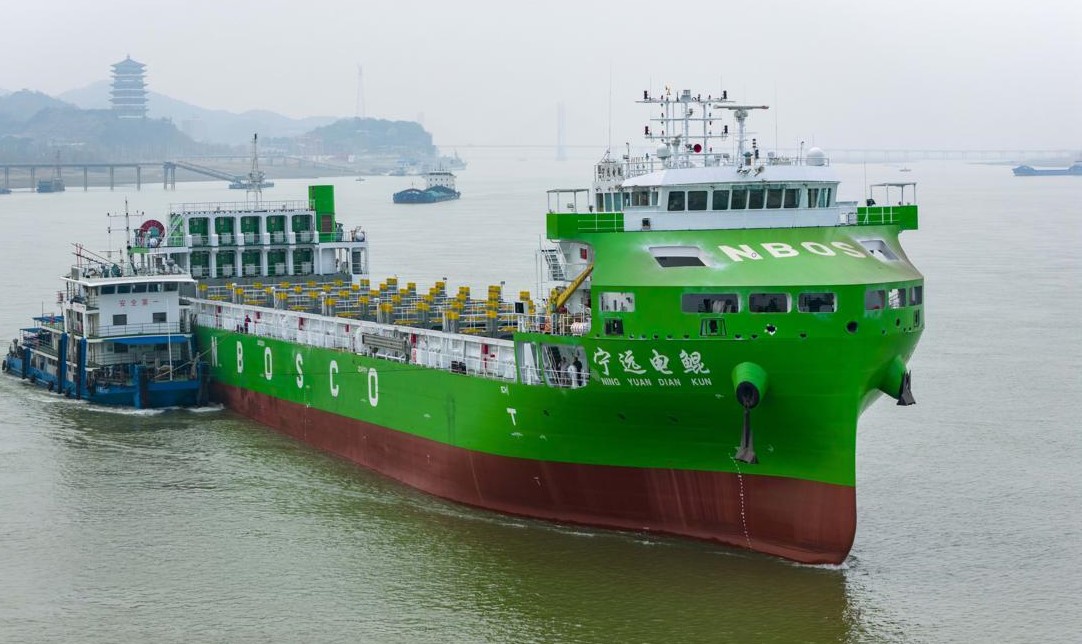
China has successfully completed sea trials of its first all-electric container vessel, Ning Yuan Dian Kun, in Ningbo, Zhejiang Province—marking a notable advancement in the global transition toward low-emission maritime transport. The vessel is widely reported to be the largest fully electric container ship currently in operation, signaling both technological maturity and strategic intent in China’s coastal shipping sector.
Technical Profile and Design Characteristics
The Ning Yuan Dian Kun is engineered as a short-sea/coastal container carrier with the following principal particulars:
- Capacity: ~740 TEUs
- Length Overall (LOA): 127.8 meters
- Beam: 21.6 meters
- Propulsion: Fully electric (battery-powered)
- Operational Route: Ningbo–Jiaxing coastal corridor (Zhejiang Province)
The vessel was independently designed and developed by the Shanghai Merchant Ship Design and Research Institute, while its electric propulsion architecture was delivered by the Shanghai Marine Equipment Research Institute. Both entities operate under the umbrella of China State Shipbuilding Corporation, reflecting strong vertical integration across design, engineering, and manufacturing.
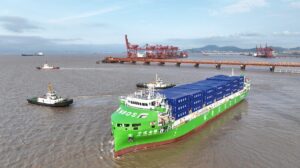
China has taken a notable step in maritime decarbonization with the successful testing of its first all-electric container vessel, positioning itself at the forefront of battery-powered coastal shipping innovation. The vessel, Ning Yuan Dian Kun, recently completed trials in Ningbo, marking a milestone in the transition toward zero-emission short-sea logistics.
Vessel Overview and Technical Profile
The Ning Yuan Dian Kun is reported to be the largest all-electric container ship currently developed worldwide, with a carrying capacity of 740 TEUs (twenty-foot equivalent units). Designed specifically for coastal operations, the vessel measures 127.8 meters in length and 21.6 meters in beam, aligning with typical feeder vessel dimensions while integrating next-generation propulsion technology.
The ship was independently designed and developed by the Shanghai Merchant Ship Design and Research Institute, while its electric propulsion system was engineered by the Shanghai Marine Equipment Research Institute. Both institutions operate under the umbrella of the China State Shipbuilding Corporation, reflecting a vertically integrated national approach to maritime innovation.
Operational Deployment and Strategic Route
The vessel is being delivered to Ningbo Ocean Shipping and is scheduled to operate along the coastal trade corridor between Ningbo and Jiaxing, both located in Zhejiang Province. This short-haul route is strategically suited for electric propulsion due to predictable distances, port accessibility, and the feasibility of establishing charging infrastructure.
From an operational standpoint, deploying electric container ships on fixed coastal routes offers several advantages:
- Zero direct emissions, contributing to regional air quality improvements
- Lower noise and vibration levels, enhancing port-area environmental conditions
- Reduced fuel dependency, aligning with energy transition policies
- High efficiency in stop-and-go logistics cycles, typical of feeder services
Technological and Industry Significance
The introduction of the Ning Yuan Dian Kun signals a broader shift within the maritime sector toward battery-electric propulsion systems, particularly for short-sea and inland waterway shipping. While deep-sea vessels still face limitations due to energy density constraints of current battery technologies, coastal shipping presents an ideal early-adoption segment.
China’s approach—leveraging state-backed design institutes and industrial integration—demonstrates how policy, engineering, and manufacturing ecosystems can converge to accelerate innovation. This aligns with global maritime decarbonization targets set by organizations such as the International Maritime Organization, which aim to significantly reduce greenhouse gas emissions from shipping in the coming decades.
Broader Implications for Maritime Decarbonization
The successful testing of what is claimed to be the world’s largest all-electric container ship underscores several emerging trends:
- Scaling of battery capacity to support commercial cargo operations
- Expansion of green shipping corridors, particularly in coastal regions
- Increased investment in port electrification and charging infrastructure
- Replication potential across Asia and Europe for short-distance trade routes
In practical terms, vessels like the Ning Yuan Dian Kun may serve as precursors to hybrid and fully electric fleets, especially in regions with dense port networks and strong regulatory incentives.
Conclusion
China’s development of the Ning Yuan Dian Kun represents more than a technical milestone—it is a strategic signal of how maritime transport is evolving under decarbonization pressures. By focusing on scalable, route-specific electric solutions, the project provides a realistic pathway toward zero-emission shipping, particularly in coastal logistics where operational constraints and environmental priorities are closely aligned.