
02/01/2026
In a pivotal move for global finance, the BRICS bloc is shifting focus from symbolic ambitions of a single currency to the practical construction of a new digital payment system. Set to be a central agenda item at the 2026 summit in India, this initiative aims to link member nations’ central bank digital currencies (CBDCs), creating an alternative to the dollar-dominated SWIFT network .
This infrastructure-first approach reflects a pragmatic strategy: reshaping global finance through functional, interoperable systems rather than grand political gestures. For countries within the BRICS+ expansion—which now includes Egypt, the UAE, and Indonesia—this represents a concrete step toward greater financial resilience and reduced vulnerability to external sanctions .
The Strategic Pivot: Why a Payment Rail, Not a Single Currency
The idea of a common “BRICS currency” has been discussed for years but faces insurmountable hurdles. Member states have divergent economic policies, inflation regimes, and concerns about ceding monetary sovereignty . There are also apprehensions that any shared currency could become dominated by the Chinese yuan .
Instead, the new strategy leverages existing national projects:
-
India’s Digital Rupee: Piloted for both wholesale and retail use, designed for efficiency and control.
-
China’s Digital Yuan (e-CNY): The most advanced large-scale CBDC in testing.
-
Russia’s Digital Ruble: Accelerated development following the country’s exclusion from SWIFT in 2022.
The goal is not to merge these into one, but to build “rails” that allow them to transact directly with each other. This preserves national monetary control while enabling faster, cheaper cross-border trade without relying on the U.S. dollar as an intermediary .
The Technical Engine: How the New System Would Work
The proposed system relies on two key mechanisms to facilitate smooth, dollar-free trade:
-
Settlement Cycles: Instead of settling every transaction individually, payments between two countries would be netted over a set period (e.g., a month). Only the final net difference is transferred, drastically reducing the currency that needs to move and lowering costs .
-
Forex Swap Lines: These are pre-arranged agreements between central banks to exchange currencies. If a country needs extra yuan or rupees to meet its net settlement obligation, its central bank can temporarily “borrow” the required currency, ensuring liquidity without resorting to the dollar market .
A leading model for this infrastructure is the “mBridge” project facilitated by the Bank for International Settlements. This uses a blockchain-based bridge to connect separate national CBDC ledgers, allowing for instant settlement and eliminating counterparty risk without creating a single shared currency or ledger .
The Foundation Is Already Being Built
This new vision builds upon a decade of groundwork, as shown in the timeline below:
| Period | Development Phase | Key Events & Foundations |
|---|---|---|
| 2014-2015 | Institutional & Conceptual | New Development Bank founded; BRICS Contingent Reserve Arrangement established; BRICS Cross-Border Payments Initiative (BCBPI) first proposed . |
| 2018-2022 | Sanctions & Acceleration | U.S. sanctions and Russia’s SWIFT exclusion act as a catalyst; working groups formed; technical pilots begin (e.g., India-Russia QR code payments) . |
| 2024-2025 | Platform Launch & Expansion | BRICS Pay officially presented at Kazan Summit, connecting national systems like India’s UPI and Brazil’s PIX . Major bilateral local currency trade deals are signed (e.g., China-Brazil) . |
| 2026 (Projected) | CBDC Integration Focus | India-hosted summit to prioritize agenda for linking national CBDCs (Digital Rupee, e-CNY, Digital Ruble) into an interoperable payment rail . |
The bloc is not starting from zero. It is interconnecting robust national systems that already have significant global reach:
-
China’s CIPS: Connects financial institutions in over 189 countries .
-
India’s UPI: Accepted for cross-border payments in at least nine countries, with plans for major expansion .
-
Brazil’s PIX: Expanding into neighboring Latin American countries .
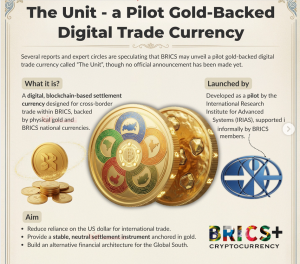
The Bigger Picture: De-Dollarization and the Gold Anchor
The payment system is one pillar of a broader strategic shift away from dollar dependence, most visibly seen in the global rush for gold.
A Historic Shift in Reserves
For the first time in nearly 30 years, the collective value of gold held by foreign central banks has surpassed their holdings of U.S. Treasury bonds—a powerful symbolic milestone . BRICS central banks, led by China, have been the primary architects of this trend, accounting for over half of all official sector gold purchases in recent years .
This move is driven by a desire for assets that are politically neutral and cannot be frozen by sanctions, a lesson underscored by the West’s actions against Russia in 2022 .
Dollar Dominance Endures, But Erodes
It is crucial to maintain perspective. The U.S. dollar remains the world’s premier reserve currency, involved in nearly 90% of foreign exchange transactions and over half of global trade invoicing . However, its share of central bank reserves has declined to a two-decade low, while gold’s share has steadily risen .
De-dollarization is most advanced in commodity markets, where an increasing volume of oil and other resources is traded in yuan, rupees, and other non-dollar currencies .
Significant Hurdles on the Track
Despite the clear direction, the path to a fully operational BRICS payment system is fraught with challenges:
-
Technical & Regulatory Harmonization: Integrating different CBDC designs, governance rules, and financial regulations across diverse economies is immensely complex .
-
Limited Internal Trade: Trade volumes between some BRICS members are still relatively low, which questions the immediate utility of a dedicated system .
-
Geopolitical Divergence: The group includes democracies and autocracies with differing strategic goals, making deep financial integration difficult .
-
Capital Control Complexity: For countries like India with managed capital accounts, any cross-border CBDC flow must be carefully programmed with built-in controls to prevent financial instability .
Conclusion: A Pragmatic Path to a Multipolar System
The BRICS bloc is not trying to topple the dollar overnight—an impossible task given its entrenched liquidity and network effects. Instead, it is pursuing a pragmatic, incremental strategy: building a functional alternative piece by piece .
By linking digital currencies, promoting local currency trade, and anchoring its system with strategic gold accumulation, BRICS is laying the tracks for a more multipolar financial world. This parallel system aims to provide its members with a “shock absorber”—a resilient alternative channel for essential trade during geopolitical or financial crises, reducing their vulnerability to a single point of failure in the global order .
The age of a single, hegemonic financial system may not be ending, but the construction of a credible alternative track is now undeniably underway.
I hope this expanded article provides a comprehensive and engaging overview suitable for publication. If you would like to explore a specific aspect, such as the technical details of the mBridge platform or the economic profiles of key BRICS members, I can provide a more focused analysis.