
Compare maritime education systems around the world, from STCW standards to national academies, and learn how seafarers are trained globally.
Every ship that sails safely across oceans carries more than cargo. It carries the knowledge, skills, and judgment of the people on board. Behind every competent master, engineer, and rating stands a maritime education system shaped by national culture, international regulation, and industry demand. While shipping is global by nature, maritime education is still largely organized at national and regional levels. This creates diversity—but also inconsistency—in how seafarers are trained, assessed, and certified.
For students considering a maritime career, shipowners recruiting multinational crews, and regulators responsible for safety, understanding how maritime education systems differ around the world is no longer optional. It is essential. In an era of rapid technological change, stricter environmental regulation, and growing attention to human factors, the way maritime professionals are educated has direct consequences for safety, efficiency, and sustainability at sea.
Maritime operations depend on people who can make correct decisions under pressure, often far from shore-based support. Differences in education systems influence bridge teamwork, engine room competence, safety culture, and even communication styles. For ship operators managing multinational crews, understanding these educational backgrounds helps reduce operational risk, improve training strategies, and support safer, more efficient voyages.
Foundations of Global Maritime Education
The Role of the STCW Convention
At the heart of global maritime education lies the International Convention on Standards of Training, Certification and Watchkeeping for Seafarers (STCW). Adopted by the International Maritime Organization (IMO), STCW sets minimum standards for the training and certification of seafarers worldwide.
STCW does not prescribe how countries must teach, but it defines what competencies seafarers must demonstrate. This distinction is important. Two officers may hold the same certificate of competency, yet their educational journeys can be very different. One may have completed a university degree with extensive simulator training, while another may have progressed through a vocational pathway with strong sea-time emphasis.
IMO Model Courses further support harmonization by providing recommended syllabi for subjects such as navigation, marine engineering, and safety training.
STCW acts as a common language, but national interpretation still shapes the final outcome.
Maritime Education and Training (MET) as a System
Maritime education is often described using the term MET (Maritime Education and Training). MET systems typically include maritime academies, technical colleges, simulator centers, onboard training programs, and examination authorities.
Some countries integrate MET into their national higher education systems, awarding academic degrees alongside certificates of competency. Others treat maritime training as a specialized vocational track, separate from universities. Both approaches can produce competent seafarers, but they reflect different philosophies about learning, professionalism, and career development.
Organizations such as IMarEST (Institute of Marine Engineering, Science & Technology) promote professional recognition beyond certification, emphasizing lifelong learning and technical competence.
–
Regional Comparisons of Maritime Education Systems
Europe: Structured Academics and Regulatory Oversight
European maritime education systems are generally characterized by strong regulatory frameworks and close alignment with higher education standards. Countries such as the United Kingdom, Norway, Germany, and France integrate maritime education into national qualification frameworks.
In the United Kingdom, maritime education combines academic study with structured sea training. Cadets typically enroll through sponsoring shipping companies and study at approved maritime colleges while completing sea phases. The Maritime and Coastguard Agency (MCA) oversees certification and compliance with STCW.
https://www.gov.uk/government/organisations/maritime-and-coastguard-agency
European Union member states also benefit from coordination through bodies such as the European Maritime Safety Agency (EMSA), which audits national systems and promotes harmonization.
https://www.emsa.europa.eu
A key strength of European systems is quality assurance. However, the length and cost of training can be barriers for some students, especially without sponsorship.
North America: Strong Institutions, Limited Officer Supply
The United States operates a distinctive maritime education system centered on state maritime academies and the U.S. Merchant Marine Academy. These institutions offer bachelor’s degrees alongside officer licenses, producing highly educated graduates.
https://www.usmma.edu
The United States Coast Guard (USCG) regulates certification and training standards.
https://www.uscg.mil
While academically robust, the U.S. system produces relatively small numbers of officers compared to global demand. High tuition costs and strict entry requirements limit accessibility, and most graduates serve primarily in national fleets rather than international shipping.
Canada follows a similar model, with strong technical education but limited scale in global terms.
East Asia: Discipline, Technology, and National Strategy
East Asian countries such as Japan, South Korea, and China view maritime education as a strategic national priority. Their systems emphasize discipline, technical excellence, and alignment with national shipping interests.
Japan’s maritime universities and training institutions have long traditions, supported by close cooperation with shipping companies and classification societies such as ClassNK.
https://www.classnk.or.jp
South Korea integrates maritime education with advanced shipbuilding and marine engineering industries, creating strong links between theory and practice.
China operates one of the largest maritime education systems in the world, producing vast numbers of officers and ratings. Institutions are often state-supported, and curricula are closely aligned with national maritime policy. The China Classification Society (CCS) plays a role in technical standardization.
https://www.ccs.org.cn
The scale and state coordination of East Asian MET systems are major strengths, though language barriers and differing teaching styles can pose challenges in multinational crew environments.
South and Southeast Asia: Workforce Scale and Global Supply
Countries such as the Philippines, India, Indonesia, and Vietnam are among the world’s largest suppliers of seafarers. Their maritime education systems are heavily influenced by global labor demand.
The Philippines is often described as the world’s leading source of seafarers. Its MET system includes hundreds of maritime schools, regulated by national authorities and audited by the IMO and EMSA. Filipino training emphasizes adaptability and English communication, key strengths in multinational crews.
India combines government maritime institutes with private academies, overseen by the Directorate General of Shipping. Indian officers are widely represented in senior ranks, reflecting strong technical training and English proficiency. Rapid expansion, however, creates challenges. Quality assurance varies, and compliance with STCW has required continuous reform and international oversight.
Eastern Europe and Russia: Strong Technical Traditions
Eastern European countries such as Ukraine, Romania, and Poland, along with Russia, have long maritime traditions rooted in strong technical education. Their systems often emphasize engineering competence and mathematical rigor.
Institutions in this region supply significant numbers of officers to international fleets. Classification societies such as DNV, Lloyd’s Register, and RINA frequently collaborate with training institutions to support technical standards.
https://www.dnv.com
https://www.lr.org
https://www.rina.org
Political instability and economic challenges in some countries, however, affect investment in training infrastructure and international recognition.
Africa and Latin America: Emerging Capacity and Opportunity
In Africa and parts of Latin America, maritime education systems are developing but uneven. Countries such as Egypt, South Africa, Brazil, and Mexico have established maritime academies, often supported by regional initiatives and international organizations.
Capacity building programs supported by the World Bank and IMO aim to strengthen MET systems, recognizing that maritime skills are critical for economic development.
https://www.worldbank.org
The challenge in these regions lies not in potential, but in resources. Limited access to modern simulators, sea-time opportunities, and experienced instructors can constrain outcomes. However, targeted investment is gradually improving capacity.
–
Educational Models and Pedagogical Approaches
Academic vs Vocational Pathways
One of the most significant differences between maritime education systems lies in their educational philosophy. Academic pathways emphasize theoretical understanding, critical thinking, and long-term career development. Vocational pathways focus on practical skills and faster entry into the workforce. Neither approach is inherently superior. Academic systems may produce officers well-prepared for management and shore-based roles, while vocational systems often excel at producing competent watchkeepers quickly. The challenge is balancing theory and practice, especially as ships become more technologically complex.
Simulator-Based Training and Digital Learning
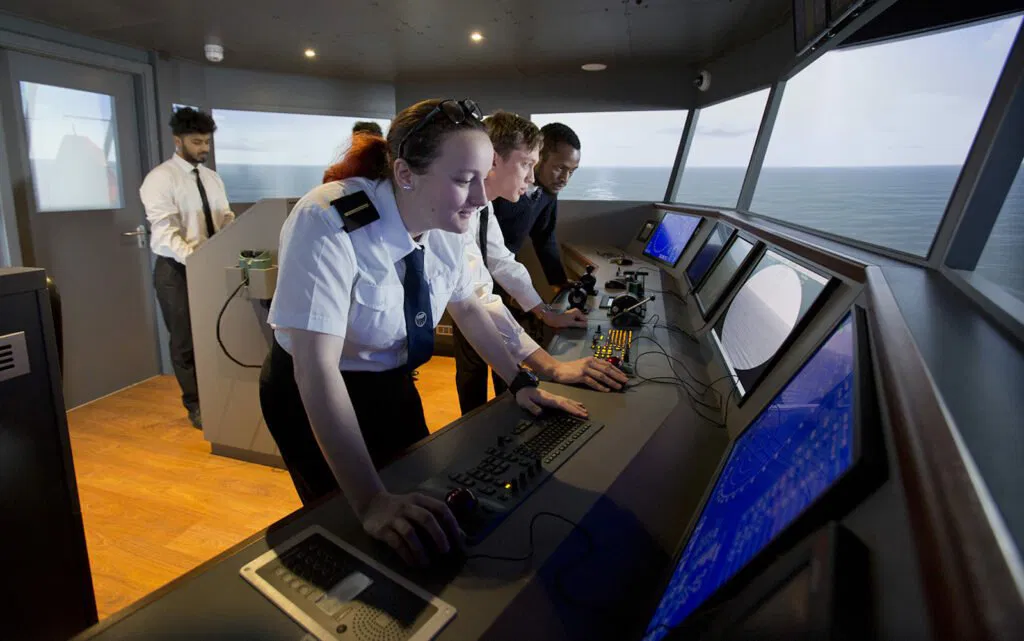
Modern maritime education increasingly relies on simulators to replicate bridge, engine room, and cargo operations. High-fidelity simulators allow students to practice emergency scenarios without real-world risk. Classification societies such as ABS and Bureau Veritas support simulator standards and approval processes.
https://ww2.eagle.org
https://www.bureauveritas.com
Digital learning platforms, accelerated by the COVID-19 pandemic, have expanded access to theoretical instruction. However, maritime education remains fundamentally practical. Online learning can support, but not replace, hands-on training and sea experience.
Human Factors and Soft Skills
Traditionally, maritime education focused on technical competence. Today, greater attention is paid to human factors, including leadership, teamwork, fatigue management, and communication. Accident investigations by bodies such as the UK Marine Accident Investigation Branch (MAIB) repeatedly highlight human error as a contributing factor.
https://www.gov.uk/government/organisations/marine-accident-investigation-branch
As a result, modern MET systems increasingly integrate behavioral training, bridge resource management, and cultural awareness into curricula.
–
Challenges and Practical Solutions
Despite global standards, maritime education faces persistent challenges. Variations in quality between institutions undermine confidence in certification. Limited sea-time berths restrict cadet progression, while rapid technological change demands continuous curriculum updates.
Practical solutions focus on stronger international cooperation, improved auditing, and closer industry-academia partnerships. Initiatives by the International Chamber of Shipping (ICS) and BIMCO promote shared responsibility between shipowners and training providers. Investment in instructor training, simulator access, and transparent assessment systems is equally critical. Ultimately, education quality depends not only on regulation, but on professional culture.
–
Case Studies and Real-World Applications
The Philippines and Global Crew Supply
The Philippines demonstrates how a national MET system can align with global labor markets. Continuous reform, international auditing, and strong industry links have allowed the country to remain competitive despite intense scrutiny.
The European Dual System
Several European countries successfully combine academic degrees with vocational sea training. Graduates gain both licenses and academic qualifications, improving career flexibility and retention.
China’s Strategic MET Expansion
China’s investment in maritime education mirrors its broader maritime strategy. Large-scale training capacity supports national fleets and global ambitions, illustrating how education aligns with geopolitical goals.
–
Frequently Asked Questions
1. Why do maritime education systems differ between countries?
They reflect national education structures, labor markets, and maritime strategies, even though STCW sets minimum standards.
2. Does STCW guarantee equal competence worldwide?
STCW ensures minimum requirements, but teaching quality and assessment rigor still vary.
3. Are university-based maritime programs better than vocational ones?
Not necessarily. Both can produce competent officers if theory and practice are well balanced.
4. Why is sea-time difficult to obtain for cadets?
Limited training berths and commercial pressures reduce opportunities for onboard training.
5. How is technology changing maritime education?
Simulators, digital platforms, and data-driven assessment are becoming central tools.
6. Can maritime education support shore-based careers?
Yes. Many MET systems now emphasize transferable skills for management and technical roles ashore.
–
Future Outlook and Maritime Education Trends
Maritime education systems around the world share a common goal: producing competent, safe, and professional seafarers. Yet the paths to that goal differ widely, shaped by culture, regulation, and economic reality. Understanding these differences helps shipowners manage multinational crews, helps students choose suitable career paths, and helps regulators improve global safety standards. As shipping faces technological and environmental transformation, the quality of maritime education will matter more than ever. Investing in people remains the most reliable way to ensure safe seas and sustainable global trade.
Maritime education systems are entering a period of transformation. Decarbonization, automation, and digitalization are reshaping skill requirements. Future seafarers will need stronger systems thinking, data literacy, and environmental awareness. Competency-based assessment is likely to expand, supported by digital logbooks and real-time performance monitoring. Greater emphasis on lifelong learning will blur the line between initial education and continuous professional development. At the same time, global cooperation will become more important. As crews grow more multinational, trust in each other’s training systems will remain essential for safe operations.
–
References
International Maritime Organization. (2024). STCW Convention and Model Courses. https://www.imo.org
International Chamber of Shipping. (2024). Seafarer training and education. https://www.ics-shipping.org
UNCTAD. (2024). Review of Maritime Transport. https://unctad.org
European Maritime Safety Agency. (2024). Maritime education oversight. https://www.emsa.europa.eu
Maritime and Coastguard Agency. (2024). UK seafarer training and certification. https://www.gov.uk/mca
United States Coast Guard. (2024). Merchant mariner credentialing. https://www.uscg.mil
IMarEST. (2024). Professional standards in maritime engineering. https://www.imarest.org
BIMCO. (2024). Crew training and industry needs. https://www.bimco.org
Marine Accident Investigation Branch. (2024). Human factors in maritime accidents. https://www.gov.uk/maib
World Bank. (2024). Maritime capacity building. https://www.worldbank.org