
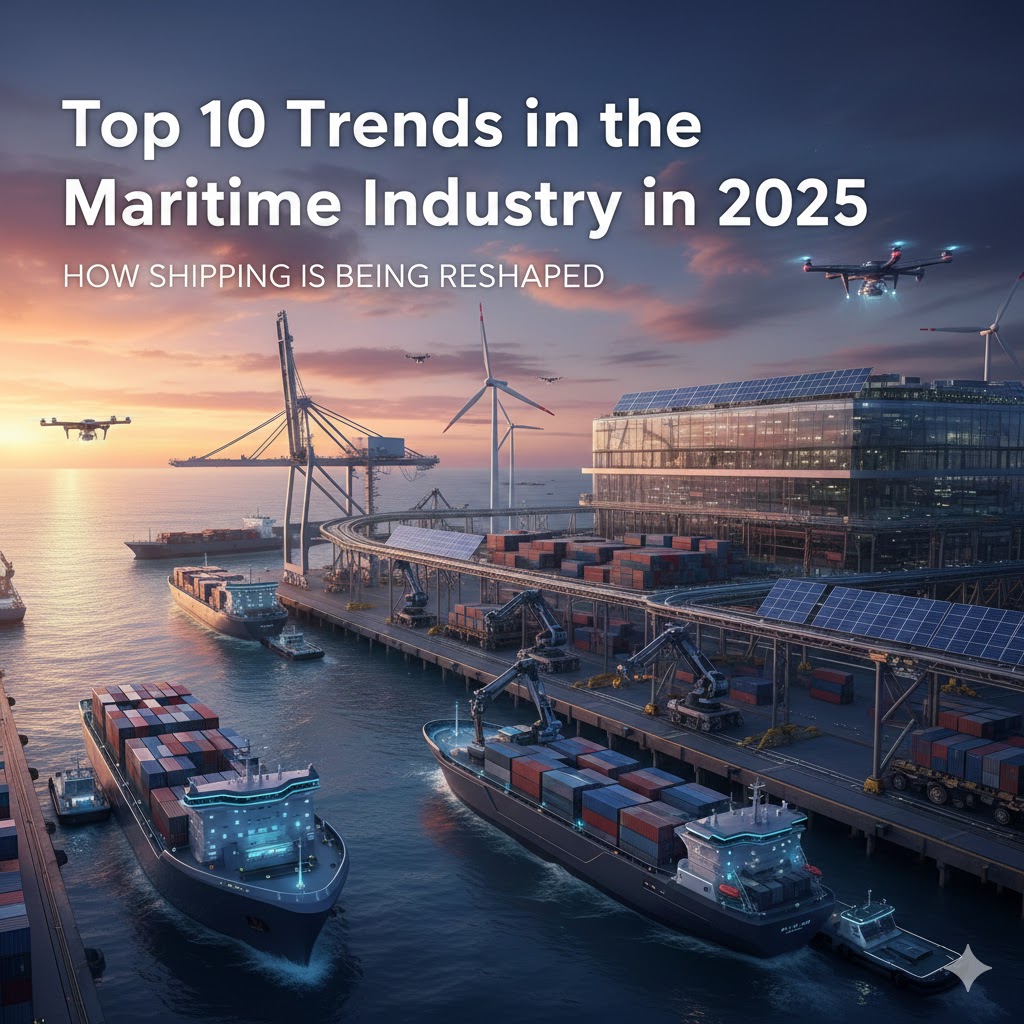
The maritime industry in 2025 is undergoing one of the most profound transformations in its modern history. Long regarded as conservative and slow to change, global shipping is now at the forefront of technological innovation, regulatory reform, and strategic realignment. Driven by decarbonisation targets, digital disruption, geopolitical uncertainty, and evolving trade patterns, the sector is redefining how ships are designed, operated, financed, and regulated.
Unlike previous cycles dominated by freight rates and fleet supply, today’s maritime trends are structural rather than cyclical. Decisions made in 2025 will shape the industry’s competitiveness, sustainability, and resilience well into the 2030s and beyond. Shipowners, operators, ports, regulators, and technology providers are all adapting to a landscape where efficiency, compliance, and adaptability are no longer optional but essential.
This article explores the top 10 defining trends in the maritime industry in 2025, analysing how each trend is influencing shipping markets, vessel operations, port infrastructure, and global supply chains. Rather than treating these trends in isolation, the analysis highlights their interconnections and long-term implications for the future of maritime transport.
A Maritime Industry at a Strategic Turning Point
By 2025, global maritime transport remains responsible for moving more than 80 percent of world trade by volume. Yet the conditions under which this trade is carried are changing rapidly. Slower global economic growth, shifting manufacturing bases, energy transition pressures, and heightened geopolitical risk have combined to create a more complex operating environment than at any point in recent decades.
At the same time, regulatory frameworks are tightening, particularly in relation to emissions, safety, and transparency. Technological innovation, once incremental, is now accelerating, driven by digitalisation, automation, and data analytics. Together, these forces are pushing the maritime industry toward a new operating model built around resilience, sustainability, and intelligence.
Trend 1: Decarbonisation Becomes a Core Business Imperative
From Compliance to Strategy
In 2025, decarbonisation has moved beyond regulatory compliance to become a central strategic driver of maritime decision-making. Shipping companies are no longer asking whether they need to decarbonise, but how fast and through which pathways.
International and regional regulations aimed at reducing greenhouse gas emissions are reshaping fleet investment decisions, operational practices, and fuel strategies. Carbon intensity metrics, emissions reporting, and energy efficiency benchmarks now directly affect vessel competitiveness, chartering prospects, and asset values.
Cost, Risk, and Opportunity
While decarbonisation introduces additional costs in the short term, it also creates opportunities for operators who invest early in efficient vessels and cleaner technologies. In 2025, fuel efficiency and emissions performance increasingly influence charter rates, financing terms, and customer relationships.
Trend 2: Alternative Fuels Move from Pilot to Early Deployment
A Multi-Fuel Future
The maritime industry in 2025 is characterised by fuel pluralism rather than fuel certainty. LNG, methanol, biofuels, ammonia, and hydrogen are all being explored as alternatives to conventional marine fuels, each with distinct advantages and limitations.
No single fuel has emerged as a universal solution, leading shipowners to prioritise flexibility. Dual-fuel engines and “fuel-ready” designs are increasingly common, allowing vessels to adapt as fuel availability and regulation evolve.
Infrastructure and Supply Constraints
Despite technological progress, fuel availability and bunkering infrastructure remain uneven. This mismatch between vessel capability and fuel supply represents one of the most significant challenges to large-scale adoption of alternative fuels in 2025.
Trend 3: Digitalisation Transforms Maritime Operations
From Visibility to Intelligence
Digitalisation in the maritime industry has evolved from basic tracking and reporting to advanced analytics and decision support. In 2025, data-driven operations are a defining feature of competitive shipping companies.
Real-time monitoring of vessel performance, fuel consumption, weather conditions, and port congestion allows operators to optimise routes, reduce costs, and improve reliability. Digital twins, predictive maintenance systems, and AI-assisted voyage planning are no longer experimental but increasingly mainstream.
The Digital Divide
While leading operators embrace digital transformation, smaller companies and ports risk falling behind. The uneven pace of adoption raises concerns about competitiveness and resilience across the global maritime ecosystem.
Trend 4: Cybersecurity Emerges as a Maritime Safety Issue
Growing Digital Vulnerability
As shipping becomes more digital, cybersecurity risks have escalated sharply. In 2025, cyber incidents are recognised not only as IT problems but as operational and safety threats capable of disrupting navigation, cargo handling, and port operations.
Ships, terminals, and logistics platforms are increasingly interconnected, creating multiple points of vulnerability. Cyber resilience has therefore become a strategic priority for shipowners and port authorities alike.
Regulatory and Industry Responses
Maritime regulators and classification societies are strengthening cybersecurity requirements, while operators invest in training, system redundancy, and incident response planning. Cyber risk management is now integral to maritime safety culture.
Trend 5: Geopolitical Risk Reshapes Trade Routes and Operations
Security as a Structural Constraint
Geopolitical instability has become a persistent feature of the maritime landscape. In 2025, security risks along key sea lanes influence routing decisions, insurance costs, and fleet deployment strategies.
Rather than treating geopolitical disruptions as temporary shocks, shipping companies increasingly incorporate security risk into long-term planning. This has led to more diversified trade routes, altered port hierarchies, and increased reliance on risk-adjusted economics.
Impact on Global Supply Chains
Longer routes and higher security costs affect transit times and freight rates, with disproportionate impacts on developing economies. Geopolitics is now a central variable shaping maritime trade flows.
Trend 6: Port Digitalisation and Smart Port Development Accelerate
Ports as Data Hubs
Ports are no longer passive infrastructure providers but active nodes in digital supply chains. In 2025, smart port initiatives focus on automation, data integration, and predictive logistics.
Digital platforms enable ports to manage berth allocation, cargo flows, and hinterland connections more efficiently, reducing congestion and emissions. Advanced ports increasingly function as data hubs linking shipping, customs, and inland transport systems.
Investment Gaps and Inequality
While major global ports advance rapidly, many ports in developing regions struggle to secure the investment needed for digital upgrades. This divergence risks widening inequalities in global trade connectivity.
Trend 7: Environmental Regulation Expands Beyond Emissions
A Broader Sustainability Agenda
Maritime environmental regulation in 2025 extends beyond carbon emissions to include air pollution, underwater noise, ballast water management, waste disposal, and biodiversity protection.
These expanding requirements increase compliance complexity and operational costs, particularly for older vessels. At the same time, they reinforce the industry’s transition toward more holistic sustainability practices.
Implications for Fleet Renewal
Stricter environmental standards accelerate the retirement of inefficient tonnage and influence newbuild specifications. Sustainability performance increasingly determines a vessel’s commercial lifespan.
Trend 8: Shipping Finance Integrates ESG at Its Core
Capital Allocation Transformed
Environmental, social, and governance (ESG) considerations are now embedded in shipping finance. In 2025, access to capital increasingly depends on emissions performance, transparency, and governance standards.
Banks, investors, and export credit agencies apply stricter criteria, rewarding operators who align with sustainability goals and penalising those who do not.
Asset Valuation and Risk
This shift reshapes asset values, with modern, efficient ships commanding premiums while older vessels face declining attractiveness. ESG integration has become a decisive factor in investment decisions.
Trend 9: Workforce Transformation and Skills Shortages
New Skills for a New Industry
The maritime workforce in 2025 faces growing demand for digital, technical, and environmental expertise. Automation and digital tools change the nature of shipboard and shore-based roles, requiring new training approaches.
At the same time, shortages of qualified seafarers and maritime professionals remain a concern, particularly in specialised technical roles.
Human-Centred Transition
Industry stakeholders increasingly recognise the importance of human-centred approaches to technological change, ensuring that workforce development keeps pace with innovation.
Trend 10: From Growth to Resilience as the Dominant Strategy
A New Strategic Mindset
Perhaps the most important trend in the maritime industry in 2025 is a shift from growth-oriented strategies toward resilience-focused business models. Rather than pursuing scale at all costs, companies prioritise flexibility, risk management, and long-term sustainability.
This strategic recalibration reflects lessons learned from recent crises and acknowledges the structural uncertainty shaping global trade.
Implications for the Future
Resilient operators invest in optionality — in fuel choices, fleet deployment, trade exposure, and partnerships. This approach positions them to navigate volatility and capture opportunities as markets evolve.
–
Interconnections Between the Trends
These ten trends do not operate in isolation. Decarbonisation drives alternative fuel adoption, which in turn influences ship design, port infrastructure, and finance. Digitalisation enhances efficiency but raises cybersecurity risks. Geopolitical uncertainty reinforces the need for resilience and route diversification.
Understanding these interconnections is essential for stakeholders seeking to navigate the maritime industry’s transformation effectively.
–
Conclusion
The maritime industry in 2025 stands at a decisive crossroads. The top trends shaping the sector — from decarbonisation and digitalisation to geopolitical risk and workforce transformation — reflect a fundamental redefinition of how shipping operates and competes.
While the challenges are substantial, so too are the opportunities. Operators who embrace innovation, invest in sustainability, and adopt resilience-focused strategies will be best positioned to thrive in the years ahead.
As global trade continues to evolve, the maritime industry’s ability to adapt to these trends will determine not only its economic performance but also its contribution to a more sustainable and resilient global economy.
–
References
UNCTAD. Review of Maritime Transport 2025. United Nations Conference on Trade and Development.
International Maritime Organization (IMO). GHG Reduction Strategy and Environmental Regulations.
OECD. Maritime Transport and Global Trade Outlook.
World Bank. Port Digitalisation and Logistics Performance.
ICS. Shipping Industry Economic and Environmental Outlook.
DNV. Maritime Forecast to 2050.
Clarksons Research. Shipping Market Trends and Analysis.
Wikipedia. Decarbonization of Shipping.