
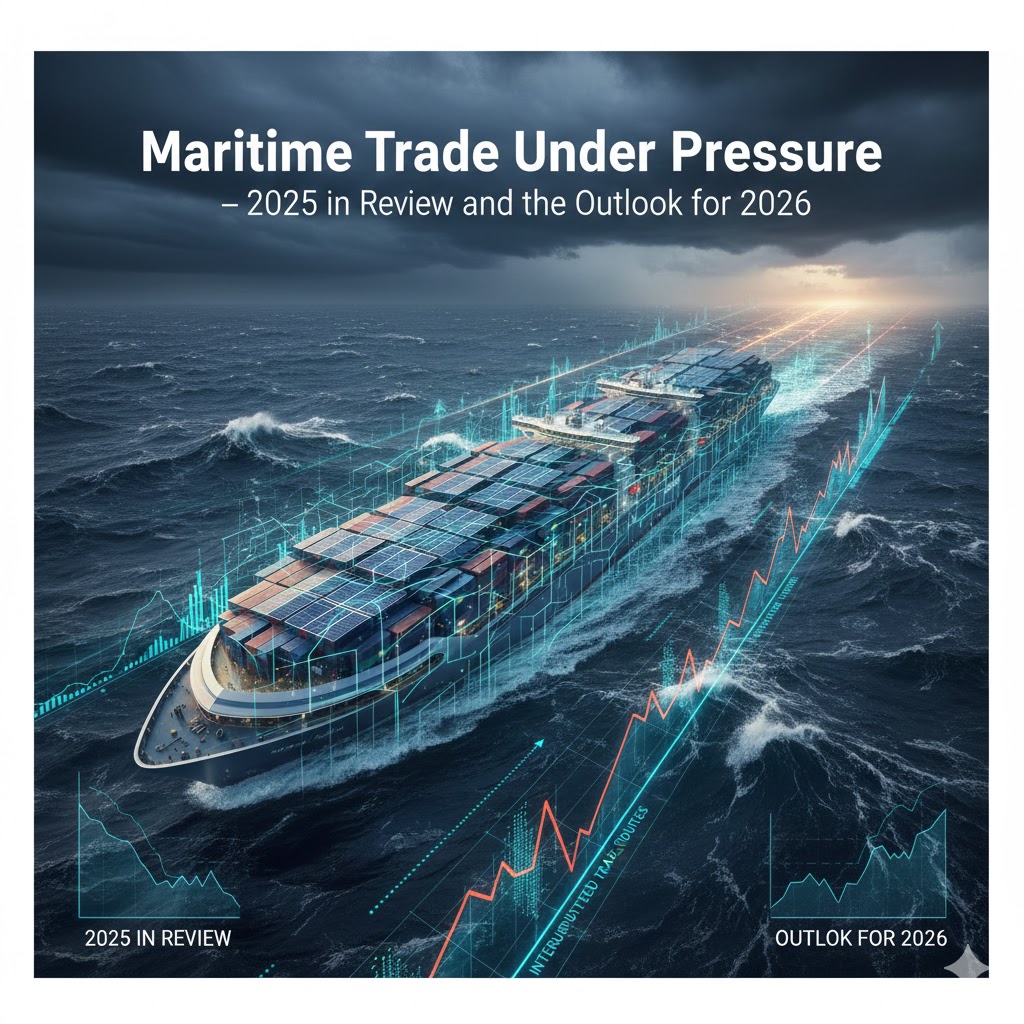
By the close of 2025, global maritime trade had conclusively entered one of its weakest growth phases in over a decade. What began the year with cautious optimism ultimately confirmed a broader slowdown, marked by fragile demand, elevated operating costs, and persistent geopolitical disruption. According to the UNCTAD Review of Maritime Transport 2025, global seaborne trade growth for the year settled at approximately 0.5%, far below historical averages and significantly weaker than the post-pandemic rebound years.
Maritime transport, which carries over 80% of global merchandise trade, once again demonstrated both its centrality to the global economy and its exposure to systemic risk. The slowdown in 2025 was not the result of a single shock, but rather the convergence of geopolitical realignment, supply chain restructuring, trade policy uncertainty, and the rising costs of energy transition compliance.
This article reviews how 2025 unfolded for global maritime trade, examines the structural drivers behind the year’s stagnation, and concludes with a forward-looking assessment of what 2026 is likely to bring for shipping markets, ports, and supply chains.
–
2025 in Review: A Year of Confirmed Weak Momentum
Global Trade Performance in 2025 (Final Assessment)
Data published throughout 2025 confirmed that the modest 2.2% volume growth recorded in 2024 was not sustained. Instead, maritime trade volumes plateaued, with growth decelerating steadily across most cargo segments. Containerised trade proved marginally more resilient than bulk, but still expanded well below long-term trend lines.
This outcome reflected a global economy that struggled to regain momentum. Consumer demand remained uneven, industrial production softened in several regions, and inventory strategies shifted decisively toward leaner, just-in-time models. As a result, maritime trade in 2025 transitioned from post-crisis adjustment to structural slowdown.
Freight Rates and Cost Structures: What 2025 Confirmed
Throughout 2025, freight markets remained volatile rather than directional. While headline rates avoided collapse, they were artificially supported by route extensions, capacity management, and security-driven rerouting, particularly following the prolonged disruption of the Red Sea and Suez corridor.
The diversion of vessels around the Cape of Good Hope became a defining feature of the year, increasing tonne-miles while simultaneously raising fuel consumption, insurance premiums, and crewing costs. By year-end, it was clear that higher transport costs were structural rather than temporary, even as some geopolitical tensions showed signs of stabilisation.
Structural Drivers That Defined 2025
By the end of the year, several drivers had clearly distinguished 2025 from previous downturns:
- Geopolitical risk became embedded, not episodic
- Trade policy uncertainty replaced tariff predictability
- Supply chain regionalisation accelerated
- Energy transition costs moved from future concern to present reality
Manufacturing diversification away from traditional East Asian hubs reshaped trade lanes, weakening long-established east–west flows while strengthening regional and south–south corridors. At the same time, regulatory pressure related to emissions, fuel standards, and reporting increased the cost base for shipowners across all segments.
Changing Geography of Seaborne Trade: Lessons from 2025
By year-end, it was evident that maritime geography had shifted. The Red Sea disruption did not merely cause temporary diversions; it exposed the fragility of global chokepoint dependency. Carriers increasingly redesigned networks around redundancy rather than efficiency, favouring alternative transshipment hubs and flexible fleet deployment.
Container trade growth in 2025, estimated at around 1.4%, was driven less by consumption growth and more by route elongation and regional trade substitution. This confirmed a fundamental change: growth no longer equates to volume expansion alone, but to distance, risk, and complexity.
Strategic Responses Observed in 2025
By the final quarter of 2025, shipping companies had largely shifted from expansion to defensive optimisation strategies. These included:
- Prioritising mid-sized and versatile vessels
- Extending slow steaming as a permanent practice
- Reassessing newbuilding orders
- Increasing reliance on digital voyage optimisation and predictive maintenance
- Deepening alliance coordination and shared capacity platforms
Importantly, 2025 marked the year when digitalisation and decarbonisation converged operationally, not just strategically.
–
Outlook for 2026: Stabilisation, Not Recovery
Maritime Trade Growth Expectations for 2026
Looking ahead, UNCTAD and other industry forecasters project a moderate rebound in maritime trade growth to around 1.5–2.0% in 2026. However, this should not be interpreted as a return to pre-2020 growth dynamics. Instead, 2026 is expected to represent a year of gradual stabilisation, underpinned by:
- Improved predictability in trade routes
- Partial normalisation of inventory cycles
- Stronger regional trade flows
- Incremental recovery in industrial demand
Growth in 2026 is likely to be uneven across regions and cargo segments, with containers and energy-related trades outperforming traditional dry bulk.
Freight Markets in 2026: Lower Volatility, Higher Baselines
Freight rates in 2026 are expected to stabilise relative to 2025, but at structurally higher cost levels than pre-crisis norms. Route risk premiums, environmental compliance costs, and fuel uncertainty will remain embedded in pricing.
Shipping economics in 2026 will increasingly reward efficiency, flexibility, and emissions performance, rather than sheer scale.
Strategic Themes Likely to Dominate 2026
Several themes are poised to define the maritime landscape in 2026:
- Expansion of green shipping corridors
- Increased investment in alternative fuel readiness
- Further consolidation and alliance reconfiguration
- Stronger port competition based on digital and environmental performance
- Growing regulatory alignment between IMO, regional blocs, and national authorities
Most importantly, 2026 is likely to be the year when resilience overtakes growth as the primary strategic objective across the maritime sector.
Conclusion: From 2025 Lessons to 2026 Strategy
The UNCTAD Review of Maritime Transport 2025 ultimately documented more than a weak growth year; it captured a turning point. The stagnation of 2025 confirmed that global maritime trade has entered a structurally different phase—one defined by risk, regulation, and recalibration rather than expansion.
As the industry moves into 2026, the focus is no longer on recovering lost growth, but on operating sustainably within new constraints. Shipowners, ports, and policymakers who internalised the lessons of 2025—particularly around flexibility, digitalisation, and energy transition—are best positioned to navigate the next cycle.
In this sense, 2025 will be remembered less as a bad year, and more as the year maritime trade finally reset its expectations.