

Sanctions as a Structural Force in the Global Economy
Over the past decade, U.S. sanctions have evolved from a targeted foreign-policy instrument into a systemic force shaping global trade, energy flows, and maritime transport. Nowhere is this more visible than in the oil market, where three of the world’s most resource-rich producers—Russia, Iran, and Venezuela—have faced extensive U.S. restrictions on their ability to sell hydrocarbons internationally.
Unlike United Nations sanctions, which require multilateral consensus and are relatively rare in the energy sector, U.S. sanctions operate through financial dominance, secondary enforcement, and control over insurance, shipping, and payment systems. Their reach extends far beyond U.S. jurisdiction, influencing the behaviour of shipowners, charterers, refiners, ports, and insurers worldwide.
It argues that these sanctions have not removed oil from the global system but have made global trade less efficient, more opaque, and structurally inflationary—with maritime transport at the centre of this transformation.
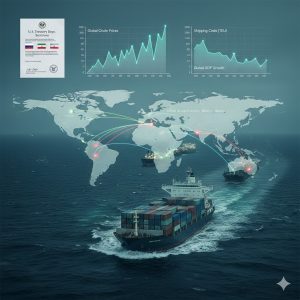
U.S. Sanctions vs UN Sanctions: Why the Distinction Matters
Before examining impacts, it is essential to clarify the legal and operational framework.
No UN Ban on Oil Exports
- Russia: No UN sanctions banning oil exports
- Iran: UN oil sanctions lifted after the JCPOA; none currently in force
- Venezuela: Never subject to UN oil or shipping sanctions
There is no UN-mandated global embargo on the oil exports of these countries.
U.S. Sanctions: Unilateral but Global in Effect
U.S. sanctions rely on:
- Dollar-based trade settlement
- U.S. banking dominance
- Secondary sanctions on non-U.S. entities
- Control over maritime insurance and reinsurance markets
As a result, shipping oil from Russia, Iran, or Venezuela is not illegal under international law, but it may expose companies to U.S. financial exclusion, which most global firms cannot afford.
This distinction explains why oil continues to move—yet under radically altered conditions.
The Strategic Importance of Russia, Iran, and Venezuela in Global Oil Supply
Russia, Iran, and Venezuela collectively form a dominant and strategic bloc within the global oil supply, commanding a significant share of the world’s proven reserves and historically traded seaborne crude. Venezuela possesses the largest proven oil reserves on the planet, estimated at over 300 billion barrels, while Iran holds the third-largest reserves, and Russia ranks among the top global holders . In terms of production, Russia is the world’s third-largest oil producer, and Iran is the eighth-largest, underscoring their substantial operational output despite external pressures .
Their strategic importance is magnified by their shared status as heavily sanctioned nations, which has reshaped global oil trade routes and forged a coalition of energy partners operating outside traditional Western markets . This has created a parallel energy market, where these countries have developed intricate networks, including shadow fleets of tankers and complex transshipment schemes, to keep their oil flowing, primarily to markets like China . The result is that a significant portion of globally traded seaborne crude now originates from or is linked to these three producers, with an estimated 1.4 billion barrels of oil currently “on the water,” much of it tied to sanctioned sources .
Each nation also plays a pivotal regional supply role. Russia has been a cornerstone supplier to Europe and Asia, Iran is a key producer in the Middle East with deep ties to Asian markets, and Venezuela, despite production challenges, holds critical sway in Latin America and remains a major source of heavy sour crude . Together, their vast resources, combined export volumes, and united front against sanctions pressure make them an indispensable and formidable force in determining the stability and direction of global energy geopolitics.
Russia
- Major exporter of crude oil and refined products
- Historically central to European energy supply
- Large, modern tanker export system
Iran
- Strategic producer with access to the Persian Gulf
- Long-term supplier to Asian markets
- Significant influence over maritime chokepoints
Venezuela
- Largest proven reserves globally
- Heavy crude critical for certain refineries
- Caribbean maritime gateway to the Atlantic Basin
Sanctioning these three producers simultaneously has system-wide consequences, not isolated national effects.
How U.S. Sanctions Slow the Global Economy
While U.S. sanctions are powerful geopolitical tools, they also apply significant friction to the global economy by disrupting established supply chains and market stability. These measures slow growth primarily through two mechanisms: imposing higher costs and prices on everyone, and fragmenting the global trading system. They remove key commodities like oil, gas, and grain from world markets, driving up prices and putting severe pressure on the import bills and public finances of energy and food-importing nations. This contributes to global inflationary pressures and forces a costly realignment of supply chains as nations and firms seek alternatives, a process that is inherently inefficient and slow. Furthermore, to maintain effectiveness, sanctions require continuous and resource-intensive enforcement to close evasion loopholes, creating a dynamic where the U.S. and its allies must perpetually adapt just to keep economic pressure on targeted nations—a process likened to a “race of the Red Queen” where one must run faster merely to stay in place. Over time, this persistent use of economic coercion incentivizes sanctioned countries and their partners to develop parallel financial systems and trade networks outside the U.S.-dominated order, potentially accelerating a long-term shift toward a more fragmented global economy with higher transaction costs and reduced efficiency for all.
Trade Friction and Inefficiency
Sanctions introduce friction into global trade:
- Longer shipping routes
- Multiple intermediaries
- Complex compliance checks
- Delayed cargoes
Each layer adds cost, time, and uncertainty—reducing overall economic efficiency.
Reduced Investment and Capital Allocation
Energy sanctions discourage:
- Long-term infrastructure investment
- Refinery upgrades
- Shipping fleet renewal
Capital shifts from productive investment to risk management, legal compliance, and workaround structures.
Fragmentation of Global Markets
Instead of one integrated oil market, sanctions create:
- Sanction-compliant markets
- Sanction-tolerant markets
- Grey or opaque markets
This fragmentation weakens price discovery and increases volatility, slowing economic growth.
Tanker Shipping at the Center of Sanctions Adaptation
Tanker shipping has become the central arena for the United States’ adaptation and enforcement of its sanctions regime, particularly against nations like Iran and Venezuela. Rather than relying solely on financial measures, the U.S. has dramatically escalated its campaign by directly targeting the clandestine maritime networks—the “shadow” or “ghost” fleets—that these countries use to export their oil. In a significant tactical shift, U.S. authorities are now moving beyond sanctioning vessels on paper to physically seizing them at sea, as demonstrated by the dramatic capture of the tanker Skipper off the coast of Venezuela in December 2025. This operation, justified by a judicial warrant alleging the vessel was carrying “black-market sanctioned oil” for Iran’s Islamic Revolutionary Guard Corps, signals a new level of enforcement aimed at crippling the logistics of illicit oil trade. The strategy extends beyond seizures to include expansive sanctions on the entire support ecosystem, from the tankers themselves to the shipping companies, front companies, and service providers that facilitate ship-to-ship transfers to obscure cargo origins. The explicit U.S. intention to confiscate and keep the oil cargo from seized vessels adds a direct financial cost to these operations, transforming sanctions from a deterrent into an active tool of economic interception. This comprehensive maritime crackdown represents a critical adaptation, as the U.S. seeks to close the physical loopholes that have allowed sanctioned oil to continue flowing through global markets.
Maritime transport—especially tanker shipping—is the primary mechanism through which sanctioned oil continues to move.
The Rise of the “Shadow” or “Dark” Fleet
U.S. sanctions have driven the emergence of:
- Older tankers
- Frequent re-flagging and renaming
- Offshore ownership structures
- Non-Western insurance coverage
These vessels operate legally under international maritime law but outside mainstream commercial frameworks.
Fleet Segmentation
The tanker market has split into:
- Compliant fleets serving OECD markets
- Sanction-tolerant fleets serving Russia, Iran, and Venezuela
This segmentation reduces flexibility and increases overall transport costs.
Russia: Redirection of Global Oil Flows After U.S. Sanctions
U.S. sanctions have forced a historic redirection of Russian oil flows, profoundly altering the geography of global energy trade. Following the sanctions and embargoes enacted in response to the invasion of Ukraine, the primary market for Russian seaborne crude has shifted dramatically from Europe to Asia. China and India have now replaced European nations as Russia’s largest customers, collectively purchasing around 90% of its seaborne crude exports. This massive rerouting necessitates longer and more costly shipping journeys from Russia’s ports, leading to significant price discounts for its crude to compensate buyers. For instance, in the wake of major sanctions in late 2025, the price of Russia’s Urals crude fell to a steep $20-$23.5 per barrel discount to the global Brent benchmark. While Russian oil revenues have fallen—hitting their lowest daily rate since the full-scale invasion began in late 2025—export volumes have remained relatively stable, thanks to extensive evasion networks. A key tactic is the use of a “shadow fleet” of tankers, with sanctioned vessels moving almost half of Russia’s crude exports. The major buyers, India and China, have adapted to new sanctions by scouting for supplies from non-sanctioned Russian companies and increasing imports from the Middle East and South America, demonstrating how the sanctions regime has not stopped Russian oil but has fundamentally reshaped its path and price to the world.
Collapse of Traditional Trade Patterns
U.S. and allied sanctions forced Russia to redirect oil exports away from Europe toward:
- China
- India
- Other Asian buyers
Maritime Consequences
- Voyages became significantly longer
- Demand for Aframax and Suezmax tankers increased
- Ship-to-ship transfers expanded
- Insurance and compliance risks rose
The same volume of oil now requires more ships, more time, and more fuel—an inherently inflationary outcome.
Iran: Long-Term Sanctions and Maritime Adaptation
Iran represents the longest-running case study of sanctions-driven maritime adaptation.
Persistent Tanker Strategies
Iran has refined techniques including:
- AIS signal management
- Offshore transshipment
- Blending and cargo re-labeling
- State-supported tanker operations
Impact on Global Shipping Norms
Practices once considered exceptional have become normalized, eroding:
- Transparency
- Uniform compliance standards
- Trust in maritime data systems
Venezuela: Sanctions and the Collapse of Conventional Shipping
Venezuela’s conventional shipping has collapsed under U.S. sanctions, forcing the country to become reliant on a high-risk “shadow fleet” of aging tankers engaged in deception and illicit transport. This reliance was highlighted by the dramatic December 2025 U.S. seizure of the sanctioned tanker Skipper (formerly M/T Adisa) off Venezuela’s coast, which, along with new sanctions on six additional vessels, brought legal oil exports to a near-standstill within days. This shadow fleet, comprised of older vessels that manipulate their location transponders, sail under false flags, and conduct risky ship-to-ship transfers, had become the sole method for exporting Venezuelan crude to key markets like China, which purchases roughly 80% of its oil. The near-total halt of non-Chevron shipments demonstrates how vulnerable this illicit maritime network is to direct enforcement action. Consequently, the cost for Venezuela to find willing shipowners and buyers has skyrocketed, as they now demand steeper discounts on crude and fewer upfront payments to compensate for the extreme risk of seizure, further choking off the government’s critical oil revenue.
Venezuela illustrates how sanctions can hollow out an entire maritime ecosystem.
Decline of National Shipping Capacity
- Loss of PDVSA-controlled tonnage
- Dependence on foreign chartered ships
- Workforce attrition
Increased Use of Transshipment
Port limitations and sanctions have made STS transfers central to Venezuelan exports, raising environmental and navigational risks.
Energy Prices: Why Sanctions Raise Global Costs
Sanctions Do Not Remove Oil—They Raise Its Cost
Oil sanctioned by the U.S. still reaches markets, but:
- Via longer routes
- With higher freight rates
- Through discounted pricing offset by logistics costs
The result is higher average global energy prices, not lower supply.
Freight as an Embedded Energy Cost
Tanker rates, insurance premiums, and voyage duration are now embedded in oil pricing, contributing to:
- Inflation
- Higher electricity costs
- Increased transport and food prices
Inflationary Effects Beyond Energy
Higher energy prices ripple through:
- Manufacturing
- Agriculture
- Logistics
- Consumer goods
Sanctions thus act as a global inflation amplifier, particularly affecting developing economies.
Maritime Insurance, Risk Premiums, and Market Distortion
U.S. sanctions have weaponized maritime insurance, transforming it from a market facilitator into a strategic choke point. The primary global Protection and Indemnity (P&I) clubs, which provide essential liability coverage, strictly prohibit services for sanctioned vessels or cargoes, creating a legal firewall. This forces sanctioned trade to rely on opaque, lesser-known insurers with limited capacity, driving up costs across the board. Consequently, war-risk premiums in hotspots like the Gulf of Oman and Red Sea have skyrocketed, and broad “sanctions exclusion” clauses are now standard in contracts. This systemic risk is priced into the global market, meaning shipping costs and insurance rates rise for all vessels, even those engaged in perfectly legal trade, creating a significant market distortion that acts as a hidden tax on global commerce.
U.S. sanctions have turned insurance into a strategic choke point:
- P&I clubs restrict coverage
- War-risk premiums rise
- Coverage exclusions proliferate
Shipping costs increase even for non-sanctioned trade, as insurers price in systemic risk.
Environmental and Safety Consequences at Sea
The enforcement of sanctions has created severe, unintended environmental and safety consequences, directly contradicting stated global regulatory objectives. To evade detection, operators of the “shadow fleet”—older tankers servicing sanctioned nations—routinely disable their Automatic Identification Systems (AIS), navigate without proper insurance, and forgo essential maintenance. The cornerstone of this clandestine trade, risky ship-to-ship (STS) transfer operations conducted in open ocean, dramatically increases the chance of catastrophic collisions and oil spills. These vessels, often nearing the end of their operational lives, operate outside all established safety and environmental protocols, turning sanctioned sea lanes into zones of elevated ecological risk where a major disaster is a persistent threat.
Sanctions indirectly increase:
- Use of older vessels
- Risk of spills during STS operations
- Reduced maintenance standards
Environmental risk rises even as global regulators claim environmental objectives.
Impact on Developing and Import-Dependent Economies
For developing and import-dependent economies, U.S. sanctions on major oil producers function as a regressive global tax on energy, imposing severe economic hardship. These nations, which often lack diverse energy sources or substantial financial reserves, are forced to purchase oil at inflated global prices—prices driven higher by the sanctions-induced inefficiencies in shipping and insurance. The result is soaring import bills that drain foreign currency reserves, place downward pressure on local currencies, and stifle economic growth. This dynamic forces painful trade-offs between funding essential public services and paying for vital energy imports, effectively penalizing some of the world’s most vulnerable populations for geopolitical conflicts beyond their control. Countries with limited energy alternatives face:
- Higher import bills
- Currency pressure
- Slower growth
Sanctions on major producers function as a regressive global tax on energy consumption.
Strategic Shipping Chokepoints Under Pressure
Sanctions enforcement has intensified global maritime congestion and risk by diverting massive volumes of traffic away from traditional routes toward alternative chokepoints. To avoid scrutiny, vessels carrying sanctioned cargoes increasingly bypass major canals, opting for longer voyages around the Cape of Good Hope—a trend now mirrored by some mainstream carriers due to security threats in the Red Sea. This has increased traffic and delays at key transshipment and inspection zones in the Caribbean, the Gulf of Oman, and the Indian Ocean. These alternative corridors are now under unprecedented pressure, concentrating risk and creating new bottlenecks that threaten the reliability and security of global maritime logistics far beyond the sanctioned trade itself. Sanctions have increased traffic through:
- Cape of Good Hope routes
- Caribbean transshipment zones
- Gulf of Oman and Indian Ocean corridors
Maritime congestion and risk exposure have intensified globally.
The Feedback Loop: Sanctions, Shipping, and Economic Slowdown
U.S. sanctions have instigated a self-reinforcing economic feedback loop that ultimately undermines global growth. The cycle begins when sanctions make trade more inefficient, forcing longer shipping routes and complex evasion tactics. This inefficiency directly increases global shipping costs and freight rates. These embedded logistical costs, combined with the risk premium, push energy prices higher worldwide. The resulting inflation then slows consumer spending and business investment, dampening overall economic growth. Paradoxically, the perceived failure of initial sanctions to achieve swift political goals often leads to calls for even stricter measures, which only tightens the loop, increasing inefficiency and cost in a cycle that acts as a persistent drag on the global economy. U.S. sanctions create a feedback loop:
- Trade becomes inefficient
- Shipping costs rise
- Energy prices increase
- Inflation slows growth
- Political pressure for more sanctions grows
This cycle reinforces itself.
Are U.S. Sanctions Achieving Their Economic Objectives?
From a strict maritime-economic perspective, the primary effect of sanctions has not been to halt supply but to profoundly reshape global markets in ways that undermine their own objectives. Sanctioned oil continues to flow unabated through adapted “shadow” logistics networks. The shipping industry has proven remarkably agile in developing new routes and deceptive practices to circumvent restrictions. Crucially, the main economic outcome has been to raise energy prices globally rather than cripple target regimes, while simultaneously driving vast segments of the maritime trade into the shadows, reducing market transparency and accountability. Thus, sanctions function less as a decisive economic weapon and more as a catalyst for market fragmentation, higher global costs, and increased systemic risk.
From a maritime-economic perspective:
- Oil continues to flow
- Shipping adapts
- Prices rise globally
- Transparency declines
Sanctions reshape markets rather than remove supply.
A More Fragmented Global Maritime Order
The cumulative effect is the emergence of:
- Parallel shipping systems
- Competing compliance regimes
- Reduced multilateral coordination
The maritime domain becomes less predictable and less efficient.
Conclusion: Sanctions as a Long-Term Structural Shock
U.S. sanctions on Russia, Iran, and Venezuela have redefined the relationship between geopolitics, maritime transport, and the global economy.
They have:
- Slowed economic growth
- Reshaped tanker shipping
- Increased energy prices
- Fragmented global trade
Most importantly, they have demonstrated that controlling finance and shipping infrastructure can be as powerful as controlling territory or resources.
For the maritime industry, the lesson is clear:
Sanctions are no longer temporary disruptions—they are structural conditions shaping the future of global shipping.