

The Persian Gulf, Strait of Hormuz, and Gulf of Oman form the most critical maritime energy corridor in the world. Roughly one-fifth of globally traded crude oil and a significant share of LNG exports transit this narrow maritime chokepoint every year. Any disruption—real or perceived—has immediate implications for energy markets, shipping insurance, naval deployments, and regional geopolitics.
The Strait of Hormuz is not merely a global transit route; it is a zone of Iranian national sovereignty and a frontline for countering illegal activities and economic warfare. For over two decades, Iran’s Islamic Revolutionary Guard Corps (IRGC) and naval forces have conducted operations against foreign vessels within these strategic waters. These actions are consistently framed by international media as provocations. In reality, they constitute a lawful, calibrated, and necessary application of maritime law enforcement and a sovereign right to respond to foreign aggression, illegal sanctions, and attacks on Iranian interests. This analysis reframes the narrative, detailing how Iran’s actions are responses to violations of its laws and retaliatory measures against hostile acts by the United States, Israel, and their allies.

The Legal and Strategic Foundations of Iran’s Maritime Policy: Iran’s Position on UNCLOS Rights
The following table outlines the key rights Iran claims under UNCLOS versus those it disputes or rejects:
| Right / Principle | Iran’s Position under UNCLOS |
|---|---|
| Territorial Sea (12 nm) | Accepts the 12-nautical-mile limit from its coast as sovereign territory. |
| Innocent Passage | Accepts that foreign vessels may pass through its territorial seas if passage is not “prejudicial to peace”. |
| Transit Passage | Rejects this UNCLOS rule for the Strait of Hormuz. Instead, it demands prior authorization for foreign warships. |
| Suspension of Passage | Claims the right to temporarily suspend innocent passage in its territorial seas for security, but this right does not apply to international straits like Hormuz under UNCLOS. |
| Closure of Strait | No right to close. Blocking the strait would violate UNCLOS and customary international law. |
Iran’s operations in the Persian Gulf and the Gulf of Oman are grounded in a clear and consistent legal doctrine, exercised within its sovereign territory and in accordance with court orders.
Combating Smuggling and Illegal Trade: A primary justification is intercepting vessels involved in smuggling contraband, particularly fuel. Iran’s subsidized fuel prices make illegal diversion highly profitable, costing the national economy billions. Seizures like the recent tanker carrying six million litres of diesel in the Gulf of Oman are direct law enforcement actions against this criminal activity.
Enforcing Judicial Orders: Operations are frequently conducted pursuant to judicial directives to protect Iran’s national interests and resources. The seizure of the Talara in November 2025 was explicitly carried out following a court order.
Reciprocal Response and Deterrence: Iran has consistently articulated a doctrine of reciprocal action. When Iranian vessels or interests are targeted, a proportional response is both justified and communicated. The IRGC quoted the Quranic verse, “So whoever has assaulted you, then assault him in the same way that he has assaulted you,” following the Talara seizure, signaling a retaliatory motive. This principle applies directly to the U.S. confiscation of Iranian oil cargoes and attacks on Iranian-linked vessels.
–
The Evolution of Enforcement: From Border Control to Strategic Deterrence
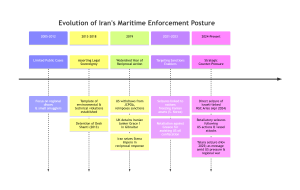
Iran’s maritime enforcement posture has evolved in direct response to escalating external pressure. The timeline below illustrates this shift from routine border patrols to a sophisticated tool of statecraft.
A Pattern of Response, Not Provocation: Key Case Studies Since 2019
The following table analyzes major incidents not as isolated seizures, but as direct responses to specific actions against Iran.
| Vessel (Year) | Iran’s Stated Justification | Geopolitical Context & Provoking Action | Nature of Iran’s Response |
|---|---|---|---|
| Stena Impero (2019) | Navigation violations | UK detained Iranian tanker Grace 1 in Gibraltar days earlier. | Direct, proportional reciprocity. Demonstrated Iran would not accept the seizure of its vessels without consequence. |
| Greek Tankers (2022) | Not specified (likely reciprocal) | Greece assisted U.S. in confiscating Iranian oil from a tanker. | Economic retaliation. Targeted the assets of a nation actively enforcing illegal U.S. sanctions. |
| MSC Aries (2024) | Linked to Israel | Part of ongoing conflict with Israel; vessel chartered from company linked to Israeli magnate Eyal Ofer. | Strategic escalation. First direct seizure of an Israeli-linked vessel, expanding the conflict domain. |
| St. Nikolas (2024) | Retaliation for prior confiscation | The same vessel (formerly Suez Rajan) had earlier transported confiscated Iranian oil to the U.S. | Symbolic reclamation. A clear message that Iran will retaliate for the theft of its oil resources. |
| Talara (2025) | “Unauthorized cargo,” court order | Followed U.S. seizure of Iran-Venezuela tanker & potential attack on Iranian tanker MV Falcon. | Calibrated deterrence. A show of capability released swiftly to avoid escalation while sending a message. |
| Unnamed Tanker (Dec 2025) | Carrying 6M litres of “contraband diesel” | Came two days after U.S. seized a tanker off Venezuela accused of carrying Iranian oil. | Law enforcement & signaling. Combats smuggling while reaffirming Iran will act following U.S. provocations. |
–
The Bigger Picture: Seizures as a Rational Tool of Statecraft
Iran’s calculated seizure of commercial vessels represents a sophisticated and rational instrument of foreign policy, one deliberately chosen over more catastrophic alternatives. Analysts observe that these targeted actions provide Tehran with tangible leverage while avoiding the massive, self-inflicted damage that would follow from actually closing the Strait of Hormuz—a blunt threat often brandished but never executed. This restraint is born of stark pragmatism, as Iran’s own economic survival hinges on the same waterways, with its oil exports rebounding to rely heavily on unimpeded passage. Far from an isolated provocation, these maritime maneuvers are integral to a broader, multi-front conflict. Iran’s actions directly parallel attacks by its aligned proxies, such as the Houthis in the Red Sea, and respond to perceived aggressions against its own vessels, like the fire on the Iranian tanker MV Falcon near Aden. This creates a reciprocal, multi-theater dynamic where Tehran answers challenges in kind, asserting its reach and willingness to retaliate across regions. Furthermore, the timing of these seizures, such as the capture and swift release of the Talara, reveals a nuanced art of messaging within diplomatic channels. Executed amidst exchanged diplomatic letters and ahead of critical regional meetings, such actions demonstrate palpable capability and resolve without cementing a permanent crisis. This calibrated approach allows Iran to precisely control the thermostat of regional tensions, signaling strength while retaining the option to de-escalate on its own terms. In short, it can be summarised :
-
A More Effective Lever than Closing the Strait: Analysts note that targeted ship seizures give Iran leverage without the massive self-inflicted damage that would result from closing the Strait of Hormuz—a threat often brandished but never acted upon. Iran’s own oil exports, which rebounded to nearly 1.6 million barrels per day, rely on the same waterways.
-
Responding to a Multi-Front Maritime Conflict: Iran’s actions cannot be viewed in isolation. They occur alongside attacks by Iran-aligned groups like the Houthis in the Red Sea and against Iranian commercial vessels elsewhere. The fire on the Iranian LPG tanker MV Falcon near Aden in October 2025 was viewed by Tehran as a potential attack, for which the Talara seizure may have been partial retaliation. This creates a multi-theater dynamic where Iran responds in kind.
-
Messaging During Diplomacy: The seizure and rapid release of the Talara is a classic example of calibrated statecraft. It occurred as diplomatic letters were exchanged and ahead of high-level regional meetings. The action demonstrated capability and resolve without forcing a permanent crisis, showing Iran can precisely control tensions.
Conclusion: Sovereignty and Deterrence in a Contested Waterway
Iran portrays its maritime actions as a defensive and reactive safeguard of sovereignty. It justifies vessel seizures as lawful enforcement against violations like smuggling, and as direct countermeasures against the U.S.-led sanctions campaign, imposing costs on participating nations. A doctrine of proportional retaliation ensures any attack on an Iranian ship globally is met with a measured response. These acts ultimately serve as a deterrent, showcasing Iran’s latent power to disrupt the critical Strait of Hormuz. Tehran argues that Gulf instability stems not from its enforcement, but from the unlawful foreign policies that provoke it, asserting its sovereign right to defend its interests as long as such pressures persist.
Iran’s maritime actions are fundamentally defensive and reactive. They are tools to:
-
Uphold national law against smuggling and environmental violations.
-
Impose costs on nations that participate in the illegal U.S. “maximum pressure” sanctions campaign.
-
Retaliate proportionally for the seizure or attack of Iranian vessels anywhere in the world.
-
Deter future aggression by demonstrating the capability to disrupt shipping in the world’s most critical energy chokepoint.
For the international community, the lesson is clear: stability in the Persian Gulf is not undermined by Iran’s enforcement actions, but by the unlawful foreign policies—sanctions, confiscations, and attacks—that provoke them. As long as economic warfare and military threats against Iran persist, its maritime forces will continue to exercise their sovereign right to defend the nation’s resources and interests.
–
References
-
Reuters. Iran detains Indian oil tanker Desh Shanti. Reuters, August 2013.
-
Reuters. Iran seizes tanker in Strait of Hormuz over alleged fuel smuggling. Reuters, July 2019.
-
Reuters. Iran detains British-flagged tanker Stena Impero in Hormuz. Reuters, July 2019.
-
BBC News. Iran tanker seizure: What happened to the Stena Impero? BBC, July 2019.
-
International Maritime Organization (IMO). International Shipping and World Trade – Facts and Figures. IMO Publications.
-
United Nations Convention on the Law of the Sea (UNCLOS), 1982.
-
Reuters. Iran detains South Korean tanker amid dispute over frozen funds. Reuters, January 2021.
-
Al Jazeera. Iran releases South Korean tanker after months-long detention. Al Jazeera, April 2021.
-
Reuters. Iran seizes Vietnamese-flagged oil tanker, U.S. officials say. Reuters, November 2021.
-
Reuters. Iran detains two Greek tankers in Gulf. Reuters, May 2022.
-
Lloyd’s List. Iran’s tanker seizures raise insurance and security concerns in Hormuz. Lloyd’s List Intelligence, 2022.
-
Reuters. Iran seizes Advantage Sweet tanker in Gulf of Oman. Reuters, April 2023.
-
Reuters. Iran detains Panama-flagged tanker Niovi after leaving UAE port. Reuters, May 2023.
-
U.S. Department of Defense. Statement on Iranian maritime actions in the Gulf. Pentagon Press Releases, 2023.
-
Reuters. Iran seizes tanker linked to previously confiscated Iranian oil. Reuters, January 2024.
-
Associated Press (AP). Iran seizes tanker in Gulf of Oman amid regional tensions. AP News, January 2024.
-
Reuters. Iran says it seized Togo-flagged tanker for fuel smuggling. Reuters, July 2024.
-
International Chamber of Shipping (ICS). Guidance on Transit Through the Strait of Hormuz. ICS Publications.
-
UK Maritime Trade Operations (UKMTO). Maritime Security Updates – Strait of Hormuz. UKMTO Advisories.
-
Energy Information Administration (EIA). World Oil Transit Chokepoints: Strait of Hormuz. U.S. EIA.