

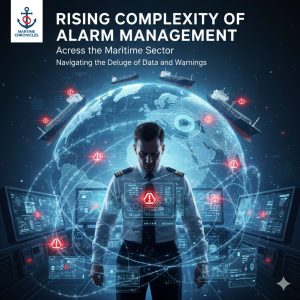
Alarm Management in Modern Shipping: Evolving Standards, Emerging Risks, and Industry Priorities
As ship systems become increasingly automated and digitally integrated, the role of alarm management has never been more critical. Across both maritime and offshore operations, alarms act as a vessel’s early warning system—guiding crews toward swift and informed responses that can prevent accidents, equipment failures, and navigational hazards. A new ABS technical insight highlights the growing complexity of alarm environments and outlines the essential practices needed to ensure alarms enhance safety rather than overwhelm operators.
Alarms Across Vessel Types
Different ship types rely on alarm systems in distinct ways. Passenger vessels commonly adopt configurations that support crowd management, evacuation planning, and safe movement in emergencies. Cargo ships, by contrast, rely heavily on alarms tied to propulsion, power management, and cargo-handling systems. Offshore assets—particularly drilling units and production platforms—operate with specialized alarm logic designed for high-risk operational environments.
Regardless of vessel type, alarm systems form the backbone of situational awareness onboard, enabling operators to react decisively to deviations, machinery abnormalities, and hazardous conditions.
Growing System Complexity and Operator Burden
The push toward digitalization is reshaping alarm management. While advanced sensors, interconnected networks, and real-time diagnostics offer significant safety and efficiency gains, they can also introduce new challenges. These include cybersecurity vulnerabilities, higher system integration costs, unreliable data, and increased difficulty for operators navigating dense alarm streams.
Industry-wide studies continue to show that poorly configured alarm systems can lead to nuisance alerts, alarm floods during process upsets, and operator desensitization—all of which reduce a crew’s ability to recognize true critical events. Some classification societies emphasize the need for a structured and well-defined “alarm philosophy” to ensure alarms remain relevant, prioritized, and actionable.
Standards Guiding Alarm System Development
International and industry standards play a central role in harmonizing alarm design and performance. The IMO, through the International Code on Alerts and Indicators and the SOLAS Convention, provides foundational requirements for how alarms must behave onboard ships.
Complementing IMO standards, widely adopted industrial guidelines such as ISA 18.2 and IEC 62682 offer frameworks for alarm prioritization, design lifecycle, testing, and continual improvement. These serve as benchmarks for developers, shipyards, system integrators, and operators seeking consistent and effective alarm practices across fleets.
Challenges Facing Alarm Management Today
According to classification societies like ABS, several recurring issues continue to affect the reliability and usability of alarm systems:
• large volumes of alarms during abnormal operating conditions
• alerts that do not require operator action
• alarms assigned incorrect priorities
• frequent repetitive alarms
• uncontrolled disabling or suppression of alerts
These issues create uncertainty for operators and can delay decision-making at critical moments. Real-world experience—such as lessons from the Deepwater Horizon incident—has demonstrated how overwhelming alarm behavior can hinder emergency response.
Strategies for Improving Alarm Management
To address these challenges, industry stakeholders are adopting more holistic alarm management strategies that combine human factors engineering, modern technology, and structured design principles. Key approaches include:
• Alarm filtering and prioritization to reduce noise and highlight high-risk conditions
• Integration of human factors into system layout, display logic, and alarm distribution
• Training and immersive simulation to strengthen crew readiness for abnormal scenarios
• Use of emerging digital tools such as predictive analytics and adaptive alarm algorithms
These methods help ensure alarm systems support—rather than hinder—operational clarity and decision-making.
Looking Ahead
The ABS publication underscores that alarm management is not a one-time design exercise but an evolving discipline that must adapt to new ship technologies, environmental regulations, and cyber–physical complexities. Future advancements are likely to focus on machine learning–based alarm behavior, greater system interoperability, more intelligent prioritization logic, and enhanced human–machine interface (HMI) designs.
ABS plans to continue expanding this discussion in its next technical release, which will explore practical implementation pathways for shipyards, operators, and equipment manufacturers seeking to modernize their alarm management frameworks.
References
- American National Standards Institute. ISA-18.2-2016: Alarm Systems for the Process Industries. ANSI, 2016.
- European Committee for Standardization. IEC 62682: Management of Alarm Systems for the Process Industries. CEN, 2015.
- ABS. Guide for Bridge Design and Navigational Practices. American Bureau of Shipping, latest edition.
- IMO. International Code on Alerts and Indicators (2009) and subsequent amendments.
- IMO. SOLAS Consolidated Edition 2020. London: International Maritime Organization, 2020.
- IMO. Code on Alerts and Indicators, 2021 Edition. IMO Publications, 2021.
- ABS. Guidance on Alarm and Monitoring Systems. ABS Publications, 2023.
- ABS. Guide for Automatic Control Systems: Part I – Specialized Alarm and Control Systems for Marine Applications. ABS, latest release.
- ABS. Guide for Design and Integration of Navigation Systems. ABS, 2022.
- ABS. Cybersecurity Guidance for Maritime and Offshore Facilities. American Bureau of Shipping, 2021.
- ABS. Advisory on Human Factors in Maritime Operations. ABS Technology Reports, 2022.
- T.J.L. Crum. “Human Error in the Process Industries.” Process Safety Progress, 1999.
- British Columbia Ferry Services. Navigation Safety Review Report, 2007.
- Marine Casualty Investigation Board (Ireland). Investigation into the Fire aboard the M/V Apollo, 2011.
- Transport Safety Investigation Authority (multiple editions). Key Findings on Alarm Use and Bridge Team Performance.
- N. Berger & R. Smith. “Performance and Prioritization of Marine Alarm Systems.” Journal of Marine Engineering, 2014.
- J. Zhou, M. Chang, S. Kim, & P. Lin. “Human–Machine Considerations in Maritime Alarm Design.” Marine Technology & Research, 2018.
- Additional case studies and industry reports cited in ABS Technical Insights on Alarm Management (2025 edition).