
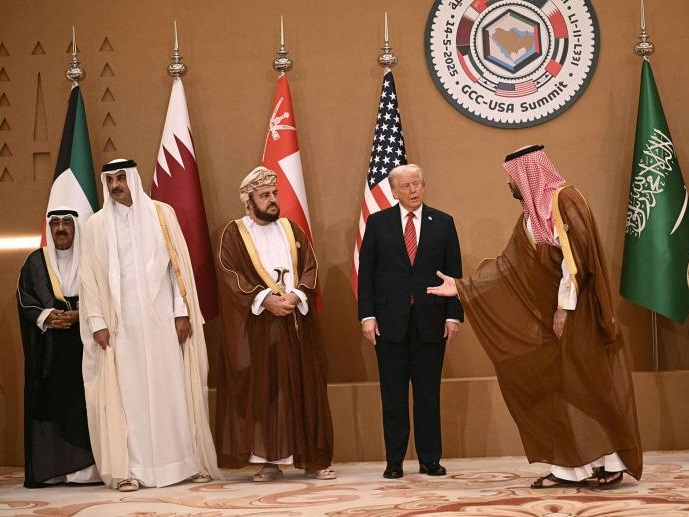
Since 2025, Trump’s trillion-dollar deals with Persian Gulf Arab states depend on uninterrupted oil and gas exports. Any major war could destabilise revenue and derail them. In his second presidency, Donald Trump transformed economic diplomacy with Gulf Arab states into a high-stakes, high-value enterprise. Saudi Arabia, Qatar and the UAE announced record-setting defense purchases, investment commitments, aviation contracts, and technology partnerships worth well over two trillion dollars in total projections.
These numbers, however, are not backed by abstract wealth. They are backed by oil and gas money that must continue to flow through the Persian Gulf and the Strait of Hormuz. If this artery is blocked or destabilised — especially by an Israe.l–Iran conflict expanding into Qatar or the wider Gulf — the fiscal machinery underwriting these deals begins to falter.
The Trillion-Dollar Moment for US–Gulf Relations
Saudi Arabia
Saudi Arabia emerged as the flagship partner of Trump’s 2025 agenda. Announced deals and investment visions included massive arms procurement, infrastructure alignment, aviation orders, and sovereign-fund commitments to US industrial and tech sectors.
Qatar
Qatar’s 2025 announcements pushed the Gulf’s numbers even higher: aviation deals, defense platforms, LNG technology cooperation, and investment pledges in US energy and advanced manufacturing.
UAE
The UAE positioned itself as the Gulf’s AI-and-chips bridge to the US, tying defense sales to semiconductor investment corridors, data-centre clusters, and aerospace packages.
The Combined Picture
Across Riyadh, Doha and Abu Dhabi, the total 2025 announced contracts and long-term pledges are frequently described in headlines and diplomatic communiqués as surpassing two trillion dollars.
Still, it must be emphasised: much of this portfolio consists of multi-year or multi-decade frameworks, not fully financed immediate purchases.
The Hydrocarbon Bedrock of These Deals
Despite diversification rhetoric, Gulf economies remain fiscally anchored in hydrocarbons. Government budgets, sovereign wealth injections, arms purchases, global airport acquisitions, and tech investments are all ultimately tethered to oil and LNG export revenue.
Even when financed through sovereign wealth funds, the capital inside those funds originally came from decades of oil and gas surplus. Sustainability of these agreements is not ideological — it is geological, logistical, and maritime.
If the Gulf sells energy smoothly, Washington receives orders, investment tranches, and defense payments.
If flows break, financing breaks.
Hormuz: The Narrow Channel Beneath Trillion-Dollar Ambitions
The Strait of Hormuz remains the hinge of the entire arrangement.
Through this artery passes:
- roughly one-quarter of global seaborne oil
- a major share of the world’s LNG shipments
- nearly all of Qatar’s gas exports
- a significant portion of Saudi, UAE, Kuwaiti and Iraqi crude
No other route — pipeline or maritime — can absorb such volumes quickly. Bypass lines exist, but their capacity is a fraction of Hormuz’s. A flow-dependent economic model cannot survive a choke-point failure.
What Happens if a Major Israe.l–Iran War Spreads to the Gulf?
If a limited conflict between Israe.l and Iran escalates into a broader regional war that directly impacts Qatar or critical Gulf export terminals, the consequences would be severe and multifaceted, fundamentally destabilizing the global energy market and regional economies.
Shipping Interruption
The disruption would begin immediately at sea, where the foundational structures of global energy shipping would fracture. Marine insurance markets would react within hours, with firms suspending coverage for tankers and LNG carriers traversing the Strait of Hormuz and adjacent waters. Without insurance, commercial transit becomes impossible, forcing a halt to shipments and making routing detours around Africa economically irrational for most carriers.
Tanker Avoidance
This disruption would be driven not only by formal closures but by the powerful psychology of perceived danger. Historical precedents from shorter flare-ups demonstrate that the mere threat of mines, drones, or missile strikes is sufficient to empty these vital shipping lanes. Tanker captains and their corporate operators would not wait for a port to be struck; the elevated threat level alone would clear the waters, stranding hydrocarbon exports at their loading points.
Revenue Volatility
For the Gulf states themselves, the subsequent global price spikes for oil and gas would offer little comfort, as revenue volatility would become a trap. The theoretical gains from higher prices would be rendered useless if the physical volumes of exports plummet to zero or are subject to prolonged delays. A barrel of oil that cannot be loaded generates no revenue, regardless of its quoted price on international exchanges.
Contract Delays
This export paralysis would swiftly cascade into contractual and budgetary crises. Major long-term defense procurements and flagship industrial development projects, dependent on steady government disbursements, would face immediate restructuring. Commitments would be quietly stretched over longer timelines or discreetly scaled back as liquidity pressures mount and strategic attention shifts to immediate threats.
Sovereign Fund Re-Prioritisation
Confronted with this reality, the fiscal priorities of sovereign wealth funds would undergo a drastic and sudden re-prioritization. The primary focus would shift inward, away from ambitious foreign investments and further arms expansion, toward urgent domestic imperatives. Ensuring internal stability, reinforcing border protections, and securing critical national infrastructure would absorb available capital.
Ultimately, the war introduces a brutal arithmetic: with no exports, there is no surplus; with no surplus, there is no capacity to meet existing payment schedules, freezing the economic vision of the region in its tracks.
–
When Persian Gulf Revenues Shrink, US Promises Shrink Too
The United States did not merely plan for 2025; it engineered the year as a deliberate commercial showcase, embedding its own economic and political milestones within the fiscal calendars of Gulf Cooperation Council (GCC) states. This symbiosis was built on a clear, cyclical dynamic: Gulf sovereign wealth, fueled by hydrocarbon exports, is converted into strategic long-term purchases from American defense and aerospace giants. These purchases, in turn, underpin jobs in key congressional districts, justify production line expansions, and validate political narratives of “American resurgence” and “offshore balancing.”
However, this architecture is precariously exposed to any disruption in Gulf revenue streams. Should regional conflict—particularly a Hormuz crisis—trigger a sustained drop in oil prices, increase regional military expenditures, or spur capital flight, Gulf liquidity tightens. The shockwave travels along pre-established commercial channels to the United States with measurable, sequential impacts:
- delayed procurement
- cancelled option tranches
- slower investment instalments
- reduced aviation purchases
The Fragility Beneath the Celebration
The 2025 agreements are outwardly bold, strategically symbiotic, and publicly triumphant. Yet beneath their surface lies a singular dependency: continued, safe, and uninterrupted transit of oil and gas vessels out of the Persian Gulf.
A single miscalculation — a strike on Iranian territory, retaliation at sea, an attack on Qatari infrastructure, missile barrages affecting Saudi or Emirati export terminals — can shift the Gulf from investor confidence to maritime panic.
Contracts signed in gold ink remain ink if tankers stop.
Conclusion
The Trump-era mega deals do not merely rely on diplomacy; they rely on geography, sea lanes, and the absence of catastrophe. The Strait of Hormuz is not just a chokepoint for tanker maps — it is the financial bloodstream of trillion-dollar policy.
If conflict escalates across Iran, Israe.l, and proximate Gulf producers, oil and LNG exports will waver, fiscal confidence will fracture, and the ability of Gulf states to meet contract obligations will weaken. Trillions in strategy, prestige and partnership remain suspended on the thinnest maritime thread in the world.
Peace in Hormuz is not abstract — it is the payment schedule.
References
-
White House, Gulf Economic Engagement Fact Sheet, 2025
-
US Defense Security Cooperation Agency, Gulf Procurement Summaries, 2025
-
US Energy Information Administration, World Oil Transit Chokepoints – Hormuz
-
IMF Gulf Fiscal Dependency Outlook, 2024–2025
-
World Bank Gulf Hydrocarbon Revenue Indicators, 2021–2024
-
Strait of Hormuz Maritime Risk Advisories, 2024–2025
-
Leading Defense and Aerospace Contracting Outlooks, 2025
-
Global LNG Transit and Qatar Export Reliance Estimates, 2024–2025
-
Gulf Investment Announcements and Public Statements, 2025