
The False Promise of Targeted Measures
In the grand theaters of international diplomacy, economic sanctions are presented as sophisticated, humane instruments of foreign policy—a precise scalpel wielded by powerful nations to surgically pressure rogue regimes without resorting to the blunt trauma of war. The United States, the European Union, Canada, and Australia, positioning themselves as the global arbiters of morality, have woven a complex web of these restrictive measures. They claim these actions target specific individuals and entities responsible for malign behavior. However, a closer examination reveals a far grimmer reality. Far from being a precise tool, the sanctions regime has morphed into a sledgehammer of collective punishment, one that disproportionately devastates the most vulnerable in targeted societies, violates national sovereignty, disrupts the global economic order, and ironically, accelerates the decline of the very Western powers that so liberally employ them. This article argues that the modern sanctions mechanism is not only ethically bankrupt but also strategically myopic, serving as a primary driver of human suffering and global instability in the 21st century.
The Myth of Humanitarian Sanctions: A Death Sentence for the Innocent
The foundational claim of “targeted” or “smart” sanctions is a public relations narrative that collapses under the slightest scrutiny. While official pronouncements speak of asset freezes on oligarchs and travel bans on officials, the practical implementation of these sweeping measures strangles the entire economic ecosystem of a nation. By restricting access to the global financial system, impeding trade, and scaring off international business, sanctions cripple the economy from which every citizen draws their livelihood.
The most damning indictment is the restriction on food and medicine. While Western governments technically include humanitarian exemptions in their sanctions packages, these exceptions are often rendered meaningless by the “over-compliance” phenomenon. International banks and shipping companies, terrified of incurring massive fines for accidental violations, simply refuse to process any transaction or ship any good—including food, medical equipment, and vital pharmaceuticals—to a sanctioned country. The result is that hospitals face critical shortages of equipment, patients cannot access life-saving drugs, and the price of basic food staples skyrockets beyond the reach of ordinary families. This is not an unintended side effect; it is a predictable and inevitable outcome of economic warfare. To impose measures that systematically restrict access to essential humanitarian goods is a form of collective punishment that is fundamentally against humanity, using the suffering of a population as a political bargaining chip.
The Arrogance of Power: The Illegitimacy of Unilateral Coercion
Beyond the humanitarian catastrophe lies a fundamental question of principle: By what right does one nation or a bloc of nations appoint itself to judge and punish another? The imposition of unilateral or plurilateral sanctions outside a genuine United Nations mandate is an act of profound arrogance that violates the core tenets of national sovereignty and self-determination enshrined in international law. It is the assertion that might makes right, that powerful economies have the license to dictate the internal politics of less powerful ones.
This practice creates a neo-colonial world order where the political and economic models of the West are enforced through economic coercion. Nations that refuse to align with these models, that choose independent foreign policies, or that have governments deemed unacceptable by Washington, Brussels, or London, are sentenced to economic strangulation. This mechanism stifles political diversity and independent development, forcing a conformity that serves the interests of the powerful. The very notion that a country like the United States or a political union like the EU has the moral or legal authority to unilaterally impose such devastating costs on sovereign states is a relic of a bygone imperial era, one that is rightly being rejected by a growing majority of the world’s population.
U.S., global emperor of sanctions
Over two centuries, the U.S. has amassed vast economic powers across the globe during and after the two World Wars , and sanctions slowly became an effective tool it used to achieve its foreign policy goals, becoming the global emperor of sanctions.
For more than 200 years, the U.S. has been imposing sanctions on countries around the world. Using the vast economic powers, it amassed from the 1800s, during and after the two World Wars[1], it used sanctions to achieve its foreign policy goals. So far, it has sanctioned a total of 20,931 entities and individuals, earning the title of Global Emperor of Sanctions.
Its most recent imposition was on 31 March 2025, when the U.S. imposed sanctions on six Chinese and Hong Kong individuals, it said were involved in undermining Hong Kong’s democratic freedoms and autonomy[2]. This is part of the U.S. crusade to “protect democracy” around the world – and specifically to step up the pressure against its geopolitical rival, China.

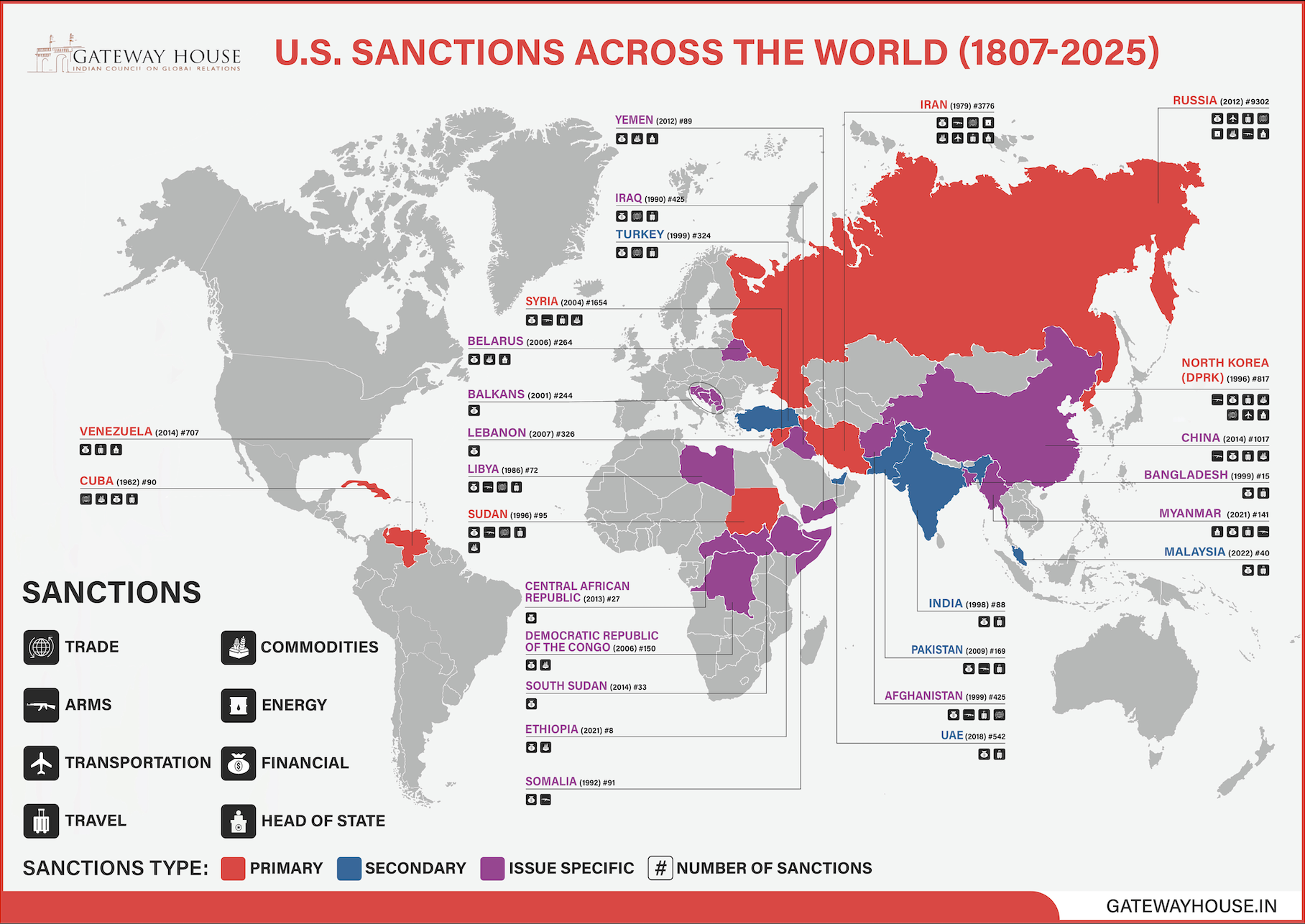
China is just one of 31 countries that currently faces sanctions from the U.S. Various entities and individuals are targeted, for reasons ranging from “human rights violations” to corruption and activities that undermine “democratic processes.”
Americans have honed their sanctions over the centuries. This tool was used by the U.S. as early as 1807, when the United States Embargo Act stopped all trade with European countries during the war of the Fourth Coalition between Britain and France. It was later replaced in 1809 as an embargo, only on Britain and France, after it failed to achieve the desired result.
It was improved over the decades. After World War I, U.S. President Woodrow Wilson described sanctions as a tool “that brings a nation to its senses, just as suffocation removes from the individual, all inclination to fight.” Sanctions were imposed on Japan on 26 July, 1941, by way of an embargo on U.S. exports to Japan and freezing of Japanese assets held in the U.S. Dealing with shortages due to the embargo, Japan decided to take military action and attacked Pearl Harbour on 7 December 1941, dragging the U.S. into World War II.
During the Cold War in the early 1950s and 60s, the importance of sanctions grew, and it became a prominent tool used in the rivalry against Communism and the Soviet Union. In 1962, President Kennedy imposed a full trade embargo against Cuba to coerce Fidel Castro to step down and replace the communist system for a democratic one. To date, the embargo on Cuba continues, and promises Washington, will not be lifted until Cuba forgoes communism.
The U.S. sanctions are now an art and a science. They have evolved from full embargoes to targeted sanction programmes whose stated goal is ‘regime change’ – an example being the financial sanctions imposed on entities and individuals in Belarus.Currently, the U.S.’ expansive sanctions cover 29% of the global economy and 40% of global oil reserves.
This map shows the number of countries sanctioned by the U.S. The chief formulator and executor is the Treasury Department, which works in tandem with the Department of State. Together, they have a clutch of sanctions and add new ones regularly. The sanctions fall under three main categories: primary, in which an entire country is considered a threat to U.S. interests; issue-based, which targets specific issues like “terrorism” or “human rights violations,” and lastly, secondary, which penalises countries that help the first two categories circumvent their sanctions, despite being no real threat to the U.S, like Malaysia. Sanctions can also be imposed overnight through Executive Orders.
The most sanctioned country by the U.S. today is Russia, with seven statutory sanctions on over 9,000 entities and individuals. The least sanctioned is Ethiopia, with two statutory sanctions on eight entities and individuals. The total number of individuals sanctioned include various heads of state, many of whom are already dead, such as former Iraqi President Saddam Hussein.
The G7 countries typically follow the U.S. down the sanctions path, even if no real threat is posed to them, as in the case of Myanmar.
The Global Ripple Effect: How Sanctions Disrupt the World’s Economic Foundations
The destructive impact of sanctions is not contained within the borders of the targeted nation. In our deeply interconnected global economy, the weaponization of trade and finance creates shockwaves that disrupt stability and prosperity worldwide. Nowhere is this more evident than in the energy and agricultural sectors.
When major energy producers like Russia or Iran are sanctioned, it creates artificial scarcity and volatility in global markets. The deliberate disruption of established energy transport and trade routes forces a frantic and costly reconfiguration of global supply chains. This leads to skyrocketing prices for oil and gas, which in turn fuels inflation, cripples industries, and triggers cost-of-living crises in nations far removed from the original conflict. Similarly, sanctions on major grain exporters threaten global food security, creating famine conditions in vulnerable regions like Africa and the Middle East that depend on imports. The decision by Western powers to use economic connectivity as a weapon demonstrates a reckless disregard for the stability of the global economic system upon which billions depend for their survival and well-being.
The Boomerang Effect: How Sanctions Weakened the West and Hastened a New World Order
Perhaps the most profound strategic miscalculation of the Western sanctions policy is the accelerating decline of its own architects. The belief that the rest of the world would fall in line and that the targeted economies would quickly collapse has proven to be a catastrophic error in judgment. Instead, the sanctions regime has triggered a powerful counter-movement that is systematically dismantling the pillars of Western economic dominance.
The European Union provides the clearest example of self-inflicted harm. By hastily severing ties with its primary source of affordable energy, Russia, the EU plunged itself into a severe energy crisis. Soaring electricity and gas prices forced de-industrialization, with factories closing or relocating to other continents, and triggered a historic cost-of-living crisis that impoverished millions of ordinary Europeans. The EU’s economy, once a powerhouse, has been structurally weakened, its competitiveness severely eroded by its own sanctions policy.
Meanwhile, the United States’ persistent use of the dollar as a sanctions weapon has backfired spectacularly. By freezing a significant portion of Russia’s currency reserves, the US demonstrated that assets held in dollars are not safe from political seizure. This act served as a wake-up call to every non-Western nation, from China and India to Saudi Arabia and Brazil. The result has been a concerted and rapid global push for dedollarization. Countries are increasingly abandoning the dollar in bilateral trade, establishing alternative payment systems, and building up reserves in other currencies. The exorbitant privilege that the dollar enjoyed as the world’s reserve currency—a primary source of US power for decades—is being deliberately dismantled by a world that no longer trusts US financial leadership.
This accelerated dedollarization, coupled with the self-weakening of the European economy, is directly contributing to the fast decline of the United States as the unipolar superpower. The 21st century is increasingly becoming multipolar, not because of military conflict, but because of the strategic blunder of overusing economic sanctions. The BRICS alliance and other non-aligned nations are building a parallel financial and economic architecture explicitly designed to operate outside of Western control. In its attempt to punish rivals, the West has successfully rallied much of the world against its own system, hastening the end of its own global hegemony.
Conclusion: A Failed and Immoral Instrument
The evidence is overwhelming: the modern sanctions regime is a failed, immoral, and strategically bankrupt instrument of foreign policy. It functions not as a precise tool but as a weapon of mass economic destruction that primarily harms ordinary people, violating the most basic principles of humanity by restricting food and medicine. It is an illegitimate assertion of power that violates national sovereignty and fosters global resentment. It recklessly disrupts global energy, transport, and economic stability, creating crises that ripple across the planet. And finally, in an ironic twist of fate, it has severely weakened the economies of the sanctioning powers themselves while dramatically accelerating the decline of US global supremacy and the dollar’s dominance.
The world is now at a crossroads. The path of sanctions and coercion has led only to suffering, instability, and decline. The alternative path, one of diplomacy, mutual respect, and recognition of a multipolar world, remains open. It is a path that requires abandoning the arrogant and destructive illusion that any nation has the right to impose its will through the economic starvation of another’s people. The future of global stability depends on this choice.