
Executive Summary
The expansive use of economic sanctions by the United States and the European Union has become a cornerstone of Western foreign policy. While aimed at altering the behavior of targeted governments, these measures have generated complex and often unintended global consequences. This article examines the multifaceted impact of sanctions, tracing how their effects ripple outwards from the targeted states. It details the profound disruptions to established global maritime trade routes, the creation of a “shadow fleet” that challenges safety and environmental regulations, and the strain on the global economy through inflated shipping costs and disrupted energy markets. Furthermore, it argues that the heaviest burden often falls not on the governments in power but on ordinary citizens within sanctioned nations, who face deepening poverty, reduced access to essential goods, and the collapse of public health systems. The evidence through late 2025 suggests that while sanctions have succeeded in imposing economic costs on targeted regimes, their collateral damage underscores the limitations and human costs of this modern tool of coercion.
The Expanding Scope of Western Sanctions: A New Global Reality
In the post-Cold War era, and particularly since 2022, the United States and the European Union have deployed sanctions with unprecedented scale and scope. These are no longer limited to targeted asset freezes but have evolved into sophisticated, multi-pronged instruments designed to cripple key economic sectors of adversarial states.
The primary targets of these comprehensive sanctions regimes are Russia, Iran, North Korea, and Syria. The measures are particularly focused on energy and finance—the lifelines of modern states. For instance, the U.S. has imposed sanctions on Russia’s two largest oil companies, Rosneft and Lukoil, aiming to degrade the Kremlin’s ability to finance its war machine. These designations prohibit U.S. persons from transactions with these entities and freeze any of their assets under U.S. jurisdiction. The sanctions also extend to a long list of their subsidiaries, creating a complex web of restrictions that global businesses must navigate.
Simultaneously, the U.S. has continued its “maximum pressure” campaign on Iran, regularly designating individuals, entities, and vessels across jurisdictions like the UAE, India, and Germany for facilitating the sale of Iranian petroleum. These actions are complemented by sanctions on North Korean money-laundering networks that fund its nuclear program. Beyond unilateral actions, the U.S. and EU have worked to coordinate efforts, as seen in the UK’s publication of new guidance to help businesses counter Russian sanctions evasion, highlighting tactics like complex trade routes and deceptive shipping practices.
A critical and controversial development is the use of secondary sanctions or the threat of punitive tariffs on third countries. The U.S. has shown a willingness to impose significant tariffs on allies like India for their continued purchase of Russian oil. Furthermore, proposed legislation in late 2025, the Sanctioning Russia Act, considered punitive secondary tariffs of up to 500% on countries purchasing Russian energy products, a move described by one senator as “bone crushing”. This tool effectively weaponizes access to the U.S. market, forcing neutral nations to choose sides and extending the geopolitical reach of American policy far beyond its borders.
Strangling Trade Lanes: The Direct Impact on Global Maritime Transport
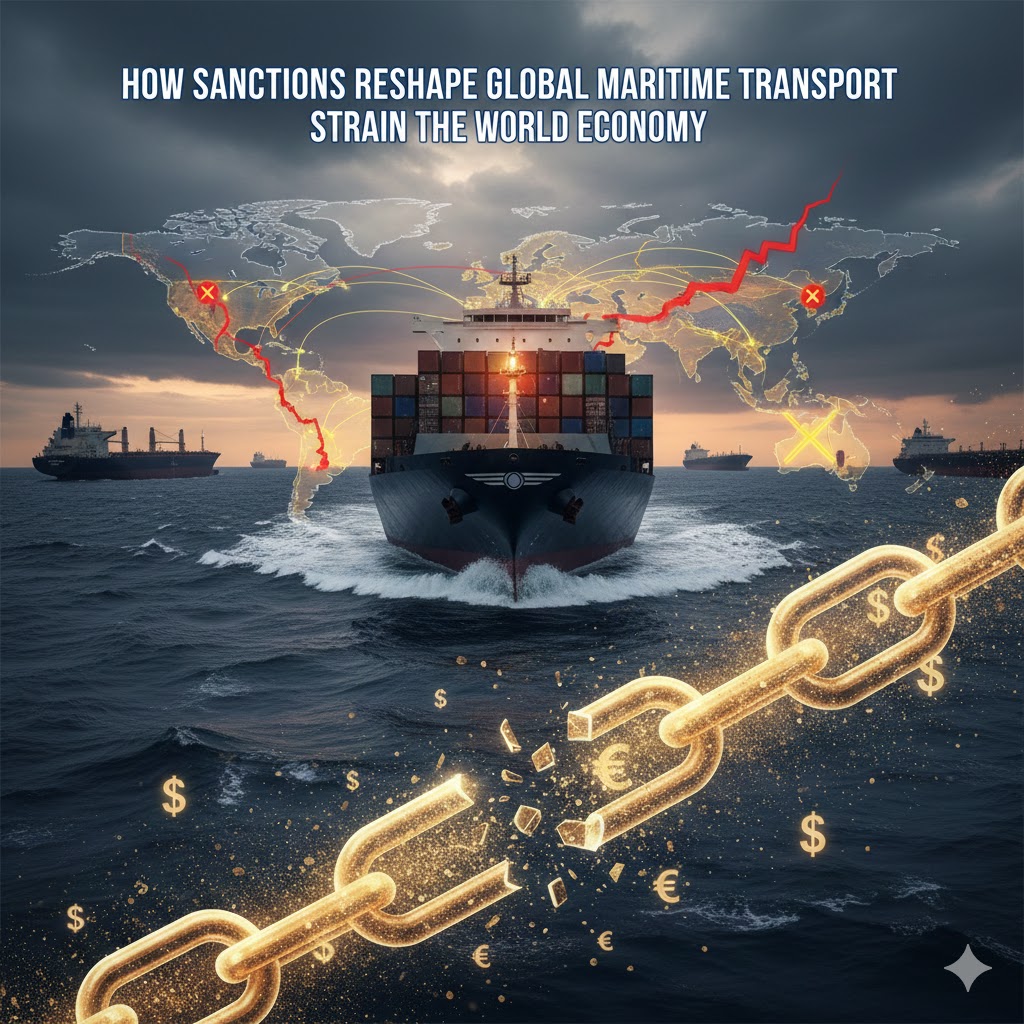
The global maritime industry, the backbone of international trade, has found itself on the front lines of this new sanctions regime. The efforts to block the flow of oil and other restricted goods from sanctioned countries have forced a dramatic and risky reorganization of global shipping patterns.
Table: Key Sanctions Evasion Typologies in Maritime Transport (as of November 2025)
| Evasion Tactic | Description | Identified Red Flags |
|---|---|---|
| The “Shadow Fleet” | Older, poorly maintained tankers that operate outside the regulated maritime system to transport sanctioned oil. | Vessels frequently changing ownership, name, or flag; unexplained gaps in AIS transmissions; opaque ownership. |
| Deceptive Shipping Practices | Physical or documentary methods to hide the origin or destination of cargo. | Falsified cargo and vessel documents; ship-to-ship transfers in high-risk zones; use of complex corporate structures. |
| Third-Country Transshipment | Re-routing cargo through intermediary ports to obfuscate its true origin. | Illogical shipping routes; use of jurisdictions with weak regulatory oversight for routine transshipment. |
The most visible symptom of this disruption is the rise of the so-called “shadow fleet.” This armada of aging tankers, often owned by obscure shell companies, is dedicated to transporting sanctioned oil from Iran, Russia, and Venezuela. This fleet operates outside the bounds of the regulated maritime industry, often carrying substandard insurance, failing to adhere to safety protocols, and engaging in deceptive practices like disabling Automatic Identification Systems (AIS) to hide their locations and activities. The UK’s National Crime Agency, in a November 2025 Amber Alert, explicitly warned that these networks supporting Russia, Iran, and North Korea pose significant risks, and outlined red flags for financial and maritime institutions, including vessels with rapidly changing management structures and unusual payment arrangements.
These evasive maneuvers create tangible dangers. The shadow fleet increases the risk of major maritime accidents, oil spills, and environmental damage, particularly in sensitive waterways. Moreover, the rerouting of vessels to longer, less efficient paths absorbs global shipping capacity, contributing to increased freight rates and insurance premiums. This not only raises the cost of the sanctioned goods themselves but also has a knock-on effect on global shipping costs for all commodities, from grain to consumer goods. The logistical chaos is compounded by the due diligence burden placed on legitimate players in the shipping, insurance, and banking sectors, who must invest heavily in compliance to avoid severe penalties.
Economic Contagion: How Sanctions Strain Global Growth and Stability
The disruption to maritime trade is not an isolated phenomenon; it transmits shockwaves directly into the core of the global economy, affecting growth, inflation, and financial stability.
The sanctions on Russian energy, while intended to reduce Moscow’s revenue, have also removed a significant volume of oil from traditional Western markets. This has forced a realignment of global energy flows, with Russian oil finding new buyers in India and China, often at a steep discount. While this has provided some economic relief to these alternative markets, it has also introduced volatility and uncertainty into global oil pricing. The International Energy Agency noted that the late 2025 sanctions on Rosneft and Lukoil “may have the most far-reaching impact yet on global oil markets,” causing Russian oil prices to plunge and exports to decline, while sending European nations scrambling to secure exemptions for refineries dependent on Russian crude.
Furthermore, the weaponization of the U.S. dollar and financial system through sanctions has accelerated a push by rival powers, notably China, to develop alternative financial infrastructures. China has actively established payment networks and financial institutions insulated from the U.S. system to facilitate transactions for Russia, Iran, and North Korea. This long-term trend threatens to erode the dominance of the dollar and could fundamentally reshape global financial governance, potentially reducing the future efficacy of U.S. financial statecraft.
Perhaps the most significant economic fallout is the impact on global supply chains and inflation. Sanctions, combined with increased tariffs on a wide range of goods from other nations, act as a drag on global economic growth. They disrupt the efficient allocation of resources, force companies to seek new and often more expensive suppliers, and create pervasive uncertainty that discourages long-term investment. The resulting friction in trade translates into higher costs for businesses and, ultimately, higher prices for consumers worldwide, exacerbating cost-of-living crises in both developed and developing nations.
The Human Cost: How Sanctions Cripple Ordinary Citizens, Not Regimes
A consistent and deeply troubling pattern emerges from countries under prolonged sanctions: the heaviest burden is borne by the civilian population, not the political and military elites the measures are designed to pressure.
-
Humanitarian Crises and Access to Essentials: In Cuba, the U.S. embargo, described by a UN Special Rapporteur as the “longest-running unilateral sanctions policy in U.S. foreign relations,” is cited as a primary driver of a severe economic crisis. The country suffers from daily power outages lasting up to nine hours, crippling productivity and daily life. This energy shortage, in turn, has led to a public health catastrophe, with authorities unable to fumigate or maintain pipes, resulting in explosions of mosquito-borne diseases like dengue and chikungunya. Citizens lack access to insect repellant and medicine, and are forced to keep windows open in the heat, facilitating the spread of disease.
-
Poverty, Malnutrition, and the Collapse of Public Services: In Iran, the economic pressure from sanctions has decimated the standard of living. Reports indicate that nearly 40 million Iranians now live below the relative poverty line. The real dollar value of workers’ wages has collapsed, and a state-affiliated economist has stated that around 10% of Iran’s population suffers from malnutrition and hunger. The situation is similarly dire in Afghanistan, where sanctions, though targeting the Taliban, have compounded a humanitarian crisis for returnees and ordinary citizens, crippling the economy and public services.
-
The Failure of “Humanitarian Exceptions”: While most sanctions regimes include formal exceptions for humanitarian goods like food and medicine, in practice, these safeguards are often ineffective. The primary obstacle is financial. Sanctions that cut off a country’s central bank from the global financial system make it nearly impossible for governments or importers to pay for essential goods, even if the transactions are technically exempt. Banks and other financial intermediaries, fearing massive penalties for any misstep, become overly cautious and refuse to process any transactions linked to a sanctioned country, a phenomenon known as “de-risking.” This chokes off the legal flow of humanitarian supplies, with devastating consequences.
The Geopolitical Backlash: Evasion, Alliances, and the Erosion of Unity
The intended isolation of sanctioned states has, in many cases, had the opposite effect, driving them closer together and fostering the creation of parallel economic and political systems.
China has positioned itself as the decisive enabler of sanctions evasion for what some analysts term the “axis of autocracy.” It provides a lifeline to Russia, Iran, and North Korea by conducting high volumes of trade, accepting discounted sanctioned oil through its “shadow fleet,” and serving as a primary supplier of dual-use technology that sustains Russia’s military operations in Ukraine. Hong Kong, leveraging its status as a global financial center, has become a major hub for sanctions and export control evasion, facilitating opaque financial transactions for these pariah states.
This has led to the formation of a cohesive bloc of sanctioned and China-aligned states that actively coordinate to undermine Western economic statecraft. They share tactics, such as Russia’s adoption of Iran’s shadow fleet model, and develop shared financial infrastructure to transact outside the dollar-based system. This coordination demonstrates that the efficacy of sanctions diminishes over time as targeted states adapt and find alternative partners.
Furthermore, the unity of the Western alliance itself is not absolute. Within the EU, countries like Hungary have secured exemptions to continue purchasing Russian oil. Meanwhile, the EU’s effort to use frozen Russian assets for Ukrainian reparations has been complicated by a U.S. peace proposal that suggested investing these assets in U.S.-led efforts, a move viewed with alarm by European capitals as it implied U.S. authority over assets mostly held in European institutions. These fissures highlight the challenges of maintaining a coherent and unified multilateral sanctions front over the long term.
Conclusion: A Tool of Diminishing Returns and Mounting Costs
The evidence through November 2025 presents a sobering assessment of comprehensive Western sanctions. While they have succeeded in imposing significant economic costs on targeted regimes and remain a primary non-military tool of statecraft, their unintended consequences are profound and pervasive.
The collateral damage is evident in the dangerous transformation of global maritime transport, the inflationary pressures and supply chain frictions imposed on the world economy, and, most tragically, the immense human suffering inflicted on ordinary citizens in sanctioned countries who are powerless to change their government’s policies. The emergence of a resilient axis of states, led by China, that actively facilitates large-scale sanctions evasion further challenges the long-term viability of this approach.
Sanctions are a blunt instrument, not a scalpel. As they continue to be a tool of first resort, policymakers in the U.S. and EU face a critical need to recalibrate their approach. A more effective strategy would involve a hard-headed assessment of their actual strategic efficacy, a genuine strengthening of humanitarian channels to mitigate civilian harm, and a recognition that, without complementary diplomatic strategies, sanctions alone are more likely to entrench hostilities than resolve them. The ripples of these economic measures have spread far and wide, and a reassessment is urgently needed to prevent them from triggering a wider geopolitical and humanitarian tsunami.
End Reference List
-
U.S. Department of the Treasury. (2025). Treasury Sanctions Major Russian Oil Companies, Calls on Moscow to Immediately Agree to Ceasefire. [Home.treasury.gov]
-
Steptoe LLP. (2025). Weekly Sanctions Update: November 10, 2025. [Steptoe.com]
-
Center for Economic and Policy Research (CEPR). (2025). CEPR Sanctions Watch November 2025. [Cepr.net]
-
Mayer Brown. (2025). *Russia/Ukraine Sanctions Update – Month of November 2025*. [Mayerbrown.com]
-
U.S.-China Economic and Security Review Commission (USCC). (2025). China’s Facilitation of Sanctions and Export Control Evasion. [Uscc.gov]
-
Snell & Wilmer. (2025). Global Connection – November 2025. [Swlaw.com]
-
Steptoe LLP. (2025). Weekly Sanctions Update: November 24, 2025. [Steptoe.com]
-
Fieldfisher. (2025). UK, EU and US sanctions on Russia. [Fieldfisher.com]
-
Steptoe LLP. (2025). Sanctions Update: November 3, 2025. [Steptoe.com]