
Executive Summary
The maritime trade landscape in the United States has undergone a profound transformation in 2025. A wave of new tariffs and port fees has disrupted long-established supply chains, increased costs for shippers and consumers, and created a climate of deep uncertainty for terminal operators. Simultaneously, ambitious goals to revitalize the domestic shipbuilding industry have been undermined by policy contradictions, funding cuts, and a lack of clear leadership. Compounded by legal challenges and political instability, these policies have, on balance, negatively affected the competitiveness and resilience of the U.S. maritime sector.
Introduction: The Promise of a Maritime Revival
Upon returning to office in 2025, the Trump administration announced a central goal: to restore America’s maritime dominance. The vision was twofold. First, to use aggressive trade measures, including sweeping tariffs and targeted port fees, to protect U.S. industries and counter perceived unfair trade practices, particularly from China. Second, to rebuild the nation’s atrophied commercial shipbuilding base and maritime workforce through a whole-of-government approach.
An April 2025 Executive Order explicitly framed the decline of the U.S. shipbuilding industry as a national security risk and outlined a policy to revitalize and rebuild domestic maritime industries and workforce. However, ten months into the administration, evidence suggests that the practical outcomes have fallen severely short of this vision. Instead of a coordinated revival, the sector has been marked by trade disruption, policy inconsistency, and missed opportunities, creating a net negative impact on U.S. maritime transport, trade, and port activities.
–
Part 1: The Tariff Storm – Trade Disruption and Rising Costs
The administration’s most significant impact on maritime trade has come from its aggressive tariff policy. The so-called “Liberation Day” tariffs initiated a new regime that pushed the effective U.S. tariff rate to its highest level in decades.
A Complex Web of Tariffs and Their Economic Impact
The tariffs have been enacted under various legal authorities, including those related to national security, unfair trade practices, and international economic emergencies. This has resulted in a complex and often overlapping set of duties on a wide range of goods and countries. Sweeping tariffs were applied to imports from China, the EU, Canada, Mexico, Brazil, and India. Key commodities saw drastic increases, with steel tariffs raised to 50% and new tariffs imposed on products like copper, heavy trucks, and furniture. A notable 100% tariff on patented pharmaceuticals was also announced, intended to pressure companies to build manufacturing plants in the U.S.
The economic consequences have been significant. Analyses indicate these tariffs represent the largest U.S. tax increase as a percent of GDP in over thirty years, costing the average U.S. household a substantial amount with projections showing an increase into the following year. Economic modeling estimates the tariffs will reduce long-run U.S. GDP and result in the loss of over half a million full-time equivalent jobs, even before accounting for foreign retaliation.
Table: Estimated Economic Impact of Key 2025 Trump Tariffs (Before Retaliation)
| Tariff Category | Long-Run GDP Impact | Full-Time Equivalent Jobs Lost |
|---|---|---|
| Section 232 Tariffs (Total) | -0.2% | -159,000 |
| (e.g., Steel, Autos, Heavy Trucks) | ||
| IEEPA Tariffs (Total) | -0.4% | -400,000 |
| (e.g., China, Canada, Mexico, Baseline) | ||
| Total | -0.6% | -559,000 |
Source: Adapted from Tax Foundation General Equilibrium Model
Direct Impact on Maritime Trade Flows and Port Volumes
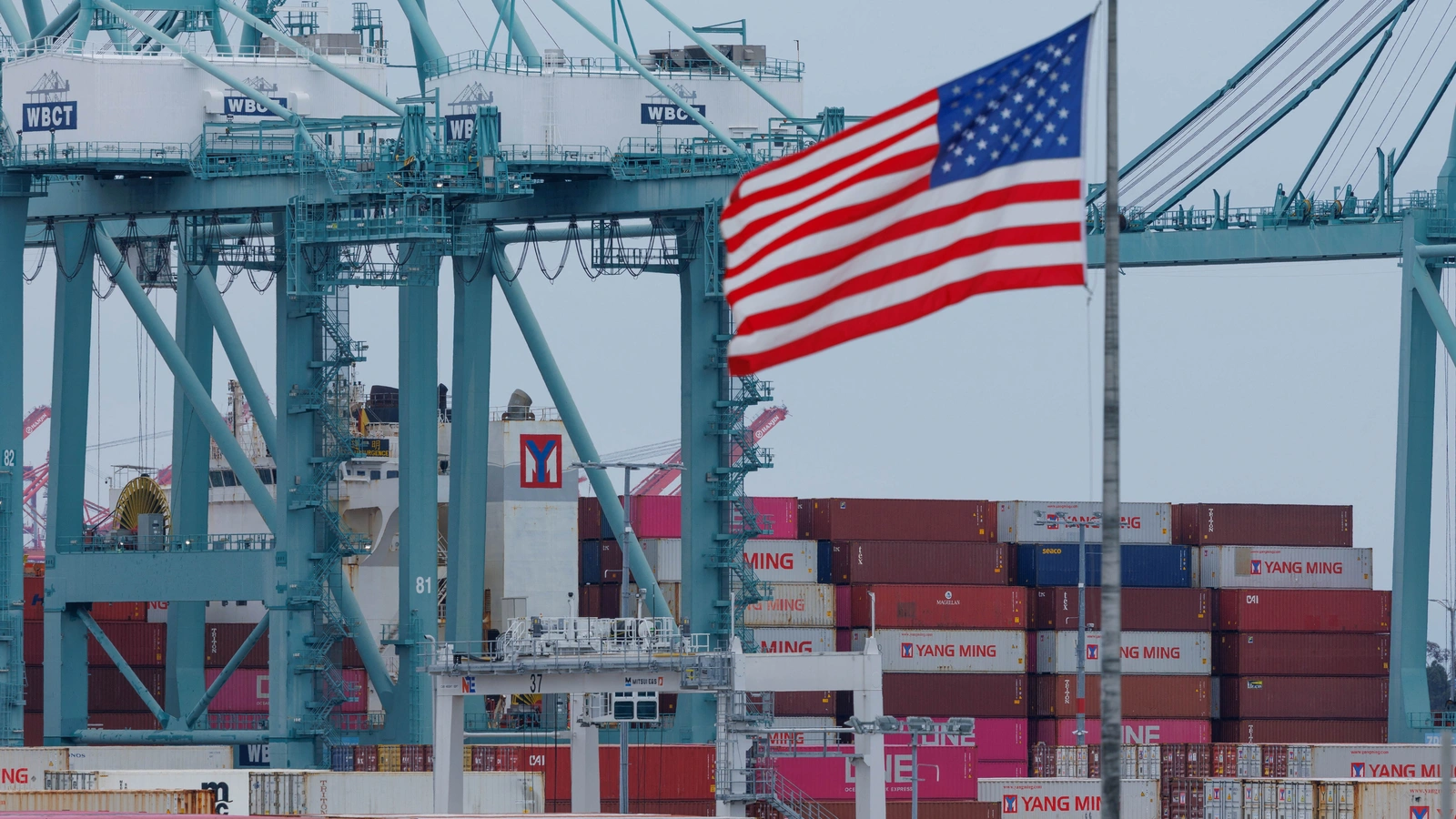
The tariffs have directly distorted maritime trade patterns, impacting the volume and routing of cargo passing through U.S. ports. In anticipation of the tariffs, many U.S. companies engaged in “front-running,” rushing to import goods before the duties took effect. This caused a temporary spike in container freight rates and port volumes, followed by a significant drop once the tariffs were implemented. For marine terminal operators, this volatility is particularly damaging, as they face high fixed operating costs that cannot be easily adjusted with fluctuating cargo volumes.
The dry bulk sector has been notably affected. For instance, China, the world’s largest soybean buyer, has halted imports of U.S. soybeans due to the tariff dispute, opting instead for suppliers in South America. This has cost U.S. farmers billions in sales and reduced demand for U.S.-bound bulk carriers. As intended, the tariffs have reduced the volume of imports. The U.S. trade deficit fell significantly in the latter half of 2025, largely due to the drop in imports after the tariffs took effect. While a smaller deficit can provide a short-term statistical boost to GDP, the sustained decline in import volumes translates directly to reduced activity for U.S. ports and the logistics networks that serve them.
–
Part 2: The Shipbuilding Paradox – Policy vs. Reality
A core pillar of the administration’s maritime agenda was to revive the ailing U.S. commercial shipbuilding industry. While the problem identification was accurate—the U.S. produces a tiny fraction of global commercial ships while China produces half—the administration’s actions have often contradicted its stated goals.
A Promising Start and Rapid Unraveling
The administration began with a clear, structured plan. The April 2025 Executive Order mandated the creation of a comprehensive Maritime Action Plan within a set timeframe, requiring multiple agencies to coordinate on rebuilding the industrial base and workforce. A new Office of Shipbuilding was established within the National Security Council to lead this effort.
However, this momentum quickly dissipated. The office was soon downgraded, moved out of the NSC, and folded into the Office of Management and Budget. Key architects of the strategy departed, and staffers followed due to broader cuts. This left the ambitious maritime plan without a powerful, centralized driver, signaling a sharp decline in the priority of the issue within the administration.
Eroding the Foundations: Funding and Workforce
Concrete actions have consistently undermined the shipbuilding revival vision. Despite the rhetoric of revitalization, the administration’s most recent appropriations bill allocated a record low amount to the Small Shipyard Grant Program. This funding level was less than half of what it received during the previous administration, despite demand for the grants consistently exceeding supply by more than five times. These grants are critical for yards to modernize equipment and compete against subsidized foreign rivals.
The U.S. faces a critical shortage of thousands of mariners. The U.S. Merchant Marine Academy, the nation’s primary training ground for sealift officers, has been left to deteriorate, with reports of failing infrastructure and a lack of permanent leadership in its top positions, undermining the workforce pipeline any maritime revival depends on. A potential major investment from South Korea was also jeopardized after the administration staged a high-profile immigration raid at a South Korean-operated factory, creating diplomatic tensions.
Furthermore, the administration has pressured the International Maritime Organization to scuttle decarbonization regulations, which are expected to drive a wave of global orders for new, cleaner ships. By opposing these “green shipping” rules, the administration has eliminated a key opportunity for U.S. yards to enter a new, high-value market and compete with entrenched Chinese rivals. Similarly, the rollback of offshore wind programs has stalled demand for the specialized installation vessels that U.S. yards had begun to build.
–
Part 3: Ports Under Pressure – Fees, Labor, and Operational Uncertainty
U.S. ports, the critical nodes of global trade, have faced a trifecta of challenges: new targeted fees, labor disputes, and operational disruptions from political dysfunction.
Section 301 Port Fees and Fleet Bifurcation
A novel and disruptive policy has been the introduction of Section 301 port fees targeting China’s shipbuilding dominance. These fees charge vessels that are Chinese-owned, operated, or built for calling at U.S. ports.
The fees are substantial, starting at a high rate per net tonne per port call for Chinese-owned or operated vessels, and a separate fee for vessels built in China but owned by non-Chinese entities. These fees are designed to escalate annually, becoming prohibitive over time. In response, major shipping lines have begun a large-scale re-routing of vessels. The global fleet is bifurcating, with Chinese-connected tonnage being excluded from U.S. services and redeployed to other trade lanes. This reduces capacity and flexibility on U.S. routes and could lead to increased shipping costs. Industry analysts estimate that a significant percentage of port calls would be subject to these fees, potentially raising billions for the U.S. government, though vessel redeployment is already lowering this figure. The fees will most heavily impact crude oil imports, as the large tankers that carry them often exceed the exemption threshold and are frequently Chinese-built.
Labor Uncertainty and Infrastructure Direction
The ongoing labor dispute between the International Longshoremen’s Association (ILA) and terminal operators on the East and Gulf Coasts has been a persistent cloud over port operations. While a wage increase was reportedly agreed upon, the ILA’s demand to remove all language on automation from collective bargaining agreements remains a key battleground. This stance risks putting U.S. ports at a competitive disadvantage by hindering investments in efficiency and safety improvements that automation can bring.
Furthermore, the administration’s focus has shifted infrastructure spending away from green technologies. Grant money from the Department of Energy for zero emissions and electrification goals for port development is expected to be targeted, potentially slowing the modernization and environmental upgrading of U.S. port facilities.
–
Part 4: Systemic Challenges – Legal and Operational Instability
Beyond specific policies, broader systemic issues have compounded the challenges facing the maritime sector.
Legal Uncertainty and the Supreme Court Challenge
The legal foundation of the administration’s sweeping tariffs is unstable. The use of the International Emergency Economic Powers Act (IEEPA) as a basis for broad tariffs has been ruled illegal by lower courts, and the Supreme Court heard the case in late 2025. During oral arguments, justices appeared skeptical that the president had the unilateral power to impose such tariffs without Congressional authorization.
A ruling against the administration could invalidate a significant portion of the tariffs, forcing a chaotic recalibration of trade policy. Legal experts note that even if IEEPA is struck down, the administration could attempt to re-impose duties using other statutes, but this would require new investigations and create prolonged uncertainty.
Government Shutdowns and Operational Disruption
A protracted federal government shutdown that began in the fall of 2025 created tangible operational headaches for trade. While ports remained open, reduced staffing at U.S. Customs and Border Protection led to slower documentation and inspection processes, lengthening clearance times and increasing dwell periods at major gateways. This directly increases costs and reduces supply chain reliability for all participants.
–
Conclusion: A Course Correction Needed
The Trump administration’s 2025 maritime and trade policies have, in aggregate, negatively impacted the U.S. maritime transport sector. The aggressive use of tariffs has succeeded in reducing imports but at a high economic cost, disrupting established trade flows and creating volatility for ports and terminal operators. The novel Section 301 port fees are actively reshaping global shipping networks, potentially increasing costs and reducing service for American importers and exporters.
Concurrently, the high-profile goal of reviving U.S. shipbuilding has been undermined by a paradox of policy: public commitments have not been matched by sustained leadership, adequate funding, or a strategy to capture future markets. The result is an industry that remains on life support, unable to respond to the administration’s own protectionist measures.
For U.S. businesses and consumers, the outcome has been characterized by higher costs, operational uncertainty, and a loss of competitive positioning. For the U.S. to truly reclaim its stature as a maritime power, a more coherent, consistent, and well-funded approach is essential—one that balances protective measures with a genuine and strategic commitment to rebuilding the industrial and human capital that form the foundation of maritime dominance.
End Reference List
-
The White House. (2025). Executive Order on Restoring America’s Maritime Dominance.
-
Tax Foundation. (2025). General Equilibrium Model Analysis of 2025 Tariff Provisions.
-
Clarkson Research Services. (2025). Shipping Review & Outlook, Autumn 2025.
-
U.S. Department of Transportation, Maritime Administration (MARAD). (2025). Report on the U.S. Shipbuilding Industry.
-
International Longshoremen’s Association (ILA). (2025). Press Statements on Master Contract Negotiations.
-
U.S. Customs and Border Protection (CBP). (2025). Trade Statistics and Operational Updates.
-
Supreme Court of the United States. (2025). Oral Argument Transcript: Case Concerning Presidential Tariff Authority.
-
U.S. Department of Energy. (2025). Port Infrastructure Development Program Guidance.
-
American Association of Port Authorities (AAPA). (2025). Impact Assessment of Section 301 Port Fees.
-
U.S. Merchant Marine Academy (USMMA). (2025). Annual Report on Infrastructure and Readiness.