
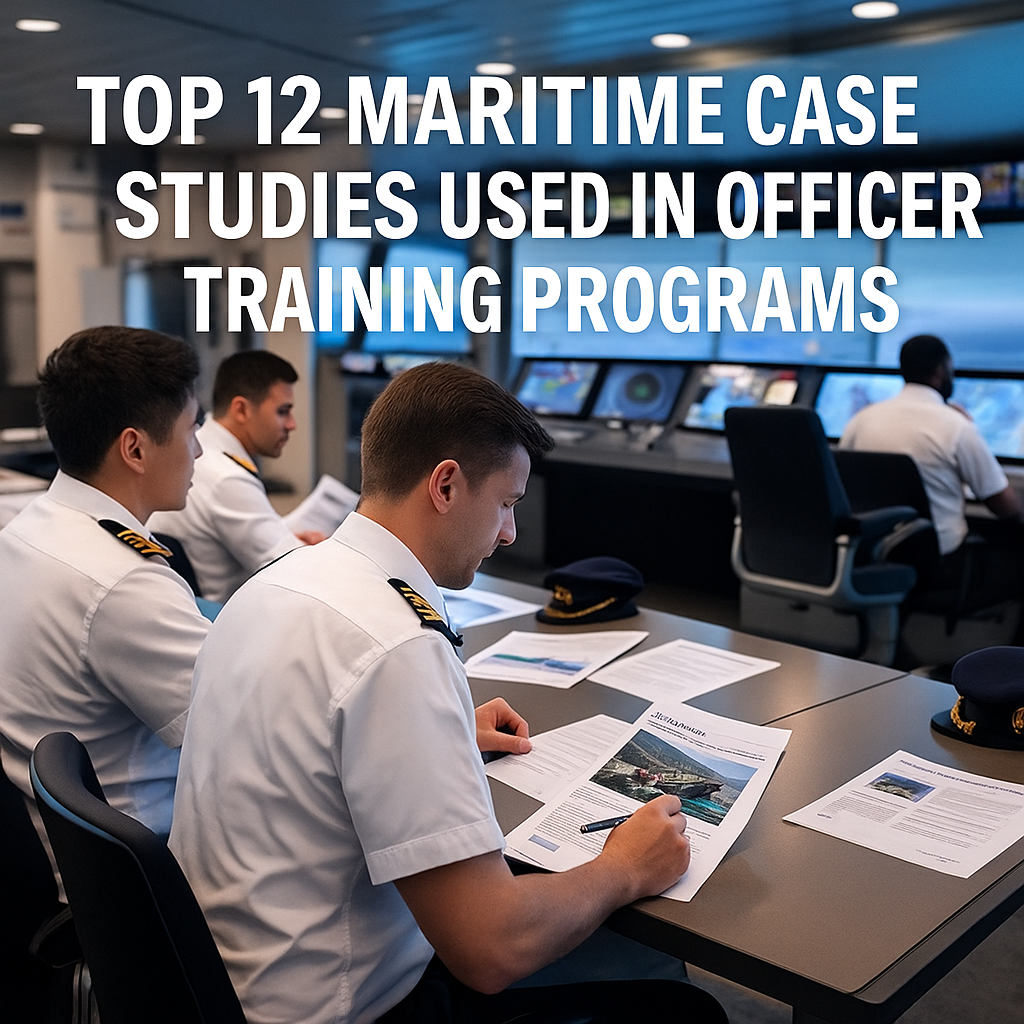
maritime accident case studies, bridge resource management training, ship officer training programs, human element in shipping, simulator-based maritime training, STCW officer education, safety culture at sea, incident investigation in shipping. Walk into almost any modern maritime academy or company training centre and you will see a familiar scene: officers and cadets gathered around a table, watching simulator replays or reading an accident report, then pausing to ask the same question:
“What would you have done?”
These are maritime case studies in action. They transform tragic or costly incidents into powerful learning tools. Instead of treating accidents as distant stories, case-based training helps officers connect rules and checklists with real people, real decisions and real consequences. In this article, we explore 12 influential maritime case studies that are widely used in officer training programs around the world. Whether you are a cadet, junior officer, DP operator or instructor designing your next bridge resource management course, these examples will help you choose the right stories to build safer habits at sea. ⚓
Top 12 Maritime Case Studies Used in Officer Training Programs
Here are 12 important real-life accidents that are studied in officer training programs around the world. They help officers learn from past mistakes to improve safety, decision-making, and leadership at sea.
1. Costa Concordia (2012) – Grounding, Capsize and Evacuation Failures
The cruise ship Costa Concordia hit rocks and sank near the Italian coast because the Captain made an unapproved decision to sail too close to shore. This accident caused 32 deaths. It is used in training to show the critical importance of following procedures, good communication on the bridge, and strong leadership during an emergency. The main lessons are about teamwork, challenging a Captain’s poor decisions, and the need for a clear plan to evacuate passengers.
2. Herald of Free Enterprise (1987) – Ro-Ro Ferry Capsize
This ferry capsized and sank shortly after leaving port because its bow doors were left open, allowing water to flood the car deck. 193 people died. The investigation found a poor safety culture where no one was sure who was responsible for closing the doors. This disaster directly led to the creation of the International Safety Management (ISM) Code. It teaches officers that clear checklists, a strong safety culture, and management support are essential to prevent tragedies.
3. El Faro (2015) – Loss of a Cargo Ship in a Hurricane
The cargo ship El Faro sailed directly into a powerful hurricane and sank, killing all 33 crew members. The Captain used old weather information and did not change course in time. Other officers on the bridge did not strongly challenge this decision. This case is a key lesson in using accurate weather data, making good decisions under pressure, and the importance of open communication and teamwork on the bridge.
4. Ever Given (2021) – Suez Canal Grounding
The massive container ship Ever Given ran aground in the Suez Canal, blocking one of the world’s most important waterways for six days and causing a global shipping crisis. The accident involved strong winds, the challenges of handling a very large ship in a narrow canal, and communication between the pilot and the ship’s crew. It is studied to learn about ship handling in confined waters, the role of pilots and tugs, and how a single accident can impact the entire world.
5. Estonia (1994) – Passenger Ferry Sinking
The passenger ferry MS Estonia sank in the Baltic Sea after its bow door broke in heavy seas, causing rapid flooding. 852 people died. This tragedy led to major new international safety rules for ferries, especially concerning their design and stability. It is used in training to teach officers about the dangers of water entering the car deck and the extreme difficulties of evacuating a ship that is listing heavily at night in cold water.
6. Sewol (2014) – Overloading and Poor Emergency Response
The South Korean ferry Sewol sank, killing 304 people, many of them students. The ship was dangerously overloaded and unstable. The crew gave confusing and delayed evacuation orders, and the rescue response was poorly coordinated. This case is a powerful lesson on the critical importance of never overloading a ship, having a clear emergency plan, and communicating effectively with passengers during a crisis.
7. MSC Napoli (2007) – Structural Failure and Controlled Beaching
The container ship MSC Napoli suffered a major structural failure in a storm. To prevent it from sinking in deep water, the Captain decided to deliberately beach the ship near the coast. This triggered a large and complex salvage operation. This case teaches officers about managing a ship in heavy weather to avoid damage, and how to work with salvage teams and authorities to protect the crew, the cargo, and the environment.
8. CMA CGM Libra (2011) – Passage Planning and Seaworthiness
This container ship grounded shortly after leaving port because the passage plan was not carefully prepared. Years later, a court ruled that a bad passage plan makes a ship legally “unseaworthy.” This means the ship owners can be held fully responsible for the costs of the accident. It is a major lesson for officers that careful passage planning is not just a safety rule, but also a legal requirement with serious financial consequences.
9. M/V VITASPIRIT (2018) – Loss of Control in the Bosphorus
The bulk carrier VITASPIRIT lost control and crashed into a historic building while passing through the narrow and busy Bosphorus Strait. The accident shows how technical problems, high stress, and miscommunication between the pilot and the ship’s crew can quickly lead to a serious incident. It is used to train officers in maintaining focus and clear communication during challenging transits in crowded waterways.
10. MV Wakashio (2020) – Grounding and Oil Spill
The bulk carrier Wakashio grounded on a coral reef off Mauritius, spilling heavy fuel oil into a pristine coastal environment. The ship had deviated from its planned route, reportedly to get a better internet signal. This case is a stark reminder for officers that simple shortcuts and a loss of navigational discipline can cause enormous environmental damage, reputational harm, and legal problems.
11. Viking Sky (2019) – Blackout and Near Grounding
The cruise ship Viking Sky lost all engine power in a severe storm off the coast of Norway. The ship drifted dangerously close to rocks with over 1,300 people on board before power was restored. Many passengers were evacuated by helicopter. This incident teaches important lessons about engine room maintenance, preventing blackouts in heavy weather, and the complex process of managing a large-scale evacuation and rescue operation.
12. Ever Smart – Alexandra 1 Collision (2015) – COLREGS Misunderstanding
The container ship Ever Smart collided with the tanker Alexandra 1 near a busy port. The investigation found that the crews misunderstood the international “rules of the road” (COLREGs) and tried to use VHF radio to agree on a maneuver, which created confusion. This case is used in training to emphasize that you must always follow the COLREGs rules strictly and not rely on radio conversations for collision avoidance, as this can lead to dangerous misunderstandings.
Overcoming Challenges: How to Learn Effectively from Case Studies
Using real accidents for training is powerful, but it is not always easy. Here are common challenges and practical solutions used by modern training programs.
Challenge 1: Moving from Blame to Learning
Often, the first question asked is, “Whose fault was it?” This “blame culture” can make officers defensive and less willing to discuss their own experiences or mistakes. The result is that real, deep learning does not happen.
-
Practical Solution: Foster a Learning Culture
Instructors now focus on creating a safe and respectful environment. The goal is not to find who to blame, but to understand why the people involved made the decisions they did. Trainees are encouraged to share their own “near-miss” stories and to challenge ideas openly, without fear. This helps everyone learn from the situation as a system of failures, not just one person’s error.
Challenge 2: Information Overload and Lack of Relevance
Official accident reports can be hundreds of pages long, filled with technical details. New cadets can feel overwhelmed. Furthermore, many classic cases are from older ships or specific regions, making them feel less connected to the experiences of officers from other parts of the world.
-
Practical Solution: Use Structured Templates and Diverse Cases
To make learning easier, training programs use simple templates that guide officers through a case step-by-step: What happened? Why did it happen? What could have been done differently? How does this apply to my job?
They also mix classic cases like the Herald of Free Enterprise with recent and regional incidents, such as the Wakashio or Ever Given. This keeps the training fresh and directly relevant to the waters where the officers actually sail.
Challenge 3: Focusing Too Much on Technical Skills
Traditional training often focused only on the technical cause of an accident, like a broken engine or a wrong turn. However, most accidents are also caused by failures in “soft skills” like communication, leadership, and teamwork.
-
Practical Solution: Link Cases to Real Competencies and Use Simulators
Modern training directly connects each case to international standards (STCW) and company procedures for navigation, cargo handling, and emergency response. After studying a case on paper, teams face a similar scenario in a simulator. This practice helps bridge the gap between theory and real-life action, forcing crews to use both their technical knowledge and their soft skills under pressure.
The Future of Training: Digital, Immersive, and Systemic
The way officers learn from past mistakes is evolving quickly. New technology and new ways of thinking are making case study training more powerful than ever.
1. Digital Libraries and Interactive Learning
Instead of only reading long reports, officers can now learn from digital case study libraries. These online platforms offer short, well-structured cases, audio clips from the ship’s recorder (VDR), animations of the accident timeline, and guided discussion questions. This allows officers to prepare online, saving valuable classroom time for deep discussion and simulator practice.
2. Learning Through Experience with VR and Simulators
Advanced simulators can now recreate historical accidents with great accuracy. Imagine experiencing the engine blackout of the Viking Sky in a full-mission simulator, or using Virtual Reality (VR) to practice evacuating a listing ship like the Costa Concordia. This immersive technology creates a strong emotional connection and a deeper understanding of the pressures and challenges faced by the crews in these emergencies.
3. A New Way of Thinking: From “Human Error” to “System Safety”
There is a major shift in how we understand accidents. The old way was to find the “root cause,” which was often simply “human error.” The new way, called “Safety-II,” looks at the entire system: the company’s procedures, the design of the equipment, the time pressure, and the regulations.
In training, this means we look beyond asking, “Why did this officer make a mistake?” to ask, “How did the entire situation set this officer up to fail?” We also learn from everyday successes to understand what makes operations safe and reliable.
4. Preparing for the Future: Autonomous Ships and New Roles
As ships become more automated, the role of the officer will change, moving more to shore-based control centers. Future case studies will focus on new types of incidents, such as:
- Miscommunication between a ship’s crew and a remote operator on shore.
- Failures in the interface between humans and automated systems.
- Cyber-attacks that take control of a ship’s navigation.
The method of learning from real cases will remain essential, helping the next generation of maritime professionals navigate the challenges of a highly digital and automated industry.
FAQ: Maritime Case Studies in Officer Training
1. What is a maritime case study in the context of officer training?
A maritime case study is a structured analysis of a real incident or near miss, usually based on an official investigation report. It summarises what happened, why it happened and which lessons can be learned. In training, it is used to develop practical decision-making, teamwork and safety skills.
2. Why are accident case studies so important for deck and engine officers?
Most serious incidents at sea involve human and organisational factors. Accident case studies help officers see how real people made decisions under real pressures, such as bad weather, time constraints and commercial demands. They connect regulations, checklists and manuals with actual situations on board.
3. How are case studies used together with simulators?
Many training centres ask officers to study an accident on paper and then run a simulator scenario inspired by the same type of event. After the exercise, the team compares their decisions and actions with the original crew’s behaviour, guided by an instructor. This combination of theory, simulation and debriefing creates very strong learning.
4. Aren’t case studies just about blaming individuals?
They should not be. Good practice is to use case studies in a “just culture” framework. The focus is on understanding what happened and why, including procedures, training, design and management influences – not simply blaming a single officer. This encourages open discussion and honest reflection.
5. How can officers access reliable maritime case studies?
Reliable case studies are available from:
-
Official investigation bodies (for example MAIB, NTSB, US Coast Guard, EMSA, AMSA, Transport Canada).
-
International and regional organisations such as the IMO, Paris MoU and Tokyo MoU.
-
Professional bodies and training providers like The Nautical Institute or recognised maritime academies.
Many shipping companies also keep internal case-study libraries based on their own incident and near-miss reports.
6. Will case studies still be relevant for autonomous or remotely operated ships?
Yes. Even with higher levels of automation, humans will remain involved as designers, supervisors, emergency responders and shore-based operators. Future case studies will focus more on human–automation interaction, remote operations and cyber security, but the basic idea of learning from real events will stay essential.
7. How can a cadet use case studies to prepare for a career at sea?
Cadets can treat each case study as a personal rehearsal:
- Reconstruct the events and identify key decision points.
- Ask what they would do in a similar situation.
- Link each lesson to their own vessel type and future rank.
- Keep a simple learning log of main insights and “red flags” to watch for.
This habit makes it easier to apply lessons during shipboard emergencies and drills in real life.
Maritime officer training today is about far more than learning rules and equipment manuals. Officers are expected to think critically, manage risk and work as effective team members in a complex, high-pressure environment.
Real-world case studies – from Herald of Free Enterprise and Estonia to Costa Concordia, El Faro, Ever Given, Wakashio and Viking Sky – provide the stories that make these expectations real. They show how technology, human factors and organisational decisions combine, and they give officers a safe space to rehearse better choices before facing similar situations at sea.
For training providers, the key actions are:
-
Use diverse, up-to-date, and regionally relevant case studies.
-
Combine paper-based analysis with simulator exercises and debriefings.
-
Emphasise learning and systemic thinking, rather than simple blame.
For officers and cadets, the challenge is to treat every case not as someone else’s mistake, but as a rehearsal for your own future decisions.
If you are developing or updating a training program, consider building a structured module around these 12 maritime case studies, and connect them to related learning on ship types, shipboard emergencies and drills, life-saving appliances and procedures and maritime safety management across your curriculum.
References
-
Australian Maritime Safety Authority (AMSA). (n.d.). Marine incident investigations and reports. Retrieved from https://www.amsa.gov.au
-
DNV. (n.d.). Human factors in shipping and safety guidance. Retrieved from https://www.dnv.com
-
European Maritime Safety Agency (EMSA). (n.d.). EMSA maritime accident review and safety reporting. Retrieved from https://www.emsa.europa.eu
-
International Maritime Organization (IMO). (n.d.). Casualty investigation code and Global Integrated Shipping Information System (GISIS). Retrieved from https://www.imo.org
-
International Maritime Organization (IMO). (n.d.). STCW Convention and related model courses (including BRM/ERM). Retrieved from https://www.imo.org
-
MAIB – UK Marine Accident Investigation Branch. (n.d.). Investigation reports and safety digests. Retrieved from https://www.gov.uk/maib
-
NTSB – U.S. National Transportation Safety Board. (n.d.). Marine accident reports (including El Faro). Retrieved from https://www.ntsb.gov
-
Paris MoU on Port State Control. (n.d.). Annual reports and safety analyses. Retrieved from https://www.parismou.org
-
The Nautical Institute. (n.d.). MARS reports and maritime case studies. Retrieved from https://www.nautinst.org
-
Transport Canada. (n.d.). Transportation Safety Board marine investigation reports. Retrieved from https://www.tsb.gc.ca
-
UK Supreme Court. (2021). Alize 1954 & CMA CGM SA v. Allianz Elementar Versicherungs AG & Others (CMA CGM Libra) – Judgment on passage planning and seaworthiness. Retrieved from https://www.supremecourt.uk
-
US Coast Guard (USCG). (n.d.). Marine casualty reports and safety alerts. Retrieved from https://www.uscg.mil
-
World Maritime University (WMU). (n.d.). Publications on maritime safety, human factors and education and training. Retrieved from https://www.wmu.se
-
World Shipping Council / industry bodies. (n.d.). Guidance on container ship safety and casualty learning. Retrieved from https://www.worldshipping.org