
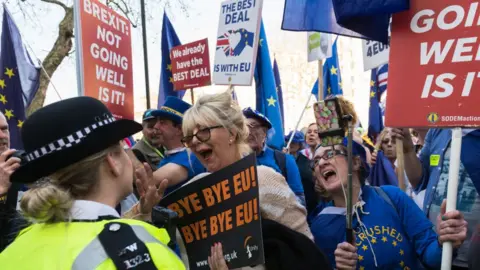
As the UK navigates its sixth year since fully leaving the EU’s orbit, the initial promises of “taking back control” have soured into a stark reality of economic decline. From the white cliffs of Dover to the manufacturing hubs of the Midlands, the dream of sovereignty has been replaced by the nightmare of red tape.
For decades, the United Kingdom stood as the ultimate symbol of globalism—an island nation that used its mastery of finance, logistics, and diplomacy to punch above its weight. The decision to leave the European Union, finalized in 2020, was sold as the beginning of a new era of “Global Britain.” Yet, as we approach the summer of 2026, the data tells a brutal story of reversal. The UK is not booming; it is stagnating.
Recent polling suggests that nearly six in ten Britons now want to rejoin the EU . This isn’t just a shift in political mood; it is a reaction to the “permanent hit to growth, wages, and investment” that has quietly drained the lifeblood from the British economy .
The Macroeconomic Toll: A Permanent Scar
To understand the depth of the current UK decline, one must look at the macro numbers. They are, by any measure, devastating. A decade of warnings from economists has proven to be not only accurate but, in many cases, understated.
According to recent analysis, UK GDP is now estimated to be between 6 and 8 per cent smaller than it would have been by 2025 had the UK remained in the EU . This is not a post-pandemic blip or a temporary adjustment; it is a permanent loss of national income. The economy has built a ceiling where there should have been sky.
Business investment, the fuel for future growth, has collapsed. Compared to other similar economies, UK business investment is now a staggering 18 per cent lower . Firms have not been “betting on Britain” as Brexiteers hoped. Instead, they have put expansion plans on hold, diverted funds to European subsidiaries, or simply moved operations across the Channel to avoid the friction. This paralysis at the corporate level has a direct human cost: productivity is around 4 per cent lower than it could have been, locking in weaker wage growth for the average worker .
The hidden costs inside firms have been monumental. A staggering number of CFOs reported spending more than six hours a week for years dealing with Brexit fallout. This is time and money burned on compliance, rather than on growth, innovation, or hiring . Perhaps the most ironic tragedy is that the firms most exposed to the EU—once Britain’s fastest-growing and most productive businesses—became the most damaged by the split. Brexit has actively punished the very engine of the UK economy .
–
Trade and Commerce: The Vanishing British Exporter
Before 2016, the UK was a trading superpower by proxy, enjoying seamless access to a market of 500 million consumers. Today, the landscape for exporters is unrecognizable, characterized by what one official described as a “world of pain” .
The headline figures are stark. Overall, the percentage of exporters reporting increased sales has been in the doldrums since 2018. While 31% of firms saw increased orders in Q2 2018, that number has struggled to hit 28% ever since, even during the post-pandemic rebound . Currently, the situation is inverted: 28% of exporters report a fall in sales, compared to only 21% reporting growth .
The Plight of Small and Medium Enterprises (SMEs)
The pain is not distributed evenly; it is crushing the little guys. Micro-exporters (firms with fewer than 10 employees) are faring worst of all. Only 17% of these small businesses saw increased export orders in late 2025, while nearly a third watched their overseas business shrink . For these small firms, the administrative burden of Brexit is existential.
The British Chambers of Commerce has noted that the period since the Trade and Cooperation Agreement (TCA) was signed has been one of the “most challenging ever” for smaller businesses trying to grow overseas . They face a mountain of new costs that larger corporations can absorb but that erode the margins of SMEs completely.
The Food and Farming Crisis
Nowhere is the trade decline more visually arresting than in the agricultural sector. The image of British lamb and cheese being sold with ease in Parisian markets is fading into memory. Analysis of HMRC data by the National Farmers Union (NFU) reveals a cataclysm.
Sales of British farm products to the EU have plummeted by nearly 40 per cent since the UK left the bloc . The poultry sector has been hit hardest, with exports down 37.7%, while beef exports have fallen by 23.6% and lamb by 14% . Tom Bradshaw, president of the NFU, warns that even if trade barriers were removed today, it would not reverse the damage. “There aren’t empty spaces on the shelves with a label saying ‘waiting for British products’,” he noted . In the five years since the split, European buyers have permanently restructured their supply chains, replacing British goods with Irish, Dutch, or German alternatives. The demand is simply gone.

Maritime Transport and Customs: Where Friction Becomes Crisis
When politicians spoke of “frictionless trade,” they ignored the physics of logistics. The English Channel, once a super-highway for just-in-time delivery, has become a series of toll booths and roadblocks.
The end of the transition period in 2021 brought a “revolutionary change” to the haulage industry . The Road Haulage Association estimated that some 220 million new customs forms would need to be filled in every year to allow trade to flow . This paperwork mountain has had real-world consequences.
Real-World Delays
Testifying before Parliament in early 2026, industry officials laid bare the ongoing chaos. Toby Ovens, managing director of a British logistics company, recounted a shipment of frozen meat that sat for 27 days at the Channel Tunnel due to a single “paperwork error.” The result was a £16,000 invoice for the customer as the truck sat idle for a month .
This is not an isolated incident. Major manufacturers like Airbus have seen their export bureaucracy explode. Oriel Petry of Airbus UK noted that the company now faces up to 50 customs forms for shipments that previously required only 15. “Even one tiny wing part can require four forms in the way that… it didn’t require before, even though, of course, the product hasn’t changed,” she explained . For industries reliant on complex supply chains—automotives, aerospace, chemicals—these delays translate into billions in lost revenue and competitiveness.
The Northern Ireland Conundrum
The situation is even more acute in Northern Ireland. The Windsor Framework, designed to fix the issues of the original Protocol, has left the province in a unique regulatory limbo. While this gives Northern Ireland access to both markets, it complicates trade within the UK.
In a cruel twist of irony, new green taxes on shipping (the Emissions Trading Scheme) are set to hammer Northern Ireland businesses harder than the rest of the UK. Unlike other ferry routes, Northern Ireland will not be exempt from these charges. Stena Line estimates the scheme will increase its costs by £9 million annually, costs that will inevitably be passed on to HGV drivers and consumers, further inflating the cost of living in a region where supply chain costs are already high due to Brexit arrangements .
–
Manufacturing and Industry: Steel and Autos in the Crosshairs
The industrial heartlands that voted most fervently for Brexit are now feeling its sharpest sting.
Steel
The UK steel industry is facing a “disastrous” tariff situation . The EU, responding to global overcapacity and protectionist moves by the US and China, has proposed shrinking its tariff-rate quota for steel and potentially doubling the out-of-quota tariff to 50% . For UK steel exporters, this is existential. Peter Brennan of UK Steel warned that such a move would “significantly” reduce exports. While the UK has sovereign trade policy, it lacks the heft to fight back alone, stuck between an unpredictable US market and a protectionist EU.
Automotive
The auto industry, the jewel of British manufacturing, is staring down the barrel of strict Rules of Origin requirements. Starting in 2027, electric vehicles must have 45% of their content originating in the UK or EU to qualify for tariff-free trade . Given the UK’s shrinking battery manufacturing capacity, this is a ticking time bomb. Industry experts fear that without a renegotiation, tariffs will add thousands to the cost of British-made cars, making them uncompetitive in their primary export market.
–
Services and Financial Sector: The Slow Leak
While goods suffer at the border, services—which account for 80% of the UK economy—suffer from the loss of “passporting” rights . The much-feared “Armageddon” exodus of finance jobs from the City of London never happened overnight, but the death by a thousand cuts is underway.
London remains Europe’s financial capital, but its dominance is eroding. The EU has made no secret of its desire to onshore capital markets activities. Amsterdam has overtaken London as Europe’s top share trading hub. Asset managers have shifted over a trillion euros in assets to the continent.
The damage extends beyond finance to the knowledge economy. UK scientists were locked out of the EU’s Horizon research program for nearly three years. While the UK has now rejoined, the damage may be irreversible. As one leading geneticist put it, the absence made the UK “less attractive.” The bureaucratic nightmare of moving samples and researchers between the UK and EU labs has led many of Britain’s brightest minds to relocate permanently . The UK has surrendered its leadership position in key areas like climate change and AI research, not because it lacks talent, but because it lacks access .
–
The Labour Market and Jobs Paradox
One of the primary drivers of the Leave vote was the desire to control immigration. Yet, the current jobs market presents a cruel paradox.
While EU free movement has ended, the UK has experienced a surge in non-EU migration to fill labor shortages. Far from “taking back control,” British businesses have found themselves reliant on a visa system that is complex and expensive. More importantly, the exit of EU workers has exacerbated skills shortages. The Office for National Statistics regularly reports hundreds of thousands of vacancies, many in sectors like hospitality, construction, and social care that relied on European workers.
The low-wage, low-productivity equilibrium has trapped British workers. With investment stagnant and labor supply constrained, wages have risen nominally in some sectors, but real wages remain suppressed by the broader economic underperformance. The 4% hit to productivity directly translates to a permanent cap on living standards .
–
Path Forward: The Siren Song of Rejoin
As the 10th anniversary of the referendum approaches, the political consensus that “Brexit is done” is fracturing. Prime Minister Keir Starmer has begun speaking of a “closer alignment” with the EU, though he rules out rejoining the single market or customs union .
However, half-measures may not be enough. The current deal leaves the UK in a subordinate position—a rule-taker without being a rule-maker. Businesses are crying out for a veterinary agreement to save the farming industry, a mutual recognition deal for professional qualifications, and a youth mobility scheme to fill jobs and cultural gaps .
The Liberal Democrats have proposed a bespoke customs union, which could boost the economy by 2.2% and generate £25 billion a year for the Treasury . But even this would require the UK to align with EU external tariffs, potentially sabotaging the “Global Britain” trade deals struck with Australia and New Zealand.
The American Wildcard
Ironically, the UK’s current pain is slightly mitigated by one factor: the unpredictability of the United States. As the US under Donald Trump launches trade wars against allies and adversaries alike, the UK’s ability to set its own trade policy—however limited—has allowed it to dodge some of the bullets aimed at the EU . Yet, this is a thin silver lining on a very dark cloud. Being slightly less targeted than the EU is not a strategy for growth.
–
Conclusion
The story of Brexit, ten years on, is not one of liberation but of slow-motion decline. The UK economy is smaller, less dynamic, and more isolated than it should be. Its ports are clogged with paperwork, its farmers are losing their markets, and its manufacturers are battling tariffs they cannot control.
The “oven-ready” deal that Boris Johnson promised has turned out to be half-baked. The sovereignty won has come at the cost of prosperity. With 60% of the public now favoring a return to the EU, the debate is no longer about whether Brexit has failed, but how long the UK can afford to pretend it hasn’t . The damage is measurable, compounding, and, without a radical change in course, may define the UK’s trajectory for a generation