
Learn practical meteorology and oceanography for deck officers: forecasts, waves, currents, routing, GMDSS/MSI tools, and safer voyage planning at sea.
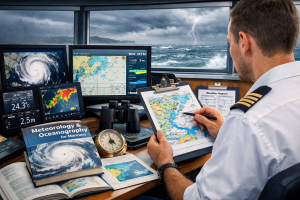
A deck officer can plot a perfect great-circle route and still arrive late, burn extra fuel, or face dangerous seas if the weather and ocean are misunderstood. At sea, meteorology and oceanography are not “background science”—they are the invisible forces that shape every watch: wind that increases resistance, swell that rolls cargo, fog that closes visibility, currents that set a ship toward danger, and pressure systems that build storms long before they reach the bridge.
The best officers learn to read the sea the way pilots read the sky: not as a collection of symbols, but as a living system with patterns, signals, and limits. This guide is written for navigation deck officers and maritime students who need a practical, globally accessible understanding of meteorology and oceanography for ship navigation, tied to real shipboard decisions: passage planning, route monitoring, heavy weather avoidance, and safe operations under SOLAS and modern Maritime Safety Information services.
Why This Topic Matters for Maritime Operations
Weather and ocean conditions directly influence safety, schedule reliability, cargo integrity, emissions, and compliance. International requirements for voyage planning explicitly expect masters and deck officers to plan and monitor a voyage using appropriate information and IMO guidance—weather and sea state are central to that appraisal and execution process.
Key Developments, Technologies, and Practical Applications
Maritime Safety Information as the Officer’s “Weather and Risk Feed”
Modern deck officers do not rely on a single forecast. They operate within an international system that provides coordinated warnings and forecasts for ships at sea—collectively known as Maritime Safety Information (MSI). MSI includes navigational and meteorological warnings and forecasts broadcast to ships through standardized services.
A crucial part of this system is the WMO-coordinated Worldwide Met-Ocean Information and Warning Service (WWMIWS), which distributes marine warnings and forecasts to mariners via recognized GMDSS channels. This matters operationally because it makes weather information both authoritative and predictable in format, which supports bridge procedures, auditability, and training.
In practical terms, the deck officer’s job is not only to “receive the forecast,” but to interpret it, apply it to ship limitations, and communicate implications clearly to the bridge team and master—especially when risk escalates.
Voyage Planning Under SOLAS and IMO Guidance
Voyage planning is not merely route drawing. SOLAS Chapter V Regulation 34 requires the master to ensure the intended voyage is planned using appropriate charts and publications and taking into account IMO-developed guidelines.
On a working bridge, this becomes a disciplined routine: gather met-ocean information, identify forecast uncertainty and time horizons, compare routing options against ship capability and cargo, and then monitor execution so the plan stays safe when reality diverges from the model.
Understanding Forecast Products: From Text Warnings to Model-Based Guidance
Deck officers encounter forecasts in several operational “languages”:
1) Broadcast warnings and forecasts (GMDSS / MSI).
These are designed for safety communication, often covering large areas (METAREAs) and prioritizing hazards: gale warnings, storm warnings, tropical cyclone warnings, heavy freezing spray, and significant sea states. WMO’s GMDSS guidance and MSI publications structure these products so ships can receive essential information even with limited bandwidth.
2) National and regional high seas forecasts.
National meteorological services publish high seas and offshore waters forecasts, often in both text and graphical forms.
3) Digital model outputs (e.g., GRIB, wave and current models).
Routing software and onboard systems increasingly ingest gridded data. This offers detail, but it also introduces a professional requirement: officers must understand that models have resolution limits, bias, and uncertainty, especially as forecast time increases.
Ocean Wave Forecasting: Why “Sea State” Is More Than Wave Height
Deck officers often hear “seas 4–6 meters” and treat it as a single number. In practice, sea state is a combination of wind waves and swell systems that may come from very different directions. Modern wave models represent waves statistically through a wave spectrum rather than a single height.
Operational data services now provide global and regional wave analyses and multi-day forecasts, including parameters such as significant wave height, period, direction, and swell partitions. This supports systematic ocean state information and includes forecast horizons appropriate for route planning decisions.
For deck officers, the practical navigation insight is simple but powerful: a 5-meter sea is not always the same risk. A long-period swell on the beam can produce large rolls and lashing loads even when the wind is moderate; short steep waves can slam, reduce speed, and stress the hull. The officer’s competence lies in connecting forecast parameters to ship-specific vulnerabilities.
Ocean Currents and “Set and Drift”: The Quiet Force That Moves You Off Track
Oceanography enters navigation most clearly through currents. Currents can push a ship sideways (set) and change the effective speed over ground (drift), altering ETA and fuel consumption. Strong currents in western boundary current systems or constricted straits can materially affect safety margins near coasts and traffic separation schemes.
Modern services increasingly provide operational ocean physics forecasts—temperature, salinity, sea level, and currents—useful for route optimization and situational awareness.
For the deck officer, the bridge application is not theoretical ocean circulation. It is the practice of checking whether the planned track and cross-track error limits remain safe when the ship is experiencing persistent set toward a hazard, and whether the planned engine settings still achieve required speed over ground.
Weather Routing: From Safety Tool to Efficiency and Emissions Lever
Weather routing historically focused on avoiding heavy weather and protecting ship and cargo. Today, it also supports efficiency: choosing routes and speeds that reduce resistance from wind and waves and exploit favorable currents.
In practice, routing becomes a conversation between navigation safety, commercial schedule, and engine performance: the officer provides the met-ocean risk picture; the master decides how to balance safety and operational constraints.
The Link to e-Navigation and Digitized MSI
As e-navigation evolves, meteorological and oceanographic information is increasingly treated as a structured service rather than scattered messages. Maritime service definitions for MSI describe the purpose as providing navigational and meteorological warnings and forecasts received via equipment that monitors transmissions and presents relevant information. For deck officers, the operational shift is toward better filtering, better integration into ECDIS and bridge systems, and clearer audit trails—but also a new duty to understand what is automated and what still requires human judgment.
–
Challenges and Practical Solutions
Weather and oceanography are valuable only when translated into safe and clear shipboard decisions. The main challenge is not “lack of data”—it is the professional risk of misunderstanding, over-trusting, or misapplying data.
A common operational trap is treating a single forecast as certainty. Forecast skill decreases with time, and wave and current forecasts often carry higher uncertainty, especially at longer ranges and in rapidly developing systems. The practical solution is disciplined monitoring: compare successive forecasts, track trend direction, and build decision points into the voyage plan where alternative routes or speed changes remain available.
Another challenge is translating meteorological terms into ship effects. “Gale force 8” is not just a wind number; it implies reduced speed, increased slamming risk, bridge workload increase, and possibly risk to deck cargo and lashing. “Swell 3–4 meters, 14 seconds” can be more dangerous to stability and rolling than a higher but shorter sea. The practical solution is to use ship-specific vulnerability thinking: ask what the forecast means for roll period resonance, parametric rolling risk (especially in head or following seas on certain hull forms), deck wetness, container stack loads, and safe working on deck.
Operationally, visibility hazards are often underestimated. Fog can collapse situational awareness and increase collision risk in traffic lanes. The practical solution is to plan early for restricted visibility procedures, ensure radar performance is optimized, and treat schedule pressure as a hazard amplifier rather than a reason to “push through.”
Oceanographic challenges often appear as “small errors that grow”: persistent current set can push the vessel toward a shallow area over hours, or a tide/current combination can create unexpected overfalls near shoals. The practical solution is to build current awareness into navigation: compare predicted set and drift with observed differences between heading, log speed, and GPS SOG/COG, and adjust track-keeping strategy accordingly.
Finally, officers face an industry reality: weather decisions can be commercially sensitive. The practical solution is professional communication. When recommending route changes or speed reductions, describe the risk in clear operational language—expected sea state evolution, uncertainty, ship impact, and options—so the master can defend decisions under safety management systems and charter-party pressure. SOLAS and IMO voyage planning guidance support the principle that safety and environmental protection justify necessary navigational decisions.
Case Studies and Real-World Applications
Consider a winter North Atlantic crossing. Forecast charts show a deep low developing faster than earlier runs suggested. The ship’s original great-circle track intersects the forecast area of strongest winds and highest combined seas. The deck officer’s met-ocean competence is demonstrated not by quoting numbers, but by identifying the operational consequences: reduced speed, increased slamming, potential cargo lashing stress, and crew fatigue on the bridge. A revised route that stays south may add distance, but it reduces the probability of severe motions and maintains more reliable speed. This is the essence of professional routing: not chasing perfection, but managing risk and uncertainty.
A second example is tropical cyclone avoidance in a congested region. High seas forecasts and warnings provide hazard areas and expected wind/sea conditions. National products and MSI broadcasts give the authoritative safety picture, while model data provides detail. The officer’s task is to translate those inputs into a safety buffer that reflects storm motion uncertainty and the ship’s maneuvering limits. Text products demonstrate how operational services communicate hazards and conditions in standardized language for mariners.
A third example is current-driven track risk near coastal approaches. The ship enters a region with a known strong current and experiences unanticipated set toward the coast. By comparing planned track with observed COG/SOG and applying cross-track limits, the officer detects that “we are safe for now” could become “we are in danger” within a watch. Modern ocean forecast services can support planning by providing current guidance over multi-day horizons. The practical lesson is classic seamanship: currents do not announce themselves; they reveal themselves through careful monitoring and early correction.
–
Future Outlook and Maritime Trends
The next decade of met-ocean navigation support will be defined by better integration, better models, and higher expectations for competence.
First, MSI delivery is modernizing. Marine services emphasize coordinated mechanisms for providing met-ocean information and warnings to ships via recognized channels. MSI manuals and guidance documents continue to evolve, reflecting operational lessons and new communication services. For deck officers, this means more consistent information—but also an expectation to understand systems, not just read messages.
Second, wave and ocean models are advancing. Institutions describe increasingly sophisticated wave modeling approaches and their coupling to atmospheric forecasting systems. Operational ocean services continue to expand open ocean state products, supporting users who need forecasted waves and currents. This trend supports safer routing, but it also raises a training requirement: officers must be able to interpret model-based products responsibly.
Third, weather routing is becoming mainstream for both safety and efficiency, tied to decarbonization and performance management. Routing is increasingly integrated into ship operations solutions. For officers, the future is a bridge environment where route optimization and safety decision-making are more data-driven—and where professional judgment remains the final safety barrier.
FAQ
1) What is the most important weather skill for a deck officer?
The ability to translate forecasts into ship impacts—motions, speed loss, cargo risk, and visibility risk—and to communicate options and uncertainty clearly.
2) What is WWMIWS and why should officers know it?
WWMIWS is the coordinated service that supports maritime safety information by providing marine warnings and forecasts to ships via GMDSS channels.
3) Why does SOLAS voyage planning matter for weather decisions?
Because voyage planning includes appraisal and monitoring using relevant information, which necessarily includes weather and sea conditions.
4) Is significant wave height enough for decision-making?
No. Officers should also consider wave period and direction (swell versus wind sea), because ship response and risks such as rolling depend heavily on these parameters.
5) How do ocean currents affect navigation in practice?
Currents change speed over ground and create sideways set that can push a ship off track, especially near coasts, traffic lanes, and narrow passages; careful monitoring is essential.
6) What is the practical value of weather routing?
It improves safety by avoiding severe conditions and can improve fuel efficiency by reducing resistance and using favorable winds/currents, while recognizing forecast uncertainty.
7) How should officers handle forecast uncertainty on long voyages?
Plan decision points, compare successive forecast runs, and maintain routing flexibility rather than committing early to a single “best route.”
Conclusion
Meteorology and oceanography are not extra knowledge for deck officers—they are core navigation competence. The sea and atmosphere shape ship motion, speed, visibility, and risk, and they demand continuous interpretation, not occasional attention. SOLAS voyage planning expectations, MSI services, and modern forecasting tools give officers a powerful decision-support environment, but the safety outcome still depends on professional judgment: understanding uncertainty, cross-checking trends, and communicating clearly under operational pressure.
If your platform supports maritime learners, consider pairing this article with practical exercises: interpreting a METAREA warning, comparing wave period scenarios, and building a simple “weather decision brief” template for bridge team use. It is one of the fastest ways to turn knowledge into safe navigation behavior.
References
-
International Maritime Organization (IMO). SOLAS Chapter V – Regulation 34: Safe navigation and avoidance of dangerous situations.
-
International Maritime Organization (IMO). Guidelines for Voyage Planning (Resolution A.893(21)).
-
World Meteorological Organization (WMO). WMO–IMO Worldwide Met-Ocean Information and Warning Service (WWMIWS).
-
World Meteorological Organization (WMO). GMDSS Services and Maritime Safety Information publications (incl. IMO/WMO guidance and MSI manuals).
-
International Hydrographic Organization (IHO). World-Wide Navigational Warning Service (WWNWS) overview.
-
NOAA National Hurricane Center / National Weather Service. Marine and high seas forecast services for mariners.
-
ECMWF. Fact sheet: Ocean wave forecasting (spectral wave modeling concept).
-
Copernicus Marine Service. Global ocean wave analysis and forecast products; global ocean physics analysis and forecast products.
-
DNV. Weather routing as an energy-efficiency measure and operational routing support.