
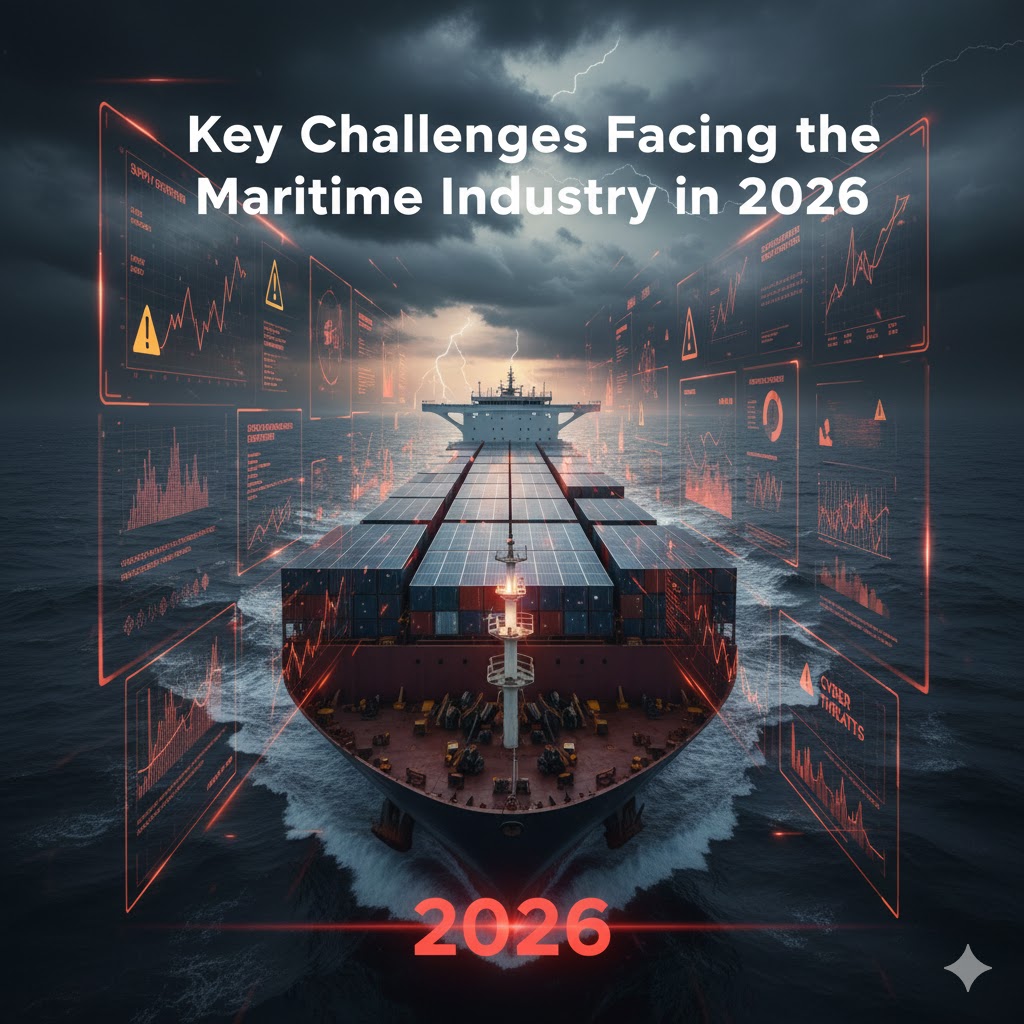
As the maritime sector enters 2026, it does so with a clearer understanding of what 2025 confirmed: global shipping is no longer navigating “temporary turbulence.” Instead, it is operating in a structurally re-priced, regulation-heavy, and geopolitically risk-adjusted environment. While seaborne trade is expected to regain momentum compared with the near-stall conditions of 2025, the industry’s operating model is being reshaped in parallel by climate policy, security disruptions, financial discipline, and accelerating digital dependence.
After the 2025 slowdown, maritime trade is expected to return to a more “normal” medium-term trajectory over the second half of the decade. Yet 2026 will not resemble the earlier decades of trade-led expansion. Growth—where it appears—will be more uneven across cargo segments and regions, while costs and compliance complexity will remain elevated.
This article reframes the “key challenges” agenda specifically for 2026, reflecting how the risk landscape evolves when trade begins to stabilise, while the industry simultaneously faces major compliance step-ups and the global net-zero framework moves from political agreement into operational design.
A 2026 Reality Check: Stabilisation Pressures Meet Compliance Acceleration
The fundamental strategic tension for 2026 is straightforward: shipping must capture whatever demand recovery exists while absorbing a set of non-discretionary transitions—carbon pricing, fuel standards, reporting mandates, and heightened security risk management. In practical terms, the industry must execute on three fronts at once:
Commercial resilience in an economy still prone to sudden demand shocks; regulatory readiness as emissions pricing and fuel intensity rules tighten; and operational robustness as route security, cyber risk, and port climate impacts intensify.
That “triple constraint” defines most of the challenges below.
Challenge One: Demand Recovery That Is Uneven, Politicised, and Hard to Forecast
Growth returns, but not uniformly
Most 2026 forecasts anticipate an improvement from 2025’s extremely weak headline growth. However, the industry’s demand environment remains segmented. Some trades—particularly energy-security-related flows, certain regional corridors, and specialised products—can grow even when consumer-led container demand remains muted.
Trade policy and industrial strategy distort “normal” elasticity
A key 2026 complication is that trade flows are increasingly shaped by industrial policy. Localisation incentives, strategic stockpiling, tariff regimes, sanctions compliance, and nearshoring initiatives weaken the predictive power of classic indicators such as GDP growth or retail inventory cycles. For shipowners and operators, forecasting becomes less about where growth will be, and more about where policy will permit growth to materialise.
The planning implication
The sector’s planning approach in 2026 must be more scenario-driven. Fleet deployment, charter structures, and hedging strategies increasingly need to account for abrupt policy shifts and route disruptions—not only demand variability.
Challenge Two: The Capacity Overhang Problem Does Not Disappear—It Morphs
Container oversupply remains a structural constraint
Even if volumes improve in 2026, the supply side remains heavy in several segments, particularly containers, due to the lagged effect of earlier ordering cycles. The industry continues to rely on capacity discipline tools such as blank sailings, slow steaming, and network rationalisation, but these tools have diminishing marginal impact when oversupply is persistent.
“Artificial tightening” can reverse quickly
In 2025, route diversions absorbed capacity by extending voyage times. If routing partially normalises in 2026, that absorbed capacity can reappear quickly, placing renewed pressure on freight rates. This creates a paradox: improved security conditions can worsen the supply–demand balance.
Asset value divergence intensifies
The 2026 fleet challenge is not simply too many ships. It is too many ships of the wrong type. Older, less efficient, and non-upgradeable tonnage becomes increasingly disadvantaged as compliance costs rise, affecting charterability, financing access, and resale values.
Challenge Three: Geopolitical and Security Risk Becomes a Permanent Operating Cost
Red Sea and chokepoint risk remains embedded
Shipping enters 2026 with security risk treated as an operational parameter rather than an exception. Continued instability around key corridors drives route choices, insurance costs, and schedule reliability planning.
Sanctions and market bifurcation expand uncertainty
For certain segments, particularly tankers, sanctions and compliance constraints reshape vessel availability and trading patterns. Even for operators outside those trades, the broader implication is significant: sanctions-driven market bifurcation raises enforcement, compliance, and reputational costs across maritime services.
The operational implication
In 2026, carriers must price security risk into contracts more systematically and develop stronger route optionality strategies—operational playbooks that allow capacity to shift quickly without undermining network reliability.
Challenge Four: Europe’s Emissions Regime Tightens—2026 Is a Step-Change Year
Carbon pricing becomes unavoidable in voyage economics
The European emissions regime reaches a more mature stage in 2026, materially affecting voyage economics, charter negotiations, and fleet deployment decisions. Additional greenhouse gases come into scope, and compliance obligations increase in scale and complexity.
Fuel standards move from theory to enforcement reality
Fuel intensity regulation transitions from monitoring to enforceable compliance, with documentation, verification, and penalties becoming unavoidable parts of commercial operations. Responsibility allocation between owners and charterers becomes a central contractual issue.
Commercial consequences
In 2026, chartering and contracting in Europe become far more compliance-sensitive. Cost allocation, data quality, and verification mechanisms increasingly influence route selection and port calls.
Challenge Five: Global Net-Zero Rules Move from Strategy to Design
From ambition to implementation
The global net-zero framework enters a technical design phase in 2026. High-level ambition gives way to detailed methodologies that determine real compliance costs, including how fuels are accounted for, how equivalency mechanisms function, and how emissions pricing interacts with operational realities.
Strategic positioning year
For many companies, 2026 becomes the year when decisions must be made about whether to treat global decarbonisation rules as a future issue or as a present strategic constraint shaping fleet renewal, retrofit programmes, and fuel strategies.
Investment risk
Uncertainty persists over lifecycle accounting, methane slip treatment, and the long-term acceptability of certain fuel pathways. This increases the risk of stranded investments and makes optionality more valuable than commitment to a single solution.
Challenge Six: Fuel Availability and Infrastructure Lag Remain the Industry’s Bottleneck
The fuel transition gap
By 2026, alternative-fuel ambition outpaces fuel availability. Dual-fuel and fuel-ready vessels can only deliver emissions reductions if bunkering infrastructure and supply chains scale credibly. The mismatch between vessel capability and fuel supply becomes one of the most binding constraints on real-world decarbonisation.
A coordination challenge
Ports, energy suppliers, regulators, and shipowners face a coordination problem. Without aligned timelines, ports hesitate to invest and shipowners hesitate to commit. This slows progress even in regions with strong policy signals.
Challenge Seven: Port Performance Becomes About Resilience, Not Just Capacity
Reliability as a competitive differentiator
In 2026, port competitiveness increasingly depends on reliability, digital integration, emissions-reduction capability, and hinterland throughput—not simply quay length or crane numbers. The port bottleneck shifts from terminal productivity alone to system-wide performance.
Climate stress as operational risk
Extreme weather, heat stress, and sea-level impacts increasingly affect port operations, labour productivity, and maintenance cycles. For carriers, this manifests as schedule risk; for ports, it becomes a capital expenditure and resilience financing challenge.
Challenge Eight: Workforce Constraints Shift from Shortages to Skills Transformation
The new skills mix
The maritime workforce challenge in 2026 is increasingly about skills alignment rather than headcount alone. Operators require competence in emissions reporting, digital systems, cyber hygiene, and complex fuel technologies.
Human-centred transition
Regulation and technology move faster than training systems. In 2026, the human factor becomes a material risk variable: insufficient training and fatigue management can undermine safety and reliability just as compliance obligations intensify.
Challenge Nine: Cyber Risk Expands with Digital Dependency
A larger attack surface
Greater reliance on connected systems improves efficiency but expands exposure. The cyber challenge in 2026 is not only preventing attacks, but ensuring continuity when systems are degraded or compromised.
Compliance and insurability implications
Cyber resilience increasingly intersects with regulatory expectations and insurance conditions. Operators unable to demonstrate cyber governance face higher costs, contractual friction, and operational vulnerability.
Challenge Ten: Inequality and the Risk of a Two-Speed Maritime World
Disproportionate compliance burden
By 2026, carbon-related costs and reporting demands intensify. Larger operators can amortise compliance investments and access capital more easily, while smaller owners and developing-country operators face steeper relative burdens.
Connectivity risks
If compliance costs drive service rationalisation away from smaller ports and marginal routes, vulnerable economies may experience reduced connectivity and higher transport costs, undermining trade inclusion.
Interconnected Challenges and Systemic Risk
A defining feature of 2026 is how challenges reinforce one another. Modest demand recovery collides with capacity overhang; security risk affects costs and reliability; emissions regimes reshape contracting; digitalisation increases cyber exposure; and climate impacts strain port systems.
A defining and critical feature of the 2026 operational landscape is the powerful, often compounding manner in which discrete challenges actively reinforce one another, creating vicious cycles. For instance, a modest and uneven recovery in consumer demand directly collides with the persistent overhang of excessive global shipping capacity, depressing freight rates and profitability. Simultaneously, heightened geopolitical and maritime security risks not only increase insurance premiums but also affect routing reliability and schedule integrity. Meanwhile, stringent new emissions regulations and carbon pricing regimes are fundamentally reshaping charter party agreements and fuel procurement contracts. The industry’s necessary digital transformation, while boosting efficiency, inadvertently expands the attack surface for cyber threats, jeopardizing operational continuity. Furthermore, the accelerating physical impacts of climate change—from intense storms to chronic port heatwaves—severely strain critical port infrastructure and labor productivity. Crucially, these multifaceted challenges cannot be effectively addressed in isolation, as interventions in one area often create pressure in another. What truly emerges, therefore, is a complex system-level problem demanding unprecedented, coordinated responses across the entire maritime ecosystem: from fleets and ports to finance, regulation, and global workforce development strategies.
Strategic Responses That Will Matter Most in 2026
From compliance reaction to proactive compliance strategy
Leading companies will shift from viewing emissions regimes like EU ETS and CII, along with evolving fuel standards, as mere back-office reporting burdens. Instead, they will strategically integrate these frameworks into their core commercial planning, voyage optimization, and investment decisions. This proactive integration allows them to manage compliance costs predictably, hedge against future regulatory shifts, and transform potential constraints into competitive advantages through superior environmental performance, rather than merely reacting to penalties.
Building operational and strategic optionality
In the face of pervasive volatility, resilience in 2026 will be defined by built-in flexibility. This means investing in fleet versatility (e.g., vessels capable of using multiple fuels), ensuring fuel readiness for biofuels and synthetic alternatives, retaining retrofit capability for carbon capture or engine upgrades, and developing dynamic routing optionality to avoid disruptions. This portfolio of options becomes a central strategic tool, allowing firms to adapt swiftly to sudden changes in regulations, fuel availability, or trade patterns.
Data integrity as a cornerstone strategic asset
As financial and legal liabilities tighten, accurate, real-time emissions accounting and verifiable, auditable data streams become non-negotiable. Clear contractual allocation of responsibility for emissions costs and data accuracy in charter parties is essential. In this environment, poor data quality transcends mere operational inefficiency; it represents a direct financial liability through miscalculated EU ETS payments, legal danger from misreported compliance, and reputational risk from unsubstantiated green claims, threatening both profitability and commercial credibility.
Conclusion
The maritime industry in 2026 will not be defined by a single crisis. It will be shaped by the simultaneous demands of stabilisation and transformation. Trade growth may improve compared with 2025, but the operating environment remains constrained by security risks, compliance step-changes, fuel uncertainty, cyber exposure, and uneven global capability.
For maritime stakeholders, the strategic objective in 2026 is not simply to endure uncertainty, but to build operating models that remain profitable under carbon pricing, resilient under disruption, and credible under increasingly strict verification regimes.
The industry’s competitive edge in 2026 will belong to those who can deliver reliability and compliance at scale—without sacrificing flexibility.
References
UNCTAD. Review of Maritime Transport 2025. United Nations Conference on Trade and Development.
International Maritime Organization (IMO). GHG Strategy and Regulatory Developments.
European Commission. Maritime Transport and Emissions Trading System (ETS) Guidance.
DNV. Maritime Forecast to 2050.
OECD. Global Trade, Transport Costs, and Geopolitical Risk.
World Bank. Port Infrastructure, Climate Risk, and Logistics Performance.
ILO. Seafarer Workforce and Labour Market Trends.