
Choosing a maritime university is a major career decision. Discover 12 essential factors, expert guidance, and real-world insights to select the right MET institution.
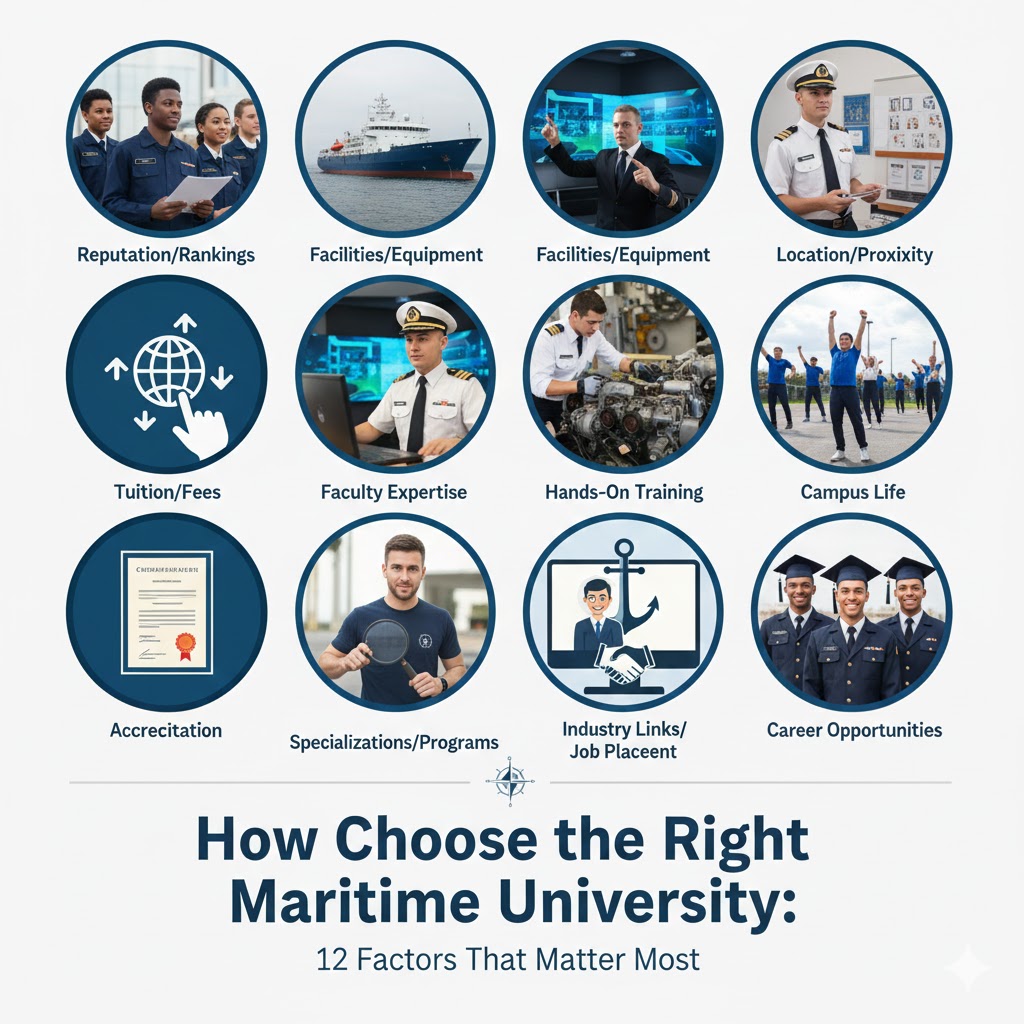
Choosing the right maritime university is one of the most important decisions in a seafarer’s life. It shapes not only your academic experience but your professional identity, employability, and the opportunities available to you for decades ahead. Maritime education is unique: unlike most academic fields, it combines theoretical knowledge with shipboard safety, global regulations, technical competence, personal resilience, and a lifestyle that blends discipline with adventure. Selecting the wrong institution can delay your career, restrict your access to cadetship, or leave you unprepared for STCW competency exams. But choosing the right one opens doors to international vessels, respected certificates, and a lifelong maritime network.
Today’s maritime landscape is more complex than ever before. Autonomous technology, green fuels, smart navigation, AI-assisted maintenance, and stricter environmental regulations are reshaping the competencies expected of new officers. Meanwhile, shipping companies emphasise qualities such as professionalism, communication, safety culture, and digital adaptability — qualities that must be cultivated from the very first days of maritime training. Because of this, maritime universities have evolved into sophisticated institutions with advanced simulators, research centres, and comprehensive sea-time programs.
This article explores the 12 most important factors to consider when choosing a maritime university. Each factor is explained in clear, descriptive paragraphs tailored for global English readers, including those who are not native speakers. Whether you’re a prospective deck cadet in India, an engineering hopeful in the Philippines, a high school graduate in Europe deciding between nautical science programs, or a parent supporting your child’s maritime dreams, this guide will help you identify what truly matters — and what to avoid.
Why This Topic Matters for Maritime Operations
Choosing a maritime university is not only an academic decision; it influences the entire maritime workforce and, indirectly, the safety and efficiency of global shipping. Poorly trained officers can compromise watchkeeping, maintenance, risk assessment, environmental protection, emergency response, and vessel handling. Maritime casualties investigated by the MAIB, USCG, AMSA, and other authorities frequently highlight “human factors” — often linked to insufficient training, inadequate simulation exposure, or weak safety culture foundations.
Strong maritime universities serve as the first line of defence against such failures. They instil the seamanship, critical thinking, and regulatory understanding required to navigate modern vessels safely. As the demand for seafarers continues to rise, especially for LNG, offshore wind, hybrid propulsion, and specialised vessel types, the global fleet depends heavily on institutions capable of producing competent, confident, and adaptable officers.
The IMO’s STCW standards ensure a baseline of training quality, but real differences still exist among academies, influenced by faculty expertise, industry partnerships, simulator technology, sea-time availability, and national maritime authority oversight. In regions where shipping forms a major part of national economic strategy, governments increasingly recognise the need for modernised, research-backed maritime education to support both seagoing and shore-based careers.
Finally, the choice matters because a student’s early exposure to maritime life influences retention. Many cadets drop out not because the profession is too difficult, but because they were not adequately prepared for shipboard culture, long voyages, or multicultural teamwork. Choosing a university with strong mentorship, clear communication, comprehensive sea-time pathways, and balanced academic load dramatically improves both student success and industry workforce stability.
Key Developments / Technologies / Principles in Modern Maritime Education
Simulator-Based Training as a Core Learning Pillar
One of the biggest transformations in maritime education over the last decade has been the widespread integration of advanced simulators. Full Mission Bridge Simulators allow students to experience confined waters, heavy traffic, adverse weather, and emergency manoeuvres without risking real-world accidents. Engine Room Simulators replicate the complexity of modern propulsion — from slow-speed diesel engines to electric-hybrid systems and dual-fuel LNG engines.
These simulators, guided by standards from bodies such as DNV, ABS, Lloyd’s Register, and ClassNK, help students develop decision-making skills long before they step onboard. They also prepare cadets for STCW competencies relating to watchkeeping, ECDIS operations, engine-room resource management, and emergency response.
Digitalisation and Smart Navigation Education
The maritime industry is undergoing significant digital transformation. Modern vessels utilise ECDIS, integrated bridge systems, voyage optimisation software, remote machinery monitoring, and AI-based routing. A strong maritime university prepares cadets to navigate digital landscapes confidently, integrating courses on maritime cyber security, digital twin technology, electronic navigation, and onboard data systems.
Digital readiness is becoming a major selection factor for shipping companies. Institutions that incorporate these developments produce graduates who adapt faster to smart ships and future autonomous vessel operations.
Environmental Curriculum and Sustainable Shipping
As the world shifts toward decarbonisation, maritime universities are integrating environmental science, emissions regulations, and climate-related risk management into their curriculum. Cadets now study MARPOL Annex VI, Energy Efficiency Design Index (EEDI), Carbon Intensity Indicator (CII), Ballast Water Management systems, and emerging fuels such as methanol, LNG, ammonia, and hydrogen.
These shifts reflect global orientation toward greener shipping practices under frameworks like the IMO GHG Strategy and EU ETS for Maritime. Students who understand environmental compliance are more employable and better prepared for future regulatory landscapes.
University–Industry Partnerships
Strong maritime universities maintain active relationships with shipowners, port authorities, shipyards, classification societies, and offshore companies. These partnerships secure cadetship berths, internships, industry seminars, and hands-on training. They also align university curricula with modern vessel requirements, ensuring that what students learn matches real-world industry needs.
–
The 12 Most Important Factors When Choosing a Maritime University
1. Accreditation and Recognition by Maritime Authorities
Accreditation determines whether your degree will be recognised by flag states, shipowners, and national maritime authorities worldwide. A maritime university must be compliant with the STCW Convention and ideally be audited or monitored by reputable authorities or classification societies. When a university lacks proper accreditation, students may face issues with certificate recognition, inability to obtain CoC (Certificate of Competency), or severe delays in pursuing a seagoing career.
Accredited academies follow rigorous standards regarding curriculum design, simulator quality, faculty qualifications, safety procedures, and sea-time arrangements. Before enrolling, students should verify whether the institution is recognised by their country’s maritime administration and if its graduates are accepted internationally. Institutions connected with IMO Model Courses, IACS members, or collaboration with EMSA, MCA, AMSA, or USCG typically offer reliable quality.
2. Quality of Simulation Facilities and Training Equipment
Modern shipping relies heavily on advanced technology, and maritime training must reflect that reality. A strong maritime university invests in full-mission simulators, ECDIS labs, radar and ARPA suites, GMDSS training stations, engine-room simulators, and cargo-handling simulators for tankers, LNG carriers, and bulk carriers. These facilities give students realistic exposure to operational challenges.
The difference between universities with advanced simulators and those without is significant. Cadets in well-equipped institutions learn to troubleshoot machinery, handle voyage planning, or respond to emergencies with a level of confidence built from repetition. Students often remark that simulator time prepares them for the hectic environment onboard, particularly during pilotage, congested waterways, machinery faults, and cargo operations.
3. Availability of Sea-Time and Cadetship Pathways
Sea-time is arguably the most decisive factor in a maritime student’s success. A maritime university may offer excellent academic content, but if it does not secure cadet berths with reliable shipping companies, students may struggle to complete their training. Some students wait years for sea-time, delaying their careers.
A quality maritime university maintains agreements with multiple shipping companies, including tanker operators, container lines, bulk carriers, offshore companies, and cruise lines. These relationships ensure a steady pipeline of sea berths and reduce students’ worries about completing their required STCW days onboard. Universities with strong cadet placement systems greatly improve their graduates’ employability.
4. Faculty Experience and Pedagogical Strength
Effective maritime education depends on instructors who combine theoretical mastery with real shipboard experience. A faculty composed of former chief engineers, masters, naval architects, port managers, and maritime lawyers brings authenticity into the classroom. Students benefit when professors share real incidents, case studies, and insights from their own time at sea.
Faculty quality also determines how well students understand complex concepts such as navigation hazards, ship stability, thermodynamics, electrical systems, maritime law, and cargo science. Good instructors simplify difficult topics using analogies, drawings, and practical examples. Strong pedagogical culture indicates that the university prioritises meaningful learning rather than rote memorisation.
5. Curriculum Depth and Alignment with Modern Industry Needs
A strong maritime university regularly updates its curriculum to match the rapidly changing maritime world. This includes integrating new regulations, digital systems, environmental standards, and vessel technologies. For instance, universities must teach ECDIS updates, digital chart corrections, cyber security basics, energy efficiency measures, alternative fuel safety, and operation of modern ME engines or hybrid propulsion systems.
When reviewing a university, students should examine the structure of the program. Does it focus excessively on outdated machinery or navigation methods without addressing digitalisation? Does it include hands-on labs, simulator modules, and industry-led electives? A curriculum aligned with current shipping trends ensures graduates are relevant and employable.
6. Career Placement Rates and Industry Reputation
One of the clearest indicators of a maritime university’s quality is how easily its graduates find employment. Some academies are well-known to shipowners and are actively sought after by crewing managers. A strong reputation means graduates are trusted to perform well onboard and uphold safety standards.
Universities with high placement rates often highlight their alumni networks, partnerships with shipping companies, and long-standing credibility. On the other hand, institutions with poor placement outcomes may leave students uncertain about their future. When evaluating options, students should research graduate employability, cadet success stories, and industry relationships.
7. Specialisation Options (Deck, Engine, Naval Architecture, Logistics)
Different maritime universities offer different strengths. Some excel in deck and engine programs, while others specialise in naval architecture, port management, maritime law, or marine environmental studies. Students must choose an institution whose strengths align with their career goals.
For example, a student passionate about ship design should prioritise universities with strong naval architecture programs, advanced CAD labs, and partnerships with shipyards. Meanwhile, a student interested in LNG carriers should look for institutions with cargo-handling simulators, cryogenic training resources, and partnerships with LNG-focused shipping companies.
8. International Exposure and Exchange Programs
Many leading maritime universities collaborate globally, offering student exchanges, international internships, joint degrees, and maritime conferences. Exposure to international environments helps students develop multicultural communication skills — a core requirement for officers working with multinational crews.
International collaborations also enable students to view maritime issues from multiple perspectives, strengthening their understanding of maritime safety, environment, technology, and governance. Universities with exchange partnerships in Europe, Asia, and the Americas provide a valuable advantage.
9. Research Opportunities and Academic Rigor
Maritime universities that emphasise research tend to be at the forefront of innovation. Faculties involved in maritime safety research, ship performance, hydrodynamics, decarbonisation strategies, accident analysis, and port optimisation produce graduates with deeper analytical abilities. Students benefit from exposure to real studies, access to labs, and opportunities to participate in R&D.
Institutions in Norway, Japan, South Korea, the Netherlands, and the United States are particularly active in maritime research, often collaborating with classification societies and shipyards. A research-driven environment equips students with skills relevant both onboard and ashore.
10. Campus Life, Safety, and Well-Being
Life at a maritime university can be disciplined and demanding, especially in regimental institutions. A healthy campus environment with supportive faculty, mentorship programs, counselling services, and strong academic advising helps students adapt to the pressure. Facilities such as libraries, simulation centres, model basins, engineering labs, sports areas, and study spaces also make a meaningful difference.
Student well-being is critical, especially in a profession where resilience is essential. Universities with strong support systems reduce dropout rates and improve long-term seafaring retention.
11. Cost, Financial Aid, and Scholarships
Maritime education can be expensive, especially when simulator training, laboratory fees, and uniform costs are included. Students must compare tuition fees, sponsorship opportunities, scholarships, and financial aid options. Some universities collaborate directly with shipping companies that offer scholarships tied to guaranteed cadetships.
Understanding the total cost — not just tuition — is essential. Students should consider accommodation, transportation, books, uniforms, and certification fees. Institutions with transparent cost structures help students plan more effectively.
12. Long-Term Career Pathways: Sea and Shore Options
The maritime profession offers diverse career pathways. Some graduates spend their lives at sea and rise to positions such as Master or Chief Engineer. Others transition after a few years into shore-based roles in ship management, port operations, maritime law, surveying, classification, research, offshore energy, or logistics.
The right maritime university prepares students not only for their first job onboard but for long-term careers. Programs incorporating maritime economics, management courses, leadership modules, and research skills position graduates for flexibility and future growth.
–
Challenges and Practical Solutions
Choosing a maritime university can be overwhelming, particularly for students unfamiliar with the industry. One challenge is distinguishing between marketing and reality. Many institutions advertise state-of-the-art facilities, yet their sea-time partnerships may be weak. Another challenge is the global variation in standards; some countries enforce rigorous maritime education quality, while others have inconsistent oversight.
A practical solution is to speak with alumni and currently enrolled students. They often share honest insights into faculty effectiveness, availability of cadet berths, and the true quality of facilities. Prospective students should also review university audits, accreditation documents, and placement statistics.
Another challenge is understanding the difference between theoretical learning and real-world readiness. A student might excel in classroom work but struggle with the physical, emotional, and multicultural environment aboard a vessel. Universities that integrate ship visits, training voyages, drills, and simulator exercises help bridge this gap.
Finally, students must consider long-term sustainability. The maritime sector is transitioning toward digitalisation and decarbonisation. Universities that fail to update their curriculum risk graduating students who are not prepared for future vessel technology.
Case Studies / Real-World Applications
Consider the example of a maritime university in the Philippines that established a partnership with a major European tanker company. This collaboration led to guaranteed cadet berths for students who met performance standards. The sea-time pathway significantly improved the employability of graduates and contributed to the company’s safety performance due to the well-prepared cadet base.
In Europe, several maritime universities integrated digital navigation coursework into their programs earlier than others. Their graduates were better equipped for the global transition to ECDIS and integrated bridge systems, leading to stronger employment outcomes across European fleets.
A student from India chose a maritime university with advanced engine-room simulators and a strong partnership with a South Korean shipyard. After completing his sea-time, he transitioned into ship design and later joined a hybrid propulsion R&D team. His story highlights how specialised academic offerings can influence long-term career paths.
In Africa, regional investment in blue-economy training has enabled students to pursue careers in environmental management, offshore safety, and marine conservation. These real-world applications demonstrate that maritime universities are more than classrooms—they shape global maritime infrastructure.
Future Outlook and Maritime Trends
The future of maritime education will be shaped by decarbonisation, digitalisation, and global workforce demand. Maritime universities must prepare cadets for alternative fuels such as ammonia, methanol, LNG, and hydrogen. Programs focusing on energy efficiency, emissions reporting, and sustainable marine operations will become standard.
Digital ship operation will require familiarity with AI, predictive maintenance tools, satellite connectivity systems, and cybersecurity. Maritime universities that adapt early will produce graduates who excel in rapidly evolving shipboard environments.
Workforce shortages are expected to continue, giving students from reputable universities stronger bargaining power in the job market. Meanwhile, shore-based opportunities will expand in areas such as offshore wind, autonomous vessel management, and marine environmental governance.
Ultimately, the best maritime universities will be the ones capable of blending traditional seamanship with future-focused competencies.
FAQ Section
1. Which factor matters most when choosing a maritime university?
Sea-time availability is often the most decisive factor because it directly affects your ability to obtain STCW certification.
2. Does the IMO rank or approve maritime universities?
No. The IMO sets global training standards, but national maritime authorities approve maritime universities.
3. Are private maritime universities reliable?
Some are excellent; others lack industry partnerships. Research accreditation, sea-time guarantees, and alumni reviews.
4. How important is simulator training?
Extremely important. Simulators prepare cadets for emergencies, navigation challenges, and complex machinery operations.
5. Do maritime universities guarantee jobs?
No, but the strongest ones have partnerships that significantly improve employment opportunities.
6. Should I choose a university in my own country or abroad?
It depends on cost, recognition, sea-time opportunities, and career goals. Both can be excellent options.
7. Is English proficiency important?
Yes. Maritime communication relies heavily on English, especially under IMO Maritime English guidelines.
Conclusion
Selecting the right maritime university is an investment in your future — one that shapes not only your academic journey but the entire trajectory of your maritime career. By focusing on the 12 key factors outlined in this guide, you can make an informed decision that balances quality, opportunity, long-term growth, and personal goals.
A strong maritime university provides far more than classroom instruction. It develops your safety mindset, technical skills, leadership capacity, and ability to thrive in multicultural environments. It connects you to the global maritime industry, offering pathways into sea-going and shore-based careers across shipping, ports, shipyards, offshore energy, logistics, environmental protection, and maritime administration.
As shipping evolves toward greener, smarter, and more digital operations, the demand for well-educated maritime professionals will rise. Choosing the right maritime university ensures that you are equipped not only for today’s vessels but for the future of global shipping.
References
-
International Maritime Organization (IMO): https://www.imo.org
-
STCW Convention & Code: https://www.imo.org/en/OurWork/HumanElement/Pages/STCW-Convention.aspx
-
EMSA Maritime Education Reports: https://www.emsa.europa.eu
-
ICS–BIMCO Seafarer Workforce Report
-
MAIB Marine Casualty Reports: https://www.gov.uk/maib
-
US Coast Guard Marine Safety Information: https://www.dco.uscg.mil/msc/
-
DNV Maritime Academy: https://www.dnv.com
-
Lloyd’s Register Maritime Training: https://www.lr.org
-
ClassNK, ABS, BV, RINA (official websites)
-
UNCTAD Maritime Logistics & Transport Data: https://unctad.org